

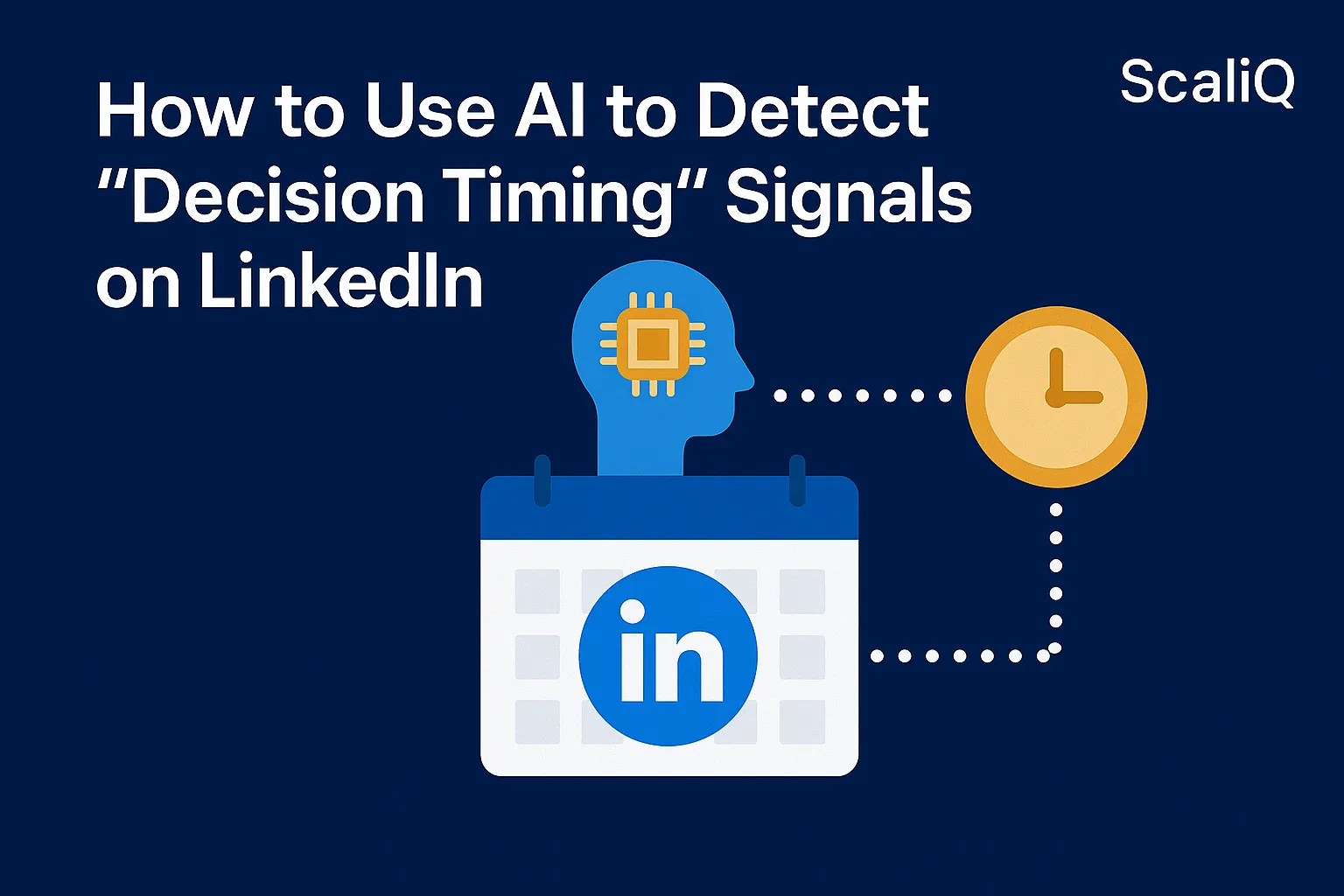
How to Use AI to Detect “Decision Timing” Signals on LinkedIn
For advanced revenue teams, LinkedIn activity is everywhere, but most of it is pure noise. Unless you can identify when engagement clusters into a real, actionable decision window, your outbound efforts will be poorly timed and largely ignored. Static lead scoring and single-event alerts consistently miss the mark on timing. Modern Go-To-Market (GTM) teams require dynamic models capable of inferring actual movement toward evaluation and purchase.
This article provides a practical, transparent framework for using AI to separate idle curiosity from active evaluation. By analyzing LinkedIn activity patterns, account context, trigger events, recency, and sequence logic, revenue teams can pinpoint exactly when to engage. Designed for advanced RevOps, SDRs, Account Executives, and revenue leadership, this guide moves beyond opaque intent data to offer a highly explainable operating model.
Through predictive, analytical platforms like ScaliQ, modern teams can leverage modeled decision windows based on observable activity patterns rather than generic, black-box intent scores. If you want to master decision timing linkedin strategies and accurately capture ai buying signals, understanding the logic behind LinkedIn intent signals is your first step.
What LinkedIn Signals Actually Indicate Buying Timing
Not all LinkedIn engagement is created equal. Treating isolated actions—such as a single post like, a random profile view, or a generic company follow—as direct buying intent inevitably floods your CRM with false positives. To accurately gauge timing, revenue teams must adopt a strict signal taxonomy categorized into person-level signals, account-level signals, trigger events, and sequence-based patterns.
High-intent interpretation relies heavily on role relevance, recency, repetition, and alignment with broader account movement. The objective is not to "see intent" directly through a single visible action, but to estimate the probability of a decision window opening. Unlike generic buyer intent data narratives that treat all engagement as equally valuable, this approach distinguishes visible platform activity from inferred purchase-stage progression, ensuring you only act on the most robust sales trigger events and LinkedIn intent signals.
Person-Level Signals That Matter More Than Vanity Engagement
To build an effective timing model, you must prioritize stakeholder behaviors that are predictive rather than casual. Strong person-level patterns include repeat engagement with category-relevant content, role-relevant posting behavior, targeted profile changes, and network expansion around specific vendors or topics.
Role relevance is a critical filter here. A junior practitioner engaging once with a post carries vastly different weight than a VP, Director, or budget owner showing repeated, clustered activity.
• Weak Pattern: A mid-level manager likes a broad thought-leadership post about industry trends.
• Strong Pattern: A VP of Operations follows your company page, connects with two of your AEs, and comments on a highly technical post about a specific pain point within a 72-hour window.
One signal rarely means much in isolation. It is the combination and sequence of social selling signals and engagement signals on LinkedIn that truly indicate emerging decision windows.
Account-Level Signals That Strengthen Timing Confidence
Individual engagement must be validated by company-level context. Hiring velocity, team expansion, leadership changes, growth signals, and organization-wide stakeholder activity drastically increase the confidence that a formal buying process is forming. Account-level changes are the ultimate filter for distinguishing a single employee's idle curiosity from a funded, real business initiative.
For advanced outbound teams, account prioritization relies on this intersection. One engaged contact at a stagnant, slow-moving account is a significantly weaker signal than multiple stakeholders showing activity at a fast-changing account with open headcount in relevant departments. Layering account intent data over person-level activity transforms basic alerts into highly accurate predictive lead scoring and purchase timing signals.
Trigger Events That Often Precede Evaluation Windows
Event-based signals can accelerate timing rapidly. Job changes, hiring surges, funding rounds, growth indicators, leadership transitions, and sudden category-adjacent content engagement act as triggers that should immediately increase your model's sensitivity.
However, there is a distinct difference between continuous engagement signals and discrete trigger events. A trigger event (like a new VP being hired) opens a potential window, but without behavioral follow-through (like that VP researching solutions), the intent remains theoretical. Triggers alone are not enough; they require subsequent behavioral confirmation.
Understanding how LinkedIn feed ranking uses signals reinforces why simplistic engagement reading is flawed—platform activity is influenced by a complex web of contextual algorithms. A modeled approach contextualizes these sales trigger events and job change signals sales reps look for, creating superior B2B decision window detection compared to manual monitoring.
A Framework for Scoring Person, Account, and Trigger Signals
The core differentiator for advanced revenue teams is deploying a transparent decision-window scoring framework. Rather than relying on flat, arbitrary weights, a sophisticated model combines person-level activity, account context, trigger events, recency decay, and sequence strength.
Transparency is non-negotiable. Reps must understand exactly why an account or contact is surfaced. This explainability is where modeled approaches differentiate from broad, opaque intent platforms. By tuning this framework to your specific GTM motions, you can accurately capture ai buying signals and operationalize predictive prospecting LinkedIn strategies for precise decision timing linkedin.
Step 1 — Score Person Signals by Role Relevance and Behavior Quality
The first step is weighting individual stakeholder actions based on their influence. Signals from decision-makers, champions, and likely buying-committee members must be prioritized over peripheral stakeholders.
Different roles carry different weighting implications. A manager’s repeated activity often signals active vendor evaluation, while an executive’s activity typically signals strategic prioritization or final-stage budget approval. Repeated category-relevant engagement, active posting behavior, or tight activity clusters should score exponentially higher than one-off interactions.
Example Narrative Model:
• C-Level Like (10 points)
• Director-Level Comment on Competitor Post (25 points)
• Practitioner Follows Company Page (5 points)
By calibrating LinkedIn buyer intent signals based on role relevance, you filter out the noise of casual engagement signals on LinkedIn.
Step 2 — Add Account Context to Avoid False Positives
Account-level data acts as a multiplier (or dampener) for person-level scores, drastically improving precision. If a Director is engaging with your content, but the company has frozen hiring and recently laid off staff, the account context should dampen the score to prevent a false positive. Conversely, if the Director is engaging while the company is aggressively hiring for their department, the account context amplifies the score, increasing urgency.
Account context prevents reps from overreacting to a single noisy contact. Frame your model around person-plus-account intelligence, merging buyer intent data and hiring signals buyer intent to create a holistic view of account intent data.
Step 3 — Apply Recency, Temporal Decay, and Sequence Weighting
Raw activity only becomes decision-window estimation when temporal mechanics are applied.
• Recency Weighting: A signal generated yesterday is highly relevant; a signal from 60 days ago is nearly obsolete.
• Temporal Decay: If a strong signal occurs but is not followed by confirming signals, the confidence score must automatically drop over time.
• Sequence Strength: Multiple related signals compressed into a short timeframe are highly predictive.
Three relevant actions occurring within 10 days demonstrate focused research and momentum. Ten scattered actions spread over 90 days indicate passive, ongoing education. Applying temporal decay ensures your purchase timing signals accurately reflect current decision windows.
Step 4 — Set Thresholds for Watch, Prioritize, and Act
Scoring must translate into operational categories. Define clear thresholds based on your ICP fit, ACV, sales cycle length, and market motion:
1. Watch (Low Confidence): Accumulating signals, but lacking sequence density or executive involvement.
2. Prioritize (Medium Confidence): Strong account context combined with relevant person-level activity. Ready for account planning.
3. Act (High Confidence): Clustered, multi-stakeholder activity aligned with a recent trigger event. Immediate outreach required.
Referencing LinkedIn audience targeting best practices when defining role, job seniority, and skills dimensions will help you refine these thresholds. A transparent threshold model builds immense trust with SDRs and RevOps teams, far outperforming the generic, unexplainable scores provided by legacy intent platforms. This is the foundation of true intent-based prospecting, predictive lead scoring, and account prioritization.
How to Distinguish Curiosity from Active Evaluation
One of the most persistent pain points for revenue teams is telling apart passive research from real purchase movement. Curiosity is usually broad, inconsistent, low-commitment, and weakly tied to role or account context. Active evaluation, by contrast, is characterized by repeated, role-relevant, multi-stakeholder, and trigger-aligned behavior.
By applying a practical diagnostic framework, teams can accurately interpret LinkedIn intent signals and buyer intent data, ensuring they only deploy resources when an account is in active evaluation.
Signals That Usually Indicate Curiosity, Not Buying Timing
To reduce false positives and prevent SDRs from burning through accounts prematurely, you must identify patterns that indicate mere awareness. Isolated likes, one-off profile visits, broad consumption of generic thought leadership, or random engagement from non-buying roles fall into this category.
These actions show that a user is educating themselves or casually scrolling, but they do not indicate buying momentum. Over-automating outreach based on these low-signal activities is a common workflow mistake that damages domain reputation and frustrates buyers. Treat these social selling signals and engagement signals on LinkedIn as false positives for immediate sales action.
Signals That More Often Indicate Active Evaluation
The combinations that deserve immediate attention involve density and alignment. Look for patterns such as repeat engagement from highly relevant stakeholders, multiple contacts from the same account showing concurrent activity, and compressed signal timing immediately following an account trigger.
Clustered activity across a likely buying committee is infinitely more predictive than isolated engagement. Signal confidence scales exponentially when individual behaviors perfectly align with broader business context, revealing true ai buying signals and actionable decision windows for intent-based prospecting.
Example Signal Combinations and What They Mean
Understanding signal combinations is best done through modeled scenarios:
• Scenario 1: A single stakeholder engages repeatedly with your content immediately after a job change, but there is no broader account movement or hiring data., Interpretation: Watch. The individual is researching for their new role, but budget and committee alignment are not yet established.
• Scenario 2: Multiple practitioners engage with technical content while the company is actively publishing job listings for that exact function., Interpretation: Prioritize. The pain point is recognized and funded, and the team is evaluating solutions.
• Scenario 3: An executive and a practitioner both show category-relevant activity within a 7-day window, shortly after a major leadership transition at the account., Interpretation: Act. The buying committee is active, the trigger is clear, and the decision window is open.
Signal combinations are always stronger than single events. Once an account enters the "Act" phase, the quality of your outreach becomes paramount. Leveraging platforms like Repliq can help tailor highly personalized messaging that reflects these timing signals. Mastering B2B decision window detection relies on interpreting these purchase timing signals for predictive prospecting LinkedIn success.
Operationalizing Decision Windows in Outbound Workflows
The true value of timing detection lies not in the score itself, but in the workflow it triggers. Revenue teams must turn scores into precise action, intelligent routing, and highly relevant messaging. Timing models are designed to support account prioritization and scale human judgment, not replace it. By embedding ai buying signals into outbound workflows, teams can systematically capture revenue that competitors miss.
Build Alert Logic Around Decision-Window Thresholds
Alerts should never fire for every single activity event—that creates alert fatigue. Build logic that only notifies reps when specific threshold conditions are met. Group alerts by account, stakeholder cluster, or motion type.
Create distinct alert tiers:
• Monitor: Silent logging in the CRM for RevOps reporting.
• Investigate: Weekly digests for SDRs to review and map the account.
• Engage Now: Real-time Slack/CRM alerts for immediate, multi-threaded outreach.
Sequence-based alerting (e.g., "3 relevant actions from 2 directors in 5 days") is vastly more useful than event-based alerting, ensuring you only react to genuine sales trigger events, decision windows, and validated account intent data.
Personalize Outreach Based on the Signal Pattern, Not Just the Persona
Outreach must reflect the specific intelligence the model suggests. Are they in exploration, evaluation, expansion, or urgency mode?
If the trigger is a hiring surge, the messaging should focus on onboarding efficiency and scaling. If the trigger is a recent job change, the messaging should validate their mandate to implement new processes. If the trigger is repeated technical content engagement, the messaging should dive straight into advanced capabilities.
Perfect timing paired with generic messaging will still underperform. SDRs must reference the likely business context naturally, avoiding invasive language. This intersection of context and outreach timing is the pinnacle of LinkedIn prospecting and intent-based prospecting.
Define SDR, AE, and RevOps Handoff Rules
Operational discipline prevents high-signal accounts from stalling in queue-based workflows. Define exact threshold conditions for handoffs:
• SDR Action: High-confidence practitioner activity combined with account growth.
• AE Review: Executive-level engagement or activity from existing closed-lost opportunities.
• RevOps Action: Automated enrichment and CRM data hygiene for "Watch" accounts.
RevOps plays a critical role in maintaining model hygiene by continuously tuning weights based on win/loss data. This structured outbound prioritization ensures your predictive lead scoring translates into closed revenue.
Connect LinkedIn Signals to Enrichment and Workflow Orchestration
LinkedIn activity should never be actioned in a vacuum. Before a rep reaches out, the signal must be enriched with adjacent GTM context—such as firmographics, technographics, and verified contact data.
Workflow orchestration connects signal detection to account research, intelligent routing, and automated task creation. Utilizing an orchestration layer like NotiQ helps operationalize these enriched signals seamlessly into your GTM actions. This automated signal activation and AI workflow orchestration provides a massive competitive advantage over manual prospecting stacks and generic alert tools, ensuring flawless account prioritization.
Validating Signal Quality, Explainability, and Compliance
Advanced revenue leaders will rightfully distrust opaque AI scores unless they can validate precision, understand the contributing signals, and ensure complete compliance. A timing model is only as valuable as the trust the sales team places in it. You must rigorously measure outcomes, demand explainability, and strictly adhere to acceptable data usage standards.
How to Validate Whether Your Timing Model Works
To anchor your operations in evidence, continuously compare surfaced decision windows against actual CRM outcomes. Track meetings booked, pipeline creation, stage progression, and final conversion rates for accounts that crossed the "Act" threshold versus those that did not.
Equally important is tracking false positives, missed opportunities, and how quickly signals decay. Validation must occur at both the contact and account levels. This is an iterative system: weights and thresholds should be routinely tuned against real pipeline outcomes and CRM validation data, not assumed to be statically correct. This is the essence of accurate predictive lead scoring.
Why Explainability Matters for Sales and RevOps Adoption
Sales reps are highly pragmatic; they are infinitely more likely to execute outreach when they can see the exact signal trail behind a score. A black-box score of "95" means nothing. A prompt stating, "Surfaced because VP of Sales viewed pricing page, connected with AE, and company opened 5 SDR roles this week" drives immediate action.
Expose the top contributing signals, the confidence level, the estimated timing window, and the exact reason the account was surfaced now. Aligning with the NIST explainable AI principles ensures your systems remain understandable and accountable, driving adoption and fostering better feedback loops through explainable AI, transparent decision timing linkedin, and clear signal transparency.
Compliance and Safe Use of LinkedIn-Adjacent Signals
Data compliance is paramount. Revenue teams must focus on the defensible, ethical use of observable and authorized data sources. This framework does not rely on unrestricted scraping, unlawful data extraction, or invasive surveillance, which violate Terms of Service and privacy laws.
Ensure human review, strict governance, and documented acceptable use policies are embedded in your outbound workflows. Trustworthiness stems from clear operational boundaries. By adhering to the NIST AI Risk Management Framework and the OECD AI transparency and explainability principles, teams can mitigate AI risk. Unlike vendors making overconfident intent assertions, responsible AI focuses on compliant decision support and safe LinkedIn data compliance.
Future Trends in LinkedIn Decision-Window Modeling
The revenue technology landscape is shifting rapidly from static lead scoring to dynamic decision-window models. The most significant emerging trend is signal fusion—the ability to seamlessly blend social platform engagement with firmographic shifts, first-party CRM data, and broader GTM intelligence.
Sequence-based detection is becoming the standard, moving away from single-event triggers. Simultaneously, regulatory and market pressures are driving stronger scrutiny on explainability and compliance. The competitive edge in the coming years will belong to teams that combine human-readable, transparent models with lightning-fast operational speed. Platforms championing this evolution are setting the new standard for dynamic lead scoring, complex signal fusion, and precise B2B decision window detection.
Conclusion
LinkedIn activity only becomes a powerful revenue driver when AI helps interpret signal combinations, account context, recency, and sequence strength to estimate precise decision timing. The goal is never to chase every random engagement event. The goal is to identify explainable, modeled decision windows that tell your team exactly when outreach is most likely to land and convert.
By implementing this practical framework, you can accurately classify signals, weight person and account context, apply rigorous temporal logic, operationalize thresholds, and continuously validate outcomes against CRM data.
It is time to move away from generic, black-box intent scoring and adopt a transparent, predictive model. Explore how ScaliQ helps advanced revenue teams model and operationalize decision windows, ensuring you capture every viable opportunity. Master your decision timing linkedin strategy, harness true ai buying signals, and never miss open decision windows again.