

Introduction
If you have spent any time in a B2B revenue role, you already know the frustration: generic LinkedIn outreach gets ignored. Modern buyers are inundated with templated messages that feel aggressively sender-focused, lack necessary context, and push for an immediate transaction. When a prospect opens an inbox full of automated pitches, their default reaction is to delete and move on.
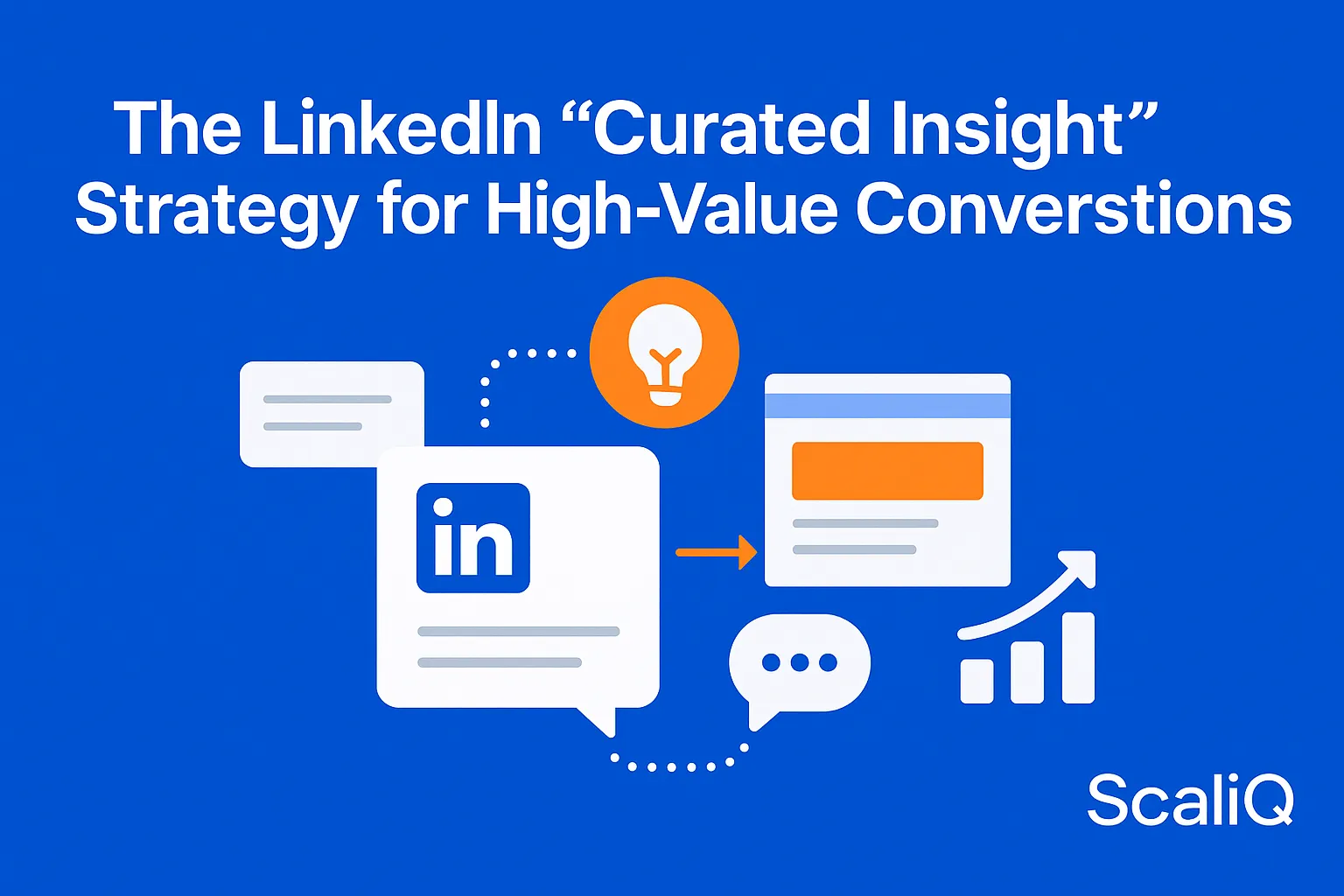
There is a better way to initiate meaningful dialogue without resorting to either mass-blasted spam or completely unscalable, hyper-manual research. This article introduces the Curated Insight Framework—a practical, scalable alternative designed for modern B2B teams. By leveraging buyer-relevant signals and pairing them with curated insights, you can execute a highly effective LinkedIn outreach strategy that respects the buyer's time and earns their attention.
This is not just another list of copy-paste templates. It is a strategic approach that sits perfectly in the middle ground between generic automation and overly bespoke research. When you pivot to value-based LinkedIn messaging, you unlock business outcomes that go far beyond superficial reply rates. You will see stronger conversation quality, a rise in profile visits, increased content clicks, and targeted traffic flowing directly to your educational assets.
At , we have built our consultative approach on this exact foundation. By prioritizing insight-sharing over immediate selling, curated insights outreach transforms cold connections into high-value B2B relationships.
Why Generic LinkedIn Outreach Gets Ignored
Most low-performing outreach fails because it centers entirely on the sender’s offer rather than the buyer’s context, timing, or priorities. When a message is built around what the seller wants rather than what the buyer needs, it creates instant friction.
Sophisticated buyers have developed a strong resistance to sales-led opening messages. They are, however, highly responsive to relevance, trust, and low-friction conversation starters. It is vital to understand that "personalized" does not automatically mean "valuable." Simply mentioning a prospect's company name or job title is not the same as sharing something useful.
Why Most Outreach Fails:
• Vague Personalization: Using a first name and company name without tying them to a specific business challenge.
• Immediate Demo Asks: Requesting 15 minutes of a prospect's time before providing any value to justify it.
• No Clear Reason to Engage: Lacking a timely trigger or relevant hook that makes the message matter today.
• The "Template" Vibe: Sounding robotic and identical to every other pitch in the prospect's inbox.
To stand out, thoughtful personalization is essential. This is backed by LinkedIn’s guidance on personalized connection requests, which emphasizes that context helps messages cut through the noise. Furthermore, research on what B2B buyers expect from sellers reinforces that buyers prioritize relevance, responsiveness, and deep business acumen over seller-centric messaging.
Unlike generic messaging or shallow personalization, insight-led messaging respects the buyer's intelligence and time. For more on optimizing your approach, explore .
The Problem With Pitch-First Messaging
Immediate asks create friction and distrust. Asking for a prospect's time before you have earned their attention creates a massive mismatch in the value exchange. In value-first sales outreach, trust-building starts in the very first message, not after the prospect replies. Prospects are significantly more likely to respond when the opening message offers context, an industry insight, or specific relevance before making any kind of ask. Effective social selling on LinkedIn requires patience and a focus on B2B lead generation on LinkedIn that feels organic.
Why “Hi {{FirstName}}” Personalization Isn’t Enough
There is a vast difference between token personalization and messaging that reflects actual buyer context. Shallow personalization often still sounds automated because it lacks a useful point of view. True thoughtful prospecting requires more than just filling in a custom variable. A successful LinkedIn outreach strategy relies on a simple formula: timing + signal + relevance. That is what makes insight-led messaging feel genuinely thoughtful and worthy of a response.
What Value-Based and Curated Insight Messaging Actually Means
To succeed in today's crowded inbox, we must define exactly what value-based LinkedIn messaging entails. At its core, it is outreach that gives the prospect a useful observation, a relevant signal, or a helpful resource before asking for any commitment.
Curated insights outreach is the process of selecting a timely signal, connecting it to a likely buyer priority, and packaging it into a concise, highly relevant message.
This framework differs from broad social selling advice because it is highly operational, message-specific, and repeatable across target accounts. It serves as the ideal middle ground between copy-paste templates and research-heavy hyper-personalization. The ultimate goal is not just to inflate reply metrics, but to foster better conversations and drive stronger downstream engagement with your content. This concept is supported by a study on communication and value creation in B2B sales, which highlights that value creation through communication is a critical driver of sales success.
How Curated Insight Outreach Is Different From Standard Personalization
When comparing outreach strategies, the differences are stark:
• Generic Template: "Hi [Name], we help companies like [Company] do X. Want a demo?" (Zero relevance, high friction).
• Shallow Personalization: "Hi [Name], saw you went to [University] and work at [Company]. We do X. Want a demo?" (Proves you looked at their profile, but offers no value).
• Curated-Insight Messaging: "Hi [Name], noticed [Company] just expanded the SDR team. Often that means a push for outbound efficiency. Here is a benchmark report on ramp times that might be useful." (Consultative, highly relevant, low friction).
Curated insights outreach gives the buyer something useful to think about, elevating the touchpoint from a transactional pitch to account-based outreach that builds authority. Personalized LinkedIn messages must evolve past superficial observations.
What Counts as a “Useful Insight” on LinkedIn
Useful insights are rooted in reality. They can include market observations, relevant articles, hiring signals, product launches, funding events, or content engagement cues that tie directly to a business priority. The best insight is not the most obscure or impressive fact you can find; it is the one most relevant to the prospect’s likely current priorities.
However, be careful not to overwhelm the message with too much information or attach unrelated content just to seem helpful. True value-first sales outreach relies on precision. Keep your LinkedIn conversation starters tight and focused on thoughtful prospecting.
When to Share Insight vs. When to Make an Ask
Insight-sharing should open the conversation and build credibility, but you must avoid becoming overly passive or endlessly nurturing. There should always be a clear path to a next step. The Call to Action (CTA) must match the warmth of the message: ask for a comment, a reaction, an opinion, or a quick exchange before ever making a stronger ask for a meeting. Not every touchpoint needs a meeting ask; sometimes, the goal is simply to earn engagement and trust. This is the cornerstone of a modern LinkedIn outreach strategy and the key to understanding how to get replies on LinkedIn using proven social selling examples.
A Repeatable Framework for Personalizing at Scale
The true power of this strategy lies in operationalizing it. The Curated Insight Framework is a repeatable, step-by-step system designed for sales and growth teams. The goal is scalable relevance, not mass automation disguised as personalization.
By standardizing the process at the workflow level, teams can keep the message itself grounded in buyer context without writing every single message from scratch. Implementing guardrails ensures the approach never sounds robotic or over-engineered. This workflow stands in stark contrast to typical template-first outreach approaches, offering a massive advantage in relevance, educational value, and conversation quality. Grounding your claims in clarity and testing aligns with CDC guidance on clear communication and trust, particularly when iterating message performance.
Here is how to personalize LinkedIn outreach at scale using the Curated Insight Framework:
Step 1 — Identify a Timely Trigger
Start with a relevant reason to reach out now. Prioritize recency and relevance over novelty. Use triggers that naturally justify your outreach timing. Never force a connection where no meaningful trigger exists. This is the foundation of signal-based prospecting and aligns with the best thoughtful prospecting and LinkedIn prospecting best practices.
Step 2 — Translate the Trigger Into Buyer Relevance
Move from raw research to message strategy. Infer what the signal might mean for the prospect’s team, goals, or current challenges. Use careful, consultative language such as “may be relevant” or “might be thinking about” rather than making overconfident, intrusive assumptions. Keep the focus entirely on the recipient, not on your solution. This secures buyer relevance in your account-based outreach and value-first sales outreach.
Step 3 — Add a Curated Point of View or Resource
Turn your research into actual value. The message should contain a short perspective, a recognized pattern, a takeaway, or a useful resource—not just a regurgitated fact. Package the insight in one or two tight sentences. This is where sharing educational content supports your outreach without making the message feel like a promotional pitch. Master this, and your curated insights outreach will establish genuine thought leadership through insight-led messaging.
Step 4 — Make the Next Step Low-Friction
Write CTAs that invite conversation rather than demand commitment. Use low-pressure prompts, such as asking if the observation aligns with their current focus, offering to share a related resource, or inviting a quick reaction. Save stronger CTAs for after a warmer interaction or when intent signals are explicit. The first goal is engagement, not calendar capture. These are the ultimate LinkedIn conversation starters that show you know how to get replies on LinkedIn using proven social selling examples.
Step 5 — Systematize Without Sounding Automated
Address the scale challenge directly. Build signal libraries, persona maps, and reusable outreach patterns while still manually customizing the final relevance layer of the message. Avoid over-automating opening lines or overusing variable-driven templates that read unnaturally. The system should standardize your research inputs and message logic, not produce generic outputs. This is the key to scaling personalization and mastering LinkedIn personalization for truly personalized LinkedIn messages.
Examples, Templates, and Metrics That Show It’s Working
To make the framework tangible, let's look at realistic, concise side-by-side examples. These scenarios highlight the difference between generic and curated-insight messaging across different personas.
When measuring success, ensure you look beyond basic reply rates. Evaluating what truly resonates with your audience aligns with CDC guidance on clear communication and trust.
Example 1 — Founder or Executive After a Growth Signal
When messaging a high-level buyer after a company-level event (like funding or expansion), connect the event to execution pressure without making intrusive assumptions.
• Generic: "Hi Sarah, congrats on the Series A! We help startups scale. Want a demo?"
• Curated Insight: "Hi Sarah, saw the Series A announcement—congratulations. Often, new funding means a push to scale operations without losing efficiency. I recently put together a brief checklist on avoiding common operational bottlenecks post-funding. Worth a look?"
This approach anchors your value-based LinkedIn messaging and account-based outreach directly to their reality, driving effective B2B lead generation on LinkedIn.
Example 2 — Sales Leader Hiring or Building Pipeline
When targeting revenue teams, use hiring patterns as a signal and connect it to priorities like ramp efficiency or outbound quality.
• Generic: "Hi Mark, we sell sales training software. Do you have 15 mins next week?"
• Curated Insight: "Hi Mark, noticed you're bringing on 4 new SDRs this month. Ramp time is usually the biggest hurdle when expanding the floor. We recently analyzed data on how top teams cut ramp time by 20%—happy to send over the one-pager if it's relevant right now."
This value-first message opens a conversation without pushing a demo, perfectly executing insight-led messaging and a refined LinkedIn outreach strategy for sales prospecting on LinkedIn.
Example 3 — Content-Engaged Prospect
When a prospect likes or comments on a specific topic, use that soft signal to bridge outbound and content distribution.
• Generic: "Hi Alex, saw you liked a post. Let's connect!"
• Curated Insight: "Hi Alex, saw your comment on David's post about AI in marketing. Since you're actively exploring that space, you might find our recent breakdown of AI prompt frameworks useful. Happy to drop the link here if you're interested."
Reference the interaction naturally and offer a relevant follow-up piece of educational content. This ties directly to website traffic and branded interest. For examples of great resources to share, look at . This is social selling on LinkedIn at its best, leveraging content engagement.
Metrics That Matter More Than Reply Rate Alone
Rethink how you evaluate success. A neutral or curious response to an insight is far more valuable than a fast "no" to a generic pitch.
Track these metrics:
• Positive reply rate
• Conversation quality and depth
• Meetings created
• Profile visits
• Content clicks
• Branded search lift
Segment your performance by signal type, persona, and CTA style to continuously improve. Focus on reply rate optimization, conversation quality, and content clicks to see the full picture.
Future Trends in Insight-Led LinkedIn Outreach
The landscape of B2B outreach is shifting rapidly. AI-assisted research is making it easier than ever to identify timely signals, summarize relevant context, and support value-driven messaging workflows at scale. However, the real differentiator will not be who has access to the best automation, but who applies the highest quality of insight and judgment behind the message.
Buyer expectations are moving definitively toward consultative, low-friction messaging rather than aggressive opening asks. We are witnessing the convergence of social selling, account research, and content distribution into a single, unified outbound motion.
By aligning with modern, consultative outreach workflows—like those championed by —teams can future-proof their pipeline. Mastering AI-assisted research for signal-based prospecting will be the defining characteristic of successful social selling on LinkedIn in the years to come.
Conclusion
High-value LinkedIn conversations start when your outreach gives the buyer something relevant to think about, not just another reason to ignore a pitch. The Curated Insight strategy provides a repeatable, highly effective middle ground between generic templates and time-intensive hyper-personalization.
By focusing on a timely trigger, inferring buyer priority, delivering a curated insight, and using a low-friction CTA, you can fundamentally transform your outbound results. Measure your success in conversation quality and pipeline generated, not just raw replies.
Audit your current messaging today using this framework. If you are ready to elevate your strategy and explore a truly consultative approach to initiating meaningful conversations, discover how can help. For more examples and deep-dive resources, explore . Stop pitching, and start providing value-based LinkedIn messaging through curated insights outreach to perfect your LinkedIn outreach strategy.