

Introduction
If you are reading this, you are likely familiar with the most common frustration in B2B sales: spending hours sending LinkedIn messages, getting profile views or accepted connection requests, but receiving zero meaningful replies.
Most beginners fail not because LinkedIn outreach “doesn’t work,” but because their approach creates too much friction. Their messages are too long, completely generic, or ask for way too much time right out of the gate. To fix this, you need a system built around earning attention rather than demanding it.
Enter the 3-Message Momentum framework—a simple, highly effective LinkedIn outreach sequence designed by ScaliQ. Instead of relying on a single, heavy-handed pitch, this system uses short conversation bursts where each message is designed to earn the next micro-commitment.
In this guide, we will break down exactly why traditional outreach gets ignored, what each of the three messages in the 3 message framework linkedin sequence should accomplish, and how to execute them. You will get practical example templates, timing rules, and strategies to improve your conversions over time. By focusing on tested, short conversation bursts, you can scale your outreach compliantly and effectively.
For those looking to dive deeper into advanced tactics after mastering this foundation, you can explore more outreach and personalization guides here: Blog.
Why Most LinkedIn Outreach Gets Ignored
Before you can fix your LinkedIn cold outreach, you have to diagnose why your current messages are failing. Beginners tend to make the same predictable mistakes: writing long introductory essays, using generic personalization, pitching immediately, and making unclear asks.
Your prospects are dealing with crowded inboxes and severe attention scarcity. According to the Pew Research Center's research on information overload, digital environments are increasingly cluttered, meaning generic or overly dense messages are instantly filtered out by the human brain. Short and relevant will always beat long and clever.
The goal of early LinkedIn prospecting messages is not to close a deal or even book a demo—it is simply to start a conversation. When you misunderstand this goal, you suffer from low reply rates, poor-quality conversations, and abysmal downstream conversion. To fix this, you must follow LinkedIn connection best practices from LinkedIn Help, which emphasize that relevance and a thoughtful personal note are the true drivers of engagement.
The Problem With Long, Generic First Messages
Long introductory messages create immediate friction. When a prospect sees a wall of text, it looks exactly like a copied-and-pasted sales pitch.
Beginners often try to prove too much value too early. They list every feature, benefit, and credential in the first message instead of earning the prospect's attention first. This "dense pitch" approach guarantees a low reply rate. A "light relevance" approach, on the other hand, respects the prospect's time.
What not to do:
This message is entirely about the sender, not the prospect. Short conversation bursts and personalized LinkedIn messaging are the antidotes to this common failure.
Why Prospects Ignore Messages That Ask for Too Much Too Soon
In any LinkedIn outreach sequence, you must understand message friction: the bigger the ask, the lower the probability of a response.
Asking, “Can we book 30 minutes this week?” in your very first message fails because you have not earned the trust required for a 30-minute commitment. Effective outreach relies on micro-commitments. You must ask for a tiny investment of time (like reading a two-sentence message) before you can ask for a larger one (like a meeting). The 3-message framework reduces friction across each touchpoint, gently guiding the prospect toward a conversation.
Why Templates Alone Are Not Enough
Many articles offer endless lists of sales outreach cadence examples, but they fail to explain the logic behind message progression.
ScaliQ’s framework-led approach is fundamentally different from generic template libraries. Copying and pasting templates might occasionally spike your reply rate, but if the sequence lacks logical micro-commitments, those replies will not convert. To truly learn how to improve linkedin reply rate, you need a sequence that improves conversation quality and conversion potential at every stage.
The 3-Message Momentum Framework
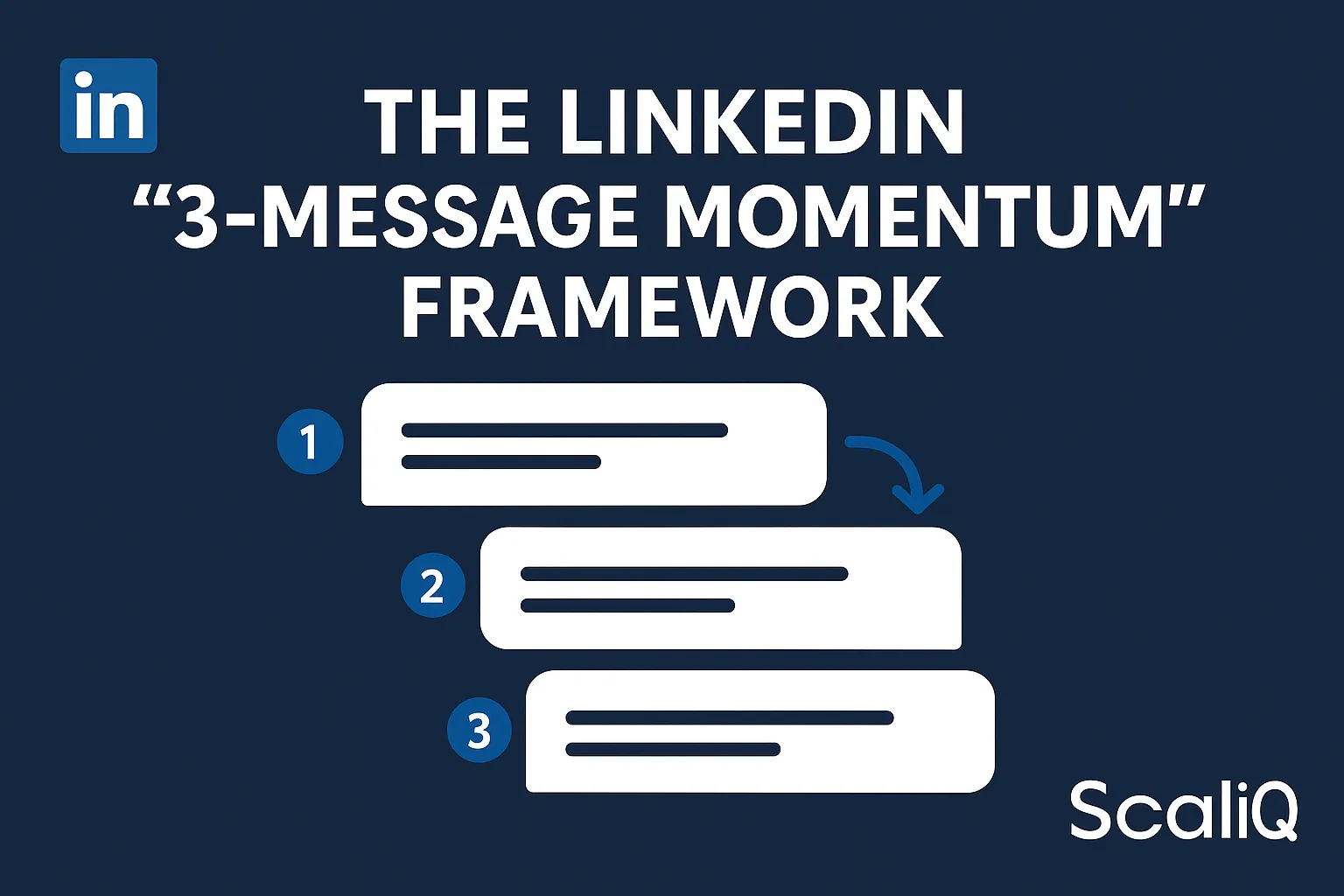
The 3-Message Momentum framework is an end-to-end LinkedIn outreach sequence optimization strategy. It is remarkably simple:
• Message 1 earns attention.
• Message 2 deepens relevance.
• Message 3 invites a low-friction next step.
Every message has exactly one job. You should never try to earn attention, deepen context, and ask for a meeting all in the same breath. Momentum is about behavioral progression. Do not force a sale; earn the next small response.
ScaliQ’s extensive experience shows that tested short conversation bursts improve conversion performance because they are easier to personalize, test, and optimize. To see how scalable execution and personalization work in practice, check out ScaliQ.
Message 1 — Earn Attention With Relevance
Your first message should not sell. Its only job is to make the prospect think, “This is relevant enough to notice.”
To do this, use one of three useful personalization inputs: their role, a recent trigger event (like a promotion or company news), or shared context. Give the prospect one clear reason for reaching out rather than stacking multiple value claims. Keep it incredibly short and easy to scan.
Message 2 — Deepen Context and Earn Engagement
Message two should add a useful angle, insight, or clarification. It should never be a generic “just bubbling this up” or “following up on my last message.”
This message builds on the first. Introduce a pain point, a pattern you have observed in their industry, or a specific observation relevant to their role. By increasing clarity and demonstrating that you understand their world, you make replying easier and significantly boost your LinkedIn response rate optimization.
Message 3 — Ask for a Low-Friction Next Step
The third message is where a light Call to Action (CTA) belongs. However, it must remain easy and respectful.
Instead of demanding a calendar booking, use low-pressure asks such as, “Worth exploring?” or “Open to seeing how others approach this?” If they do not reply after message three, stop. The goal of a cold outreach sequence best practices framework is to start a conversation. Pushing aggressively past this point damages your brand and violates platform etiquette.
Why This Sequence Creates Momentum
The psychology behind the 3 message framework linkedin strategy is simple: each message reduces uncertainty and earns a small level of trust.
You are guiding the prospect through micro-commitments: attention, then engagement, then a next step. For beginners, this methodical progression works infinitely better than one long, desperate pitch. It directly influences downstream conversion outcomes, ensuring that when prospects do reply, they are actually interested.
Templates and Examples for Each Message
To execute the best LinkedIn outreach sequences for beginners, you need practical templates you can adapt immediately. Below is one template per message, complete with annotations explaining why the lines work and what micro-commitments they are designed to earn.
Template for Message 1
The Goal: Earn attention through relevance.
Annotations:
• Personalization cue: "noticed you’re leading the [Department] team..." (Shows you know who they are).
• Reason for reaching out: "following your recent push into..." (Ties to a relevant, real-world trigger).
• Soft close: "Open to connecting?" (A zero-friction ask).
Variation for Sales Leaders: Swap the trigger event for a role-specific pain point, such as scaling outbound volume without losing personalization.
Template for Message 2
The Goal: Deepen context and introduce a relevant observation.
Annotations:
• Additive observation: "most [Title]s are struggling to..." (Validates their likely problem without sounding presumptive).
• Insight: "found a way to bypass that..." (Adds value rather than just repeating the first message).
• Engagement ask: "Is this something your team is running into...?" (Invites a simple 'yes' or 'no' conversation).
Template for Message 3
The Goal: Ask for a low-friction next step and bow out gracefully.
Annotations:
• Low-friction CTA: "open to a quick look..." (Much softer than asking for a 30-minute meeting).
• Respectful exit: "If it isn't a priority... no worries at all." (Removes pressure and protects brand trust).
Stopping here ensures platform safety and prevents you from looking like a spammer.
Weak Sequence vs Optimized Sequence
To truly understand LinkedIn response rate optimization, look at the difference between weak and optimized short conversation bursts.
Weak Sequence:
• Message 1: "Hi, we do X. We are the best. Can we book a 30-minute meeting tomorrow?" (Too long, immediate hard pitch).
• Message 2: "Just following up on my last message to see if you want to book a meeting." (Adds zero value).
• Message 3: "Did you see my last two messages? Here is my calendar link." (Aggressive and annoying).
Optimized Sequence:
• Message 1: Short, relevant observation based on their role.
• Message 2: Introduces a specific industry pain point and an insight.
• Message 3: A low-friction ask ("Worth exploring?") with a graceful exit.
The optimized sequence works because it respects the prospect's time, builds logical context, and lowers the barrier to entry for a reply.
Timing, Personalization, and Optimization
Great messaging can still fail if your cadence is too aggressive or completely random. Beginners must learn how to personalize efficiently without writing every message from scratch. By tweaking your message length, personalization points, and CTA types, you can master outreach sequence optimization.
For guidance on scalable personalization workflows, tools like Repliq.Co can provide essential support. Furthermore, adhering to LinkedIn follow-up and personalization best practices from the LinkedIn Talent Blog ensures your timing feels natural and respectful.
How Long to Wait Between Messages
Timing should feel respectful, not relentless. A standard beginner cadence looks like this:
• Message 1: Sent with the connection request (or immediately after acceptance).
• Message 2: Wait 3 to 4 days after the connection is accepted.
• Message 3: Wait another 5 to 7 days.
If a prospect shows intent signals—such as viewing your profile multiple times—you can adjust this timing slightly. However, knowing when to pause is always better than sending an unwanted nudge.
How to Personalize Without Writing Every Message From Scratch
You do not need to write bespoke essays for every prospect. Use a simple, scalable framework based on three variables:
1. Role: What is their daily focus?
2. Recent Trigger: Did their company just raise funding or launch a product?
3. Relevant Pain Point: What problem does their role typically face?
Meaningful personalization connects your solution to their specific world. Surface-level tokens (like just inserting their first name) are not enough. Create reusable message structures with variable context to scale your personalized LinkedIn messaging effectively.
What to Measure if You Want Better Conversions
High reply volume is meaningless if the replies are all "Please take me off your list." Beginners should track:
• Connection acceptance rate
• Reply rate
• Positive reply rate (intent)
• Conversation quality
• Next-step conversion
Test one variable at a time—like changing your CTA from a meeting request to an open-ended question—so you get clean data. Connect your optimization back to actual business outcomes, not just vanity metrics.
How AI Can Support Better Sequencing Without Making Messages Sound Robotic
AI is an incredible tool for AI-assisted personalization for outbound LinkedIn messaging, provided it is used correctly. Use AI to summarize company research, generate personalization prompts, and draft sequence variations.
However, never rely on over-automation or send generic AI output unchanged. AI is an assistant for relevance and speed, not a substitute for human judgment. Automation-first tools that prioritize sheer scale over nuanced conversation building will ultimately damage your sender reputation.
Common Mistakes That Kill Reply Rates
Even the best framework falls apart if you make critical execution errors. Below are the most common mistakes that break sequence momentum, along with exactly what to do instead.
Always keep platform safety in mind; overly aggressive outreach can lead to ignored invitations and spam reports. Familiarize yourself with LinkedIn invitation restrictions via LinkedIn Help to ensure your account remains compliant and safe.
Mistake #1 — Pitching Too Early
Immediate demos, unsolicited offers, and long explanations create instant resistance. When you pitch in the first message, you signal that you care only about your quota, not their problems.
• What to do instead: Open with context and relevance. Stick to the framework’s first-message objective: earn attention, do not sell.
Mistake #2 — Treating Every Follow-Up The Same
"Just following up" or "bubbling this to the top of your inbox" messages fail because they add absolutely no new value.
• What to do instead: Ensure each follow-up progresses the conversation. Introduce a new insight, a relevant case study, or a specific pain point to maintain momentum and secure micro-commitments.
Mistake #3 — Over-Personalizing or Faking Personalization
Shallow comments about a prospect's recent post ("Great post on leadership!") or exaggerated familiarity feel forced and manipulative. According to a study on personalization and message length from Boise State University, execution and genuine relevance matter far more than superficial personalization.
• What to do instead: Focus on meaningful relevance. Personalization works when it connects directly to the prospect’s professional world and challenges, not when it tries too hard to be their best friend.
Mistake #4 — Being Too Pushy With Timing or Volume
Sending too many messages or connection invitations too quickly hurts your trust with prospects and flags your account to LinkedIn’s spam filters.
• What to do instead: Maintain respectful pacing. Follow the sequence stopping rules—if they do not reply after message three, walk away.
Mistake #5 — Optimizing for Replies Instead of Conversions
Curiosity replies, polite objections, and low-intent responses will inflate your reply rate, but they are not qualified conversations.
• What to do instead: Optimize your LinkedIn lead generation messaging for progression to the next step. Focus on conversion-oriented message momentum rather than just inbox activity.
Conclusion
Better LinkedIn outreach is not about sending more messages—it is about sending three short messages with three clear jobs. The 3-Message Momentum framework guarantees that you stop pitching into the void and start building logical, conversion-focused conversations.
Remember the core structure:
• Message 1 = Relevance
• Message 2 = Context
• Message 3 = Low-friction next step
Momentum beats one-shot pitching every time because it reduces friction and earns trust gradually. Take action today: pick one existing LinkedIn sequence that is underperforming, rewrite it using this 3-message framework, and test it with a small batch of prospects.
By focusing on ScaliQ’s tested short conversation bursts and conversion-oriented personalization, you will see immediate improvements in your pipeline quality. Ready to scale this approach? Explore ScaliQ for seamless personalization and outreach optimization here: ScaliQ, and continue learning with more practical guides at Blog.