

Why Mutual Connections Increase Trust in Outreach
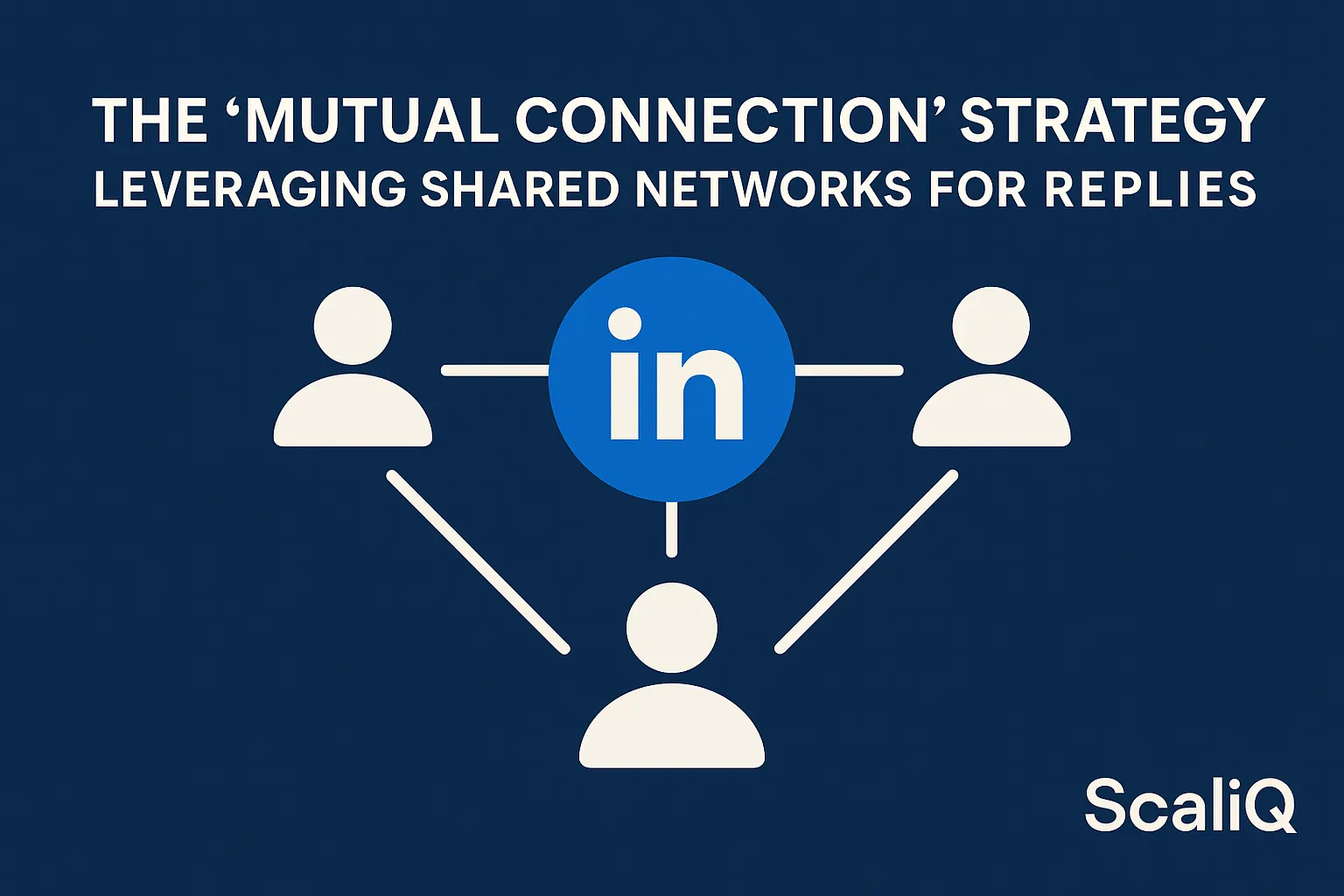
Mutual connections are individuals who are connected to both you and your prospect on LinkedIn. Unlike a direct referral or a formal introduction—where someone actively vouches for you—a mutual connection simply serves as a shared point of reference.
When a prospect sees familiar network overlap, a psychological mechanism known as "trust transfer" occurs. The message suddenly feels less random and more credible. Shared networks function as vital social proof in outreach. While they do not guarantee a reply, they significantly lower the friction of a first impression.
This directly addresses the massive pain point of low reply rates in B2B prospecting. According to OECD research on social connections and trust, social ties heavily influence human cooperation and the establishment of trust. Similarly, a CDC overview of social connection reinforces that relationship context dictates how open we are to engaging with others. By prioritizing trust-based prospecting over high-volume, generic messaging, you align your outreach with human psychology.
Why cold messages get ignored
The vast majority of LinkedIn messages fail because they lack relevance, context, and credibility. Beginners often make the mistake of opening immediately with a hard pitch, overusing rigid templates, and failing to give the prospect a genuine reason to care.
Today's decision-makers have crowded inboxes filled with automation. When a message lacks any familiar context, the easiest response is to simply ignore it. Familiarity matters in first-touch communication because it answers the prospect's immediate subconscious question: "Why are you in my inbox?"
How shared network signals make outreach feel warmer
A mutual connection creates a highly effective middle ground between a true cold message and a formal referral. The goal of using shared network signals is not to aggressively "borrow authority" from the mutual contact, but to establish relevant, human context.
Even without a formal introduction, genuine shared network overlap lowers a prospect's natural resistance. It signals that you run in the same professional circles, instantly making your outreach feel warmer and more relationship-based.
Why this matters for beginners
If you are new to sales or networking, you do not need an advanced, complex sales process to use this tactic effectively. Mutual-connection outreach is an accessible, highly effective first step toward more human, relationship-driven prospecting.
Mastering this method improves more than just your basic metrics. Beginner LinkedIn prospecting tips often focus purely on volume, but leveraging network-based sales outreach improves the actual quality of your replies and sets a much more positive tone for the ensuing conversation.
How to Reference a Mutual Connection Naturally
Using a mutual connection in your messaging requires tact. If done poorly, you risk sounding awkward, pushy, or overly familiar. The mention should be brief, highly relevant, and strictly secondary to the actual reason you are reaching out.
The shared connection is the context, not the whole pitch. Furthermore, you must adhere to ethical communication standards. As noted in FTC guidance on endorsements and material connections, you should never imply an endorsement, approval, or closeness that does not actually exist.
What natural wording sounds like
The most effective formula for this type of warm outreach is: Shared context + relevant reason for outreach + low-pressure next step.
Natural phrasing is subtle. Consider these examples:
• “I noticed we both know [Name] from our time in the [Industry] space…”
• “I came across your profile through [Shared Event/Community]…”
• “Given our overlap with [Name/Company], I thought it made sense to reach out regarding…”
Subtlety works better than overexplaining the relationship. State the overlap, and immediately move on to the value you bring.
Message examples for common scenarios
Here is how to apply this to standard LinkedIn outreach templates:
Scenario 1: Connection request with a light mutual reference
• Weak: "Hi, I see we both know Sarah. Let's connect so I can sell you my software."
• Improved: "Hi [Name], I noticed we’re both connected to Sarah from the marketing community. I'm actively expanding my network with other B2B marketing leaders and would love to connect."
Scenario 2: First DM after connecting
• Weak: "Thanks for connecting! Sarah is great. Anyway, my company helps..."
• Improved: "Thanks for accepting. Since we both run in the same circles as Sarah, I thought I’d share a resource on [Topic] that her team recently found helpful. No expectations, just thought it might be relevant to your current projects."
Scenario 3: Email or LinkedIn message mentioning a shared contact (No Intro Ask)
• Weak: "Sarah told me to reach out to you about our services." (If untrue, this is highly manipulative).
• Improved: "Hi [Name], I was looking at Sarah's recent post about [Topic] and your profile came up. It looks like you're tackling similar challenges at [Company]. I’d love to share how we solved this for [Similar Company]."
Scenario 4: Intro request to the mutual connection
• Weak: "Hey Sarah, introduce me to your connection John so I can pitch him."
• Improved: "Hi Sarah, I see you’re connected to John Doe at [Company]. I’ve been hoping to speak with him about [Topic]. If you feel comfortable, would you be open to facilitating a brief introduction? If not, no worries at all."
What makes the message feel pushy or manipulative
Name-dropping simply to borrow credibility is a major red flag in trust-based prospecting. Prospects have a high radar for manipulation.
Avoid these critical errors:
• Pretending to have a close relationship with the mutual connection when you do not.
• Making the mutual connection the entire focal point of the message.
• Pivoting aggressively from a friendly name-drop into a hard, immediate pitch.
• Using vague, obviously automated wording (e.g., "I see we have mutual connections in common!").
Best practices for tone and timing
If the shared connection is highly relevant (a strong tie), mention it early in your opening line. However, do not force it into every message in a sequence.
Sometimes, it is better to save the reference for a first follow-up. For instance: "I forgot to mention yesterday—I originally found your profile through our mutual connection, [Name]." Keep the tone conversational, and always ensure your call-to-action remains simple and low-pressure.
Mutual-Connection Outreach vs Fully Cold Outreach
Mutual-connection outreach is a highly effective, scalable middle ground between traditional cold outbound and referral selling. However, not every prospect will have a usable network overlap, meaning revenue teams ultimately need a hybrid approach.
A peer-reviewed study on trust and communication networks highlights that trust and communication continually reinforce one another over time within networks. Similarly, SBA guidance on referral-based networking shows why warm pathways consistently outperform fully cold approaches in formal business contexts.
When mutual-connection outreach works best
This relationship-driven outreach strategy is ideal when credibility and trust matter more than raw volume. High-fit situations include:
• High-value target accounts (ABM).
• Tight, niche industries where reputation is everything.
• Founder-led sales where peer-to-peer trust is vital.
• Early relationship building and networking.
• Prospects who are highly active and engaged on LinkedIn.
When fully cold outreach is still useful
Fully cold outreach remains necessary when no relevant shared network exists, or when rapid scale is your top priority.
However, "cold" does not have to mean "generic." Even without a mutual connection, you must still use personalized cold outreach based on the prospect's role, company news, industry shifts, or specific pain points to increase reply rates.
A simple comparison table to include
Common Mistakes and How to Measure Results
To successfully implement trust-based prospecting, you must avoid the pitfalls that cause beginners to burn bridges, and you must know how to measure whether the tactic is actually working.
Measuring only raw reply volume is a mistake. A spike in replies telling you to "stop emailing me" is not a success. Instead, focus on small, measured tests rather than overhauling your entire outbound process overnight. For deeper insights into advanced outbound testing, visit the ScaliQ blog.
Common mistakes to avoid
Beginners often let the excitement of finding a mutual connection override common sense. Avoid these errors:
• Mentioning irrelevant or incredibly weak mutual contacts.
• Overpersonalizing the message to the point where it feels awkward or invasive.
• Treating the shared connection as a free pass to pitch aggressively.
• Using the exact same copy-pasted wording for every prospect.
• Assuming all mutual connections carry equal weight (a shared CEO is different than a shared intern).
Metrics that matter
For true reply rate optimization, look beyond vanity metrics. Track the following:
• Reply rate: The total percentage of responses.
• Positive reply rate: The percentage of responses that are favorable or curious.
• Meeting-booked rate: How many conversations convert to calls.
• Conversation quality: The tone and length of the back-and-forth dialogue.
• Acceptance rate: How many of your LinkedIn connection requests are approved.
Positive replies and conversation quality are the true indicators of trust-based outreach success.
How to run a simple test
To see how mutual connections improve LinkedIn outreach reply rates for your specific business, run a simple A/B test:
1. Segment a list of similar prospects.
2. Send Group A a mutual-connection version of your messaging.
3. Send Group B a standard, personalized cold version (without the connection mention).
4. Keep all other variables (time of day, value proposition, call-to-action) consistent.
5. Compare the positive reply rates and meeting booked rates over a defined two-week period.
Best Practices and Expert Takeaways
The core rule of trust-based prospecting is simple: Relevance first, trust second, pitch third.
Mutual-connection outreach is most effective when it feels human, truthful, and entirely led by context. Building a repeatable process to identify, validate, and naturally reference shared network signals will fundamentally change how prospects perceive you in their inbox.
At ScaliQ, our expertise is rooted in helping teams operationalize this exact workflow. By structuring your relationship-driven outreach around genuine shared context, you stop acting like a spammer and start acting like a trusted peer.
Conclusion
Mutual connections have the power to turn cold, ignored outreach into warmer, credible conversations. By leveraging the social proof of a shared network, you bypass the friction of a completely cold introduction.
The workflow is straightforward: find the right connection, rigorously validate its relevance, reference it naturally and briefly, and measure your qualitative and quantitative outcomes. Remember, this tactic is never about manipulating trust—it is about starting a conversation from a place of real, shared context.
Before you send another generic message today, take five minutes to review your prospect list. Look for those hidden shared network signals, and start your next conversation on warmer terms.