

How to Use AI to Build Prospect “Opportunity Scores” on LinkedIn
Advanced outbound teams face a paradox: they have access to thousands of LinkedIn prospects, but no reliable way to identify who is most likely to convert right now. When your total addressable market is vast, signal overload paralyzes execution. Traditional lead scoring is often static, CRM-centric, and far too generic for the fast-paced, event-driven nature of LinkedIn-led prospecting workflows.
This article will show you how to build an explainable AI-powered opportunity scoring system utilizing fit, intent, timing, and relationship signals. Designed for RevOps leaders, SDR managers, and advanced outbound operators who already understand basic lead scoring, this framework introduces a dynamic, LinkedIn-native methodology. By leveraging recency decay, multi-source enrichment, and CRM feedback loops, you can move beyond basic qualification and start ranking active outbound prospects by conversion likelihood.
Drawing on deep practitioner experience building systems that rank prospects by conversion likelihood, ScaliQ provides the data-driven platform perspective behind this advanced opportunity scoring methodology.
Whether you are struggling with manual prioritization fatigue or opaque, black-box AI tools, mastering LinkedIn opportunity scoring and AI prospect ranking will transform how your team builds pipeline.
Detailed Table of Contents
Why LinkedIn Opportunity Scoring Beats Static Lead Scoring
Traditional lead scoring was built to qualify inbound leads based on static demographic data and basic email clicks. Opportunity scoring, however, is built for outbound. It ranks active prospects by conversion likelihood, answering not just "are they a fit?" but "are they ready to buy?"
LinkedIn is uniquely valuable for this because it offers a rich layer of identity and context signals. Publicly accessible data such as job changes, title relevance, company growth activity, posting behavior, and network proximity provide a dynamic view of a buyer's current state.
Static scoring systems fail outbound teams in several ways: they rely on stale CRM data, over-index on static profile attributes, lack timing detection, and suffer from poor rep trust because the scores lack context. Opportunity scoring, by contrast, is dynamic, event-driven, and intrinsically tied to actionability.
Advanced teams need predictive rankings that refresh as signals change. This conversion likelihood scoring approach is supported by recent B2B lead scoring model research, which highlights the necessity of dynamic, multi-dimensional models for accurate prediction.
Where Traditional Lead Scoring Breaks Down in LinkedIn Prospecting
When SDRs encounter signal overload, manual prioritization fatigue sets in. Demographic-only models treat two prospects with the exact same "VP of Sales" title as equal. However, one might have held the role for five years at a stagnant company, while the other just joined a recently funded startup and is actively hiring.
LinkedIn profile data alone is not enough to infer readiness or timing. A static CRM field might show a prospect is in your ICP, but it misses the fresh, publicly available LinkedIn event indicating they just launched a new initiative. Furthermore, when prospect qualification is driven by black-box scores—where reps are told to "call this person because the AI said so"—rep confidence plummets, operational adoption fails, and the system is abandoned.
What a True Opportunity Score Needs to Do
A useful opportunity score must accomplish four distinct goals: rank, explain, refresh, and recommend.
Instead of generating one opaque aggregate score (e.g., "92/100"), a true AI prospect ranking system uses component scores. This means evaluating fit, intent, and timing separately to provide a nuanced view of the buyer. The score must work at both the contact and account level, ensuring that account prioritization aligns with individual prospect readiness.
The Core Signals: Fit, Intent, Timing, and Relationship Proximity
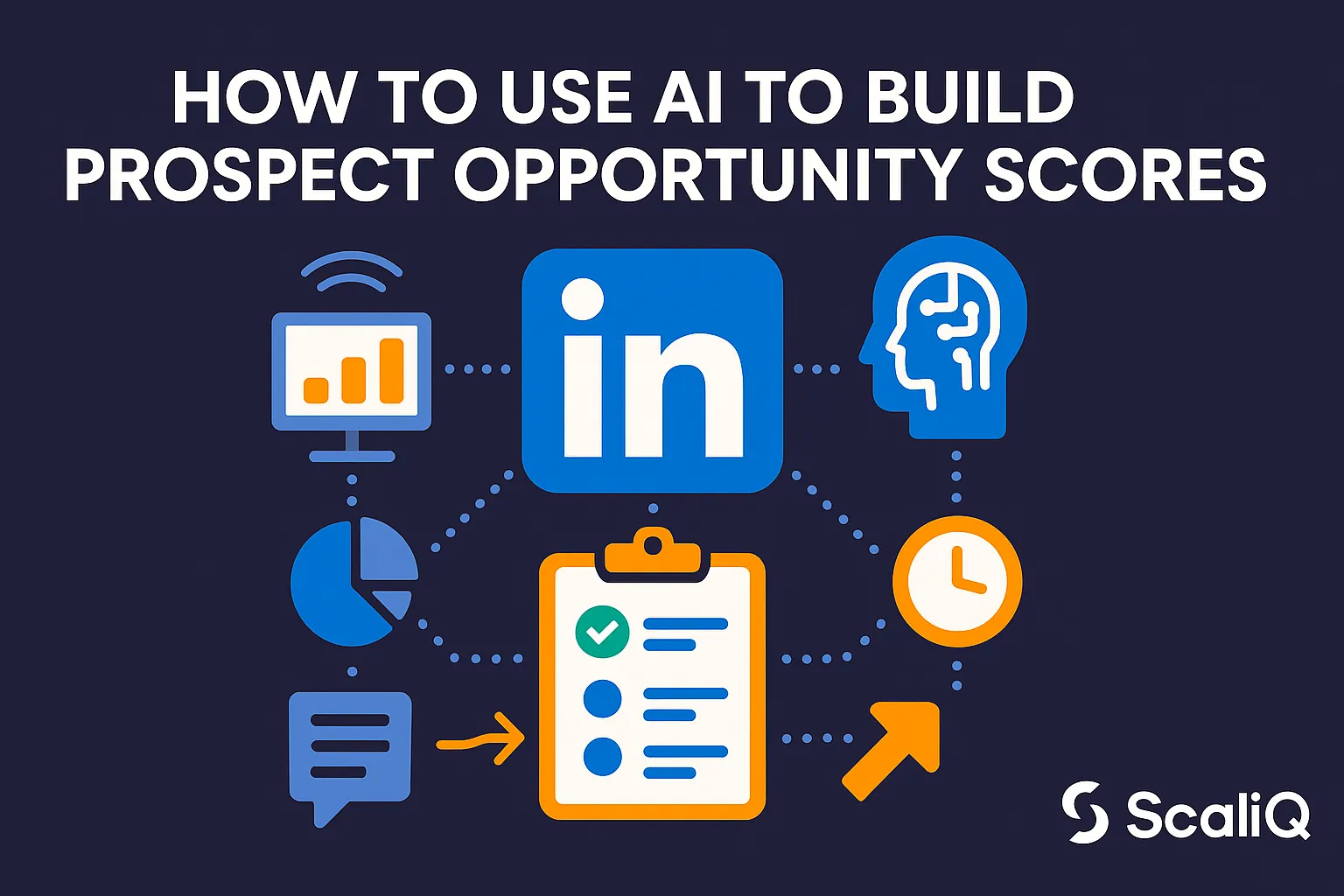
To build an effective signal-based scoring architecture, you must separate your model into distinct components: ICP fit, role authority, intent, timing, and relationship proximity.
Keeping these dimensions visible to users rather than hiding them inside a single score builds trust. Each component requires its own weighting logic and refresh cadence, as they predict conversion readiness in fundamentally different ways.
Fit Signals: ICP Match, Role Relevance, and Firmographic Alignment
Fit is the foundational layer of your prospect scoring model. It determines if an account and contact are worth selling to in the first place.
Account fit includes company size, industry, geography, growth stage, and technographic alignment. Contact fit covers role authority and functional alignment, such as seniority, department, and likely influence on a purchase.
It is crucial to include negative scoring for bad-fit segments to filter out noise. However, fit should not dominate the full score if timing and intent are weak. Fit is relatively stable; just because an account is a perfect ICP match does not mean they are ready to buy today.
Intent Signals: Engagement Clues and Buying-Cycle Indicators
Intent signals detect real interest beyond static profile attributes. This involves observing publicly visible LinkedIn behavior and surrounding context signals, such as posting themes, company growth activity, hiring velocity, and engagement patterns.
When combined with first-party website behavior and third-party intent sources, the model strengthens significantly. Intent should always be interpreted probabilistically. A prospect posting about a pain point is an inferred intent signal, whereas a prospect visiting your pricing page is an observed intent signal. Understanding these nuances is critical, as validated by B2B buying journey stage research, which demonstrates how digital behavior helps estimate a buyer's exact stage.
Timing Signals: Recency, Momentum, and Trigger Events
Timing is the dimension that separates a "good-fit" prospect from an "active opportunity." Timing signals rely on recency-based events such as job changes, team expansion, funding rounds, rapid hiring, leadership shifts, or newly relevant public initiatives.
To make timing actionable, you must introduce recency decay. A six-month-old funding announcement should not carry the same weight as a seven-day-old leadership change.
Pseudologic for decay: Timing Score = Base Event Value * (1 / Days Since Event).
Because buyer intent data signals change rapidly, timing signals must be refreshed far more frequently than firmographic fit.
Relationship Proximity: Why Network Context Changes Prioritization
Relationship proximity is the LinkedIn-native advantage that generic scoring systems miss. This dimension evaluates mutual connections, prior touchpoints, account familiarity, and existing team relationships.
Proximity can drastically increase response likelihood, even if intent is less explicit. A prospect with a low intent score but strong mutual connections to your executive team warrants higher prioritization. Relationship signals are not enough to drive a sale alone, but in combination with fit and timing, they provide powerful messaging recommendations and warm entry paths for LinkedIn prospecting automation.
How to Build an Explainable Scoring Model
Designing a predictive lead scoring system requires prioritizing explainability over black-box complexity. The best model for operational adoption is a hybrid approach combining rules, machine learning, and human review.
Adhering to NIST explainable AI principles ensures your AI prospect ranking is transparent, trustworthy, and actionable for the end-user.
Step 1: Turn Raw Signals into Features
Raw signals must be converted into structured, interpretable features before they can be scored. Feature engineering takes messy LinkedIn and GTM data and normalizes it.
For example, you can use AI/LLMs to normalize hundreds of varied job titles into a standard "Seniority: VP, Department: Sales" format. You can also classify unstructured public hiring posts into standardized "Growth Indicator" fields. Consistency in feature engineering matters far more than the complexity of the AI model.
Step 2: Weight Fit, Intent, Timing, and Proximity
Once features are engineered, you must operationalize a scoring formula. Weights should start with expert rules and evolve based on observed outcomes.
Instead of a flat point system, utilize weighted subscores. A starting model might look like this:
• Fit: 35%
• Intent: 30%
• Timing: 25%
• Proximity: 10%
These weights are starting points to calibrate, not universal rules. Different sales motions require different weights; an enterprise ABM motion might weigh fit and relationship proximity higher, while a high-velocity mid-market SDR motion might over-index on timing and intent.
Step 3: Add Reason Codes and Rep-Facing Explanations
Every high score must come with reason codes. If a prospect is ranked #1, the SDR needs to know why.
Good reason codes map directly to the visible components of the score: "Strong ICP Match," "Recent Job Change (Under 30 Days)," "Account Hiring Surge," or "High Website Intent." Poor reason codes look like "AI Score: High."
Pairing these explainable AI reason codes with "recommended next step" guidance turns ranking into action, driving higher adoption, better coaching, and easier model debugging.
Step 4: Use Hybrid Logic Instead of a Fully Opaque Model
There is always a tradeoff between predictive power and interpretability. A fully manual point scoring system is too rigid, while a black-box ML model creates rep distrust.
The optimal architecture is a hybrid system: use deterministic rules for governance-critical logic (e.g., strict ICP filtering), machine learning for pattern detection (e.g., identifying intent clusters), and analyst review for edge cases. Hybrid systems perform better operationally, especially in cold-start situations where limited historical data makes expert priors useful, a challenge well-documented in CRM cold-start modeling research.
Worked Example: A Sample LinkedIn Opportunity Scorecard
To make this framework tangible, here is a sample scorecard for outbound prioritization.
An orchestration layer like Www.Notiq.Io can turn this signal capture, enrichment, and scoring logic into a fully automated workflow for your reps.
How to Combine LinkedIn Data with CRM and Website Signals
Relying on LinkedIn alone limits your predictive accuracy. To build a world-class predictive lead scoring engine, you must blend multiple sources. LinkedIn serves as the identity-and-context layer, your CRM acts as the outcome-and-history layer, and website activity functions as the intent-and-timing layer.
What LinkedIn Contributes Best
LinkedIn is the premier front-end signal source for outbound discovery. It excels at identity resolution, role context, seniority mapping, company updates, public growth clues, and relationship proximity. It tells you exactly who to target and provides real-time context when their professional situation changes.
What CRM Contributes Best
Historical outcomes improve ranking quality. Your CRM contributes data on prior touches, email engagement, stage progression, past opportunities, meetings booked, and closed-won/closed-lost feedback. While CRM data is often delayed or manually entered, it is essential for calibration. CRM outcomes validate whether your prospect scoring model is actually predicting revenue.
What Website and Intent Data Contribute Best
First-party behavioral evidence dramatically improves timing sensitivity. Website intent data includes pricing-page engagement, repeat visits, content consumption, and account-level browsing patterns. High-intent actions (e.g., visiting the pricing page three times in a week) boost the score, while low-signal noise (a single bounce on a blog post) is filtered out.
A Practical Signal-Blending Workflow
To deploy this signal architecture, follow a structured AI sales prospecting workflow:
1. Capture Signals: Aggregate publicly available LinkedIn events, CRM history, and website analytics.
2. Normalize: Standardize titles, company names, and event types.
3. Enrich: Append missing firmographics.
4. Score Components: Run the data through your Fit, Intent, Timing, and Proximity weights.
5. Generate Reason Codes: Attach plain-text explanations to the scores.
6. Push Ranked Outputs: Deliver prioritized lists directly to rep queues.
Refresh frequencies should vary by volatility: firmographics can refresh monthly, while website visits and job changes should trigger event-based updates. A ranking layer like ScaliQ focuses on conversion-likelihood scoring across these combined signals. Once ranked, these insights can dynamically inform downstream messaging, a process detailed further at Blog.
Calibration, Governance, and Measuring Pipeline Impact
Advanced operational governance is what separates a theoretical model from a revenue-generating engine. Scoring systems must be calibrated continuously, governed carefully, and measured against real pipeline outcomes. Trust comes from rigorous measurement and documentation, adhering to standards like the NIST AI Risk Management Framework for lifecycle controls.
How to Validate and Calibrate the Score
Calibration is an ongoing process, not a one-time launch task. You must validate your score against reply rates, meetings booked, opportunity creation, pipeline progression, and win rates.
Test your model by comparing top-decile scored prospects against bottom-decile outcomes. Validate performance across different segments, channels, personas, and account tiers. Use closed-lost feedback and direct rep input to continuously refine your weights and thresholds.
How to Handle Recency Decay and Score Refresh Cadence
Stale scores create rep distrust and lead to wasted outreach. Operationalizing freshness requires defining which signals decay quickly and which persist.
Event-triggered refreshes should be used for high-volatility signals (e.g., a prospect visits the pricing page or changes jobs). Periodic refreshes are sufficient for stable fit indicators (e.g., company employee count). If a high-intent signal decays over 14 days without action, the system must automatically rescore and deprioritize the prospect.
How to Reduce Bias and False Positives
Bias can enter your model through title proxies, industry overfitting, incomplete data, or over-weighted engagement patterns.
To govern this, mandate human-in-the-loop reviews, maintain transparent feature documentation, and run periodic fairness checks by segment. Explainable reason codes help surface problematic logic early. Reducing bias is not just about AI ethics; it is about eliminating false positives to ensure reps are calling on true revenue opportunities.
What to Measure to Prove Pipeline Impact
To justify the scoring system internally, you must measure both operational efficiency and pipeline generation. Vanity metrics are insufficient.
Track operational metrics like rep focus efficiency, sequence prioritization, and time-to-first-touch. More importantly, track pipeline metrics: meeting rate by score band, opportunity conversion by score band, and total pipeline generated per rep. A successful system proves that top-tier scores consistently yield higher downstream conversion rates.
Advanced Strategies & Innovations
For mature teams, opportunity scoring is evolving beyond individual contact ranking into holistic account orchestration and AI-driven reasoning.
From Contact Scores to Account Opportunity Maps
One strong contact score can be misleading if the broader account lacks momentum. Advanced teams are moving from isolated contact scoring to account opportunity maps. By aggregating multiple contact scores, tracking account-wide momentum, and identifying buying-group clues, revenue teams can produce a highly accurate, account-level view of conversion likelihood.
AI-Generated Reasoning and Next-Best Actions
Ranking must translate into execution. The next frontier is utilizing AI to generate plain-text summaries explaining exactly why a prospect is a high priority and recommending the next-best action. By connecting score explanations directly to outreach sequencing, reps spend zero time interpreting data and 100% of their time personalizing their approach based on validated signals.
Practical Toolkit: Scorecard, Checklist, and Implementation Notes
Deploying this system requires a structured approach. Use these assets to move from concept to execution.
Minimum Viable Opportunity Score Checklist
• Signal Families: Ensure you are tracking at least one signal for Fit, Intent, Timing, and Proximity.
• Baseline Weights: Establish v1 weights (e.g., Fit 40%, Timing 30%, Intent 20%, Proximity 10%).
• Refresh Cadence: Set automated decay rules for timing and intent events.
• Reason Codes: Map every high score to a plain-English explanation.
• Validation KPIs: Define the pipeline metrics you will use to calibrate the model.
30-60-90 Day Rollout Plan
• Day 1-30 (Pilot Design): Define ICP features, establish baseline weights, and run historical CRM data through the model to back-test accuracy.
• Day 31-60 (Soft Launch): Roll out ranked lists to a small cohort of top-performing SDRs. Establish tight rep feedback loops to catch false positives.
• Day 61-90 (Full Rollout & Calibration): Deploy to the wider team. Run first-quarter calibration milestones against meetings booked and adjust weights accordingly.
Conclusion
High-performing LinkedIn opportunity scoring is not about slapping a vague AI layer on top of traditional lead scoring. It requires a fundamental shift toward dynamic, outbound-focused prioritization.
By structuring your model around fit, intent, timing, and relationship proximity, and enriching it with multi-source data, recency decay, and explainability, you build a system that sales teams actually trust. The ultimate business outcome is undeniable: better rep prioritization, stronger conversion likelihood, and vastly more efficient pipeline creation.
Audit your current scoring model against this framework today. To see how these principles are operationalized in real outbound workflows, explore how ScaliQ applies explainable opportunity scoring to drive revenue.