

The LinkedIn “Trust Transfer” Strategy Using Third-Party Signals
Modern B2B buyers are overloaded. Their inboxes are flooded with AI-assisted messages, generic personalization, and self-promotional claims. Because the technical barrier to sending outbound messages has dropped to zero, skepticism has skyrocketed. Today, trust—not personalization—is the real bottleneck in LinkedIn outreach.
This presents a critical challenge for revenue teams: how do you make skeptical prospects trust an unfamiliar brand faster without sounding manipulative or overly aggressive?
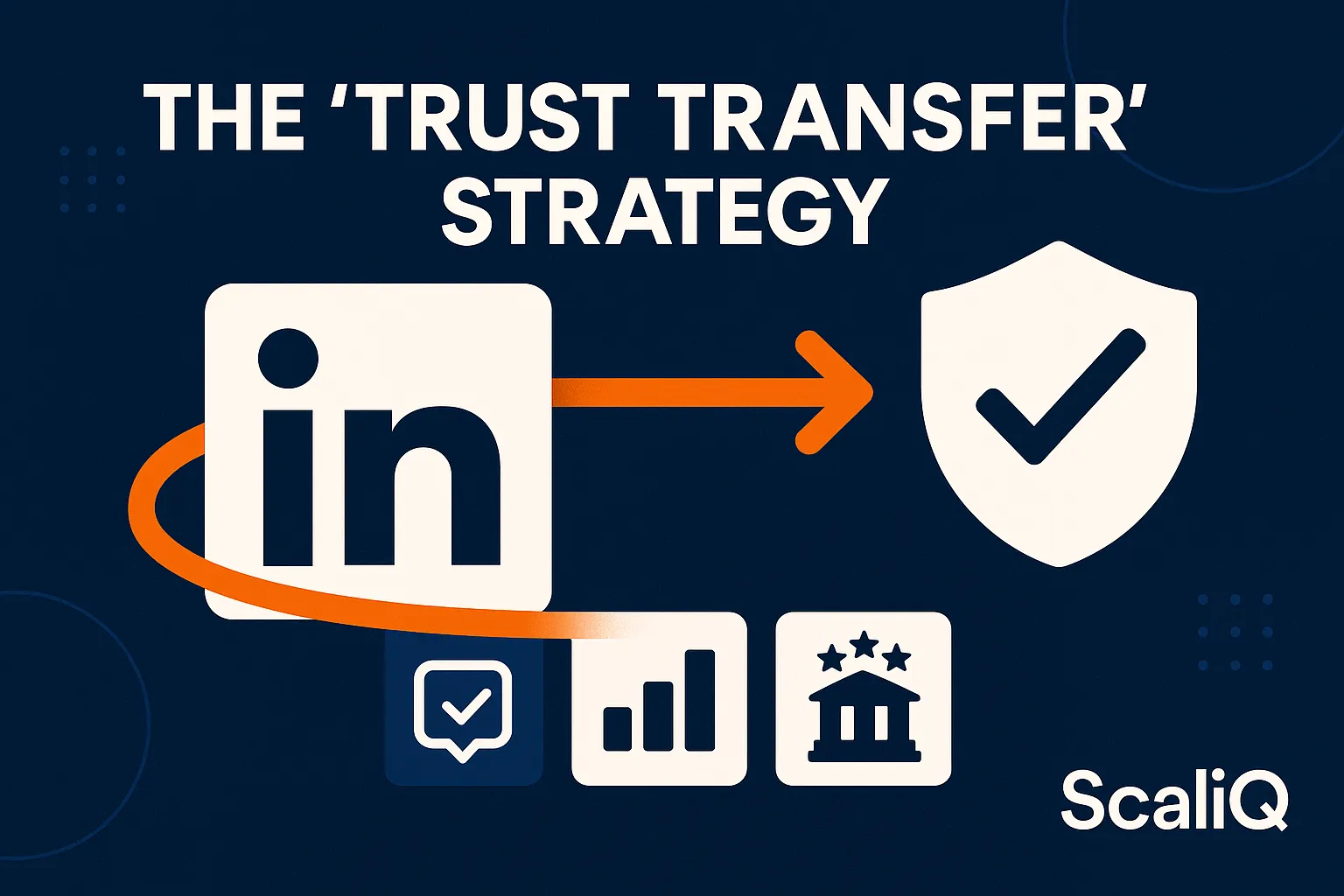
The answer is not another template or generic social proof tactic. It requires a LinkedIn trust transfer strategy. Trust transfer is a psychology-driven system for borrowing credibility from trusted third parties and strategically injecting it into your outreach to de-risk the conversation.
In this guide, we will cover exactly what trust transfer on LinkedIn entails, which third-party signals work best, how to sequence credibility across multiple touchpoints, and how to measure the impact on your reply rates. We will also break down weak versus strong message examples to demonstrate how authority leveraging outreach operates in practice.
This framework is built for advanced B2B teams who already understand the basics of outbound and are looking for repeatable credibility workflows. Rooted in psychology-driven outbound systems, ScaliQ approaches trust architecture as a measurable, operational science. For readers looking to explore more advanced outbound systems after mastering this framework, you can find further insights on the Blog.
What LinkedIn Trust Transfer Actually Means
At its core, trust transfer is the act of borrowing credibility from entities the buyer already respects—such as recognizable customers, industry media, niche experts, shared communities, or measurable outcomes.
It is vital to distinguish this from generic social proof. Social proof is broad evidence that other people use your product. Trust transfer, however, is the strategic use of relevant third-party signals to lower skepticism at specific points in the outreach journey. The psychological mechanism is simple: the prospect is not trusting you yet; they are trusting what you are associated with.
In the B2B reality, this is especially useful when brand recognition is low, deal risk is high, and the market is saturated with generic outreach. When a buyer lacks context about your company, they look for external validation to determine if a conversation is worth their time. This dynamic is heavily supported by the Stanford research on source credibility in persuasion, which demonstrates that individuals evaluate unfamiliar claims based on the credibility of the associated sources.
Why standard LinkedIn personalization is no longer enough
Personalization without proof often feels performative rather than credible. A message that begins with "I noticed you posted about X" proves you can use a scraping tool or read a profile, but it does nothing to prove you can solve their problem.
Conversely, stating, "We helped a similar team solve X," immediately introduces borrowed authority. Standard competitor advice often fixates on clever openers, templates, or shifting the tone of the message. However, without a foundational trust architecture, even the most highly personalized message will fail to convert a risk-aware buyer. True LinkedIn outreach credibility requires evidence, not just observation. Skepticism toward LinkedIn outreach cannot be cured with a compliment; it must be dismantled with proof.
The psychology behind trust transfer
The persuasion logic behind trust transfer is rooted in risk mitigation. In B2B buying, credibility reduces uncertainty, lowers perceived risk, and makes the next ask feel safer.
External proof consistently beats self-description in first-touch outreach. A prospect will always discount what you say about yourself, but they will heavily weigh what third parties say about you. The highest-performing trust signals for B2B outreach are highly specific and contextually relevant, not just impressive on paper.
This introduces the concept of "credibility continuity"—the idea that your profile, your message, and your destination page must seamlessly reinforce the same trust cues. The Edelman-LinkedIn B2B thought leadership report reinforces this, showing exactly why third-party-backed content and validated expertise heavily influence B2B buying behavior and drive decision-makers to engage.
Which Third-Party Signals Build Trust Fastest
Advanced teams do not just dump random logos into every message. They understand that the best signal is not necessarily the "biggest" one—it is the one most relevant to the buyer's role, industry, and immediate pain point.
Choosing which third-party signals transfer the most trust in LinkedIn outreach requires matching the proof to the prospect. One strong, highly contextual signal is always more persuasive than a laundry list of vague claims.
Customer logos, outcomes, and case-study proof
Recognizable customers and named outcomes are often the strongest trust accelerators in B2B outbound. However, specificity is key.
Stating "we work with leading brands" triggers skepticism because it is vague and overused. Stating "we helped [relevant type of company] improve [specific outcome]" instantly transfers credibility. If your Ideal Customer Profile (ICP) is narrow, category-specific case studies transfer significantly more trust than generic enterprise logos. If you are selling to a mid-market logistics firm, a case study from another logistics firm is infinitely more valuable than a logo from a Fortune 500 tech company. When logos are not widely recognized, prioritize specific, quantifiable outcomes over brand names to maximize expert validation and credibility stacking.
Expert endorsements, podcasts, media, and niche authority
Thought leader mentions, podcast features, creator collaborations, and earned media act as powerful "micro-authority" signals.
These signals are highly persuasive when targeting founder-led, specialist, or tight-knit niche communities. In many cases, niche authority beats mainstream authority because it feels more relevant and less inflated. Being featured on a highly specific industry podcast will transfer more trust to a niche buyer than a generic mention in a major publication.
Crucially, any mention must be truthful and proportionate. Do not imply an endorsement where there was only exposure. Ethical borrowed authority marketing relies on verifiable facts.
Mutual connections, communities, and warm-adjacent trust
The warm introduction effect remains one of the strongest ways to bypass skepticism. Mutual relationships reduce friction, even in nominally cold outreach.
Shared communities, alumni networks, or trusted industry memberships act as "proximity signals." These should be used lightly in copy without overplaying the familiarity. Mentioning a shared Slack community or a mutual connection works best when that shared network is genuinely relevant to the business conversation, instantly boosting LinkedIn prospecting credibility.
Founder authority vs SDR authority
The sender’s role dictates which trust signals feel natural and believable. What proof works best for founder-led outreach versus SDR outreach varies significantly.
For founders, the strongest signals are media mentions, category expertise, original thinking, operator credibility, and high-level customer results. Founders can leverage their personal brand authority. For Sales Development Representatives (SDRs), the focus should shift to customer outcomes, recognizable case studies, mutual relevance, and proof-rich assets that borrow trust from the company and its broader ecosystem. SDRs should act as curators of the company's best authority leveraging outreach assets, utilizing sales trust signals examples that fit their position.
How many proof elements are too many?
There is a simple rule for credibility stacking: lead with one primary signal and support it with one secondary signal only if absolutely necessary.
Too many trust cues can look manufactured, defensive, or crowded. Signal overload creates cognitive friction, especially in short, first-touch DMs. If a message contains three named logos, a podcast mention, and a metric, it reads like a desperate pitch rather than a peer-to-peer conversation. Always match your proof density to the message length and the current stage of the relationship to maintain a balanced LinkedIn social proof strategy.
How to Stack Credibility Across Profile, DM, and Landing Page
Trust transfer is not just a message tactic; it is a full-funnel outreach system. Advanced teams operationalize proof across a stage-by-stage framework encompassing the profile, connection request, first DM, follow-up, and destination page.
Trust works best when every touchpoint confirms the exact same story. Many generic resources discuss outreach messaging but completely ignore trust continuity across surfaces. For teams looking to operationalize these proof assets inside scalable outreach workflows, ScaliQ provides the infrastructure to ensure inconsistent profile and landing page proof never derails a campaign.
Profile-level trust signals
Your LinkedIn profile should validate your message, not introduce completely different positioning.
Optimize your headline, about section, featured content, and visible credibility markers to reflect the specific outcomes you promise in your outreach. If your DM claims you help SaaS companies scale revenue, your featured section should link directly to a SaaS revenue case study. These profile elements create legitimacy before the DM is even opened. Ensure all profile proof is clear, specific, and easy to verify, cementing your LinkedIn personal branding for outbound and solidifying trust signals for B2B outreach.
Connection request and first-message trust cues
The first touch should include a relevant proof cue early, but it must not turn into a résumé dump.
Lead with relevance, followed by one authority signal tied directly to the buyer's context. A proven sequence is: pain/observation → relevant proof → low-friction next step. Keep these trust cues concise. In short-form outreach, brevity signals confidence. Understanding how to build trust in LinkedIn messages means knowing how to deploy authority signals in cold outreach without overwhelming the reader.
Follow-up messages that deepen trust instead of repeating the pitch
Follow-ups are the perfect place to add a second layer of proof. Instead of sending a guilt-inducing "just bubbling this up," offer a relevant case study, an expert mention, a teardown, or a genuinely useful resource.
Follow-ups should reduce uncertainty, not restate the original ask. Adopt a "proof-first nurture" approach rather than pressure-based follow-ups. Every touchpoint should add new evidence or context to the conversation, seamlessly executing trust transfer linkedin strategies and providing strong b2b outbound social proof examples.
Proof-rich landing pages that convert LinkedIn trust into clicks and meetings
When a prospect finally clicks a link in your message, the destination page must continue the exact same trust story.
Message-to-page mismatch kills credibility instantly. If you referenced a specific pain point in the DM, the landing page should prominently feature customer logos, case studies, testimonials, and founder credibility directly related to that pain point. Crisp proof blocks are essential.
The design, tone, affiliation, and transparency of your website deeply affect perceived legitimacy. This is heavily documented in the Stanford web credibility study and further outlined in the Stanford web credibility guidelines, which prove that verifiable expertise on a destination page is what ultimately converts third-party validation for lead generation into booked meetings.
Weak vs Strong Trust Transfer Message Examples
To move beyond theory, advanced operators need practical teardowns. Specificity, relevance, and source credibility drastically change how a message is received.
It is crucial to emphasize ethical use: trust transfer should clarify legitimacy, not fake proximity or inflate relationships. For additional insights on building robust personalization systems to support this trust architecture, Blog offers supporting resources on how to use borrowed authority without sounding manipulative.
Example 1 — Generic self-promotion vs contextual customer proof
Weak: "We are the leading provider of outbound automation. We help companies book more meetings and scale revenue. Want to chat?" Why it fails: It relies entirely on self-praise and vague results. It forces the buyer to take on all the risk of believing an unknown brand credibility claim.
Strong: "Noticed your team is scaling the outbound motion this quarter. We recently helped [Competitor/Similar Company] increase their positive reply rate by 22% by restructuring their data workflows. Worth a look for your team?" Why it works: It shifts from "trust me" to "here is evidence adjacent to your problem." The specific customer proof and exact metric reduce friction, while the soft CTA lowers the barrier to entry, naturally improving cold outreach response rates.
Example 2 — Name-dropping vs credible association
Weak: "I was just on the [Massive Industry Podcast] talking about sales. We are connected to [Famous Influencer]. You should buy our tool." Why it fails: It overuses podcast names and expert endorsements in a way that feels inflated and manufactured. It screams of desperation.
Strong: "Loved your recent post on outbound friction. It actually mirrors a framework we recently discussed on the [Niche Industry Podcast] regarding deliverability. Have you tried adjusting your sender rotation?" Why it works: It shows ethical, proportionate borrowed authority. It references credible context without manufacturing borrowed status. Always ensure truthful representation of affiliations to avoid reputational risk and maintain ethical outreach.
Example 3 — Founder-led outreach vs SDR-led outreach
Founder-led (Strong): "After 5 years operating in B2B SaaS, I noticed a massive gap in how teams handle data compliance. We built a framework to solve this, recently featured in [Industry Publication]. Would love your feedback on it." Why it works: It leans on operator insight and category authority.
SDR-led (Strong): "Saw you're leading the RevOps team at [Company]. We just helped [Similar RevOps Team] cut their data processing time in half using our compliance workflow. Open to seeing how they did it?" Why it works: It leans on customer proof and external validation. Credibility must match the messenger for authority leveraging outreach to succeed.
A simple trust transfer message formula
To standardize this across your team, use this repeatable formula: Relevant trigger + Proof cue + Why it matters to them + Low-friction CTA.
Whether you are targeting enterprise CTOs or mid-market marketing directors, this framework remains effective. It can easily be repurposed into a social post or LinkedIn carousel. The key is ensuring the formula feels conversational, not over-engineered, providing a reliable blueprint for your LinkedIn social proof strategy and generating consistent sales trust signals examples.
How to Measure Reply and Conversion Lift
Advanced teams do not stop at anecdotal reply improvements—they test trust signals systematically. To validate whether trust transfer is actually working, you must measure impact across the entire outreach funnel, not just on superficial vanity metrics.
Metrics that matter
To understand how do third-party signals improve linkedin outreach response rates, track the following:
• Positive reply rate: This matters far more than total replies (which include opt-outs and rejections).
• Meeting-booked rate: The ultimate indicator of whether trust was successfully transferred.
• Click-through rate to proof assets: Measures engagement with your credibility continuity.
• Landing-page conversion rate: Validates your message-to-page match.
Segment these metrics by persona, industry, and sender type to isolate exactly which cold outreach response rates are improving.
A simple test design for trust signals
To measure reply rate improvement accurately, run an A/B test comparing a control message (standard personalization) versus a trust-transfer version.
Change only one variable at a time: test a customer outcome against a media mention, or a mutual connection against founder authority. Keep the audience, offer, and CTA strictly consistent. Maintain sample-size discipline to ensure statistical significance. The impact of sender- and message-level cues on response behavior is thoroughly documented in this field experiment on response and compliance rates, proving that isolated authority signals in cold outreach directly drive conversion lift.
Building a credibility library for scale
To turn trust transfer from founder intuition into a repeatable outbound capability, teams must organize their proof assets.
Create a shared credibility library categorized by persona, vertical, buyer pain, and outreach stage. This should house customer stories, expert mentions, proof snippets, and modular landing-page blocks. Operationalizing third-party validation inside scalable personalization workflows is exactly what separates average teams from top performers. For teams ready to systematize credibility stacking across massive campaigns, ScaliQ is the natural fit.
Future Trends in LinkedIn Trust Transfer
As AI-generated outreach volume continues to rise, the baseline quality of personalization will commoditize. When everyone can generate a highly personalized message in seconds, verifiable third-party proof will become the ultimate competitive advantage.
We will see a massive rise in micro-authority signals: hyper-niche communities, highly specialized podcast appearances, creator collaborations, and category experts. Furthermore, trust continuity across all channels—LinkedIn, landing pages, short-form content, and email—will matter significantly more than isolated message optimization. Teams must begin thinking in terms of holistic trust systems, abandoning one-off copy hacks in favor of emerging trends that prioritize verifiable legitimacy.
Conclusion
LinkedIn trust transfer is a distinct, highly effective framework for reducing skepticism by borrowing credibility from relevant third parties. By moving away from generic social proof, you can strategically de-risk the buying journey for your prospects.
The practical model is clear: choose the right signal, place it early in the interaction, stack it lightly, align it across your profile, message, and landing page, and rigorously measure the lift. The best outreach does not just personalize—it de-risks.
Audit your current LinkedIn flow today to identify broken trust continuity and scattered proof. For advanced revenue teams, ScaliQ provides the psychology-driven outbound systems, external-proof positioning, and repeatable conversion-focused workflows required to win in a saturated market.
Continue mastering these strategies on the Blog, or if you are ready to operationalize credibility-driven outreach at scale, visit ScaliQ to transform your pipeline.