

The LinkedIn Outbound Funnel: Awareness → Engage → DM → Booking
We are living in the golden age of sales tools, yet the average response rate on LinkedIn is plummeting. Why? Because while access to automation has increased, strategy has not kept pace. Most sales teams treat LinkedIn outreach as a simple "connect and pitch" task rather than a nuanced funnel. They blast generic templates to thousands of prospects and wonder why their calendar remains empty.
The problem isn't the platform; it is the funnel—or the lack thereof. Poor sequencing, generic messaging, slow follow-ups, and unclear cadences create friction that repels high-value prospects. To succeed today, you need a sophisticated linkedin outbound funnel that mirrors the complexity of modern B2B buying journeys.
This guide provides a comprehensive blueprint for building an AI-enhanced linkedin outreach strategy. By leveraging insights from ScaliQ’s dataset of over 500 optimized outbound campaigns, we will break down exactly how to construct a funnel that converts strangers into booked meetings using day-by-day actions and ai funnel building logic.
Why Most LinkedIn Outbound Fails
The primary reason most campaigns fail is that they are built on linear, manual workflows that cannot adapt to prospect behavior. Sales development representatives (SDRs) often rely on a static "three-touch" sequence: a connection request, a pitch, and a "bumping this up" message. This approach ignores the nuances of human interaction.
Top failure patterns include:
• Generic Messages: Templates that lack relevance to the prospect's specific pain points or recent activity.
• Inconsistent Follow-Ups: Manual tracking leads to missed windows of opportunity, where a prospect is interested but the follow-up arrives too late.
• Poor Targeting: Focusing on volume rather than fit, leading to low engagement rates that damage domain and profile reputation.
A major differentiator between top performers and average campaigns is the use of data to inform cadence and engagement signals. Competitors rarely address the "why" behind the timing of a message. They provide tools to send messages but lack the intelligence to tell you when to send them based on engagement signals.
Furthermore, manual workflows inevitably create drop-offs mid-funnel. If a prospect views your profile but doesn't accept your request, a manual process usually lets that lead go cold. An automated, AI-driven funnel captures that signal and triggers a different workflow.
According to a study on AI personalization effectiveness found on arXiv, personalized interactions significantly outperform static templates by aligning content with user intent. Despite this, many B2B teams persist with low-effort, high-volume strategies that result in low linkedin reply rates and massive linkedin personalization challenges.
The Core Stages of a High‑Converting LinkedIn Funnel
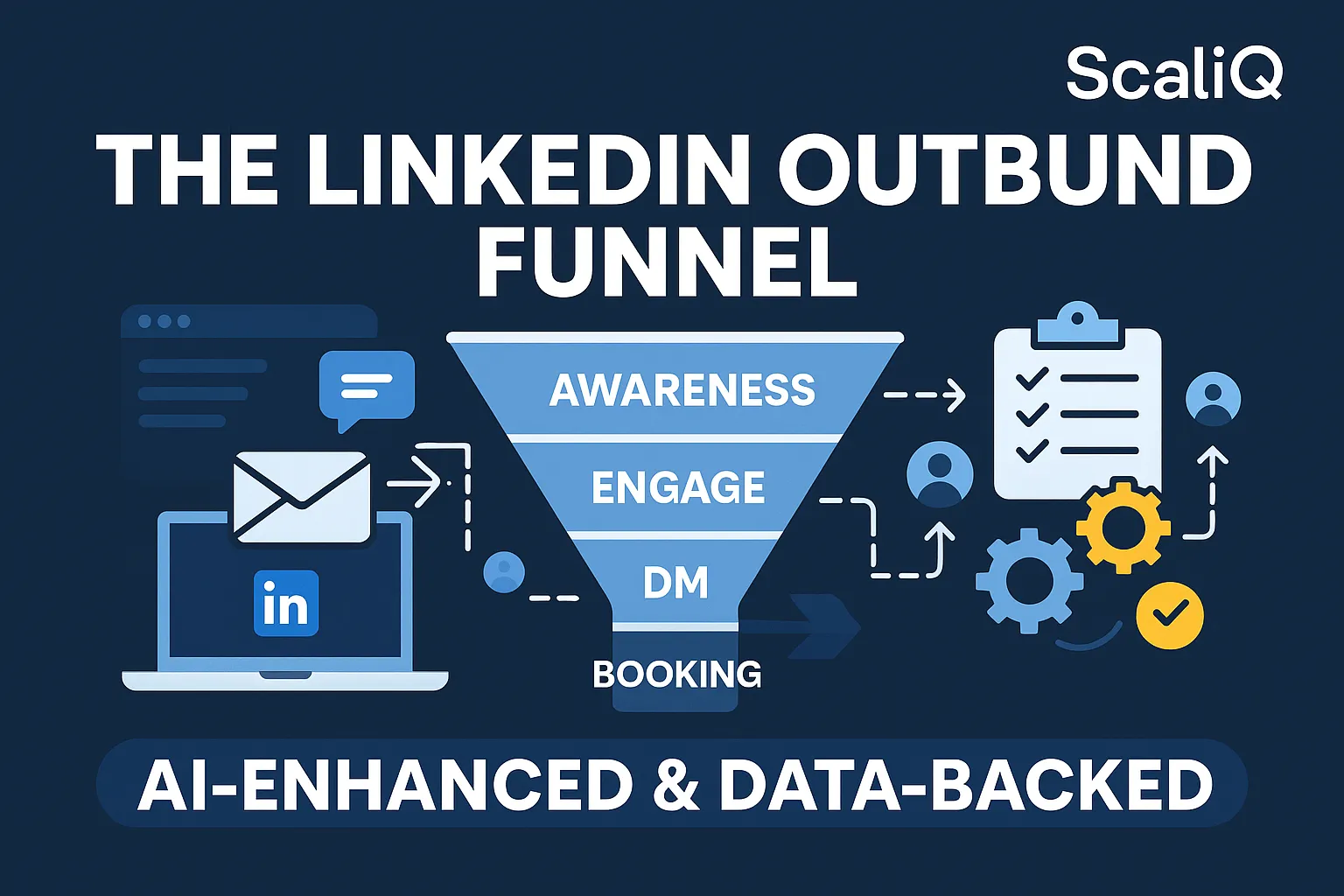
A successful linkedin lead generation funnel is not a flat list of tasks; it is a progression of stages designed to build trust before asking for time. The blueprint for a high-converting linkedin outbound funnel follows four distinct stages: Awareness, Engage, DM, and Booking.
Each stage serves a specific purpose in the B2B pipeline. Skipping a stage—for example, jumping straight from Awareness to Booking—is the digital equivalent of proposing marriage on a first date.
Based on ScaliQ’s analysis of 500+ campaigns, success in these stages is defined not just by replies, but by micro-conversions (e.g., profile views, likes, and acceptance rates).
Discover how ScaliQ’s automated funnel-building capabilities streamline these core stages.
Stage 1 — Awareness
Before you ever send a connection request, the prospect should ideally recognize your name or face. The Awareness stage focuses on linkedin outreach strategy fundamentals: profile optimization and passive engagement signals. This involves visiting a prospect's profile to trigger a notification and ensuring your own headline and banner clearly articulate your value proposition. Warming up a prospect here increases acceptance rates significantly later on.
Stage 2 — Engage
The goal of the Engage stage is to create familiarity without demand. This involves small interactions such as liking a recent post, commenting with genuine insight, or endorsing a skill if you have a mutual connection.
• Timing: 1–3 soft touches pre-connection.
• Objective: To be a familiar face in their notification feed, making the eventual connection request feel like a natural next step in linkedin prospecting.
Stage 3 — DM
Once connected, the Direct Message (DM) stage begins. This is where most funnels break. The goal is to start a conversation, not to close a deal immediately. Guidelines here focus on relevance.
• Personalization Logic: Mentioning the specific reason for connecting (e.g., a shared group, a recent post, or a specific technology they use).
• AI Variations: Using AI to generate linkedin dm outreach variations ensures that even at scale, no two messages look exactly like bot-generated spam.
Stage 4 — Booking
The final stage is transitioning from a text-based conversation to a call. This requires clear Calls to Action (CTAs) and friction-reducing messages. "Success" here looks like a seamless handoff to a calendar link after interest is established. This is the crux of linkedin appointment setting—knowing exactly when to drop the link.
Optimal Cadence, Timing, and Messaging Benchmarks
The difference between a nuisance and a helpful resource is often timing. To build the best linkedin outreach sequence, you must adhere to a strict linkedin cadence that respects the prospect's time while remaining persistent.
Connection Request Timing (Day 1)
The initial request should ideally be sent mid-week (Tuesday to Thursday) during business hours of the prospect's time zone.
• Message Length: Keep it under 300 characters.
• Personalization Ratio: 20–40% typical acceptance rates are the benchmark for personalized requests. If you are below 20%, your targeting or messaging is off.
• Focus: Connection request optimization relies on a low-friction "hook" rather than a pitch.
Follow‑Up Timing (Day 2–5)
If the connection is accepted, do not message immediately. Wait 24 hours.
• The "Double Tap": Avoid sending two messages in rapid succession unless they are logically connected (e.g., a typo correction or a resource link).
• Cadence: A typical linkedin follow up cadence involves a value-add message 2 days after connection, followed by a "thoughts?" or context-bump 3 days later.
• Behavioral Triggers: If they view your profile but don't reply, a soft follow-up is warranted.
Conversion Timing (Day 5–10)
This is the window to transition to booking. Data suggests that if a conversion doesn't happen within the first 10 days of the connection, the likelihood drops significantly.
• Benchmarks: Personalization can improve reply rates by 2x-3x during this phase.
• Reference: While discussing timing, it is useful to look at broader messaging studies. For instance, M+R nonprofit messaging cadence benchmarks highlight that frequency must be balanced with high relevance to avoid unsubscribe (or in this case, unconnect) behavior. This principle applies directly to linkedin funnel timing.
How AI Personalization Improves Acceptance and Reply Rates
Generic templates are the death of outbound sales. AI for outbound sales linkedin strategies allow you to scale personalization depth that was previously only possible manually.
Research consistently shows an engagement lift when messages address specific user attributes. By moving from "Hi [Name]" to "Hi [Name], I saw your post about [Topic]...", you shift the dynamic from sales to conversation.
AI‑Powered Message Variations
AI excels at generating unique, tone-consistent messages that avoid spam filters.
• Use Cases: You can instruct AI to adjust the message based on the prospect's industry (e.g., formal for Legal, casual for Tech) or persona (e.g., concise for CEOs, detailed for CTOs).
• Research: According to research on AI-driven personalized content available on arXiv, systems that adapt content style to the recipient demonstrate significantly higher retention and interaction rates. This validates the use of ai outreach personalization.
Behavior‑Based Messaging
Behavior-based outreach moves beyond static sequences. It involves dynamic responses based on profile activity.
• Example: If a prospect accepts your request and immediately endorses you, the AI should trigger a "Thank you" message branch rather than a generic pitch.
• Logic: If a prospect visits your company page, the next message should reference your solution's relevance to their industry.
Dynamic Funnel Branching
This is the most advanced form of ai funnel logic. It involves creating multiple paths:
1. Replied: Stop automation, alert human.
2. Ignored: Continue value-drip sequence.
3. Viewed Profile: Trigger a soft "saw you stopped by" message.
4. Engaged with Content: Trigger a contextual comment reference.
Putting It All Together: A Scalable Funnel You Can Automate
To execute this, you need a unified system that moves a lead from Awareness to Booking without manual intervention until the conversation starts. This is where linkedin automated funnel tools shine. ScaliQ automates the routing, timing, branching, and message generation, solving the pain points of manual tracking and inconsistent follow-ups.
The AI‑Enhanced Day‑By‑Day Funnel Blueprint
Here is a linkedin sequence blueprint for a 10-day sprint:
• Day 0 (Auto): Visit Profile & Like 1 Post (Awareness).
• Day 1 (Auto): Send Personalized Connection Request (Trigger: "Saw your post on X").
• Day 2 (Wait): If accepted, wait 24 hours.
• Day 3 (Auto): Send Welcome DM (No Pitch). Ask a low-friction question.
• Day 5 (Auto): If no reply, send Value Asset (Case Study/Whitepaper).
• Day 7 (Auto): "Did you see this?" soft bump.
• Day 9 (Auto): Break-up message or final value add.
• Day 10: Move to "Nurture" list if no response.
Scaling the Funnel Without Risk
Linkedin automation safety is paramount.
• Velocity: Start slow (20 invites/day) and ramp up.
• AI Assistance: AI helps randomize sending times and message structures, making automation behavior look human to detection algorithms.
• Rule: Never scrape private data; rely only on public profile information and strictly adhere to platform Terms of Service.
KPIs, Tracking, and Optimization
You cannot improve what you do not measure.
• Acceptance Rate: Target >30%.
• Reply Rate: Target >10-15%.
• Conversion Rate: Target >3-5% (Booking).
• Focus: These linkedin outreach metrics tell you which part of the funnel is leaking (e.g., high acceptance but low reply means your pitch is weak).
Case Studies / Real‑World Examples
While every industry differs, the data trends are clear.
• Mini Case Study 1: A SaaS company implemented AI-boosted acceptance messages referencing recent funding news. Their acceptance rate jumped from 18% to 42% in three weeks.
• Mini Case Study 2: A marketing agency used dynamic branching. Prospects who viewed the CEO's profile received a specific "Thanks for visiting" video message. This segment saw a 25% higher reply rate than the general pool.
These examples highlight the power of a linkedin success case study driven by AI logic.
Tools & Resources for LinkedIn Funnel Building
To build this, you need the right tech stack.
• ScaliQ: The central engine for linkedin funnel tools. ScaliQ differentiates itself with an AI branching and timing engine that adjusts sequencing logic based on real-time prospect behavior, rather than just blasting static lists.
• Sales Navigator: Essential for granular targeting.
• CRM Integration: To ensure data flows back to your central system.
Future Trends & Expert Predictions
The future of linkedin outbound lies in predictive intelligence. We are moving toward:
• AI Sentiment Routing: AI that analyzes a reply's sentiment (hostile, curious, objection) and drafts the appropriate counter-response automatically.
• Predictive Scoring: Algorithms that predict which prospects are most likely to convert based on passive signals before you even message them.
• Multi-Turn Personalization: AI that can sustain a conversation over several messages.
A study on personalized AI collaboration (arXiv) suggests that human-AI loops will become the standard, where AI handles the groundwork and humans intervene only for high-value closing interactions.
Conclusion
Building a high-converting linkedin outbound funnel requires more than just a tool; it requires a strategy rooted in psychology and data. By combining a structured 4-stage funnel (Awareness, Engage, DM, Booking) with AI-powered sequencing and personalization, you can fix the most common outbound failures: irrelevance and poor timing.
The days of manual "spray and pray" are over. The future belongs to smart, automated, and deeply personalized funnels.
Ready to transform your outreach? Build your LinkedIn funnel in ScaliQ using AI-powered sequencing today.