

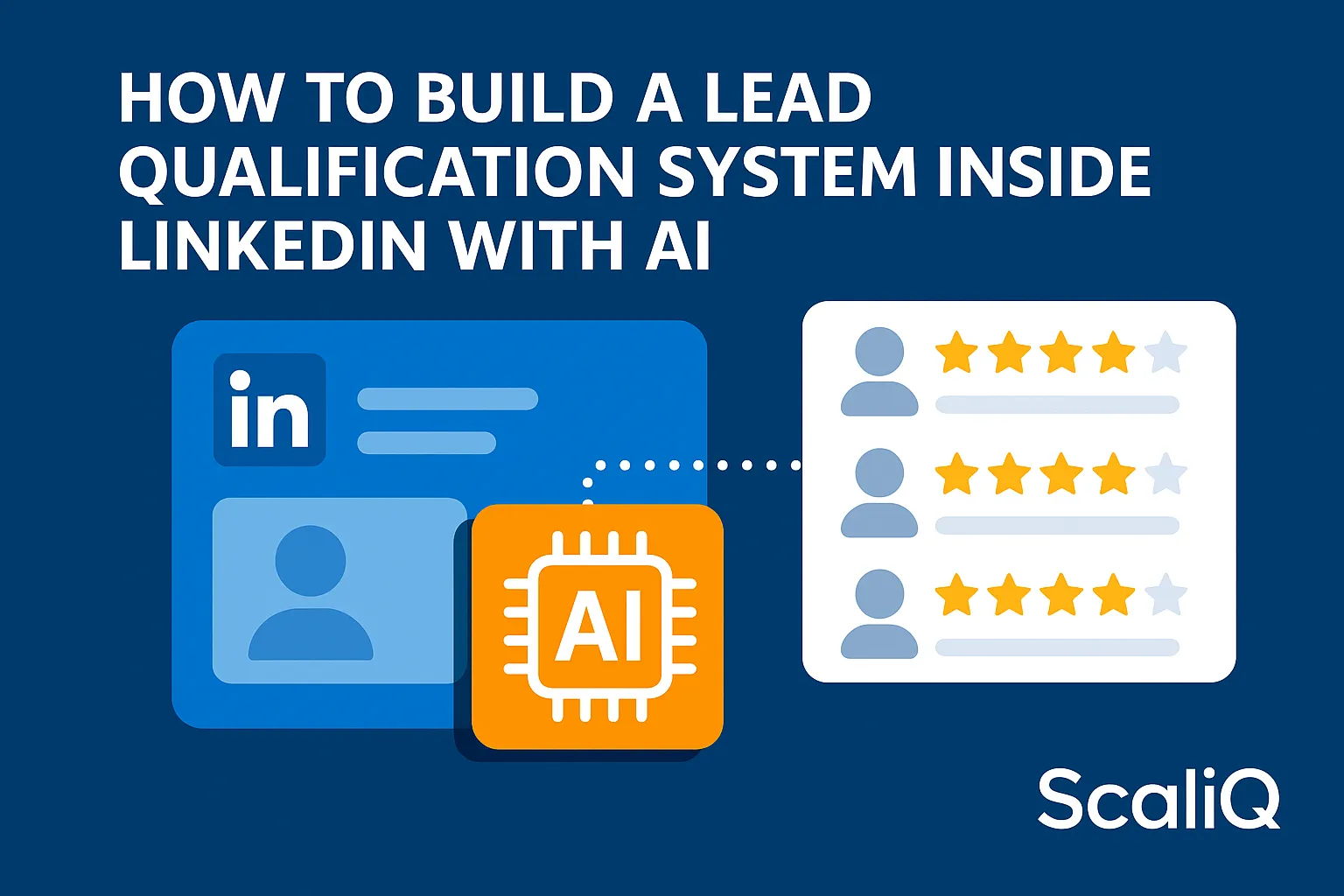
How to Build a Lead Qualification System Inside LinkedIn With AI
Every sales leader knows the frustration: your SDRs spend hours manually combing through LinkedIn profiles, trying to decipher if a "like" means interest or just politeness. Without a structured way to measure intent, teams waste valuable time chasing curiosity clicks while missing out on prospects who are genuinely ready to buy.
The core problem is that LinkedIn lacks a native qualification system. Unlike a CRM that tracks website visits and email opens, LinkedIn provides a firehose of unstructured engagement data. This forces sales teams to guess which prospects show real buying intent, leading to inconsistent pipelines and missed revenue.
This guide delivers a repeatable, AI‑powered framework to solve that problem. By moving beyond intuition and leveraging campaign‑trained models, you can build a linkedin qualification system that scores leads with high accuracy. We will explore how to interpret real engagement signals using AI—backed by ScaliQ’s qualification models built from years of real campaign performance data—to transform your prospecting from guesswork into a precise science.
Why LinkedIn Needs a Real Qualification System
LinkedIn is the world's largest B2B database, rich in intent signals, yet it remains notoriously difficult to interpret manually. A prospect might visit your profile because they are researching a solution, or simply because they saw a comment you left on a viral post. To a human observer, these actions look identical. To a data-driven sales team, the difference is the gap between a closed deal and wasted time.
Manual qualification suffers from severe inconsistency. One SDR might prioritize leads based on job titles, while another prioritizes recent posting activity. This lack of standardization creates "signal noise," where low-intent curiosity clicks clog the funnel, obscuring the high-value prospects. Furthermore, manual review is unscalable; as your network grows, the ability to mentally score every interaction vanishes.
This is where a dedicated system becomes essential. Unlike traditional CRM-based scoring, which relies on email clicks or whitepaper downloads, a linkedin qualification system must analyze social nuance. It requires a centralized scoring engine that can weigh a profile visit differently depending on the context of the interaction.
For teams struggling with inconsistent pipelines, ScaliQ offers a solution to inconsistent manual qualification by providing AI models trained on actual campaign outcomes rather than static data.
Research supports the necessity of modeling these interactions mathematically. According to "LinkedIn engagement forecasting research" available on arXiv, social engagement patterns follow predictable trajectories that, when modeled correctly, can forecast future interaction probabilities with significant accuracy. This indicates that what feels like random social noise is actually a structured dataset waiting to be analyzed.
The Core Signals That Reveal Real Buying Intent
To build an effective linkedin qualification system, you must first distinguish between general "engagement" and "qualified engagement." Not all clicks are created equal. A "Like" from a peer in your industry is networking; a "Like" from a decision-maker at a target account is a buying signal.
We categorize these linkedin intent signals into three primary buckets:
1. Profile-based signals: Static data points such as role, seniority, industry relevance, and company size.
2. Behavioral signals: Dynamic actions including recent posting activity, commenting patterns, and content themes.
3. Engagement signals: Direct interactions with your brand, such as DM replies, post interactions, and profile visits.
The goal is to filter out curiosity clicks—superficial interactions that lack commercial intent. For example, a student viewing your profile is curiosity; a VP of Sales viewing your profile after you posted a case study is intent.
According to EU "real-time social media veracity research," distinguishing between authentic, high-value interactions and superficial noise requires analyzing the velocity and context of the interaction, not just the action itself. This research supports the need for a system that looks deeper than surface-level metrics.
Profile Signals With Predictive Value
Profile signals are the foundation of ai lead qualification. Before assessing behavior, the system must validate fit. Key indicators include:
• Role Relevance: Does the title match your Ideal Customer Profile (ICP)?
• Seniority: Is the prospect a decision-maker or an influencer?
• Industry Fit: Is the company in a sector you service?
• Shared Networks: Are they connected to your existing customers?
It is critical to program your system to avoid biases. Assumptions based on geography or university background often lead to false negatives. Instead, focus strictly on commercial fit indicators that historically correlate with closed-won deals.
Behavioral & Engagement Signals That Show Intent
Behavioral signals are where social engagement indicators become predictive. This involves analyzing "patterned activity." A single comment is an event; a comment followed by a profile visit and a connection request is a pattern.
When building your linkedin lead scoring model, look for multi-signal intent clusters. For instance, if a prospect engages with a post about "AI sales workflows" and simultaneously fits your ICP, the score should spike.
Validating these patterns is crucial. "Social media authenticity indicators" from ScienceDirect suggest that genuine behavioral patterns display consistency over time, whereas bot-driven or superficial engagement is often sporadic or disconnected from the user's typical baseline. Your system must prioritize these consistent, authentic patterns.
How AI Automates Prospect Scoring in Real Time
Manually tracking the signals above is impossible at scale. This is where ai lead qualification steps in. AI automates the extraction of features from LinkedIn profiles and engagement behaviors, converting unstructured social data into structured scores.
The workflow typically follows this path:
1. Raw Signal Detection: The system detects an event (e.g., a comment).
2. Feature Extraction: AI identifies the user's role and the sentiment of the comment.
3. Normalization: The data is standardized for comparison.
4. Score Update: The prospect's score is adjusted in real-time.
Real-time scoring allows for "speed to lead" on social channels. If a high-value prospect engages, your sales team can be notified instantly. For teams looking to orchestrate these complex ai sales workflows, resources like the Notiq blog provide excellent guidance on workflow automation and connecting disparate data sources.
ScaliQ takes this further by utilizing behavioral signal mapping that goes beyond simple enrichment. Instead of just knowing who the lead is, the model understands how they act, applying a layer of behavioral intelligence that static databases cannot provide.
Extracting and Normalizing LinkedIn Signals
AI tools can "read" signals that humans miss. However, for a linkedin qualification system to work, data must be normalized. A "Director" at a 10-person startup is different from a "Director" at a Fortune 500 company.
Normalization involves mapping these diverse titles and company sizes to a standard scale (e.g., Tier 1, Tier 2, Tier 3). This ensures that your linkedin intent signals are weighted consistently across the board, preventing a small business lead from outscoring an enterprise opportunity simply due to title inflation.
Interpreting Intent Patterns With Predictive Models
Once data is normalized, predictive models (often based on Machine Learning or LLMs) analyze the data for clusters correlated with intent. This is ai intent detection in action.
For example, a predictive scoring model might identify that prospects who ask questions in comments convert at a 3x higher rate than those who simply "like" a post. The model then assigns a higher weight to question-based comments.
To ensure the integrity of these interpretations, we look to methodologies used in SpringerOpen "fake news detection research." This research highlights the importance of cross-referencing source credibility with content patterns to validate signal authenticity. Similarly, sales AI uses these principles to verify that a signal is a genuine expression of business interest rather than a bot or a spam account.
Building a Predictive LinkedIn Lead Scoring Model
Building your own linkedin lead scoring model requires a structured approach. You cannot rely on "gut feeling." You need a mathematical framework that separates curiosity from buying intent.
A robust model includes:
• Data Inputs: The specific signals you will track.
• Weights: The point value assigned to each signal.
• Scoring Rules: Thresholds that trigger specific actions (e.g., "Score > 50 = Send DM").
• Decay Logic: Reducing points over time if a prospect stops engaging.
Step-by-Step Framework (Signals → Weights → Score)
To create a repeatable linkedin scoring model, follow this pipeline:
1. Define the Baseline (0-100 points): Start every prospect at 0.
2. Assign ICP Points (Max 40 points):, C-Level Role: +20, Target Industry: +10, Company Size Match: +10
3. Assign Engagement Points (Max 60 points):, Profile Visit: +5, Post Like: +2, Post Comment (Generic): +5, Post Comment (Insightful/Question): +15, DM Reply: +20
4. Apply Decay: Subtract 5 points for every week of inactivity.
5. Define Tiers:, Tier A (High Intent): 70+ points (Immediate personal outreach)., Tier B (Warm): 40-69 points (Nurture with content)., Tier C (Low/Cold): <40 points (Automated monitoring).
Using Campaign Data to Train and Improve the Model
The most accurate models are not static; they learn. A campaign-trained model uses feedback from actual sales cycles to adjust weights. If you find that "Profile Visits" rarely lead to meetings, you reduce that weight. If "DM Replies" convert at 90%, you increase it.
This is where generic enrichment fails. It provides static data, whereas real engagement signals provide context. ScaliQ leverages over 10 years of AI modeling and real-campaign training data to refine these weights automatically, ensuring the model evolves as market behaviors change.
Comparing Generic Scoring Tools vs Campaign-Trained Models
Many teams attempt to use generic tools for ai lead scoring, but they often hit a ceiling. Generic tools rely on static enrichment—knowing a prospect's job title and email. While useful, this lacks the behavioral nuance required for high-accuracy qualification on social channels.
Where Generic AI Scoring Falls Short
Tools that focus heavily on database enrichment—often associated with keywords like clay lead scoring, apollo intent scoring, or lemlist engagement scoring—are excellent for building lists but often struggle with dynamic prioritization.
Their limitations include:
• Static Enrichment: They know who the person is, but not what they are doing right now.
• No Intent Differentiation: They often treat all "likes" as equal.
• No Dynamic Scoring: They rarely include decay logic or complex behavioral clustering specific to LinkedIn.
Advantages of Campaign-Trained, LinkedIn-Specific Models
A campaign-trained scoring system offers significantly higher linkedin qualification accuracy. By training the AI on historical campaign performance, the model "knows" which patterns lead to revenue.
The advantages include:
• Deeper Pattern Recognition: Identifying subtle signals that human SDRs miss.
• Better Prioritization: separating the "window shoppers" from the buyers.
• Higher Response Rates: Outreach is timed perfectly with peak interest.
Tools & Resources for Building Your Qualification System
Ready to build your system? Here is a checklist of the essential elements you will need:
• Scoring Template: A spreadsheet or software to define your weights and thresholds.
• Signal Mapping Sheet: A document listing every tracked behavior and its associated intent level.
• CRM Sync Rules: Logic for pushing qualified leads from LinkedIn to your CRM.
• Model Feedback Loop: A process for reviewing closed-won deals to refine scoring weights.
• Workflow Orchestration: Tools to automate the data flow.
For teams looking to generate a sophisticated scoring model without starting from scratch, ScaliQ provides the infrastructure to build and deploy campaign-trained qualification models instantly.
Future Trends & Expert Predictions
The field of ai sales workflows is evolving rapidly. We are moving toward a future where ai sales assistants do more than just draft emails—they will act as autonomous agents managing the entire qualification process.
Key trends to watch include:
• LLM-Powered Agents: AI that can read a LinkedIn comment, understand the nuance, score the lead, and draft a hyper-personalized reply in seconds.
• Real-Time Multi-Signal Scoring: Systems that aggregate data from LinkedIn, Twitter/X, and website visits into a single, unified "intent score."
• Predictive Pipeline Automation: AI that forecasts revenue based on the aggregate engagement score of your LinkedIn network.
The future of lead scoring is not just about data; it is about the intelligent interpretation of human behavior at scale.
Conclusion
Building a high-accuracy linkedin qualification system transforms prospecting from a game of chance into a predictable revenue engine. By leveraging ai lead qualification and focusing on real engagement signals, you can eliminate the guesswork that plagues manual SDR teams.
The benefits are clear: consistent lead quality, accurate prioritization, and real-time responsiveness. Do not let high-intent prospects slip through the cracks of a noisy network.
Start building your scoring workflow today. For a system that comes pre-trained on millions of successful campaign interactions, consider optimizing your workflow with ScaliQ.