

Introduction
For facility management and commercial cleaning companies, successful business development requires reaching the correct property, facilities, operations, procurement, or ownership stakeholder at precisely the right time. However, many service providers approach LinkedIn as a high-volume messaging channel rather than a strategic platform for account research and relationship building.
Operational leaders are inundated with generic messages touting “quality,” “reliability,” or “affordable services.” Because these claims lack context, they are incredibly easy for busy decision-makers to ignore. To generate genuine commercial cleaning leads, service providers must pivot away from indiscriminate messaging.
This guide outlines a repeatable workflow for identifying relevant accounts, understanding their operating context, personalizing outreach, and measuring commercial outcomes. By connecting your LinkedIn outreach for facility management companies directly to property type, portfolio size, geography, site count, operational triggers, and specific service requirements, you can build a pipeline of qualified opportunities.
At ScaliQ, our expertise is rooted in structured account research, persona-based segmentation, and repeatable prospecting workflows rather than generic automation or message volume. When you align your outreach with the actual operational realities of your target accounts, facility management lead generation becomes a predictable, value-driven process.
Define and Segment Your Ideal Commercial Cleaning Prospects
Broad industry targeting often leads to wasted effort. To succeed, you must replace generic targeting with a facility-services Ideal Customer Profile (ICP) that reflects true account fit, operational complexity, and buying responsibility.
Segment your target accounts by examining the following criteria:
• Property or asset type: Is the facility commercial office space, industrial, retail, or healthcare?
• Geography and service territory: Does the account fall within your active or planned service footprint?
• Portfolio size and number of locations: Are you targeting a single large headquarters or a distributed multi-site network?
• Business size and operating model: Is the facility managed in-house, or is it outsourced to a third-party property management firm?
• Cleaning, maintenance, compliance, or vendor-coordination needs: What specific operational burdens is the prospect currently facing?
It is crucial to distinguish between the organization that uses the service and the person who influences, evaluates, or approves the vendor. To streamline this, create a simple account-research worksheet with fields for:
• Company and location
• Property portfolio or site footprint
• Likely service requirements
• Current operational challenge
• Relevant buying roles
• Potential trigger
Multi-site operations prospecting requires a nuanced approach. Multi-site businesses often require messaging around standardized service levels, centralized reporting, vendor coordination, and consistency across locations.
When discussing facilities-specific role distinctions, it helps to use terminology informed by IFMA and BOMA International, ensuring you do not treat all property or facilities roles as interchangeable. Furthermore, when defining your market segmentation or territory planning, referencing reliable data such as the Census Bureau janitorial-services profile can help ground your strategy in market reality.
If you are looking to operationalize this research, ScaliQ offers robust resources for structured account research, segmentation, and operational prospecting workflows to help you capture high-quality facility management leads.
Segment by Persona, Not Just Job Title
Successful property management business development requires understanding the distinct priorities of different stakeholders:
• Property owners and asset managers: Focused on asset value, risk mitigation, tenant retention, and overall portfolio profitability.
• Property managers: Concerned with day-to-day tenant satisfaction, operational efficiency, and budget adherence.
• Facilities directors and facility managers: Prioritize service performance, safety compliance, and maintaining physical environments.
• Operations leaders at multi-site businesses: Need visibility, consistency, and centralized reporting across geographically dispersed locations.
• Procurement and finance stakeholders: Evaluate vendor cost, contract terms, and consolidation opportunities.
Do not assume that the highest-ranking person is the only relevant contact. Identify which persona experiences the operational problem, who influences vendor selection, who approves the budget, and who ultimately manages the provider. Targeted facilities director contacts will respond differently than property owners, requiring distinct messaging for property owner outreach.
Match the Service Need to the Account Context
Your messaging must directly address the specific context of the account. Outreach will differ significantly based on the prospect's current situation:
• Routine commercial cleaning: Focus on reliability, staff retention, and consistency.
• Cleaning quality or inspection concerns: Highlight rapid response times, quality assurance technology, and transparent reporting.
• Vendor consolidation: Emphasize the ease of a single point of contact and unified billing.
• Multi-location coordination: Discuss centralized management and standardized service delivery across sites.
• Compliance or audit readiness: Focus on specialized training, safety protocols, and documentation.
• Occupancy growth, expansion, or new-site readiness: Address scalability and seamless onboarding for new locations.
Never contact a prospect with a service claim that has not been connected to a visible business context. Facility services sales rely heavily on meeting specific FM vendor selection criteria, and demonstrating that you understand their unique challenges is the key to generating qualified commercial cleaning company leads.
Find Decision-Makers and Buying Signals on LinkedIn
Finding the right stakeholders requires a structured LinkedIn and Sales Navigator research process. Instead of blindly searching for job titles, use a methodical approach to locate relevant accounts, roles, and timely reasons to reach out.
Utilize LinkedIn’s powerful account and lead filters, including:
• Geography
• Industry
• Company size
• Seniority
• Job title
• Location or territory
• Account lists
Always research the company before the individual. Understanding the company's property footprint, locations, operating model, and likely service complexity is essential before engaging. Map multiple stakeholders within one account rather than relying on a single contact, as B2B LinkedIn prospecting usually involves buying committees.
Look for verified buying signals, such as:
• New locations or facility openings
• Expansion or acquisitions
• Leadership changes
• Hiring activity
• Occupancy or operating growth
• Announcements related to facilities or operations
Verify each signal through the prospect’s profile, company page, website, or other available business context before referencing it. While a tool like the Sales Navigator resource is excellent for identifying contacts, saving searches, and tracking relationship intelligence, it cannot confirm service territory, buying authority, incumbent-provider status, or contract timing. That requires your industry expertise. Use these tools for facilities director lead generation, but rely on human validation to ensure accuracy in your LinkedIn Sales Navigator facility management strategy.
Build a Buying-Role Map
To effectively navigate facility management business development, build a compact role-mapping framework for each target account:
• Problem owner: Who experiences the operational issue firsthand?
• Evaluator: Who compares providers, scopes services, or runs the RFP?
• Budget owner: Who approves the spending?
• Implementation owner: Who manages the vendor after selection?
Use LinkedIn profiles and company information to identify likely responsibilities, but avoid presenting your assumptions as undeniable facts. This nuanced approach is vital for property manager prospecting and overall facilities services sales.
Turn Signals Into Relevant Outreach Timing
A buying signal should create context, not serve as a pretext for an unsupported claim. When you spot a signal, connect it to a plausible operational question. For example, if a company announces an acquisition, ask how they are managing service consistency across their newly expanded geographic footprint.
Always include a qualification reminder: ask about site count, geography, service scope, operational priorities, and timing rather than immediately assuming they are conducting a vendor review. This positions you as a consultant rather than a vendor, enhancing your commercial property management prospecting and multi-site facilities management services outreach, while elevating your property owner marketing efforts.
Write Personalized Connection and Follow-Up Messages
The goal of your B2B LinkedIn outreach strategy is to create concise, credible messages that reflect the recipient’s role and operating context.
Follow this proven message structure:
1. Relevant context: Acknowledge their role, company, or a recent trigger event.
2. Specific operational observation or question: Tie the context to a potential facility challenge.
3. Practical value: Offer a useful resource or insight.
4. Low-pressure next step: Ask a simple question rather than demanding a 30-minute call.
Messages must be tailored. A property manager responsible for several buildings cares about tenant complaints and budget constraints. A facilities director focuses on service performance and compliance. A multi-site operations leader manages consistency across locations, while an owner or asset manager focuses on risk, cost, occupancy, and asset performance.
Lead with an operational issue rather than a generic company introduction. Offer a useful resource—such as a facility checklist, a benchmark framework, or an account-specific observation—before asking for a sales meeting. According to Journal of Business & Industrial Marketing research on social selling, role relevance, personalization, and avoiding aggressive or repetitive outreach are critical to success in property manager outreach and broader LinkedIn outreach.
Connection Request Framework
Your connection request should be short and adaptable:
• Mention the relevant role, property type, location, or operating context.
• State why the connection is relevant.
• Avoid an immediate service pitch or lengthy company description.
Example Direction: Reference a multi-site or property-management context. Ask a concise question about consistency, vendor coordination, or service visibility. Keep the request focused on relevance rather than a meeting demand. This approach yields higher acceptance rates for a LinkedIn connection request for facility services, driving better facility management lead generation and property owner outreach.
Follow-Up Message Framework
Your LinkedIn follow-up strategy should be based on relevance and response rather than maximum volume.
Suggested stages:
• Share a practical resource or operational insight.
• Ask one qualifying question.
• Offer a brief conversation only when the account and persona appear relevant.
• Close the sequence respectfully if there is no engagement.
Never criticize an incumbent provider. Instead, frame the conversation around visibility, consistency, response times, reporting, or service outcomes. This professional approach builds trust and is essential for building maintenance sales leads and facility services sales.
Build a Value-Led, Multi-Touch Outreach Workflow
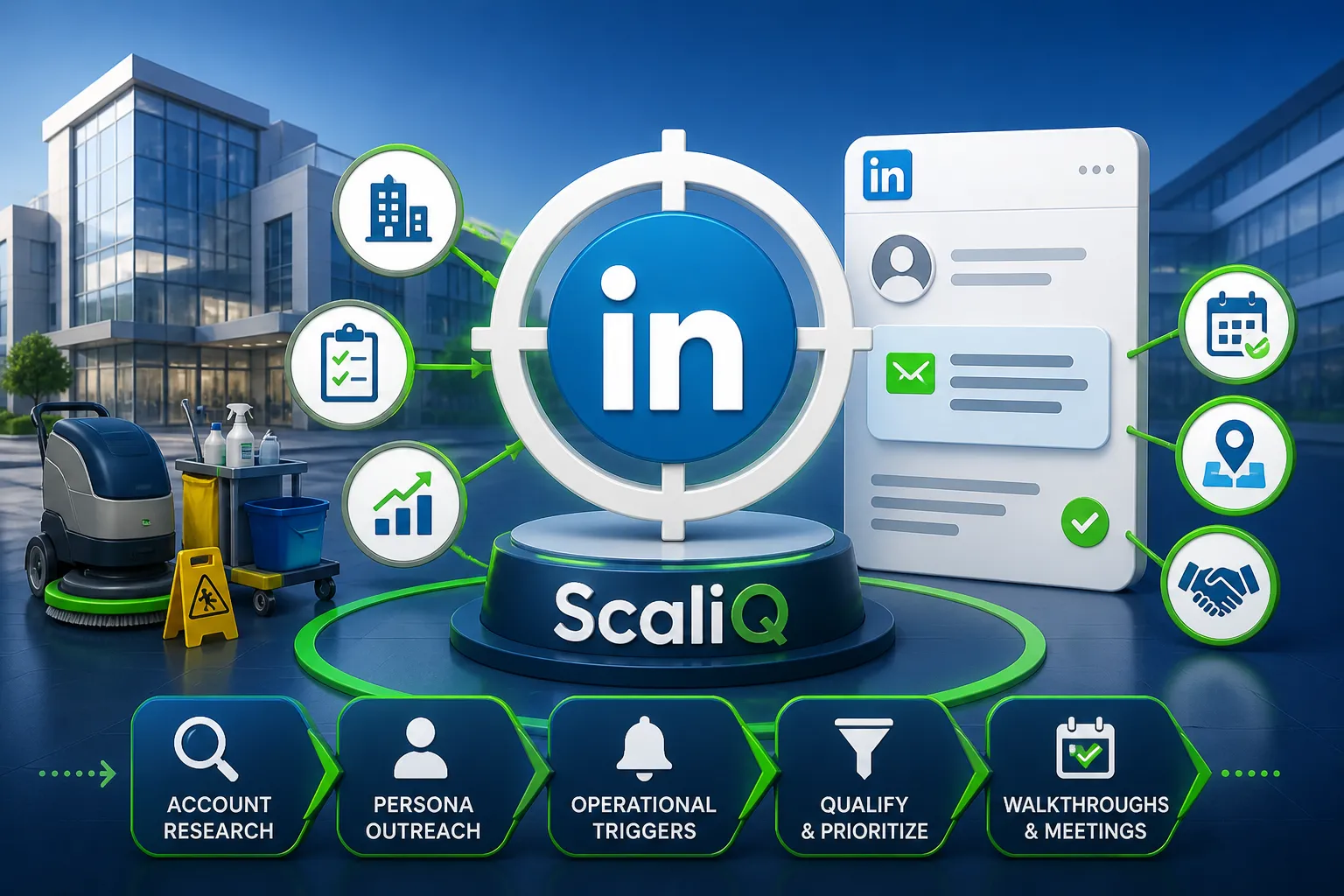
To consistently generate facilities services prospecting results, you must turn individual messages into a structured process connecting research, engagement, follow-up, qualification, and handoff.
Execute this recommended workflow:
1. Define account and persona criteria.
2. Research the company and operating context.
3. Identify relevant stakeholders.
4. Record a verified trigger or business reason.
5. Engage with relevant content where appropriate.
6. Send a concise connection request.
7. Follow up with practical value.
8. Qualify the conversation.
9. Record the outcome in your CRM or account worksheet.
10. Stop, nurture, or progress the account based on intent.
Coordinate LinkedIn with email, referrals, content, and phone outreach where appropriate. If you are incorporating commercial email follow-up, ensure full compliance with the FTC’s CAN-SPAM Act compliance guidance, which includes truthful identification, non-deceptive messaging, physical-address disclosure, and clear opt-out handling.
Always mandate human review of AI-assisted research or message drafts to protect accuracy, relevance, and credibility. Implement strict stop rules for unanswered or clearly unsuitable prospects. ScaliQ’s operational perspective emphasizes that repeatable workflows should improve research consistency and qualification, not encourage indiscriminate automation. For related AI workflow orchestration resources, explore Www.Notiq.Io where relevant, and visit the Blog for deeper educational content on account research, segmentation, and B2B LinkedIn prospecting.
Add a Qualification Check Before Booking a Meeting
Before booking a meeting, determine commercial relevance to ensure you are dealing with qualified facility management leads. Use these qualification questions:
• How many sites or properties are involved?
• Which locations fall within the service territory?
• What services or outcomes are under review?
• Who else participates in the buying decision?
• Is there a current provider or internal process?
• Is there a known timing, expansion, or service-quality issue?
Understand the difference between a polite social reply and a qualified commercial conversation. Capture site fit, service scope, decision role, timing, and next steps in a consistent format to accurately map your facility services sales funnel and align with FM vendor selection criteria.
Measure Conversations, Meetings, and Pipeline Contribution
To truly gauge success, move performance measurement beyond connection volume and surface the indicators that represent commercial intent.
Define your core funnel metrics:
• Target-account coverage
• Connection acceptance
• Meaningful replies
• Qualified conversations
• Meetings with relevant buying roles
• Walkthrough or site-assessment opportunities
• Sales-accepted opportunities
• Pipeline contribution
Accepted connections and likes are activity indicators, not proof of buying intent. As noted in academic research on LinkedIn B2B engagement, while there is a relationship between LinkedIn activity, engagement, website visits, and sales outcomes, engagement alone does not guarantee revenue.
Review performance by:
• Persona
• Property or business type
• Geography
• Service need
• Trigger type
• Message or content offer
Implement a simple weekly review process:
• Identify which segments generated qualified conversations.
• Compare trigger-based outreach with broad outreach.
• Review whether meetings included the right roles.
• Record objections, timing issues, and recurring operational concerns.
• Improve the ICP, message, and qualification criteria.
Each commercial cleaning company should calibrate this measurement model using its own data to accurately track LinkedIn outreach metrics, facility management lead generation metrics, and the overall facility services sales funnel.
Common Mistakes to Avoid
Generic prospecting and automation-led workflows often fail in the facility management sector. Avoid these common mistakes to ensure your personalized LinkedIn outreach succeeds:
• Targeting job titles without account context: Always research the property, portfolio, geography, and operating model first.
• Sending generic service pitches: Tie your message to a relevant operational issue or verified signal, avoiding unsupported claims about safety, geographic coverage, or customer results.
• Contacting only one stakeholder: Map the buying group and distinguish influence from budget authority.
• Automating before validating the data: Review AI-assisted research and message drafts for accuracy to maintain legal, compliant data use.
• Optimizing for volume: Prioritize account quality, relevance, and qualified conversations over sheer numbers.
• Criticizing incumbent vendors: Ask about service priorities and improvement opportunities instead of attacking competitors.
• Continuing after clear disinterest: Use respectful stop rules and permission-aware follow-up.
By prioritizing a facility-specific approach over generic sales-intelligence and platform-led automation, you protect your brand's reputation and drive superior facility management business development and facilities services prospecting.
Conclusion
A successful LinkedIn outreach strategy for facility management requires a dedicated operating model:
• Segment the right accounts and personas.
• Research site footprint and operational context.
• Identify and verify buying signals.
• Write concise, role-specific messages.
• Use a value-led multi-touch workflow.
• Measure qualified conversations and pipeline—not activity alone.
LinkedIn works significantly better for facilities services prospecting when it is deeply connected to operational knowledge and rigorous account qualification. Rather than trying to boil the ocean, begin with one territory, one priority segment, and one repeatable outreach workflow before expanding.
ScaliQ stands at the forefront of persona-based segmentation, operational research, and workflow consistency, ensuring your data use is always legal and compliant.
ScaliQ Explore ScaliQ’s operational prospecting approach to master your LinkedIn outreach for facility management companies and scale your facility management lead generation today.
Frequently Asked Questions
How do facility management companies generate leads on LinkedIn?
Facility management companies generate leads on LinkedIn through a combined process of account segmentation, decision-maker research, verifying operational triggers, sending personalized messaging, sharing practical content, and executing structured follow-up. LinkedIn should support qualification and relationship development, not function solely as a message-volume channel for facility services sales and facility management lead generation.
Who should commercial cleaning companies target on LinkedIn?
Commercial cleaning companies should target property owners, property managers, facilities directors, asset managers, procurement stakeholders, and multi-site operations leaders. The correct contact depends entirely on who identifies the operational problem, evaluates providers, controls the budget, and manages implementation within the account. This requires tailored multi-site operations prospecting and property management business development to reach the right facilities director contacts.
What should a facility-services LinkedIn outreach message say?
A facility-services LinkedIn outreach message should be concise and based on relevant account context. It should pose a specific operational question and offer a useful, low-pressure next step. Avoid opening with generic claims about quality, reliability, or low pricing, as these are easily ignored during property manager outreach and B2B LinkedIn prospecting.
How often should facility management prospects be followed up with?
Follow-up cadence should be based on relevance, engagement, permission, and the prospect’s specific buying context—not a fixed high-volume schedule. Your LinkedIn follow-up strategy must include respectful stop rules and alternative nurture options, such as sharing useful content or scheduling a later check-in, ensuring a permission-aware outreach approach to facility services prospecting.
Which metrics matter most for LinkedIn outreach?
The metrics that matter most prioritize commercial intent over surface-level engagement. Focus on qualified replies, conversations with relevant buying roles, meetings, walkthrough opportunities, sales-accepted opportunities, and overall pipeline contribution. Distinguish these qualified facility management leads and facility management sales pipeline indicators from vanity LinkedIn outreach metrics like views, likes, or accepted connections.