

How to Use New Product Launches as a LinkedIn Prospecting Signal
A company announces a highly anticipated product on LinkedIn. Within hours, the comments section is flooded with congratulations, and the executive team’s inboxes are packed with generic sales pitches from vendors hoping to capitalize on the news. For most sellers, discovering this product launch prospecting opportunity happens too late, and their outreach fails to create commercial relevance.
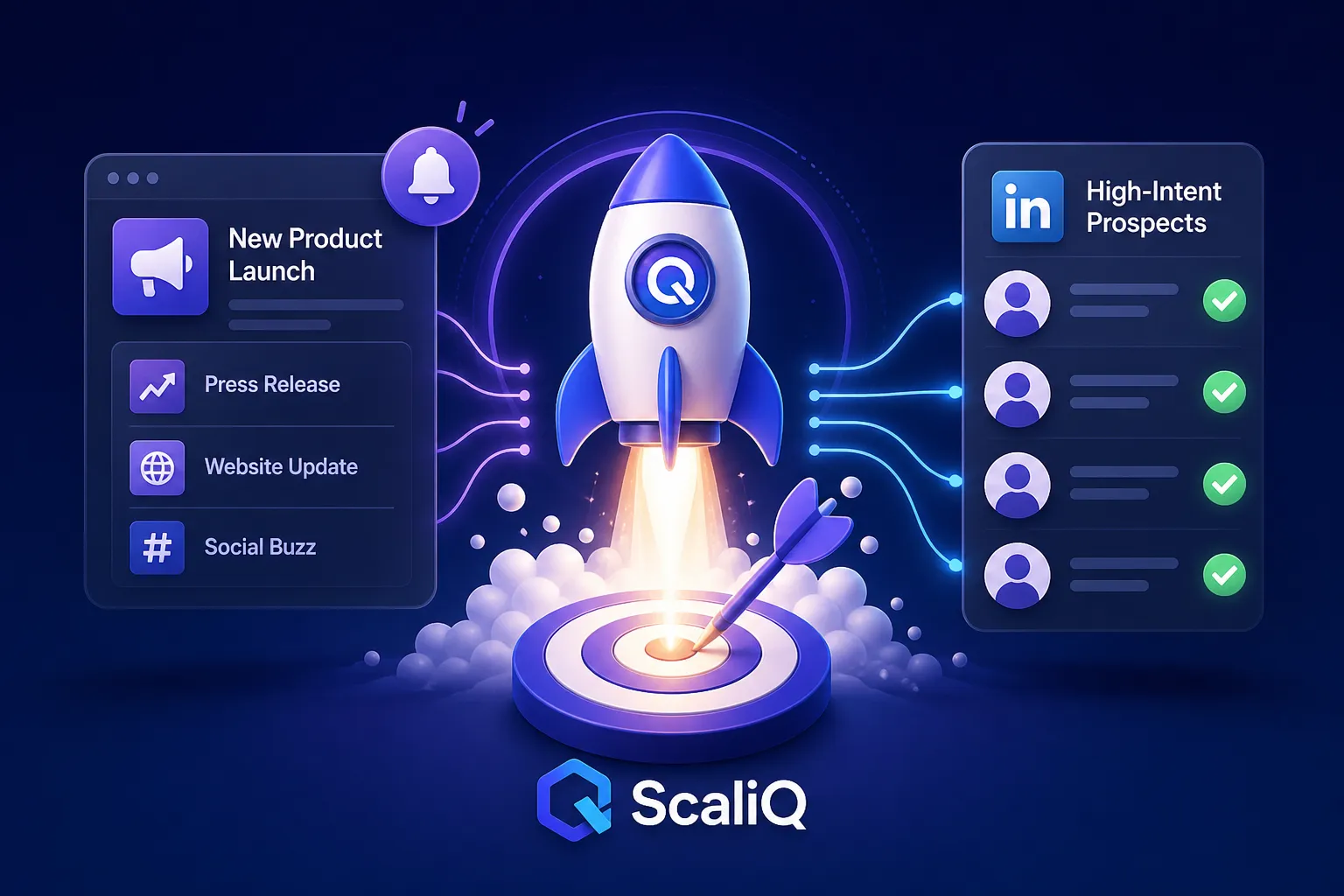
However, when properly interpreted, a product launch is one of the most powerful LinkedIn sales triggers available. A strategic launch is rarely just a public announcement; it is an observable event that indicates active changes in a company’s priorities, resource allocation, and go-to-market strategy. A new product creates downstream requirements across marketing, hiring, operations, technology, and customer acquisition.
It is crucial to understand that product launch signals are indicators for research—not automatic proof of purchase intent. Responsible interpretation means distinguishing observable evidence from assumptions about a company’s needs. To succeed, sellers must detect the launch, verify its strategic importance, map likely business needs, identify the right stakeholders, personalize their outreach, and measure the outcomes.
To help revenue teams execute this workflow while the business change is still timely, ScaliQ serves as a signal-driven resource for identifying and interpreting these critical moments, ensuring your outreach is backed by evidence rather than guesswork.
Why a New Product Launch Creates a Prospecting Opportunity
Relying on static firmographic data—like company size or industry—only tells you what a company is. It does not tell you what a company is doing right now. In contrast, go-to-market signals like a new product launch reveal immediate, active shifts in business priorities.
When a company brings a new product to market, it creates a ripple effect of downstream requirements. Marketing and demand generation teams need new positioning and campaigns. Sales enablement and customer acquisition leaders must train reps to sell the new offering. Hiring and team expansion accelerate to support the product's lifecycle. Operations and fulfillment teams must adjust internal processes to handle new delivery expectations. Simultaneously, technology, integrations, and infrastructure must scale, while partnerships and customer support teams prepare for new user inquiries.
These resulting needs make new product outreach highly effective, provided the signal is meaningful. However, not all launches are equal. A routine feature update, minor release, or standard promotional announcement does not carry the same weight as a new strategic product line. While product-led growth and frequent release cycles create more observable B2B prospecting signals, they also increase the noise sellers must filter through.
Understanding this complexity is vital. As noted in the Wharton School’s organizational buying behavior model, buying decisions are shaped by a complex mix of individual, organizational, interpersonal, and environmental factors. One product announcement alone does not guarantee a budget has been unlocked; it simply provides a highly relevant context for a conversation.
What Counts as a Meaningful Product-Launch Signal?
A stronger signal usually includes multiple forms of corroborating evidence. You are looking for more than just a single social media post. Meaningful product launch announcements are typically supported by:
• A detailed LinkedIn announcement from an executive or the official company page
• A dedicated product or launch landing page
• Public beta access, active changelog updates, or extensive product documentation
• New job postings directly connected to the product or market expansion
• Customer case studies, new partnership announcements, or pricing model changes
• Increased public activity and content sharing from product, marketing, sales, or technology leaders
To use intent data for prospecting effectively, you must distinguish between different types of evidence. Announcement evidence simply means the company stated a launch occurred. Strategic evidence shows the company is actively investing resources, such as hiring new specialists. Commercial evidence proves the company is actively seeking adoption, onboarding customers, or expanding its market share.
Crucially, sellers must avoid presenting a launch as confirmed buying intent. According to INFORMS academic research on market signals, there is a distinct difference between observable market cues and reliable conclusions about internal corporate behavior. Treat the launch as a reason to investigate, not a guarantee of a sale.
How to Find New Product Launches on LinkedIn and Beyond
Relying on a single alert system is rarely enough to build a reliable pipeline. Instead, revenue teams need a repeatable discovery workflow. LinkedIn is the premier starting point for finding a LinkedIn product launch announcement. Sellers should monitor company pages for official announcements, track founder and executive posts for strategic context, and follow product leaders for technical updates. Additionally, employee resharing and customer reactions in the comments often provide valuable insights into market reception.
However, account research on LinkedIn should always be cross-referenced with complementary sources. To confirm whether a launch is current, strategic, and relevant, sellers should check:
• Company product pages and online newsrooms
• Product changelogs and developer documentation
• Public beta or early-access sign-up pages
• Current job postings on the company website or job boards
• Funding, partnership, or geographic expansion press releases
• Customer success stories and industry event presentations
Combining these sources helps you verify the legitimacy of the launch. For more insights on building repeatable research and signal-monitoring workflows, explore our educational resources at Blog.
A Five-Step Product-Launch Detection Workflow
To systematize how to find new product launches on LinkedIn, follow this five-step detection workflow:
1. Search LinkedIn: Actively monitor company pages, executive profiles, and specific launch-related terms (e.g., "introducing," "new feature," "beta").
2. Record the Evidence: Document the original announcement date, the exact product name, the launch stage, and the source URL.
3. Cross-Reference: Check the company’s website, press page, and product documentation for corroborating evidence.
4. Review Related Activity: Look for corresponding hiring surges, marketing campaigns, technology shifts, and leadership commentary.
5. Store the Signal: Compile this data into an account research brief to guide your prioritization and outreach strategy.
Remember to record the actual evidence, not just your interpretations. While automation can help surface these signals, human review is essential to confirm relevance before initiating outreach. For instance, utilizing LinkedIn Sales Navigator provides an excellent discovery layer for account and lead monitoring, but it should function as part of a broader, human-verified launch-qualification system.
How to Qualify and Prioritize Product-Launch Signals
Separating interesting announcements from actionable prospecting opportunities requires a structured approach. Without qualification, sellers risk wasting time on trigger-based selling that yields no results.
To evaluate sales intelligence for product launches, use a simple launch-signal scoring model based on five criteria:
• Recency: How recently did the launch or related activity occur? (Signals decay quickly).
• Strategic importance: Is this a net-new product, an entry into a new market, a major capability, or just a minor feature update?
• Market relevance: Does the launch align with your target customer profile or the solution you provide?
• Evidence depth: Is the product launch prospecting signal supported by multiple public sources (e.g., jobs, press, docs)?
• Resource commitment: Are there visible signs of hiring, new partnerships, marketing spend, or technology infrastructure changes?
Based on these criteria, classify your accounts:
• High priority: Recent, strategically important, well-supported by evidence, and highly relevant to your solution.
• Medium priority: Relevant to your solution, but with limited supporting public evidence.
• Low priority: Minor updates, stale news, unclear strategic value, or poorly matched to your target account profile.
This score dictates your research depth and outreach timing. It does not imply a guaranteed buying opportunity. As highlighted by University of St. Thomas research on sales proposal signals, buyers interpret signals and outreach differently based on their internal context; therefore, messaging must remain cautious and strictly evidence-based.
Product-Launch Qualification Checklist
Before reaching out based on company product launch signals, run through this practical B2B prospecting signals checklist:
• Is the launch less than three months old or still being actively promoted?
• Is it a new product, market expansion, or strategic capability rather than a routine patch or update?
• Is there a clear target audience or commercial use case defined?
• Are there related job postings or visible team expansions?
• Are executives, product leaders, or customers actively discussing it?
• Does the account fit your ideal customer profile (ICP)?
• Can you identify a specific, plausible business consequence to discuss?
Warning: Sales trigger events like a launch do not prove the company is actively evaluating a new vendor. Use the launch to start a relevant conversation, not to assume a sale.
Map the Launch to Likely Business Needs and Stakeholders
Converting a product announcement into a multi-contact prospecting plan requires mapping observable evidence to plausible business consequences. Using a trigger-to-need matrix allows sellers to hypothesize how a launch impacts different departments.
When formulating your stakeholder mapping, always use language such as "may indicate," "could create," or "worth exploring." Never assert an unverified problem. Because a major launch impacts the entire organization, it justifies a multi-threaded account map involving product, marketing, sales, operations, technology, and hiring stakeholders.
Hiring and Team Expansion Signals
New product activity frequently creates go-to-market hiring signals. A launch may create immediate demand for product marketers, sales development representatives, account executives, customer success managers, solutions architects, or regional specialists.
When you spot related job postings, it confirms the launch is receiving tangible organizational investment. This is excellent new product lead generation data. However, you should only contact recruiting, people operations, or department leaders when the specific role they are hiring for aligns with your outreach hypothesis and the solution you sell.
Marketing and Customer Acquisition Signals
A new product inevitably triggers marketing and customer acquisition signals. Likely consequences include the need for new positioning and messaging, fresh demand-generation campaigns, product education content, competitive differentiation strategies, and launch webinars.
Relevant contacts include heads of marketing, product marketing leaders, and growth executives. When conducting new product outreach to these product marketing signals, tie your angle directly to the launch’s target audience or market expansion goals, rather than pitching a generic suite of marketing services.
Operations and Technology Signals
A strategic launch often strains existing infrastructure, creating product launch signals related to operations and technology. This may involve needs surrounding infrastructure scalability, data integrations, customer onboarding workflows, internal process adjustments, and security compliance.
Relevant stakeholders span revenue operations, engineering, IT, data management, and customer success. Trust and accuracy reminder: You must only infer technology needs or operations signals when they are supported by the product’s public description, technical documentation, job postings, or verified company activity. Do not claim a company has a technical problem unless public evidence supports that hypothesis.
Build Launch-Specific LinkedIn Outreach That Creates Relevance
Research is only as valuable as the message it produces. The goal of new product outreach is to be specific, timely, and non-opportunistic.
A highly effective, launch-triggered personalized LinkedIn outreach message follows a four-step structure:
1. Reference the evidence: Mention the specific, observable launch or product update.
2. Provide business context: Mention the likely business context or downstream effect without overstating it.
3. Connect to an outcome: Link that context to a relevant problem or outcome your solution addresses.
4. Ask a low-friction question: End with a soft, conversational call to action.
Avoid generic congratulations, excessive flattery, and messages that immediately push for a product demo. Your trigger-based outreach examples must adapt based on the launch stage and the recipient's specific role.
Outreach by Launch Stage
Adapt your messaging to where the company is in the launch lifecycle:
• Pre-launch: Ask about their preparation, positioning strategy, or the operational challenges they are solving ahead of the release.
• Beta: Reference their early access or testing phase, and ask how the team is managing user feedback and adoption support.
• Launch day: Acknowledge the LinkedIn product launch announcement and connect it to a specific go-to-market or operational consequence.
• Post-launch growth: Reference follow-up activities, such as hiring surges, new customer stories, or market expansion efforts.
Your outreach must be grounded in what the source actually confirms. A strong framework for LinkedIn sales triggers looks like this:
“I saw [specific launch evidence]. Teams introducing [relevant product type] often revisit [relevant business area]. Is that a priority for your team as adoption develops?”
Outreach by Stakeholder
The same launch requires entirely different messages depending on the stakeholder.
• Product leaders: Focus on user adoption, feedback loops, roadmap execution, and product operations.
• Marketing leaders: Focus on market positioning, demand generation, and buyer education.
• Sales leaders: Focus on rep enablement, pipeline creation, and navigating new buyer conversations.
• Operations leaders: Focus on process capacity, onboarding efficiency, and execution.
• Technology leaders: Focus on infrastructure scaling, integrations, data hygiene, and reliability.
• Hiring leaders: Focus on talent requirements and team expansion timelines.
Start with one strong, evidence-backed angle rather than spamming every employee at once. When you are ready to scale and execute repeatable outreach campaigns based on this account research on LinkedIn, platforms like Repliq.Co can assist with outreach execution, while your signal discovery and research context remain grounded in your core workflow.
Automate Product-Launch Monitoring Without Losing Human Judgment
Scaling signal-driven prospecting requires a balance between automation and human oversight. Teams can automate signal tracking to increase efficiency while preserving accuracy and relevance.
Tasks that should be systematized include:
• Monitoring company pages and executive social activity
• Collecting product announcements and related URLs
• Enriching accounts with role, industry, hiring, and company context
• Assigning launch stages and initial priority scores
• Routing qualified sales trigger events to the appropriate sales or marketing rep
• Creating a concise research brief for human review
However, crucial tasks must remain human-reviewed:
• Determining whether the launch is actually strategically meaningful
• Confirming whether the account truly fits the ideal customer profile
• Ensuring the inferred business need is defensible based on evidence
• Selecting the most appropriate stakeholder and tailoring the message
• Verifying that the outreach respects privacy, platform rules, and context
This balanced approach contrasts sharply with tool-centric workflows that merely scrape large volumes of intent-based prospecting on LinkedIn without explaining what action should follow. Many platforms provide alerts or intent data, but a significant competitive gap exists: few explain launch-specific verification, prioritization, timing, and messaging.
ScaliQ is designed to fill this gap, serving as the central signal-driven workflow for monitoring, enriching, and operationalizing product-launch research. It supports timely research and interpretation rather than replacing seller judgment or guaranteeing intent. (Note: All signal monitoring must rely on transparent sources, accurate records, privacy-aware research, and strict compliance with applicable platform and data-use requirements).
Measure Whether Product-Launch Prospecting Is Working
To evaluate signal quality and outreach performance, revenue teams need a practical measurement framework. Tracking results by launch stage, signal source, industry, persona, and message angle will reveal what drives revenue.
Key B2B prospecting signals metrics include:
• Time from launch detection to first outreach
• Signal-to-research completion rate
• Reply quality (positive/curious responses, not just total replies)
• Qualified-conversation rate
• Meeting conversion rate
• Conversion rates segmented by stakeholder type
• Opportunity or influenced-pipeline creation
• Performance of product launch prospecting compared to other sales trigger measurement categories (e.g., funding, hiring, leadership changes)
A high response rate is meaningless if the conversations are poorly qualified. Encourage your team to record exactly which evidence supported each outreach hypothesis and track whether the prospect ultimately confirmed or rejected that hypothesis during the discovery call.
Conclusion: Turn Product Activity Into Timely, Evidence-Based Outreach
Treating a product launch as a LinkedIn sales trigger transforms generic prospecting into highly relevant, timely outreach. The core process is straightforward: Find the launch, verify it across relevant public sources, score its recency and importance, map the possible consequences to the right stakeholders, write a role-specific message, and measure your qualified outcomes.
Product launches create a valid reason to research an account and start a conversation—they do not grant permission to make unsupported assumptions. When timing and context matter, signal-driven prospecting is infinitely more useful than dialing through static lists or sending generic congratulations messages.
To operationalize this strategy, explore ScaliQ for signal-driven research, deep account context, and timely new product outreach workflows. ScaliQ helps teams identify and act on public business-change signals while keeping human review, relevance, and responsible data use at the center of the sales process.