

Introduction
LinkedIn inboxes are saturated. Advanced B2B buyers can spot recycled outreach templates, automated sequences, and forced personalization within milliseconds. The core problem is that most cold direct messages (DMs) fail because they fall into three traps: they are too generic to be noticed, too pitch-heavy to be welcomed, or too vague to be trusted.
To cut through the noise, modern revenue teams need more than a clever opening line. This guide will show you how to use open loop messaging as a full conversation design system, not just a fleeting curiosity hook. When executed correctly, open loops are ethical, signal-based, and strategically sequenced across multiple messages to drive engagement.
This framework is built for founders, SDRs, and outbound teams who already understand basic personalization but require a more advanced, psychology-driven approach to generate pipeline. Based on ScaliQ’s applied curiosity loops analyzed across thousands of real-world DM conversations, this guide provides the exact architecture for psychology-driven outbound.
Below, we will define open loop messaging linkedin strategies, break down the core framework, provide annotated examples, detail follow-up sequences, and clarify how to measure true success. If you want to master curiosity-based outreach and elevate your LinkedIn outreach messaging, this is your definitive blueprint.
What Open Loop Messaging Means on LinkedIn
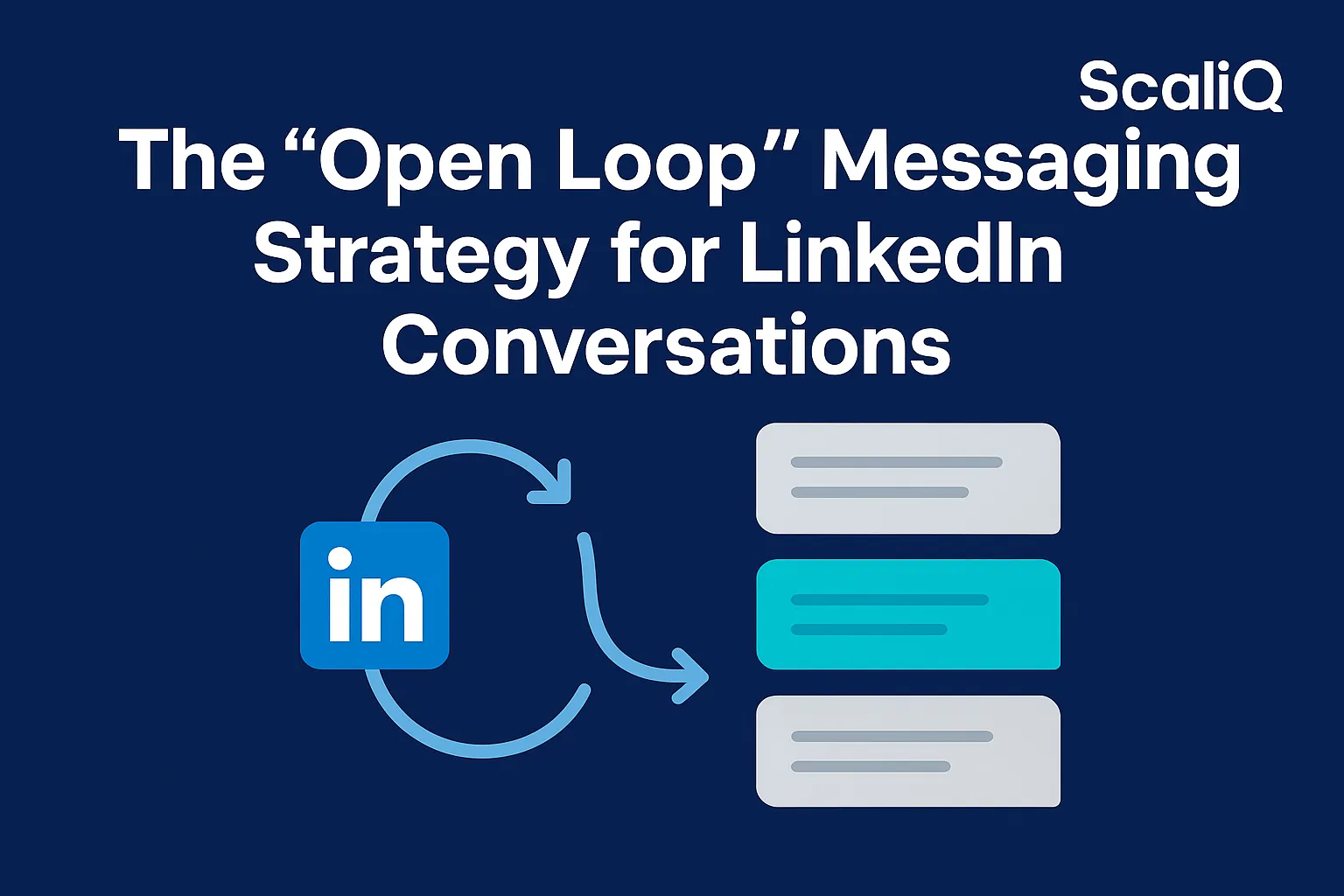
Open loop messaging linkedin strategies rely on a core psychological trigger: the information gap. An open loop introduces incomplete but highly relevant information tied to a prospect's existing priorities, creating a natural urge to seek closure. However, on LinkedIn, this loop only works when relevance precedes curiosity.
Sophisticated buyers immediately reject vague teaser copy ("I have a secret strategy for your business"). They respond to credible, specific intrigue ("I noticed your recent shift upmarket and saw a gap in how you're positioning against X"). The goal of open loop copywriting is never to trick a prospect into a reply at any cost. It is to earn a meaningful next step in a business conversation.
What an “open loop” actually is in a DM context
In a practical DM context, an open loop is a message that provides enough context to prove you understand the buyer's world, but intentionally withholds the final conclusion, insight, or solution. It shifts the dynamic from "let me pitch you" to "let's discuss this observation."
The best open loops hint at a specific insight rather than a hidden product offer. Unlike email, where longer copy is sometimes tolerated, LinkedIn is a conversational medium with a lower tolerance for gimmicks and a higher demand for immediate trust. The open loop must feel like a peer-to-peer observation, prompting a natural back-and-forth dialogue.
Why open loops work when generic personalization stops working
First-line personalization has become commoditized. Mentioning a prospect's alma mater or recent post is no longer enough to combat inbox fatigue. Open loops cut through this sameness because they are built from real, publicly accessible account signals rather than trivial data points.
Curiosity without context feels manipulative; curiosity anchored in deep relevance feels earned. The psychology behind this is rooted in the Zeigarnik effect—the human tendency to remember and focus on uncompleted tasks or unresolved information. When you present a relevant, unfinished thought, the buyer's brain naturally wants to close the loop. This approach is validated by research on personalized outreach response rates, which highlights how contextual relevance significantly outperforms generic messaging in cold outreach on LinkedIn.
What open loop messaging is not
Open loop messaging is not clickbait. It is not a bait-and-switch tactic, it does not rely on fake familiarity ("Great catching up last week!"), and it strictly avoids low-value, friction-heavy openers like "Can I ask you a question?"
Ethical curiosity-based outreach does not hide the reason for the interaction indefinitely. The loop should create a clear, logical path to clarity, rather than forcing the prospect to chase you for basic context. Trust is fragile, especially with senior B2B buyers. If your sales psychology messaging feels deceptive, the relationship is dead before it begins.
The Signal + Hypothesis + Invitation Framework
To move away from rigid, template-heavy competitor content, advanced teams rely on a flexible operating system: the Signal + Hypothesis + Invitation Framework. This three-part structure is the engine behind effective open loop messaging linkedin campaigns. Each component is designed to neutralize a specific failure mode: irrelevance, vagueness, and friction.
Step 1 — Signal: start from something observable and relevant
A strong signal proves that your outreach is earned, not manufactured. Compliant, observable signals include recent hiring activity, go-to-market (GTM) shifts, messaging updates, product launches, ICP expansion, content themes, or team restructuring.
By starting with a signal, you immediately establish relevance. However, the signal must be specific enough to prove you did your research, but not so over-explained that the message becomes dense. To preserve clarity and brevity, use exactly one clear signal per message.
Step 2 — Hypothesis: propose a plausible issue, opportunity, or pattern
Once you establish the signal, you must bridge it to buyer relevance using a hypothesis. A hypothesis proposes a plausible issue, opportunity, or pattern related to the signal.
The key to sales psychology messaging is sounding informed, but never arrogant or presumptuous. Use phrasing like, "Usually, when teams shift toward X, they run into Y," or "There may be an uncaptured opportunity around Z." Unlike traditional outreach that forces a rigid diagnosis onto the buyer, a hypothesis suggests a possibility, naturally opening a curiosity loop based on buyer intent.
Step 3 — Invitation: ask for the smallest next step
The final step is the invitation. This keeps the conversation low-friction and non-pushy. Instead of demanding a 30-minute calendar booking—which introduces massive friction in a first-touch LinkedIn DM—ask for the smallest possible next step.
Ask whether your hypothesis is relevant, if it's worth sharing a quick insight, or if your observation aligns with what they are seeing internally. The best reply-driven messaging makes it effortless for the prospect to respond with a single sentence.
Message formula and anatomy
Here is the functional formula for your open loop copywriting: [Signal] + [Hypothesis] + [Invitation]
Annotated Example:
• (Signal): "Saw you just brought on two new enterprise AEs to move upmarket."
• (Hypothesis): "Usually when teams make that shift, their current case studies don't resonate with enterprise procurement, slowing down deal velocity."
• (Invitation): "Are you seeing that friction yet, or is your collateral already updated?"
This message leaves one key detail unresolved (how to fix the friction) while making the relevance undeniable. It is short (under three lines) and highly specific. Following NIST principles for effective communication ensures that your message remains clear, relevant, and respectful of the buyer's time. For more on designing these architectures, explore ScaliQ's blog on outbound execution principles.
Open Loop vs Direct-Value vs Pain-Point-First Outreach
Mature revenue teams do not rely on a single tactic; they choose their messaging style based on buyer awareness, trust levels, and signal strength. Understanding when to use open loops versus other frameworks is what separates strategic LinkedIn outreach strategy from amateur spam.
When open loops outperform direct-value messaging
Open loops excel when buyers are highly sophisticated, naturally skeptical, or oversaturated with generic value claims. Curiosity-based outreach earns attention when you possess a genuine, data-backed insight but lack the relationship equity required for a hard pitch. It is also highly effective when the prospect may not yet realize they have a problem, making an open loop the perfect pattern interrupt outreach to shift their perspective.
When direct-value messaging is the better choice
Direct-value messaging outperforms open loops when intent is already warm, problem awareness is high, or timing is obvious. If a prospect posts, "We are actively looking for a new CRM," forcing a curiosity loop is unnecessary and frustrating. In these scenarios, straightforward, direct-value LinkedIn outreach messaging is more respectful and effective. Do not manufacture mystery when clarity will close the deal.
Where pain-point-first outreach fits
Pain-point outreach leads with a definitive statement about a buyer's problem. However, it often fails because it assumes too much or relies on tired industry clichés ("Are you tired of losing data?"). Open loops soften this aggressive approach by turning a harsh assertion into a question-worthy insight. Instead of telling the buyer their process is broken, a hypothesis-driven open loop asks if they are experiencing a pattern you've observed elsewhere.
Strategic takeaway for advanced outbound teams
The decision rule for advanced teams is simple: use open loop messaging linkedin strategies when relevance is emerging, direct-value when urgency is clear, and pain-led framing only when the diagnosis is obvious and well-supported by data. Unlike generic template libraries that obsess over the first line of an email, true outbound success requires dynamic conversation architecture. This is where ScaliQ’s focus on ethical personalization and verification provides a massive advantage over static swipe files, generating highly qualified replies.
Examples by Role, Awareness, and Intent
A framework is only as good as its execution. The following examples adapt the Signal + Hypothesis + Invitation model across different roles, awareness levels, and intent strengths. Do not copy these blindly; adapt the patterns to your specific LinkedIn cold message examples.
Founder-to-founder open loop examples
Founders can leverage a stronger point of view, sharper market observations, and peer-level language. Founder outreach should feel deeply strategic, avoiding the tone of delegated SDR copy.
• Example 1 (Company Launch/Hiring Signal): "Noticed the recent Series A and the push into the EMEA market. Usually, founders scaling that fast run into localized compliance bottlenecks before the end of Q2. Have you mapped out that data residency piece yet, or is it still on the roadmap?" (Why it works: Peer-level tone, identifies a highly specific, time-bound risk, low-friction ask).
• Example 2 (ICP/Messaging Shift): "Saw the website update—looks like you're pivoting away from SMBs entirely. Most founders I talk to find their legacy content actually hurts enterprise conversions during this transition. Curious if you're seeing that drag on your current pipeline?" (Why it works: Proves observation of a strategic shift, proposes a logical consequence).
SDR or AE examples for outbound prospecting
Sales reps must balance personalization with scalability, using account signals without sounding overly scripted.
• Example (Sales Leader Persona): "Looks like your team just expanded the outbound SDR org by 30%. Typically, when headcounts grow that fast, ramp time extends because the legacy playbook breaks at scale. Are your new reps hitting quota in month 3, or is ramp taking longer than expected?" (Why it works: Uses a clear hiring signal to propose a specific, role-relevant pain hypothesis).
Examples by buyer awareness level
The width of your curiosity loop must adjust based on the buyer's awareness.
• Unaware: (Wider loop, focusing on an industry shift). "Seeing a lot of logistics VP's moving away from legacy routing this quarter due to the new fuel regulations. Is this impacting your Q3 margins yet?"
• Problem-Aware: (Tighter loop, focusing on the friction). "Noticed you're aggressively hiring for customer success. Usually, that’s a sign churn is creeping up due to onboarding bottlenecks. Is that the primary focus right now?"
• Solution-Aware: (Tightest loop, focusing on execution). "Saw you're implementing Salesforce CPQ. Teams usually struggle with the pricing rule migrations in month two. Have you locked down a framework for that yet?"
Examples by intent signal strength
• Weak Signal: "Noticed your team is publishing a lot around AI compliance. I have a brief observation on how competitors are gating that content. Open to a quick note?" (Do not overstate certainty).
• High-Intent Signal: "Saw you downloaded our benchmark report on API latency. Usually, engineering leads only pull that data when they are actively experiencing timeout errors. Are you currently troubleshooting a specific endpoint?" (Direct hypothesis justified by strong signal).
Teardown of weak vs strong openers
Weak Opener (Vague Teaser): "Hey John, I have a secret strategy that will 10x your leads. Can we chat?" (Failure mode: Zero relevance, clickbait, massive friction).
Weak Opener (Generic Personalization): "Hey John, saw you went to NYU. Go Bobcats! Anyway, we sell IT services..." (Failure mode: Bait-and-switch, irrelevant trivia).
Strong Opener (Signal-Based): "Hey John, saw your post about migrating to AWS. Usually, teams miss the hidden egress fees during the first phase. Did you factor those into the initial cloud budget?" (Success mode: High relevance, credible hypothesis, easy to answer). For more inspiration on message variants and outreach experiments, check out Repliq's blog.
When to Deepen and Close the Loop in Follow-Ups
Open loops are not meant to stay unresolved indefinitely. To function as a true conversation design system, the loop must unfold logically across a sequence. Knowing when to open, deepen, and close the loop is the secret to mastering reply-driven messaging.
The first follow-up after no reply
If the prospect does not reply to the opener, your first follow-up must add context, not simply repeat the teaser. Deepen the relevance by introducing a second signal, sharpening the hypothesis, or stating a more explicit reason for your outreach. Use short, respectful nudges rather than aggressive sequence spam.
Example: "To add some context to my note yesterday—I asked because we recently saw [Competitor] struggle with that exact AWS migration issue. Just wanted to see if it was on your radar."
When a prospect replies with mild curiosity
When a prospect replies with "What do you mean?" or "Can you elaborate?", you have successfully earned the next turn. Now, you must close part of the loop with enough substance to maintain trust. This is the moment to introduce a concise example or pattern recognition. Do not immediately pitch; instead, validate their curiosity with a valuable insight.
When to introduce proof
Proof should only be introduced once interest exists. Dumping case studies in the first message creates bloat. Instead, use proof fragments—a short result, a pattern seen across similar teams, or one concrete data point. This increases trust and ensures the loop doesn't feel like empty intrigue. The strategic timing of this clarity is backed by a study on message content and engagement, which proves that introducing clear, relevant proof at the right conversational stage drastically improves engagement quality.
How and when to fully close the loop
The loop must close once the prospect shows enough intent to evaluate your relevance. Closing the loop means revealing the missed opportunity, the specific insight, or the recommendation you hinted at. Dragging the mystery out for too long erodes trust. If they ask how you solve the problem, give them a direct, transparent answer.
Suggested cadence and sequence logic
Optimize for conversation progression, not touch count. A practical sequence logic looks like this:
1. First-touch: Open the loop (Signal + Hypothesis + Invitation).
2. Follow-up 1: Deepen the loop (Add context/second signal).
3. Reply received: Close part of the loop (Provide insight/proof fragment).
4. Follow-up 2 (if interested): Fully close the loop (Reveal solution/recommendation).
5. Final touch: Optional, low-friction CTA (Offer a resource or gracefully exit).
How to Avoid Manipulative Hooks and Measure Reply Quality
Ethical boundaries are non-negotiable for long-term brand perception and reply quality. The best open loops reduce friction and increase relevance without resorting to deception. If your replies are frequent but angry or confused, your messaging is miscalibrated.
What makes an open loop feel manipulative
An open loop crosses into manipulation when it relies on forced intrigue, hidden intent, misleading claims, or exaggerated familiarity. Withholding basic context just to trick someone into replying is a dark pattern. For a deeper understanding of these boundaries, refer to the OECD guidance on dark patterns and the FTC report on manipulative patterns, which clearly distinguish ethical persuasion from coercive, deceptive messaging practices.
Self-Audit Checklist:
• Does the recipient understand why I am contacting them?
• Is my hypothesis based on a real observation, or am I making it up?
• Am I withholding my identity or core intent?
Trust-preserving principles for ethical curiosity
The recipient should always understand the context of your outreach, even if the final insight is saved for the next message. Specificity, sincerity, and low-pressure language preserve credibility. Trust-preserving personalization aligns perfectly with the philosophy of meaningful dialogue over spammy automation, ensuring that curiosity-based outreach builds relationships rather than burning bridges.
How to measure quality replies, not vanity metrics
Raw response rates are vanity metrics if the replies are negative ("Unsubscribe"), confused ("Who are you?"), or unqualified. A quality reply involves relevant interest, a contextual correction ("Actually, we use X, not Y"), qualification progress, or conversation advancement. Track metrics that matter: positive reply rate, meeting conversion from replies, and pipeline stage progression.
Common mistakes teams make
Teams fail when they over-automate. Common mistakes include opening loops without real signals, asking for 30-minute meetings too early, failing to close the loop when asked, over-personalizing trivial details (like a prospect's pet), and blasting the exact same template across entirely different market segments. Over-automation strips authenticity, making your outreach instantly recognizable as a bot. AI should assist with signal interpretation, but human logic must govern the conversation.
Tools, Workflow, and Team Execution Tips
To operationalize this framework across your revenue organization, you must systematize how you gather signals, build hypotheses, and maintain quality assurance (QA).
Building a repeatable signal library
Instead of writing hundreds of rigid templates, build a reusable signal library. Categorize compliant, publicly accessible signals by:
• Company Events: Funding, M&A, new office openings.
• Buyer Role Changes: New executive hires, promotions.
• Content Behavior: Engaging with specific industry topics, publishing reports.
• GTM Changes: Pricing updates, new product lines, website overhauls.
Documenting which signal categories yield the highest-quality replies allows your team to scale personalized outbound messaging efficiently.
Creating hypothesis banks by ICP and role
Map common hypotheses to specific personas and market contexts. A hypothesis bank ensures that your SDRs maintain high relevance without having to invent new sales psychology messaging from scratch every morning. For instance, tailor one set of hypotheses for VP of Sales (focusing on quota and ramp time) and another for VP of Ops (focusing on tool consolidation and efficiency).
QA guidelines for advanced outreach teams
Before launching a campaign, run your messaging through a strict QA review checklist:
1. Is the signal clear and factual?
2. Is the hypothesis credible and non-assumptive?
3. Is the invitation low-friction?
4. Is the tone ethical and professional?
5. Is the next-step logic clear?
Judge the message quality manually before relying on performance data. If it sounds "too vague" or "too salesy," rewrite it. For teams looking to scale this ethical, signal-based conversation design seamlessly, ScaliQ provides the ideal workflow infrastructure.
Future Trends in LinkedIn Conversation Design
As AI-assisted personalization becomes mainstream, the bar for message quality is rising exponentially. The future of outbound is not about generating more automated volume; it is about superior signal interpretation and intelligent conversation orchestration.
Why generic curiosity hooks will keep losing effectiveness
As more revenue teams adopt lazy, teaser-based copy, the novelty of the "mystery hook" will completely disappear. Buyers are developing an acute sensitivity to manipulation. In the near future, generic curiosity will be ignored, and buyers will exclusively reward credible, well-researched specificity. Pattern interrupt outreach will only work if the pattern being interrupted is superficiality.
The move from sequence-first to conversation-first outbound
We are witnessing a shift from blasting linear sequence steps to designing narrative progression across multiple channels. LinkedIn DMs should not exist in a vacuum; they must fit into a broader outreach arc that includes email, voice notes, and social engagement. The focus is shifting to reply-driven messaging, where the sequence adapts dynamically based on the prospect's conversational input.
What advanced teams should test next
Advanced teams should stop A/B testing subject lines and start experimenting with conversation architecture. Test different loop widths based on buyer awareness levels. Experiment with the exact timing of when you introduce proof fragments. Test different signal categories against each other, and refine your invitation phrasing. Most importantly, measure the quality of conversation progression rather than just the initial headline response lift.
Conclusion
Open loop messaging on LinkedIn is a highly effective strategy, but only when executed with relevance, specificity, low friction, and ethical sequencing. It is never about vague intrigue; it is about leveraging the Signal + Hypothesis + Invitation framework to initiate meaningful, peer-to-peer business discussions.
To succeed, you must operationalize the flow: identify a compliant signal, frame a credible hypothesis, invite a low-friction reply, deepen the loop with context, and close it with targeted proof at the exact right moment. Remember that the ultimate metric of success is not any reply, but qualified replies that actively move the revenue conversation forward.
Stop deploying rigid templates and start treating your LinkedIn outreach as dynamic conversation design. By mastering this psychology-driven approach, you will cut through the noise, build immediate trust, and generate high-quality pipeline. To dive deeper into advanced outbound strategies and messaging architectures, explore ScaliQ's blog.