

Introduction
B2B sales teams are sending more LinkedIn messages than ever, yet they continually face the same frustrating bottleneck: low reply rates, an endless cycle of follow-ups, and agonizingly slow movement from a connection request to a booked meeting. If your outbound pipeline feels sluggish despite high activity, the problem likely isn't your product—it's the friction in your conversation path.
This guide introduces the "Short Path to Yes," a practical, LinkedIn-specific framework designed to minimize friction from the moment you send a connection request to the moment you book a meeting. The goal is simple: reduce conversation steps without sounding aggressive, overly salesy, or robotic.
Throughout this article, you will learn exactly what causes outreach bottlenecks, how to structure a compact and highly effective messaging sequence, where AI can accelerate your workflow responsibly, and when a long nurture sequence still makes sense. Designed for intermediate B2B sales reps, SDRs, and outbound leaders who already understand the basics of prospecting, this fast outreach framework will help you build a more efficient system.
At ScaliQ, our perspective is rooted in being a practical, workflow-first brand focused on reducing conversation steps and accelerating conversions. By adopting a LinkedIn short path to yes strategy, you can cut out the noise and get straight to value. To explore more about optimizing your outbound workflow ecosystem, visit the ScaliQ blog, learn more about our core philosophy at ScaliQ, or discover advanced personalization tools at Repliq.
Why LinkedIn Outreach Gets Stuck
The primary reason LinkedIn outreach feels slow, bloated, and low-converting is rarely a lack of effort. Instead, it comes down to a series of common blockers: generic messaging, weak timing, too many qualification steps, and unclear next actions. When reps string these errors together, they create an overcomplicated path from the first touch to a meaningful sales conversation.
This issue goes far beyond "bad copy." When a prospect is forced through a maze of generic check-ins and self-serving questions, it creates severe buyer fatigue. It also wastes rep time, keeping them bogged down in stalled conversations instead of speaking with ready buyers. To overcome low reply rates on LinkedIn outreach, teams must realize that customized, frictionless paths perform exponentially better than rigid, multi-step cadences. In fact, research on customized vs. standardized B2B outreach demonstrates that highly tailored outreach consistently outperforms standardized, generic LinkedIn messages. Furthermore, academic research on LinkedIn demand generation confirms that the platform remains a premier environment for B2B evaluation, provided the outreach respects the buyer's time.
The Hidden Cost of Too Many Outreach Steps
Every extra step in your messaging sequence increases drop-off, delays qualification, and significantly lowers conversion efficiency. Many sales teams obsess over optimizing individual messages but fail to optimize the total conversation path length. Having too many qualification steps before booking a call creates unnecessary hurdles. By shifting from "touch count" thinking to "time-to-meeting" thinking, reps can achieve conversation step reduction, ultimately leading to a shorter sales cycle.
Why Generic Personalization Fails
There is a massive difference between surface-level personalization and relevance-first personalization. Mentioning a prospect’s first name, their company, or the university they attended is no longer enough to earn attention. True sales outreach personalization relies on observable buyer signals—such as recent company growth, hiring trends, or specific role changes. If you want to know what makes LinkedIn messages convert faster, it is this shift from generic pleasantries to deep, signal-based relevance.
When Long Nurture Sequences Hurt More Than They Help
Long nurture sequences are not inherently wrong, but they are often entirely unnecessary for warm-fit prospects displaying clear buying signals. Bloated sequences create friction when a buyer only needs a simple, low-friction next step. While traditional sales engagement platforms often push heavy, multi-touch cadences as a cold outreach conversion strategy, these can alienate prospects who are ready to move quickly. Understanding the best alternatives to long nurture sequences on LinkedIn is critical for accelerating your pipeline.
The Short Path to Yes Framework
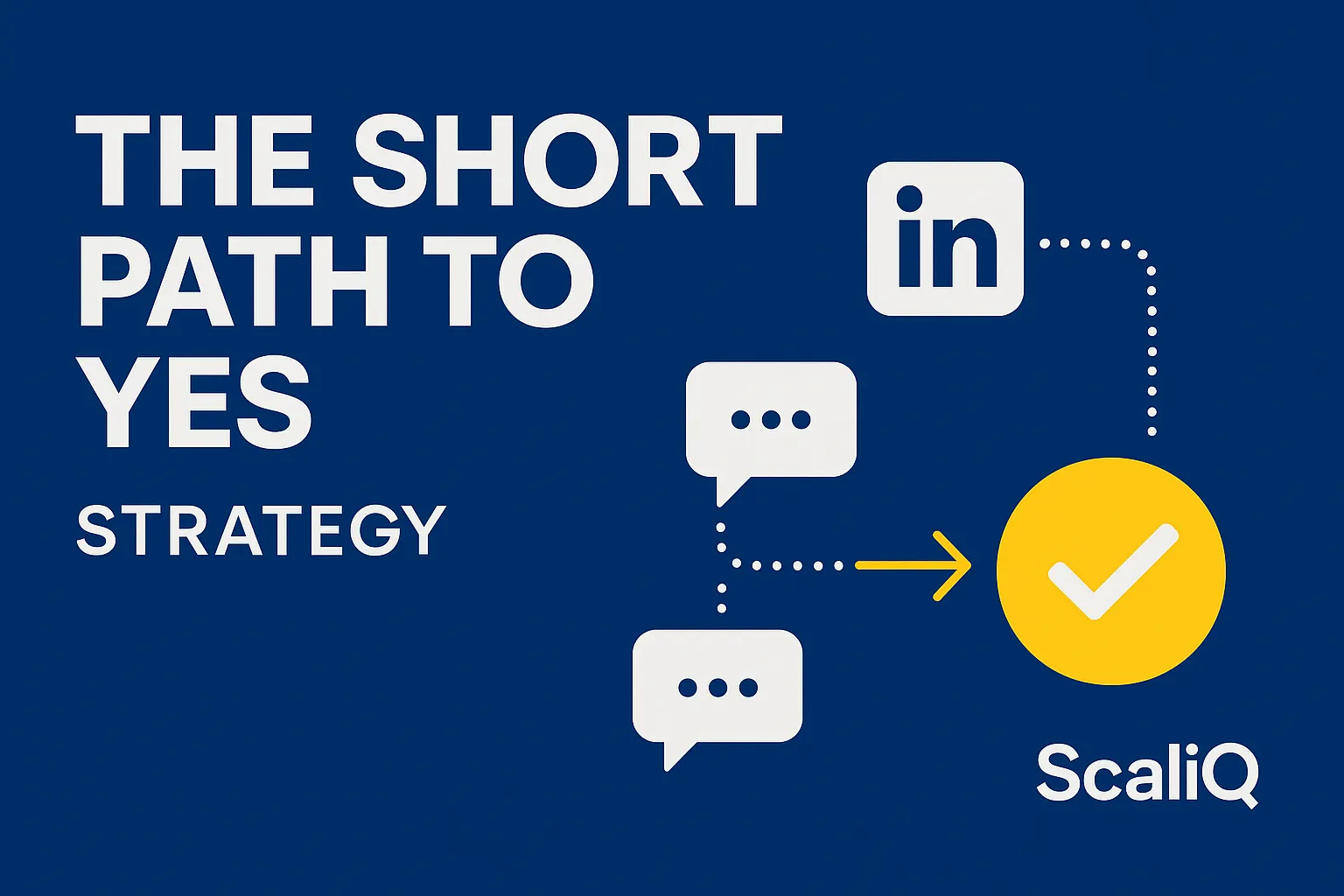
The Short Path to Yes is ScaliQ's proprietary framework, built to serve as a compact, intentional sequence that reduces total conversation steps while preserving and building trust. This fast outreach framework ensures that you are not rushing the buyer, but rather systematically removing unnecessary friction from their journey.
The core model follows a strict progression:
1. Targeted Prospect Selection
2. Relevance-First Opening
3. Contextual Value
4. Micro-Commitment
5. Fast Meeting Transition
Imagine a simple flow diagram: Signal Identified → Contextual Connect → Micro-Ask → Intent Confirmed → Meeting Booked. By utilizing this LinkedIn messaging framework, you minimize the gap between curiosity and a calendar invite. To learn more about how we simplify workflows and own this practical framework, visit ScaliQ.
Step 1 — Start With Tight Prospect Selection
Faster conversions begin long before you type your first message. A LinkedIn short path to yes strategy only works if your list quality is exceptionally high. This requires a robust B2B prospecting framework rooted in signal-based outreach. Rely on observable, publicly accessible triggers—such as role relevance, active hiring for specific departments, or recent job changes. High-quality LinkedIn lead generation is about selecting the right accounts at the right time.
Step 2 — Lead With Relevance, Not a Pitch
Your first touch must anchor on context, not product details. The best opening lowers a prospect's natural resistance by immediately proving that the message is meant specifically for them. Keep your language concise and offer exactly one clear reason for reaching out. Effective personalized prospecting within your LinkedIn outreach strategy means showing the buyer why them, and why now, which is exactly how to get replies on LinkedIn.
Step 3 — Use a Micro-Commitment Before the Meeting Ask
Pitching a 30-minute demo in your second message creates high friction. Instead, use micro-commitments. These are small, low-friction next steps that build momentum faster than a heavy call-to-action (CTA). Ask if a specific problem is relevant, if they have noticed a certain industry pattern, or if they would be open to a short idea. This approach to short path conversion LinkedIn ensures conversion acceleration, proving to be a highly effective LinkedIn outreach framework for faster replies.
Step 4 — Move Qualified Replies to a Call Quickly
Once a prospect responds positively to your micro-commitment, you must identify their buying signals and transition cleanly to a meeting. Avoid over-qualifying inside the LinkedIn chat interface when the next best step is a short, verbal conversation. Emphasize speed, clarity, and convenience in the handoff. Knowing how to shorten the path to conversion on LinkedIn is key to successful meeting booking and driving a shorter sales cycle.
Message Flow From Connect to Meeting
To turn this framework into an actionable LinkedIn outreach strategy, you must master the compact message flow. The goal is to move smoothly from a connection request to the first reply, pivot to qualification, and make the meeting ask. Every message should have exactly one job, utilizing concise, platform-native language rather than sounding like a stiff email cadence pasted into a social platform. This is what makes LinkedIn messages convert faster.
Connection Request Message
Keep the connection request short and entirely context-based. Avoid product-heavy language and premature asks. A successful LinkedIn connection request relies on shared context or an observable trigger.
Example Formula: "Hi [Name], noticed you're scaling the outbound team at [Company] right now. I follow a lot of leaders in the [Industry] space and would love to connect and follow your updates."
This aligns perfectly with LinkedIn research on relationship-based outreach, which emphasizes building rapport before making demands.
First Follow-Up After Acceptance
Once accepted, your value and relevance must become clearer, but the message should remain brief. Reference a specific pain point or pattern without sounding scripted, and end with a low-friction micro-commitment.
Example Formula: "Thanks for connecting, [Name]. I noticed [Company] is hiring SDRs. Usually, when teams scale that fast, keeping the messaging relevant without slowing reps down becomes a bottleneck. Are you running into that at all?"
This LinkedIn follow-up messaging is a core pillar of the fast outreach framework and true sales outreach personalization.
Qualification Pivot
When the prospect replies (e.g., "Yes, that's actually a big focus for us right now"), you need to gauge whether they are curious, warm, or ready for a next step. Ask exactly one clarifying question to confirm intent, avoiding the trap of having too many qualification steps before booking a call.
Example Formula: "Makes sense. Are you currently trying to solve that by adding more tools, or by consolidating the workflow you already have?"
This step ensures conversation step reduction while maintaining high-quality LinkedIn lead generation.
Meeting Ask and Handoff
Once intent is visible, convert that momentum into a call naturally. Frame the meeting around usefulness and brevity rather than high-pressure sales tactics.
Example Formula: "We actually built a framework that cuts those outreach steps in half for teams like yours. Open to a brief, 10-minute chat next Tuesday to see if it’s a fit for your new SDRs?"
This approach guarantees smooth meeting booking and conversion acceleration. For teams looking to support these faster outbound execution workflows, advanced personalization tools like Repliq can streamline the handoff.
Using AI for Faster Personalization
Artificial Intelligence is a powerful support layer for research, signal extraction, and draft creation, but it is not a replacement for human judgment. By using AI responsibly, you can dramatically compress outreach time while keeping relevance exceptionally high, solving the problem of manual personalization taking too much time. The ideal model is "AI-generated, human-edited," ensuring you preserve trust and message quality. As noted in LinkedIn guidance on personalization at scale, AI should empower reps, not replace their authentic voices. Furthermore, adhering to NIST guidance on trustworthy AI ensures your workflows remain ethical, compliant, and secure.
What AI Should Handle in the Workflow
AI sales outreach excels at repetitive preparation tasks that typically drain rep time. Use AI outbound sales tools to summarize prospect research, extract buying signals from publicly accessible data, draft initial personalized openers, and prioritize accounts. This workflow automation allows more reps to reach more relevant prospects at a much faster pace.
What Humans Should Still Review
Unchecked automation often results in generic LinkedIn messages or risky, out-of-context statements. Humans must always review AI-generated drafts for tone, relevance, factual accuracy, and the appropriateness of the ask. Implementing a simple human approval process for high-value accounts ensures trustworthy AI usage and maintains the integrity of your sales outreach personalization.
How AI Supports the Short Path to Yes
AI connects directly back to the fast outreach framework by enabling less research time, faster message drafting, quicker response handling, and cleaner handoffs. AI's true value in conversion acceleration is not merely volume, but removing friction without sacrificing quality. Unlike automation-first tools that prioritize scale over conversation design, AI sales outreach should be used to make the Short Path to Yes scalable.
Long Nurture vs. Short-Path Outreach
Understanding when to deploy a short path conversion LinkedIn strategy versus a long nurture sequence is critical for maximizing rep efficiency.
By adopting a fast outreach framework, teams can drastically reduce rep effort while increasing speed to meeting. To explore deeper resources on optimizing these sequences, visit the ScaliQ blog, or check out ScaliQ and Repliq.
When a Short Path Works Best
The short path thrives in ideal scenarios: strong Ideal Customer Profile (ICP) fit, visible buyer signals, clear pain point alignment, and straightforward offer value. When these elements align, short-path outreach significantly boosts SDR productivity, leading to faster pipeline creation and a much shorter sales cycle for LinkedIn lead generation.
When Longer Nurture Still Makes Sense
There are exceptions where a cold outreach conversion strategy requires more time. Longer nurture sequences are necessary in complex stakeholder environments, when dealing with low-awareness prospects, or when your offer requires extensive market education. Following LinkedIn outreach best practices means knowing which B2B prospecting framework to apply to the right audience.
A Practical Before-vs-After Comparison
Consider how many steps should a LinkedIn prospecting sequence have.
Before (Bloated Sequence):
1. Connect Request (Generic)
2. Day 1: Long pitch about product features.
3. Day 4: "Did you see my last message?"
4. Day 7: Whitepaper link with a 30-minute demo ask.
5. Day 12: Break-up message.
After (Short Path to Yes):
1. Connect Request (Signal-based context).
2. Day 1: Observation of pain point + Micro-commitment question.
3. Reply received → 1 Clarifying question.
4. Reply received → 10-minute meeting ask.
By focusing on conversation step reduction, the effective LinkedIn outreach framework for faster replies eliminates the aggressive follow-ups and replaces them with a frictionless, two-way dialogue.
Tools, Workflow Tips, and Execution Checklist
To implement the LinkedIn messaging framework consistently across your team, you need a consolidated workflow. Documenting approved message patterns and personalization triggers reduces rep effort and ensures high-quality AI sales outreach and workflow automation. For teams looking to operationalize this exact framework, ScaliQ provides the necessary infrastructure.
Short Path Execution Checklist
Use this checklist to execute the LinkedIn short path to yes strategy effectively:
• [ ] Define ICP & Identify Signal: Ensure the account is showing publicly accessible buying triggers.
• [ ] Draft Concise Opener: Write a connection request based strictly on context, not pitching.
• [ ] Use One Micro-Commitment: Ask a low-friction question to gauge interest.
• [ ] Watch for Intent: Monitor replies for curiosity or pain acknowledgment.
• [ ] Move to Call Quickly: Transition to a short, low-pressure meeting ask immediately after intent is shown.
This fast outreach framework ensures your LinkedIn outreach strategy remains sharp and effective.
Team Enablement Tips
Outbound leaders must coach reps on utilizing shorter sequences without sacrificing message quality. Review rep conversations regularly to identify friction points, unnecessary qualification steps, and weak CTAs. Use real, successful conversation examples as training material to drive rep productivity and master conversation step reduction.
Future Trends in Faster LinkedIn Conversions
The landscape of outbound sales is shifting rapidly. Buyers are becoming highly intolerant of generic automation, demanding context-rich relevance instead. The Short Path to Yes aligns perfectly with emerging trends like AI-generated but human-edited LinkedIn personalization, signal-based outreach, and micro-commitments.
Relevance-First Outreach Will Keep Replacing Volume-First Tactics
The industry is moving away from scaling volume for its own sake, pivoting toward maximizing quality-per-touch. This shift directly impacts buyer trust, the overall buyer experience, and conversion speed. True sales outreach personalization and intelligent AI sales outreach will dominate the most successful LinkedIn outreach strategy playbooks moving forward.
Workflow Consolidation Will Matter More
Sales teams are tired of toggling between disconnected tools for prospecting, enrichment, messaging, and meeting booking. Workflow consolidation is becoming essential. By integrating AI outbound sales tools into a single, unified motion, teams can achieve true conversion acceleration. This practical efficiency is the exact positioning that ScaliQ champions.
Conclusion
Faster LinkedIn conversions do not come from adding more steps to your cadence; they come from relentlessly reducing friction. The Short Path to Yes framework proves that a tight, intentional sequence—selecting the right prospect, opening with relevance, earning a micro-commitment, and moving qualified interest to a call quickly—will always outperform a bloated, generic nurture campaign.
The best outreach feels personal, concise, and highly useful. It respects the buyer's time and avoids overengineered qualification hurdles. We encourage you to audit your current LinkedIn flow today. Identify the unnecessary touches, remove the friction, and rewrite your messaging around conversation-step reduction.
To explore how you can operationalize a faster, relevance-first outbound workflow and implement a true LinkedIn short path to yes strategy that drives a shorter sales cycle, discover the fast outreach framework solutions available at ScaliQ.