

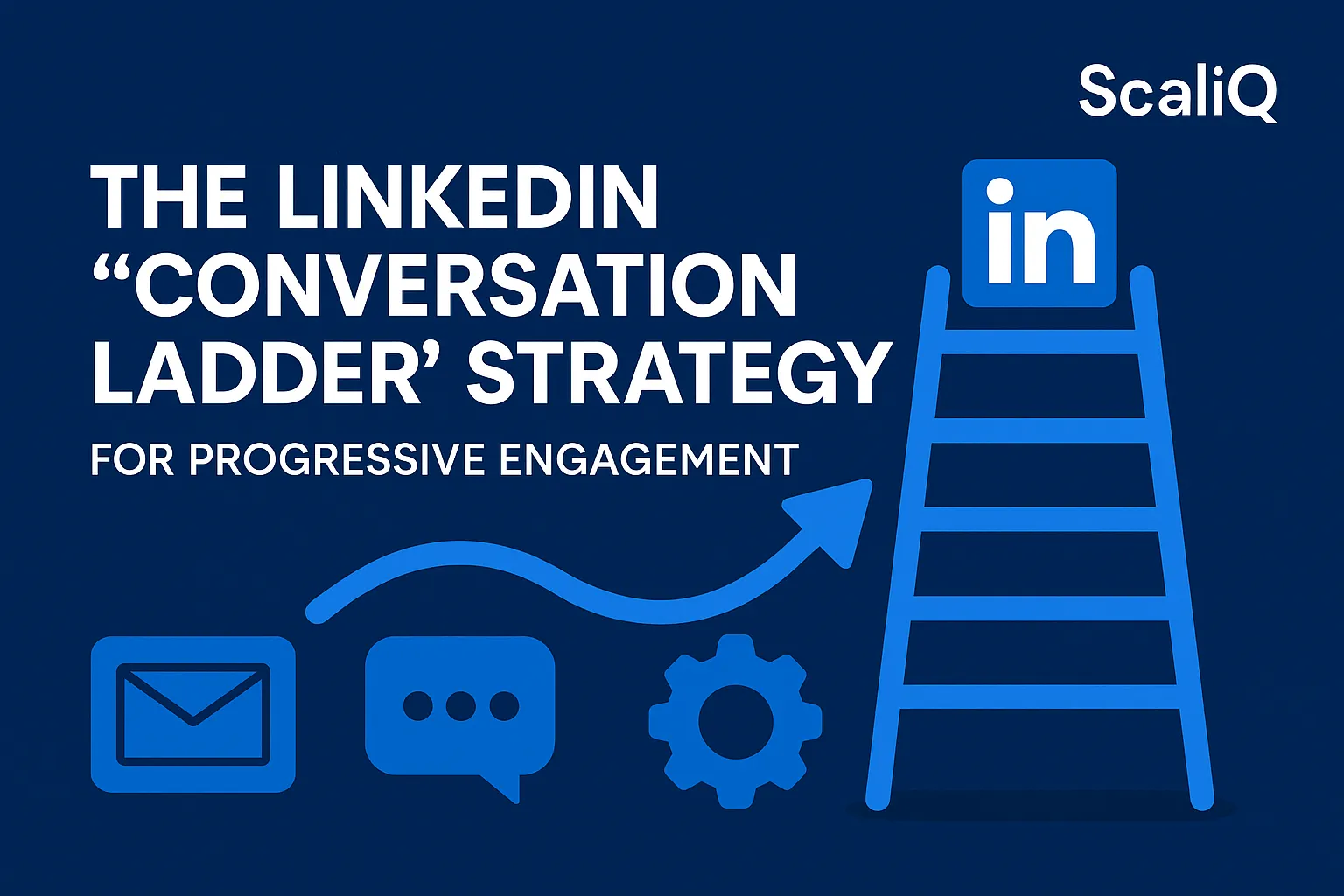
The LinkedIn “Conversation Ladder” Strategy for Progressive Engagement
Connection requests are routinely ignored. First messages often feel too cold, and direct pitches immediately lower the quality of any resulting replies. If you run outbound campaigns, you already know the common frustration: treating LinkedIn like a traditional email blast simply does not work.
LinkedIn is fundamentally a trust-first channel. Familiarity must come before the ask. To succeed, modern B2B marketers, sales teams, and outbound operators need a more structured system than "connect and pitch." Enter the LinkedIn conversation ladder strategy—a practical, repeatable framework designed to move prospects from passive awareness to active conversation.
Unlike generic social selling advice that relies heavily on manual guesswork, a multi-step engagement model focuses on conversion. It leverages clear stages, timing rules, behavioral triggers, and precise measurement. At ScaliQ, our experience building progressive engagement flows has consistently proven that optimizing for conversion efficiency—rather than just outreach volume—yields significantly higher quality pipeline.
If you are ready to stop burning through your total addressable market and start building genuine, conversion-focused relationships, this guide is your blueprint. You can also explore more of our outreach and engagement strategies on our blog .
What a LinkedIn Conversation Ladder Is
A LinkedIn conversation ladder strategy is a stage-based framework for progressive engagement. It deliberately walks a prospect through a sequence of interactions: awareness, light engagement, connection, context-driven follow-up, and finally, a soft call-to-action (CTA).
The primary goal of this LinkedIn outreach strategy is not simply to manufacture "more touches" for their own sake. Instead, it is about better sequencing. By building trust and relevance prior to asking for a prospect's time, you dramatically increase the likelihood of a positive response.
This model stands in stark contrast to one-step pitching, generic automated sequences, and high-volume cold outreach. Those outdated methods exacerbate the core pain points of modern outbound: low acceptance rates, ignored messages, and the struggle to balance deep personalization with operational scale.
Why Progressive Engagement Outperforms Direct Pitching
Prospects are exponentially more likely to respond when they recognize the sender's name or have seen relevant interaction from them previously. Familiarity, proper timing, and deep context are the true drivers of reply quality.
The conversation ladder supports authentic prospect warming. It builds trust without forcing fake relationship tactics or pretending you have known the prospect for years. When compared to typical message-first approaches—which often feel intrusive and transactional—personalized outreach based on prior engagement feels natural. As noted by the U.S. Small Business Administration, social media is a two-way conversation, and treating it as a one-way broadcasting tool fundamentally limits your B2B social selling success.
Conversation Ladder vs. Sales Sequence
While a traditional sales sequence focuses almost entirely on follow-up mechanics (e.g., sending email 1, waiting two days, sending email 2), a conversation ladder focuses on relationship progression before, during, and around the ask.
A LinkedIn messaging sequence is just one component of the ladder. True engagement funnels track passive and semi-active signals—such as a prospect liking your comment or viewing your profile—not just direct messages. Furthermore, a conversation ladder is highly adaptable and can sit seamlessly inside a broader outbound or multichannel LinkedIn lead nurturing system.
The Core Stages of Progressive Engagement
To operationalize this multi-step engagement concept, teams can rely on the ScaliQ 5-Stage Progression Model. This engagement funnel provides a clear roadmap for every interaction. For each stage, you must understand the objective, the required actions, what to avoid, and the behavioral signal that earns you the right to progress to the next step.
Stage 1 — Research and Signal Gathering
Every effective conversation ladder linkedin strategy begins with context, not messaging. Before taking any action, you must gather intelligence.
Review the prospect's role, company initiatives, recent posts, mutual connections, and job changes. Look for thought leadership topics they engage with or visible buying signals. This research dictates your segmentation; the ladder for an enterprise CEO will look drastically different than the ladder for a mid-market marketing manager.
Your objective here is to find a "reason to reach out" rather than a "reason to pitch." This foundational step is the bedrock of effective LinkedIn lead nurturing, prospect warming, and personalized outreach.
Stage 2 — Passive Familiarity Through Low-Friction Touches
Once research is complete, initiate passive familiarity. This involves low-friction actions such as profile views, following their account, and selectively liking their posts. These serve as pre-connection warm-up signals.
Light engagement is often enough for highly active prospects, while deeper interaction may be required for those who rarely post. The key here is restraint. Avoid liking everything they have posted in the last year, which creates an obviously artificial and off-putting engagement pattern. The goal of this progressive engagement is simple brand recognition, not an immediate response. This is the cornerstone of B2B social selling and mastering how to warm up prospects on LinkedIn.
Stage 3 — Active Engagement Through Relevant Comments or Content Interaction
Passive likes only go so far; thoughtful comments create much stronger familiarity. Active engagement involves leaving comments that add perspective, ask a useful question, or reinforce a prospect’s post without sounding performative.
For example, instead of commenting "Great post!", say: "Great point about data decay, Sarah. Have you found that your team struggles more with email accuracy or phone number routing?"
Not every prospect publishes content regularly. If they don't, this stage should adapt based on available signals—such as commenting on a company post they were tagged in or engaging with content they have shared. This social selling on LinkedIn requires personalized outreach and is a critical leap in progressive engagement.
Stage 4 — Connection Request With Context
You have earned recognition; now it is time to connect. A connection request should only be sent after the prospect has had a chance to see your name via profile views or content interactions.
Write short, contextual invites tied to shared relevance. Do not use this space for product positioning. For example: "Hi David, loved your recent comment on the shift in outbound tactics. I’m following similar trends and would love to connect to see more of your insights."
Avoid over-explaining, hard pitching, or forcing artificial urgency. If you have built enough familiarity in Stage 3, you can sometimes skip the note entirely. Ensure you align your connection mechanics with the official LinkedIn connections and invitations FAQ to maintain a healthy account standing and execute a flawless LinkedIn outreach strategy.
Stage 5 — Follow-Up Message and Soft CTA
Upon acceptance, your first message should continue the conversation, not immediately force a meeting. This is where many break the conversation ladder linkedin strategy.
A soft CTA might involve offering a relevant idea, asking a low-friction question, or sharing a useful resource. For example: "Thanks for connecting, David. Since you mentioned outbound challenges, I recently put together a breakdown of how we reduced data decay by 40%. Happy to send the link over if it’s helpful?"
A direct ask is only appropriate after clear context, sustained engagement, or a definitive signal of relevance. Remember that your follow-up differs if the prospect actively engaged with you earlier versus if they silently accepted the connection. To elevate your LinkedIn messaging sequence and LinkedIn lead nurturing, consider integrating specialized tools for personalized messaging support .
Timing, Triggers, and Personalization Rules
A conversation ladder works best when actions are triggered by prospect behavior, not blindly dictated by a calendar. Moving from concept to execution requires a practical rules engine to manage spacing, progression criteria, and evolving personalization.
How Long to Wait Between LinkedIn Touchpoints
Interactions must be spaced out so they feel deliberate, not rushed. Timing depends heavily on the prospect's activity level, buyer intent, and whether they have engaged back.
For active prospects, you might view their profile on Monday, like a post on Wednesday, comment on Friday, and connect the following Tuesday. For passive prospects, this timeline might stretch over three weeks. Frame your timing as a flexible range based on decision logic rather than rigid, unbreakable rules. This multi-step engagement is a core pillar of LinkedIn outreach best practices and dictates the pacing of your LinkedIn messaging sequence.
The Best Triggers for Moving to the Next Step
Behavioral signals reduce randomness and improve relevance. The best triggers for moving a prospect to the next ladder stage include:
• Recent post engagement
• A profile view back
• An accepted connection request
• A reply to a comment
• Company news or a role change
A trigger-based ladder is inherently more natural than a fixed sequence. Furthermore, negative signals—such as a prospect ignoring your comments or posting about budget cuts—should trigger a pause in the engagement funnel, not an escalation of your signal-based outreach and prospect warming.
Personalization Rules for Each Stage
Personalization should match the intimacy of the touchpoint. Early in the ladder, use broad relevance (e.g., industry trends). Later, use specific context (e.g., referencing a specific challenge they mentioned in a post).
There is a massive difference between good personalization and superficial token personalization (simply inserting {{Company_Name}} into a generic script). Use role-based context, content-based context, and company-change context to drive genuine conversations. Above all, personalized outreach and LinkedIn lead nurturing should support authenticity, not create a deceptive illusion of a close relationship vital to B2B social selling.
Segmenting the Ladder for Different Prospect Types
Not all prospects climb the ladder at the same speed.
• Founders and Executives: Require high-value insights, immense restraint, and highly customized soft CTAs.
• Marketers and Sales Leaders: Often appreciate direct, peer-to-peer networking and content engagement.
• Inbound-Warm Prospects: High-intent leads require fewer warm-up steps and can often bypass Stages 2 and 3.
Adapt your LinkedIn conversation ladder strategy based on these prospect segmentations to ensure your progressive engagement remains highly relevant.
How to Scale Without Sounding Automated
The biggest operational concern for teams adopting this model is how to make the ladder repeatable without becoming robotic. Scale must come from systems, templates, quality assurance (QA), and signal tracking—not from mass-blasting identical interactions.
What to Systematize vs. What to Keep Human
To successfully scale LinkedIn outreach, you must adopt a hybrid model. What to systematize: Segmentation logic, stage definitions, trigger tracking, overarching message frameworks, and review checklists. What to keep human: Nuanced post comments, high-stakes follow-up messages, soft CTAs, and account-specific judgment.
By utilizing AI-assisted personalization for research while keeping the final touch human, you maintain the integrity of your multi-step engagement and overall LinkedIn outreach strategy. You can explore how to systematically orchestrate these workflows .
Safe Automation Boundaries and Anti-Spam Safeguards
Automation should support relevance and consistency; it must never mimic human behavior deceptively. Red flags that violate safe automation boundaries include over-messaging, repetitive invites, generic bot-like comments, and premature CTAs.
Always pause ladders when there is no signal, negative sentiment, or a clear lack of fit. Preserving your brand trust and avoiding sounding spammy on LinkedIn matters infinitely more than maximizing activity volume. All workflows must strictly adhere to the LinkedIn Professional Community Policies to ensure legal, compliant data use and ethical automation.
Operational Workflow for Teams
Sales and marketing teams must coordinate seamlessly. Marketing can own audience research and initial content engagement, while sales takes ownership of connection requests and follow-ups.
Document your ladder stages in a playbook so outbound operators execute consistently. Utilize checklists and QA reviews for invites, comments, and follow-ups. This structured engagement workflow prioritizes conversion-focused outreach over the generic, high-volume sequence tools that prioritize throughput over authenticity.
How to Measure Success and Avoid Common Mistakes
To prove the ladder is working and prevent misuse, you must move beyond vanity metrics. Success is defined by healthy progression from stage to stage and ultimate conversion efficiency.
Metrics That Actually Matter
Track your stage-to-stage progression rates:
1. Profile engagement to Invite sent
2. Invite accepted to Message sent
3. Message sent to Positive reply
4. Positive reply to Meeting booked
Positive reply quality is far more important than raw reply volume. Pay close attention to disengagement signals in your engagement funnel, such as no response after multiple steps, ignored invites, or declining response quality. Track these metrics by segment and ladder path, not just by individual rep. For deeper insight into relationship-building indicators, understand how Sales Navigator SSI is calculated to monitor your reply rate and meeting conversion health.
Common Mistakes That Break the Ladder
Mistakes in progressive engagement make outreach feel manipulative rather than helpful. Common errors include:
• Pitching too early (skipping Stages 2 and 3).
• Over-engaging unnaturally (liking 10 posts in 5 minutes).
• Using generic personalization.
• Forcing every prospect through the exact same path regardless of signals.
• Failing to pause the ladder when signals are weak.
These LinkedIn outreach mistakes destroy trust and render your personalized outreach ineffective.
Ethical and Compliance Considerations
Authenticity, transparency, and the responsible use of social proof are non-negotiable. Any claims, testimonials, endorsements, or referrals used in your outreach must be truthful and not misleading.
Relationship-building should never cross into manufactured familiarity. Ensure you review the FTC endorsement guidance for social media to maintain strict compliance and trustworthiness when leveraging social proof in your messaging.
Mini Case Comparison — Direct Ask vs. Conversation Ladder
Consider two approaches to cold LinkedIn pitching alternatives:
The Direct Ask (Cold Pitch):
• Day 1: Connection request with a pitch: "Hi, we help companies scale ROI. Can we book 15 mins?"
• Result: Ignored. High friction, zero context, low odds of a quality reply.
The Conversation Ladder:
• Day 1: View profile and read recent post.
• Day 3: Leave a thoughtful comment on their post about scaling challenges.
• Day 6: Send connection request: "Loved your thoughts on scaling, let's connect." (Accepted).
• Day 8: Follow-up: "Thanks for connecting. Since you mentioned scaling, I have a brief guide on how we optimized this. Worth a look?"
• Result: High context, low friction, significantly higher odds of a positive reply. This progressive engagement strategy ties directly to ScaliQ's focus on conversion outcomes over sheer volume.
Tools and Resources for Running a Conversation Ladder
Executing this strategy requires a practical implementation bridge. The right tools support the ladder’s logic without replacing human judgment.
What to Look for in a Progressive Engagement Stack
An effective stack includes tools for account research, trigger tracking, AI-assisted personalization support, workflow orchestration, and analytics.
Look for platforms that offer signal capture, intelligent segmentation, message drafting support, stage tracking, and strict QA controls. Teams need tools aligned to trust-building workflows and lead nurturing, not just outbound volume blasters. Ensure these tools integrate smoothly with your broader multi-step engagement systems.
Where ScaliQ Fits
ScaliQ is built specifically to align with progressive engagement flows and conversion-focused outreach systems. Rather than prioritizing blind automation, ScaliQ provides the workflow structure necessary to help teams execute the conversation ladder consistently and compliantly.
By supporting operational discipline, intelligent personalization, and clear progression logic, ScaliQ empowers teams to scale their outreach safely. Discover how our tools can elevate your strategy .
Conclusion
The most effective LinkedIn outreach is rarely a single-message event. It is a highly structured progression from relevance to familiarity, and finally, to a meaningful conversation.
By implementing the 5-stage conversation ladder, respecting timing and behavioral signals, applying genuine personalization, and exercising restraint, you transform your outreach. Success must be reframed around better conversations and higher-quality conversions, not simply more sent messages.
We encourage you to review your current LinkedIn lead nurturing campaigns today. Rebuild them as a multi-step engagement ladder with clear stages and precise measurement. At ScaliQ, our focus remains on progressive engagement systems that improve conversion outcomes through structured, human-centered workflows. To dive deeper into these strategies, explore our latest playbooks .