

Introduction
Most outbound teams do not struggle with finding prospects—they struggle with contacting them at the right moment. Static lead lists age fast. By the time a sales rep works their way to the bottom of a spreadsheet, the business context of those accounts has likely shifted. Trigger-based outreach solves this by creating a dynamic queue based on real, observable business change.
This is a practical, operator-level guide focused specifically on LinkedIn outreach trigger events, moving past generic sales-trigger theory. Designed for SDR leaders, outbound operators, and demand generation teams, this framework will help you improve AI outbound timing and execute highly effective signal-based outreach.
In this guide, we will break down a complete end-to-end framework: how to identify the best triggers, distinguish them from buyer intent signals, score and stack events, translate them into highly relevant messaging, and operationalize the workflow. Drawing on ScaliQ’s extensive experience designing campaigns around hiring, funding, posting, and growth triggers, this article provides the practical lens needed to upgrade your outbound engine. For additional outbound workflow and prospecting playbooks, visit the ScaliQ blog.
Which Trigger Events Matter Most on LinkedIn
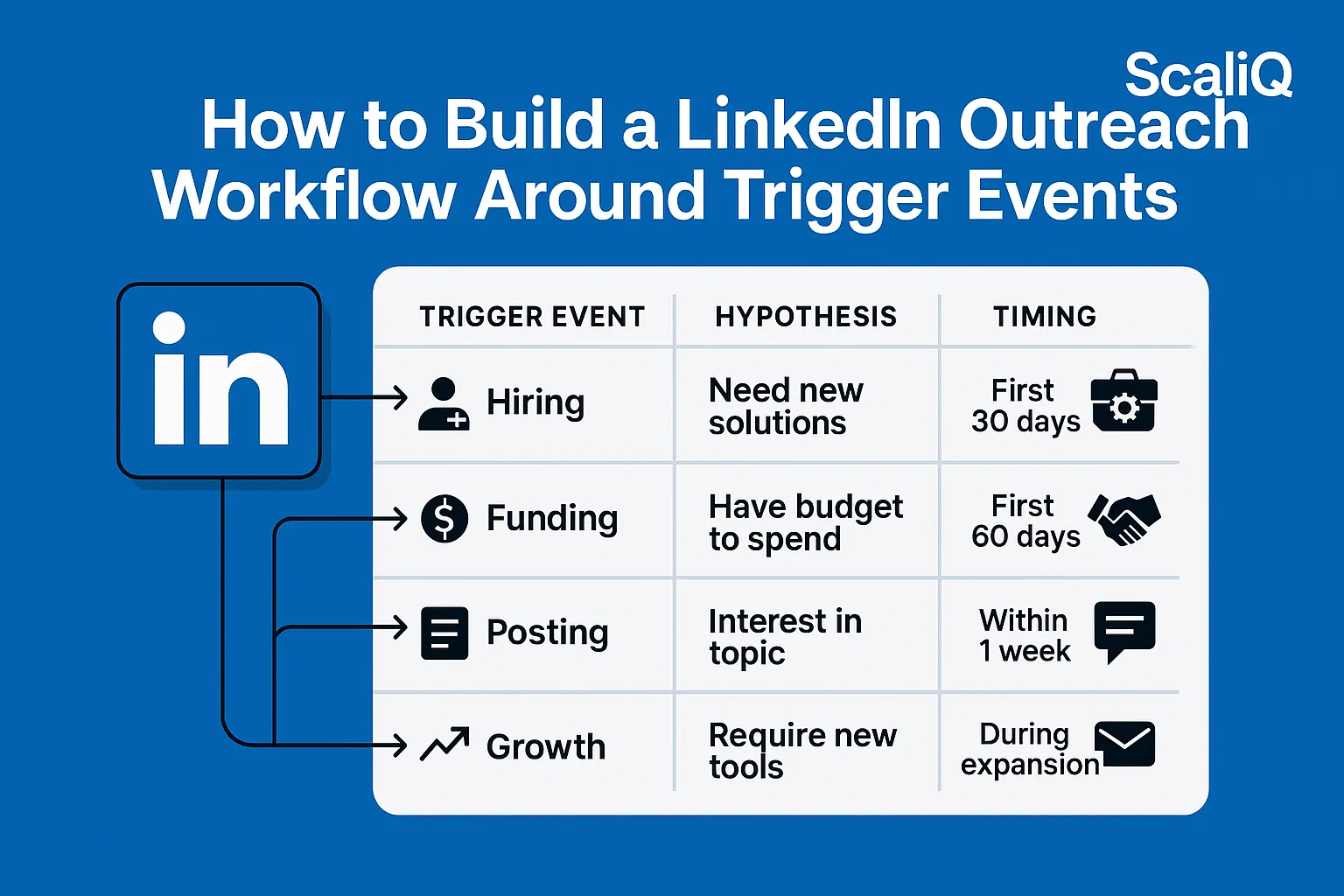
To execute an effective LinkedIn sales workflow, you must establish which signals are strongest for channel-native outreach. The best trigger events for LinkedIn outreach are visible signs of business change that imply urgency, budget, strategic movement, or operational pressure.
However, not every company update deserves outreach. The goal is relevance, not volume. Advanced teams adopt a trigger-to-hypothesis mindset: each event should suggest a likely business need, rather than just serving as an excuse to say "congrats." By focusing on high-quality sales trigger events, you ensure your timing aligns with actual business friction.
Hiring Signals
Hiring spikes are among the most reliable company growth signals because they directly indicate resource strain, team expansion, or new go-to-market priorities. To use hiring signals for prospecting effectively, you must interpret role-specific context. For example, a surge in SDR hiring implies pipeline pressure and a need for sales enablement; RevOps hiring implies upcoming process and tech-stack changes; Customer Success hiring implies a focus on retention or scaling onboarding.
Recency is critical. Outreach is vastly more relevant when hiring is actively occurring or recently announced, rather than months after the roles are filled. Because hiring alone can sometimes be noisy, signal quality improves dramatically when paired with role type, hiring velocity, or team expansion patterns. As highlighted by BLS job openings and turnover data, workforce shifts and hiring velocity are highly meaningful indicators of organizational change and internal restructuring.
Example Angle: "Noticed you are adding X new SDRs this quarter, which usually means managing pipeline consistency becomes a much harder challenge."
Funding Announcements
Funding often signals new initiatives, aggressive hiring plans, GTM expansion, and a higher willingness to test new solutions. However, a common mistake in event-driven outbound is relying on lazy, generic messaging like, "Saw you just raised money, congrats!"
Instead, a successful funding announcement outreach template connects the capital injection to a likely next operational challenge. The funding stage also changes the outreach hypothesis: Seed rounds may signal rapid experimentation and foundational building; Growth rounds (Series B/C) signal scaling and process formalization; Late-stage rounds imply heavy execution pressure and path-to-profitability mandates.
Leadership Changes and Job Moves
Executive hires, promotions, and job changes are high-value moments because strategy, vendors, and internal priorities almost always shift with leadership movement. It is important to distinguish between warm-path champion tracking (following a past user to a new company) and cold job change LinkedIn outreach triggered by a new decision-maker entering a target account.
A role change is most meaningful when it involves a new CRO, VP of Sales, Head of Growth, or RevOps leader, as these individuals typically initiate a new decision cycle within their first 90 days. Prospect monitoring should focus on these exact timing windows, engaging the leader shortly after their transition when they are actively assessing their new team's capabilities and gaps.
Posting Activity, Expansion, and Growth Signals
Company posting, executive content, launch announcements, market expansion, and visible momentum reveal active priorities. On LinkedIn, posting signals function as first-party, visible indicators of business focus, making them exceptionally useful for channel-native outreach.
Examples of powerful LinkedIn outreach trigger events include a company opening a new market, an executive posting about a specific process pain, announcing a strategic partnership, or sharing team milestones. These growth signals become even stronger when tied directly to a specific business hypothesis. As supported by Census business formation statistics, geographic expansion, business formation, and visible growth milestones are highly reliable indicators of expanding operational needs.
A Practical Ranking Framework for Trigger Quality
To avoid drowning in data, operators need a ranking framework for sales trigger events examples. Triggers should be ranked by relevance to your ICP, urgency, visibility, and the ease of converting the signal into a business hypothesis.
Hiring, funding, leadership changes, and posting/activity signals tend to be the strongest when recent and role-relevant. Weaker signals—such as general company anniversaries or minor product updates—should not be discarded automatically, but rather used as secondary indicators in a stacked model. This workflow-first approach to signal-based outreach and AI outbound timing stands in stark contrast to typical tool-centric discussions that merely list triggers without operationalizing them.
Trigger Events vs Buyer Intent Signals
A common point of failure for advanced outbound teams is conflating trigger events with buyer intent signals. While both are critical for AI sales prospecting workflows, confusing these concepts leads to poor prioritization and mistimed outreach.
A trigger event is an observable business change (e.g., a new executive hire). A buyer intent signal is evidence that a company is actively researching, evaluating, or engaging around a specific product category (e.g., downloading a whitepaper on CRM software). Understanding when each should drive trigger event LinkedIn outreach fills a strategic gap that competitors often address conceptually, but fail to execute operationally.
What a Trigger Event Tells You
A trigger event tells you that something fundamental changed inside the business. It does not necessarily mean the company is actively shopping for software right now. Instead, trigger events are the ultimate tool for hypothesis generation. They allow you to say, "Because X happened, this company likely now faces Y challenge." LinkedIn account signals are especially suited to this motion because these business changes are publicly visible in profile updates, company posts, and PR announcements.
What Buyer Intent Signals Tell You
Buyer intent signals point to active category interest. They show that a prospect is researching topics, consuming competitor content, or exhibiting distinct buying-pattern behaviors. According to Forrester on B2B buying signals, intent data is incredibly powerful for prioritization, but it requires contextual interpretation.
Intent alone is often less useful for crafting a personalized opening message. Telling a prospect, "I saw you were researching our category," feels invasive and lacks a narrative hook. Buyer intent tells you who is looking, but trigger events provide the narrative for why now.
When to Use Trigger Events Alone vs When to Stack Them with Intent
Strong, obvious events—such as a new VP of Sales joining and immediately hiring five SDRs—are usually enough to justify highly personalized outreach on their own. However, weaker or more ambiguous events should be stacked with additional confirmation.
Signal Stacking Comparison:
• Trigger Only: A new VP of Marketing is hired. (Action: Reach out with a hypothesis about their first 90-day strategy).
• Intent Only: A company surges on intent topics for "lead routing." (Action: Monitor, or route to an SDR for soft engagement).
• Stacked Signals: A company hires a new RevOps leader and shows intent for "lead routing." (Action: Immediate, high-priority outreach combining the strategic shift with the active research).
Why This Distinction Improves LinkedIn Outreach
Conceptual clarity directly improves your LinkedIn sales workflow. Better categorization leads to better AI outbound timing, sharper prioritization, and the elimination of generic personalization. Trigger events improve your message relevance and narrative hook, while buyer intent signals improve your confidence and account routing. By connecting these concepts to actual signal-based outreach execution, teams can stop guessing and start timing their engagement perfectly.
How to Prioritize, Score, and Stack Signals
The major pain point for modern sales teams is no longer a lack of data; it is signal overload. Without a clear scoring model, reps waste time chasing low-impact updates. To fix this, you need an executable scoring framework that balances recency, fit, relevance, and confidence.
The 4-Part Signal Scoring Model
A robust scoring model for LinkedIn outreach trigger events relies on four pillars:
1. Recency: Fresh events outperform stale events. On LinkedIn, timeliness dictates message credibility. A funding round from last week is a strong hook; a funding round from nine months ago is old news.
2. ICP Fit: A strong trigger at a bad-fit account still ranks lower than a moderate trigger at a perfect-fit account. Fit always dictates priority.
3. Event Relevance: Score the event based on how directly it connects to the specific problem your offer solves.
4. Signal Strength/Stacking: Isolated events score lower than multiple converging events.
How to Stack Signals for Better Confidence
Combining multiple events—known as signal stacking—drastically increases your confidence in the account's readiness. Signal stacking helps reduce false positives and keeps reps from reacting to weak, standalone events.
• Example 1: Funding + Hiring. A Series B announcement followed by 10 open engineering roles implies immediate scaling and a need for developer productivity tools.
• Example 2: Leadership Change + Posting Activity. A new CMO joins and immediately posts about "rebuilding the demand gen engine." This is a high-confidence indicator of upcoming vendor evaluations.
• Example 3: Expansion + Role-Specific Hiring. Opening a new EMEA office while hiring regional sales directors signals a complex GTM expansion requiring localized support.
Filtering False Positives and Low-Quality Events
Not every trigger deserves immediate messaging. Common failure modes include outdated announcements, irrelevant hiring (e.g., an IT company hiring a janitor), vanity PR posts, or broad macro-news with no operational impact. To combat false positives in sales trigger events, implement minimal qualification rules. If a signal does not pass basic ICP and role-relevance checks, it should be watched, enriched, or deprioritized, saving manual research time that slows outbound execution.
Response Windows by Trigger Type
The ideal response window after a trigger event varies. Some triggers are immediate-response events, while others require a broader follow-up window depending on the prospect's decision cycle. The goal of AI outbound timing is "speed-to-context." You want to contact prospects while the event is still relevant, but only after you have gathered enough enrichment data to avoid sending a shallow, automated-sounding message.
Building a Trigger Priority Queue for Reps
Scored signals must flow into a dynamic prospect queue, replacing static lead lists. Queues should be tiered into actionable categories: "Reach Out Now," "Monitor," and "Enrich Before Action." This is where AI sales prospecting workflows shine, maintaining fresh prioritization at scale. Orchestration layers like NotiQ can manage this routing, enrichment, and signal-driven workflow automation, ensuring reps only spend time on the highest-probability accounts.
Turning Signals into Personalized LinkedIn Messages
Referencing a trigger event is not the same as being relevant. The true job of outbound personalization is translating the observed event into a plausible business need and a useful outreach angle.
The Trigger-to-Hypothesis Messaging Formula
To avoid generic trigger event outreach, use a repeatable messaging formula:
Trigger Event → Likely Challenge → Reason for Reaching Out Now → Low-Friction Next Step.
Your hypothesis must be specific enough to feel thoughtful, but humble enough to avoid sounding presumptuous. For instance, a hiring surge points to onboarding pressure; funding points to execution speed; a job change points to a strategic reset.
Messaging Angles for Hiring Triggers
When leveraging hiring signals, anchor your outreach around workload, pipeline scale, team enablement, or operational efficiency. Avoid generic congratulations.
• Connection Request Example: "Hi [Name], saw the push to expand the SDR team this quarter. Usually, that means pipeline consistency is top of mind. Would love to connect."
• Follow-Up Note: "With [X number] of new reps ramping up, keeping messaging consistent usually becomes a bottleneck. We help teams like yours automate QA on rep activity. Open to a quick look?"
Messaging Angles for Funding and Expansion Triggers
Frame your funding announcement outreach template around urgency, GTM complexity, and speed of execution. Sound consultative, not opportunistic.
• Micro-Template: "Noticed the recent Series B—congratulations. Typically, with that kind of capital comes the mandate to scale the GTM motion twice as fast. Reaching out because we help growing revenue teams execute [Specific Solution] without breaking their current processes. Is this on your radar for Q3?"
Messaging Angles for Leadership Changes and Posting Activity
New leaders bring evaluation cycles and fresh process expectations. When conducting job change LinkedIn outreach, acknowledge their transition and the strategic reset it implies. For posting signals, if a prospect complains about a process pain on LinkedIn, mirror their framing lightly without sounding copied or automated. Use their vocabulary to demonstrate active listening.
How to Avoid Robotic Automation
Low-quality automation fails because it merely names the event but completely misses the business context. To build a workflow around trigger events without sounding automated, you must include a human review layer. AI is excellent for drafting hypotheses and organizing data, but human reps must verify nuance, relevance, and tone. The NIST AI risk management playbook provides excellent guidance on responsible AI use, emphasizing the necessity of human oversight and governance to maintain credibility in AI-assisted messaging.
Building an AI-Assisted LinkedIn Outreach Workflow
To move from theory to practice, you need an end-to-end AI sales prospecting workflow. AI outbound timing works best when paired with clear routing rules and human review.
Step 1 — Capture Relevant Signals Continuously
Teams must monitor hiring, funding, leadership changes, posting activity, and growth indicators continuously, rather than relying on one-off manual research. Focus strictly on ICP-relevant trigger categories. Modern prospect monitoring relies on compliant, publicly accessible web and LinkedIn-visible signals to keep the pipeline fresh.
Step 2 — Enrich Accounts and Contacts Before Outreach
Raw signals are not enough. Reps need CRM enrichment to understand account context, contact fit, role relevance, and recent activity. Enrichment bridges the gap between event detection and message quality, answering three vital questions: Why this company? Why this person? Why now?
Step 3 — Score, Route, and Prioritize
Apply your scoring model to push hot accounts into action queues and hold weaker accounts for monitoring. Routing should assign ownership based on segment, territory, account status, or trigger type. Establish strict SLAs for following up on high-confidence signals so the AI outbound timing advantage is not lost.
Step 4 — Use AI to Draft, But Keep Human Review
Leverage AI to summarize the trigger event, propose a business hypothesis, and generate a draft personalized opener. However, human editing is mandatory for nuance, credibility, and channel fit before sending the LinkedIn message. This balance point between scale and trustworthiness is critical. Following guidelines like the NIST AI risk management playbook ensures safe, governed implementation of AI-assisted outbound.
Step 5 — Launch Trigger-Specific LinkedIn Plays
Move from ad hoc outreach to repeatable execution by mapping each trigger type to a specific playbook. A hiring play, a funding play, and a leadership change play should each have a predefined message angle, CTA, follow-up cadence, and stop conditions. Event-driven outbound thrives on structured consistency.
Step 6 — Measure Quality, Not Just Volume
Stop measuring just emails sent or connections requested. Track reply quality, meetings booked, positive response rates by trigger type, and time-to-first-touch. Monitor false positives, the number of message edits required by reps, and signal-to-meeting conversion rates. Use this data to continuously refine your scoring model.
Workflow Differentiation: What Advanced Teams Do Better
Advanced teams recognize that trigger-event tools vs intent-data tools is the wrong debate; the real differentiator is workflow orchestration. While list-centric approaches focus merely on data collection, a workflow-first approach excels in timing strategy, signal interpretation, enrichment, personalization, and human review. ScaliQ acts as the strategic partner for building these advanced, signal-driven outbound systems around hiring, funding, posting, and growth triggers.
Future Trends in Signal-Based LinkedIn Outreach
The era of static prospecting lists is ending, replaced by continuously refreshed, event-driven prospect queues. The future of AI outbound timing lies in AI agents capable of monitoring signals, drafting hypotheses, and routing opportunities in near real-time.
Signal stacking and multi-source verification will become the baseline standard for advanced outbound teams. As market awareness grows—shaped by platforms like LinkedIn Sales Navigator, Clay, Common Room, ZoomInfo, and UserGems—the companies that win will be those that master the operational workflow of turning public, compliant data into timely, highly relevant human conversations.
Conclusion
The best LinkedIn outreach happens when teams successfully connect observable business-change signals to a clear hypothesis and act within the ideal timing window. Success requires a strict five-step logic: identify the right trigger events, distinguish them from buyer intent, score and stack them for confidence, translate them into relevant messaging, and operationalize the workflow using AI paired with human review.
Your outbound success will not come from simply finding more signals, but from turning the right signals into better-timed, more credible conversations. Evaluate your current outbound motion today: is it static and list-centric, or is it truly dynamic and event-driven? With ScaliQ’s hands-on experience building elite campaigns around hiring, funding, posting, and growth triggers, transitioning to a signal-based model has never been more achievable.