

Introduction
Broad Ideal Customer Profile (ICP) lists often look exceptional on paper, yet they frequently underperform in active campaigns. The reason is simple: hitting a firmographic checkbox does not equal real market affinity. B2B growth, demand generation, and sales operations teams spend countless hours trying to identify prospects who actually care about their category, only to face low reply rates from cold, disconnected audiences.
While the platform does not offer a universal, native shortcut to directly target any competitor's followers in standard sales workflows, B2B teams can still leverage these follower signals as a high-intent starting point. By treating audience affinity as a directional clue rather than a ready-made list, you can build a more precise, high-converting pipeline. Generating LinkedIn company followers leads is not about finding a native targeting hack; it is about utilizing an audience signal that becomes incredibly valuable when combined with data enrichment, segmentation, and strategic activation.
This guide is designed for intermediate to advanced outbound teams seeking a sharper alternative to broad audience targeting on LinkedIn. We will walk through a complete, operational workflow: discovery, enrichment, scoring, segmentation, and outbound activation.
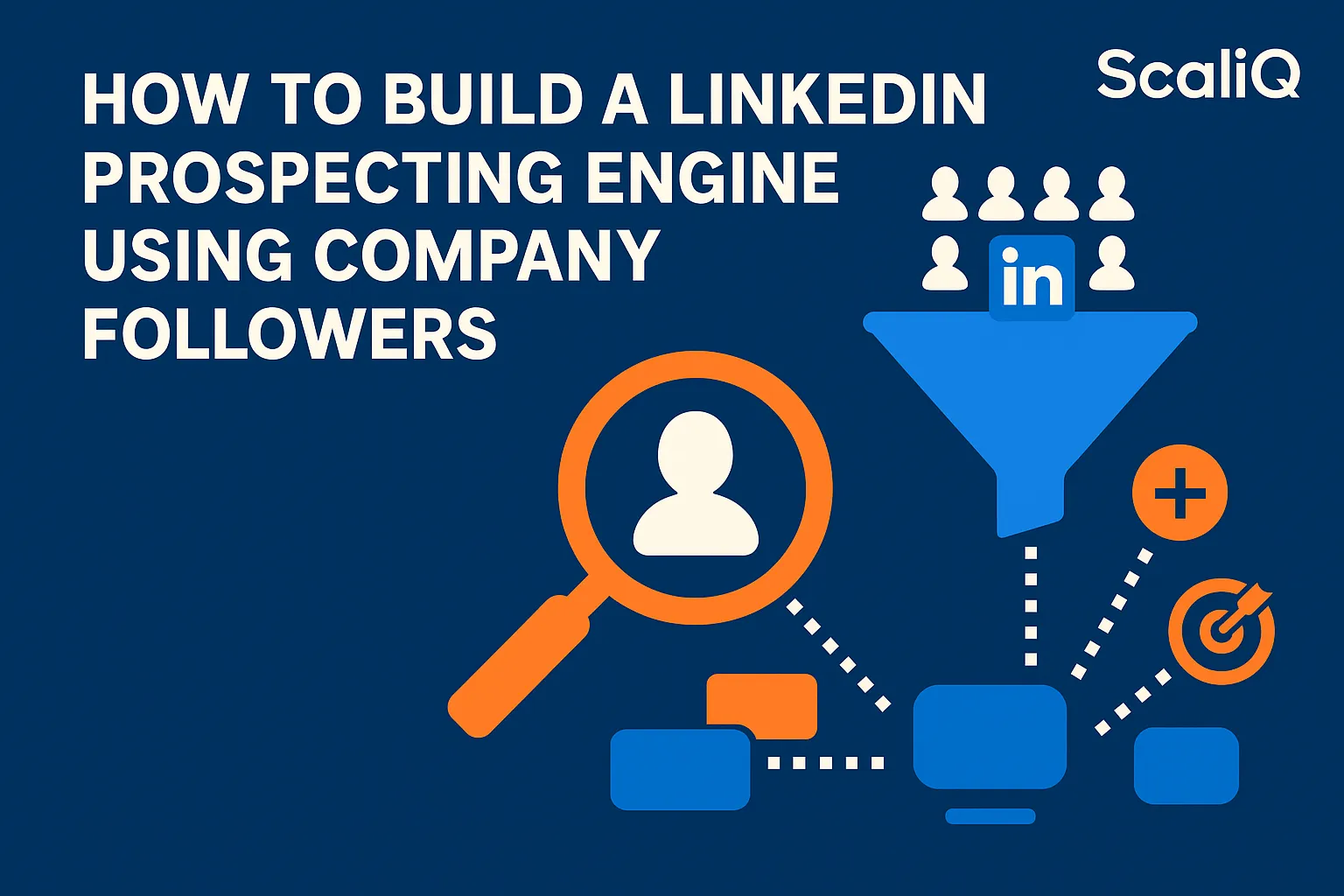
At ScaliQ, we have extensive experience building workflow-driven systems that target competitor audiences at scale. As a strategic orchestration layer for scalable competitor-audience targeting workflows, ScaliQ transforms raw social signals into high-performing B2B campaigns. This is not a tutorial on scraping; it is a blueprint for building a compliant, high-performing LinkedIn prospecting engine.
Why Company Followers Are a High-Intent Prospecting Signal
To move beyond the limitations of standard list building, modern sales teams must understand why follower-based signals consistently outperform broad ICP filtering, particularly for awareness-stage and competitor-led prospecting.
What follower affinity actually tells you
When a professional follows a specific company page, it indicates one of three things: category interest, competitor awareness, or role-relevant curiosity. However, it is critical to treat this follower data as an audience hypothesis, not undeniable proof of purchase intent.
This approach is fundamentally different from cold list building based strictly on industry codes, headcount, or generic job titles. Broad lists assume intent based on identity; follower affinity infers intent based on behavior. By integrating company followers targeting into your broader account-based targeting strategy, you capture buyer intent signals that traditional firmographics miss. For foundational context on how platform data is structured, you can review official LinkedIn follower analytics.
Why follower-based prospecting can beat broad ICP lists
Relying solely on broad ICP targeting low quality leads often results in generic messaging that fails to resonate. In contrast, targeting a narrower audience already showing affinity to a competitor, category, or adjacent solution provides a massive relevance advantage.
This relevance translates into better personalization angles, stronger campaign themes, and improved social audience segmentation. Follower-based prospecting is especially powerful when website intent data is weak, anonymous, or entirely unavailable. Unlike typical manual list-building or one-dimensional automation tools that blindly message anyone fitting a title, an enriched follower workflow ensures your LinkedIn lead generation efforts are directed at professionals already educated on your market space.
Best use cases for B2B teams
The most successful B2B prospecting engine does not treat all follower signals equally. The best use cases for this strategy include:
• Competitor audience targeting: Engaging users who follow direct competitors to highlight your unique value proposition.
• Category education campaigns: Reaching followers of industry publications or thought leaders to build early-stage awareness.
• Adjacent-market account discovery: Targeting followers of complementary software tools (e.g., a CRM integration targeting followers of the CRM platform).
• Early-stage ABM: Identifying active stakeholders within target accounts before they submit an inbound request.
LinkedIn audience segmentation B2B strategies are most powerful when follower signals are layered with strict firmographic and persona filters, ensuring you only engage the right people within the right context.
The Limits of Direct LinkedIn Follower Targeting
Before operationalizing this strategy, it is vital to set accurate expectations about platform capabilities. Misunderstanding what is natively possible often leads to broken workflows and compliance risks.
What LinkedIn does and does not let you do
A common question among growth teams is: can you target followers of a company on LinkedIn? The reality is that you generally cannot use standard sales workflows, including LinkedIn Sales Navigator, to directly export or target any competing company’s followers as a ready-made prospect list.
Users frequently confuse native page analytics (which show aggregated data about your own followers), ad-context targeting options (which allow for broader audience targeting linkedin parameters in paid campaigns), and direct sales prospecting workflows. For context on platform boundaries, including how pages interact with users, refer to LinkedIn Page invitation limits.
Visibility gaps and signal quality issues
Follower and engagement data on social platforms is often partial, indirect, or inaccessible depending on the specific page, user privacy settings, or your network relationship. You will face visibility gaps.
Furthermore, signal quality issues are inevitable: not every follower is a buyer (many are employees, investors, or students), and not every buyer follows relevant pages. Because of this, limited visibility into LinkedIn followers means that social audience segmentation must be treated as just one of several buyer intent signals, not your entire go-to-market strategy.
Why most SERP content stops at extraction
If you search for how to find leads from competitor followers, most existing guides focus entirely on exporting or scraping data. They fail to show how to qualify, enrich, and activate those disconnected lead generation tools into a coherent GTM motion.
This article outlines a full engine. Competitor content often features weak enrichment logic, little to no lead scoring, and limited guidance on safe scaling. Strategic orchestration—building a system that processes data intelligently—will always outperform extraction-only workflows that dump unverified names into a spreadsheet.
A Step-by-Step Follower-to-Lead Workflow
To turn audience affinity into pipeline, you need a governed, operational framework. Here is the exact workflow for translating social signals into actionable B2B campaigns.
Step 1 — Choose the right seed companies
Your workflow begins by selecting audience seeds. Do not limit yourself to direct competitors. Look at category leaders, integration partners, and adjacent-solution pages. The goal of company followers targeting is to choose companies whose followers are highly likely to overlap with your desired ICP.
Prioritize your seeds by market relevance rather than brand size alone. A niche competitor with 5,000 highly qualified followers is a far better target for linkedin competitor audience targeting than a massive enterprise brand with 500,000 irrelevant followers.
Step 2 — Use LinkedIn discovery to identify likely accounts and personas
Once you have your seed companies, utilize discovery layers to turn audience clues into target accounts. A standard sales navigator prospecting workflow involves searching for companies and buyer personas connected to the market segment indicated by the follower affinity.
LinkedIn Sales Navigator is an excellent discovery tool for this phase. You are not extracting a direct list of followers; rather, you are using the platform to identify individuals who match your persona criteria within the accounts that exhibit market awareness. This translates raw audience signals into highly targeted account hypotheses for your LinkedIn prospecting.
Step 3 — Add external enrichment and verification
Raw social signals are virtually useless without enrichment. Before anyone enters a campaign, the data must be layered with firmographic, role, and contact information.
Account-based targeting requires you to enrich records with company size, industry, geography, role seniority, and department data. If you are wondering what tools help find prospects from competitor company followers, look to dedicated B2B data providers that specialize in waterfall enrichment. Crucially, strictly verify all email and contact data before it enters your LinkedIn lead generation sequence to protect your sender reputation.
Step 4 — Score for fit, affinity, and campaign readiness
Not all enriched leads are created equal. You must score and prioritize accounts based on three layers: ICP fit, follower/competitor affinity, and reachable campaign context.
For the first iteration of your workflow, rely on simple scoring logic rather than complex AI models. Create tiers:
• Tier 1: High ICP fit + High market affinity (Prime targets)
• Tier 2: Medium ICP fit + High market affinity (Secondary targets)
• Tier 3: Test segments to validate new hypotheses
By structuring your linkedin company followers leads this way, you ensure your sales team spends their time on the buyer intent signals that matter most, establishing a highly efficient process for how to build a LinkedIn prospecting workflow at scale.
Step 5 — Route segments into outreach or ABM motions
The final step is routing your segmented lists into the appropriate activation motions. Different segments require different approaches: outbound email, strategic LinkedIn touchpoints, targeted account-based campaigns, or educational nurture tracks.
Your messaging should reference category pain points or market context. Never make invasive claims about their follower behavior (e.g., do not say, "I saw you follow X"). Instead, speak to the problems associated with that category.
This process transforms a one-off list build into a repeatable B2B prospecting engine. For teams looking to seamlessly operationalize this entire workflow, book a demo with ScaliQ to connect your audience signals directly to your outbound activation.
How to Enrich, Segment, and Prioritize Audience Data
Going beyond basic list creation means turning noisy, unstructured signals into campaign-ready segments. Here is how to process the data effectively.
Enrichment fields that matter most
To filter out irrelevant followers and focus strictly on likely buyers or influencers, you must prioritize the right enrichment fields. The highest-value data points include role, seniority, department, company size, industry, geography, and go-to-market relevance.
An example segmentation schema for an intermediate B2B team might look like this:
• Target: VP of Sales (Role/Seniority)
• Company Size: 50-200 employees (Firmographics)
• Signal: Follows [Competitor CRM] (Affinity)
By defining these parameters, your linkedin audience segmentation b2b strategy ensures your account-based targeting efforts are laser-focused, drastically reducing the noise inherent in social audience segmentation.
Segmenting by campaign use case
Once enriched, group your audience into specific buckets tailored to your campaign use cases. Examples include:
• Competitor-switch campaigns: Highlighting feature differentiators to users aware of a rival.
• Category education campaigns: Sharing thought leadership with followers of industry media.
• Partner-led campaigns: Offering joint-value propositions to followers of integration partners.
Segment-level messaging drastically improves relevance compared to a generic sequence. This structured audience targeting linkedin approach is the foundation of scalable, high-converting LinkedIn prospecting.
Prioritizing follower signals vs. other intent signals
How do social signals compare with website intent, content engagement, or first-party signals? Follower-based affinity should be viewed as an early to mid-funnel signal.
Use this simple prioritization framework for your linkedin lead generation workflows:
1. First-party intent (Inbound requests, high-value website visits)
2. Multi-signal overlap (Follows a competitor AND visited your pricing page)
3. Follower-only affinity (Fits ICP and follows a competitor)
Understanding how to prioritize social signals vs website intent ensures your sales reps focus on the warmest buyer intent signals first, upgrading priority only when additional behavioral evidence appears.
Messaging personalization without crossing the line
Outreach should reflect inferred category interest, not cross the line into invasive surveillance. Explicitly stating that someone followed a page is rarely appropriate and often harms trust.
Instead, use personalization angles based on market position, use cases, and likely pain points.
• Poor Messaging: "I saw you follow [Competitor] on LinkedIn, want to buy our tool instead?"
• Strong Messaging: "Many revenue leaders in the [Industry] space are struggling with [Specific Pain Point]. Since you're navigating the current CRM landscape, how are you handling [Specific Challenge]?"
Good messaging in LinkedIn lead generation stems from intelligent competitor audience targeting logic, not just regurgitating extracted data points.
How to Operationalize Outreach Safely and at Scale
Building a workflow is only half the battle; executing it sustainably requires strict adherence to compliance, trust, and platform safety.
LinkedIn automation and scraping risks
Aggressive scraping, unauthorized browser automation, or policy-violating workflows create severe account and operational risks. Safe scaling requires a deep understanding of platform rules, not just technical possibilities.
If manual LinkedIn prospecting too slow is your primary complaint, do not default to reckless automation. Build conservative workflow designs with manual review checkpoints. To understand the boundaries of acceptable platform use, carefully review the LinkedIn rules on automated activity.
Compliance basics for outbound activation
B2B outreach requires strict, compliance-aware execution, particularly when moving prospects from social platforms to email sequences. Key areas to address include providing truthful sender information, clear opt-out handling, including physical address requirements in emails, and respecting jurisdiction-specific privacy rules (such as GDPR or CCPA).
Teams operating across multiple regions must align their LinkedIn lead generation processes with internal legal review. For foundational guidelines on compliant outreach, consult the FTC CAN-SPAM compliance guide and the ICO guidance on B2B marketing.
Safe scaling principles for repeatable outreach
Sustainable systems will always outperform brittle growth hacks. To learn how to build a LinkedIn prospecting workflow at scale, establish strict operational safeguards:
• Data hygiene: Regularly clean and format your lists.
• Verification: Never email unverified addresses.
• Pacing: Stagger outreach to protect domain health.
• Suppression lists: Ensure existing clients and active opportunities are excluded.
Separate your discovery, enrichment, and activation into governed steps. This prevents the chaos often caused by disconnected lead generation tools and establishes a reliable B2B prospecting engine.
Where human review should stay in the loop
Automation is highly effective for data gathering, enrichment, scoring, and routing. However, humans must stay involved for messaging review, segment validation, and compliance checks.
Strategic orchestration beats blind automation every time. By keeping humans in the loop for quality assurance, your workflow automation enhances audience targeting linkedin efforts without sacrificing the personalized touch necessary for successful LinkedIn prospecting.
Tools, Workflow Stack, and Orchestration
To execute this blueprint, you must understand the roles of various tools within your technology stack, moving away from fragmented tactics toward unified orchestration.
The four layers of the workflow stack
A complete competitor-audience prospecting stack is broken into four distinct layers:
1. Discovery: Identifying the signals and target accounts.
2. Extraction/Collection: Gathering the raw data compliantly.
3. Enrichment: Layering firmographics and verified contact info.
4. Activation: Executing the outreach sequence.
Most disconnected lead generation tools solve one layer well but fail to provide a cohesive operating system. Orchestration is the missing layer that connects these fragmented tasks into a repeatable workflow automation engine, far superior to a manual sales navigator prospecting workflow.
How to evaluate tools by role, not hype
When evaluating your stack, look for specific competencies in each category. Assess search quality, enrichment depth, verification accuracy, routing flexibility, and governance.
For example, LinkedIn Sales Navigator is unmatched for discovery. Tools like Clay excel at custom data enrichment, while platforms like Apollo are widely used for contact verification and sequencing. The strategic gap in the market is that while many tools help extract or enrich, very few help teams run the full workflow coherently from end to end.
Why orchestration is the real differentiator
The true competitive advantage comes from connecting market signals, data enrichment, prioritization, and activation into one seamless process. This is exactly where ScaliQ differentiates from narrow point solutions and manual scraper tools.
By orchestrating the workflow, you eliminate data silos and ensure your competitor audience targeting is executed flawlessly. For teams looking to connect enrichment, scoring, and execution with an AI workflow orchestration layer, NotiQ serves as a powerful complementary tool to govern how to build a LinkedIn prospecting workflow at scale.
Future Trends in Signal-Based LinkedIn Prospecting
The landscape of B2B outbound is evolving rapidly. Forward-thinking teams are already adapting to the next phase of audience targeting.
From static lists to signal-driven prospecting engines
The era of manually built, static lead lists is ending. The shift is moving entirely toward signal-based prospecting engines that combine social, firmographic, and behavioral signals in real-time. This trend is driven by the growing need for better prioritization, higher conversion rates, and less wasted outreach. Modern linkedin lead generation workflows rely on dynamic buyer intent signals to trigger action exactly when relevance is highest.
AI-assisted segmentation and prioritization
Artificial Intelligence is revolutionizing how we process data. AI can now help classify accounts, score segments, and generate campaign variants at scale once the data foundation is clean.
However, AI-assisted audience prioritization amplifies workflow quality; it does not replace the need for accurate data or sound strategy. A strong B2B prospecting engine uses AI to speed up social audience segmentation, not to bypass fundamental market research.
Competitor-audience targeting as a durable GTM motion
More revenue teams are building permanent workflows around competitor and category affinity instead of relying exclusively on native paid ads or broad filters. Competitor audience targeting has proven to be a highly durable GTM motion. This aligns perfectly with ScaliQ’s strategic positioning: scalable, workflow-driven growth that turns audience targeting linkedin signals into measurable, account-based targeting success.
Conclusion
LinkedIn company followers are most useful as an intent-rich signal, not a magical native targeting feature. Broad lists fail because they lack relevance; follower signals succeed because they indicate actual market awareness.
The recommended operating model is clear: choose the right audience seeds, translate those signals into specific accounts and personas via discovery, enrich and score the data, segment by campaign use case, and activate with compliance-aware outreach. This strategy goes far beyond merely scraping data—it is about building a durable, scalable LinkedIn prospecting engine.
ScaliQ specializes in building these precise, workflow-driven systems to target competitor audiences effectively and safely. If your team is ready to operationalize a scalable follower-to-lead engine and stop wasting time on low-intent lists, book a demo with ScaliQ today.