

Introduction
LinkedIn outbound motions can generate highly valuable replies, but for scaling revenue teams, inbox triage quickly becomes an inconsistent and slow bottleneck. When volume rises, relying on Sales Development Representatives (SDRs) to manually read, interpret, and route every response leads to operational friction. High-intent conversations get buried under administrative replies, out-of-office notifications, and polite declines.
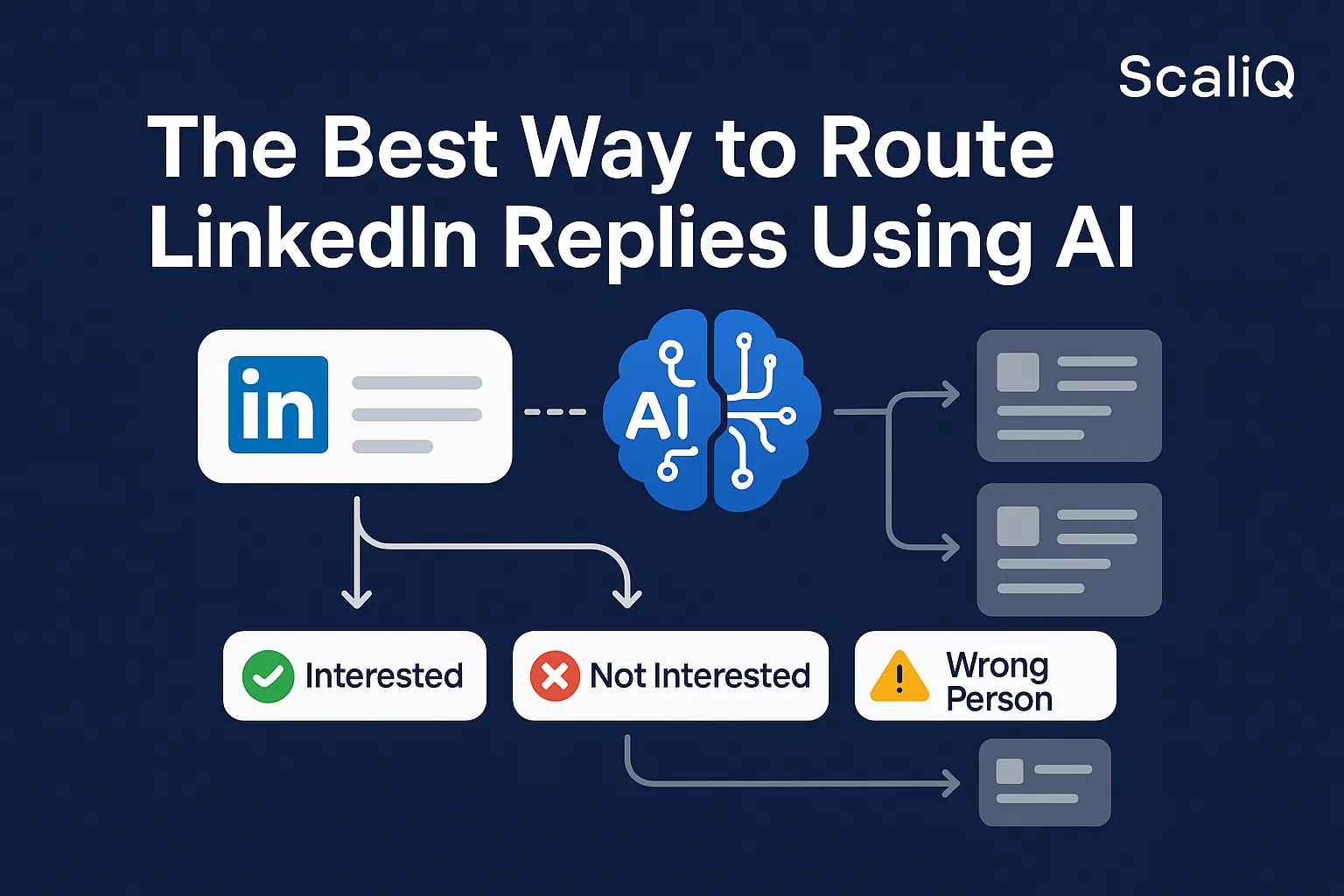
This article provides the definitive blueprint for solving this operational problem. We will demonstrate the best way to classify LinkedIn replies by intent using AI, and detail how to route each message into the correct downstream workflow. This is not generic automation advice. It is a practical, production-ready system covering taxonomy design, routing logic, edge-case management, and performance measurement.
The business stakes for getting this right are massive. Poorly managed inboxes result in missed interested leads, wasted SDR time, a degraded prospect experience, and significant compliance risks when unsubscribe-type replies are mishandled. Implementing structured linkedin reply routing powered by accurate ai intent classification transforms an unmanageable inbox into a predictable pipeline engine.
At ScaliQ, we have extensive experience building robust intent detection layers for outreach inboxes that handle massive reply volumes. By applying advanced LinkedIn message intent detection, organizations can orchestrate complex workflows safely and efficiently. For teams looking to build a deeper outbound operations knowledge base, exploring related technical articles at Blog is a critical next step.
Why Manual LinkedIn Reply Triage Breaks at Scale
Manual triage of LinkedIn replies is inherently unscalable. For advanced outbound teams managing high reply volume, manual sorting creates lag, inconsistent qualification, and uneven prioritization across SDRs, Account Executives (AEs), and RevOps operators.
When teams must sort positive replies, objections, referrals, administrative messages, and out-of-office responses within a single, unified queue, high-intent conversations inevitably get buried. This manual bottleneck directly impacts operational KPIs: speed-to-response plummets, opportunities are missed, rep workload balloons, and ownership assignment becomes chaotic. Fast, clean follow-up on LinkedIn leads requires a systematic approach, not brute force.
The operational failure modes of manual routing
The breakdown of manual routing follows a predictable pattern. Handoffs to AEs are delayed, duplicate responses occur when multiple reps touch the same inbox, and there is a stark lack of owner clarity. Furthermore, two reps might interpret the exact same message differently, leading to inconsistent prospect experiences.
Inbox spikes—such as those following a highly successful campaign launch—amplify these issues exponentially. The directive to "just have reps check replies manually" becomes unsustainable. For SDR leaders and RevOps professionals, missed LinkedIn outreach replies represent lost revenue. These leaders need reliable systems and lead qualification automation, not operational heroics from their reps.
Why keyword rules and sentiment analysis are not enough
Many teams attempt to automate inbox triage for sales teams using basic keyword rules or sentiment analysis, but these methods fall short. "Positive" sentiment does not always equate to buying intent; a prospect might say, "I love what you're doing, but we just signed with a competitor." Conversely, "negative" language might still contain a referral or indicate future interest ("I'm not the right person, but reach out to Sarah").
Keyword routing routinely fails on nuanced replies such as polite declines, mixed objections, or indirect referrals. Specialized prospect response classification requires understanding context, not just matching strings of text. When designing these systems, teams must prioritize reliability and oversight. As outlined in the NIST AI risk management framework, trustworthy AI systems require careful governance to mitigate the risks of misclassification and ensure operational safety.
What advanced teams actually need instead
Advanced outbound teams need intent-based reply handling: a system that classifies each reply into actionable buckets and triggers a defined next step. This is workflow orchestration, not just categorization for the sake of reporting.
Compared to generic automation stacks, a purpose-built conversation routing automation system offers superior precision, consistency, and handling capacity. It connects the classification directly to routing, assignment, and workflow execution. To see how a system layer effectively bridges this gap in sales outreach inbox management, explore ScaliQ.
The LinkedIn Reply Intent Taxonomy Outbound Teams Actually Need
A successful AI intent classification system requires a taxonomy tailored specifically to LinkedIn outbound motions, rather than generic customer support models. A good taxonomy must be operationally useful, mutually understandable across sales and RevOps teams, and specific enough to trigger the correct downstream action.
Taxonomy design should reflect downstream actions, not academic labeling. The goal of what intents should be used to classify LinkedIn outreach replies is to drive the next best action efficiently.
Core intent classes for LinkedIn outbound replies
To achieve precise reply categorization, teams should implement a core set of primary labels. This covers the vast majority of outbound scenarios:
• Interested: Clear buying intent, pricing requests, or meeting readiness., Example: "Send over some times to chat next week."
• Objection: Interest is blocked by a specific hurdle (budget, competitor, feature)., Example: "We are locked into a contract with Vendor X until Q4."
• Referral: The prospect is redirecting you to a colleague., Example: "I don't handle this, you need to speak with our VP of Ops."
• Follow-Up Later: Timing is wrong, but the door is open for future contact., Example: "Reach back out in six months when our budget opens up."
• Not Interested: A polite but firm decline., Example: "No thanks, we have this handled internally."
• Unsubscribe: A demand to cease communication., Example: "Take me off your list. Stop messaging me."
• Out-of-Office (OOO): Automated or manual away messages., Example: "I am on annual leave until the 15th."
• Ambiguous / Human Review: Low-signal or highly complex messages requiring human eyes., Example: "Maybe. Who are you working with currently?"
Why multi-label classification matters
Many LinkedIn replies contain more than one signal. A prospect might express interest but introduce a timing delay ("Looks great, but hit me up next quarter"), or present an objection alongside a referral ("We don't have budget, but check with marketing").
Forcing every multi-intent reply into a single label reduces routing quality and can result in lost pipeline. Advanced workflows require multi-label logic or a primary-plus-secondary intent approach to handle ambiguous LinkedIn reply classification accurately. Robustness in handling these complex inputs requires careful tuning to minimize false positives. For deeper insights into maintaining system accuracy and human-AI teaming, refer to the NIST guidance on AI accuracy and trustworthiness.
How to design a taxonomy your team can actually use
SDR, AE, and RevOps teams must align on taxonomy definitions, routing thresholds, and exception handling. The taxonomy must be simple enough to maintain but granular enough to support specific workflows like lead qualification automation and conversation routing automation.
Teams should document example messages, borderline cases, and routing owners for each intent class. As classification systems should be context-specific and tied to governance decisions, aligning your definitions with frameworks like the OECD AI classification framework ensures that your taxonomy remains standardized, actionable, and scalable.
How to Map Each Intent to Routing and Follow-Up Actions
The true value of AI intent classification is unlocked through downstream actions: owner assignment, CRM updates, playbook triggers, suppression logic, and meeting workflows. Moving from classification theory to execution requires a workflow-first structure mapping the intent to the routing rule, the next action, the owner, and the system update.
Positive intent: interested, pricing request, meeting-ready
High-intent replies must be prioritized for the fastest SLA and routed to the right owner immediately. This is how sales teams prioritize LinkedIn responses faster. Actions include assigning the conversation to an AE, creating a high-priority CRM task, triggering a meeting-booking workflow, enriching the account data, and pausing any further automated outbound touches. If the system supports sub-intents, routing rules should distinguish between "mild interest" (requires SDR qualification) and "meeting-ready" (direct AE handoff).
Mid-funnel intent: objection, timing delay, follow-up later
These replies are not dead ends. They require objection handling, nurture, or timed re-engagement. Routing by motion is key here: trigger an objection handling playbook, create a follow-up date task, or move the prospect into a slow-nurture queue. A "not now" message should stay active as a future task, whereas a hard objection on a low-tier account might be marked low-priority. Proper LinkedIn prospect response handling ensures mid-funnel leads are nurtured, not abandoned.
Alternative path intent: referral and redirected contact
Referral reply handling deserves dedicated routing. Referrals should not be treated as standard positive replies because they require a different motion. Actions include creating a new contact record in the CRM, assigning the referral path to an SDR, and preserving the relationship context from the original reply so the SDR can say, "Your colleague John suggested I reach out." Because referrals often co-occur with "not me" sentiments, multi-label support is critical for accurate prospect response classification.
Low-priority and risk-sensitive intent: not interested, unsubscribe, out-of-office
It is vital to separate commercial low-intent replies from compliance-sensitive replies. Unsubscribe and compliance routing for LinkedIn replies must be flawless. A "stop messaging me" intent should trigger immediate suppression logic and sequence pause rules. For out-of-office replies, the workflow should delay action, capture return dates, and avoid misclassifying the automated reply as disinterest. All workflows managing sales outreach inbox management must be strictly compliant with platform terms; teams must adhere to the LinkedIn automated activity policy to ensure platform-safe usage.
Human review queues for high-value or uncertain replies
Automation should stop and escalate when necessary. Low-confidence classifications, replies from Tier-1 strategic accounts, legal/compliance sensitivities, or highly unusual language patterns require human-in-the-loop review. Setting confidence thresholds and routing to review queues allows teams to automate at scale without over-trusting the model. This nuanced guardrail is the best way to automate LinkedIn reply routing at scale, differentiating advanced systems from generic workflow tools. For an ecosystem that supports robust downstream response actions and review handling, consider integrating solutions like Repliq.Co.
Handling Edge Cases Like Multi-Intent and Ambiguous Replies
Edge-case handling separates a demo-friendly workflow from one that operates reliably in production. Real-world LinkedIn replies are often messy, short, or contain mixed signals. Addressing these ambiguous LinkedIn reply classification challenges is a major differentiator for advanced ai intent classification systems.
Compound replies with more than one actionable signal
What happens when a reply expresses multiple intents in one message? Consider examples like, "Interested, but not me—talk to our VP next quarter," or "Send pricing, but we already use another vendor." These multi-intent replies require an action hierarchy or decision tree so workflows do not conflict. For instance, an Unsubscribe intent must always override an Objection intent, and a Referral intent should trigger a new contact creation before applying a Timing Delay to the original prospect.
Short, vague, or low-signal responses
Replies such as "maybe," "sure," "not now," or "send details" routinely create misroutes in rigid systems. Resolving these low-signal messages requires analyzing context, prior message history, and confidence scoring. Raw confidence scores without escalation logic are insufficient; if a system is only 60% confident that "sure" means meeting-ready, sales inbox automation rules must route that message to a human review queue rather than firing off an automated calendar link.
Sarcasm, language variation, and non-standard phrasing
Nuanced language, sarcasm, and indirect declines can break keyword rules on nuanced responses. A prospect saying, "Yeah, right, like I have budget for that," is an objection, not a positive confirmation. AI models must be tested on non-standard phrasing and regional language variations. The goal is operational resilience—building a system that gracefully escalates when confused—rather than promising perfect, infallible LinkedIn message intent detection.
Compliance-sensitive and platform-sensitive scenarios
Teams must design safe handling rules before maximizing automation depth. Replies requesting no further contact or implying legal sensitivity must touch suppression logic instantly. LinkedIn workflows must respect platform policies and avoid unsafe automation assumptions, such as continuing to message a prospect who has vaguely opted out. Always align your unsubscribe and compliance routing for LinkedIn replies with the LinkedIn automated activity policy.
How to Measure Routing Accuracy and Pipeline Impact
To evaluate whether AI reply routing is working, teams must look beyond raw accuracy. Different misroutes carry vastly different business costs; missing a meeting-ready lead is expensive, but ignoring an unsubscribe request is a compliance violation. Advanced teams measure model quality against operational and revenue outcomes to validate their sales inbox automation.
The right model metrics: precision, recall, confidence, and error cost
Precision and recall must be understood in operational terms. High precision reduces false positives (ensuring SDRs aren't chasing bad leads), while high recall reduces missed opportunities (ensuring no interested replies slip through). Teams should measure precision recall and classification metrics by intent class. A single blended score is useless; you need 99% precision on unsubscribes and high recall on interested replies. For foundational guidance on these concepts, review Google for Developers on precision, recall, and classification metrics.
The operational KPIs revenue teams should track
The business impact of lead qualification automation is visible in operational KPIs: speed-to-first-response, manual triage time reduced, queue handling capacity, owner assignment accuracy, and SLA adherence. These metrics matter differently across roles. SDRs care about manual triage time reduced, AEs care about owner assignment accuracy, and RevOps cares about queue handling capacity. Tracking these reveals how sales teams prioritize LinkedIn responses faster.
Pipeline and business outcome metrics
Ultimately, routing must drive revenue. Track the meeting-booked rate from positive replies, opportunity creation from routed conversations, and the reduction in lost opportunities due to missed replies. When measuring pipeline impact, compare pre-automation and post-automation periods carefully, avoiding overclaiming causality. Use a closed-loop feedback process, taking CRM outcomes and feeding them back into taxonomy refinement to continuously improve the best way to automate LinkedIn reply routing at scale.
Building trust in the system over time
Trust is built through iteration. Teams should routinely review misroutes, retrain models or refine prompts, adjust taxonomy definitions, and expand edge-case coverage. A phased rollout is highly recommended: begin with assistive routing (shadow mode), move to partial conversation routing automation, and finally enable higher-confidence autonomous actions. This disciplined, governed approach stands in stark contrast to generic AI hype. It aligns with best practices found in the NIST AI risk management framework and the NIST guidance on AI accuracy and trustworthiness.
Future Trends in AI-Powered Reply Routing
The landscape of B2B sales workflow automation is shifting rapidly. Outbound workflow orchestration is moving away from isolated inbox tools toward integrated, intelligent systems that manage the entire reply lifecycle.
From rules to LLM-based classification
Modern revenue teams are replacing static keyword maps with contextual, LLM-based intent classification. Large Language Models excel at understanding the nuance, sarcasm, and multi-intent nature of human conversation. However, better LinkedIn message intent detection matters only when it is tied to safer, more reliable sales inbox automation and workflow execution.
Multi-channel and orchestration-first workflows
LinkedIn reply routing no longer exists in a vacuum; it fits into broader revenue operations systems. Multichannel response handling is expanding to unify email, LinkedIn, and social selling motions. Orchestration depth—the ability to handle classification, assignment, suppression, CRM updates, and follow-up timing all in one fluid motion—is rapidly becoming the primary buying criterion for conversation routing automation and sales outreach inbox management.
Conclusion
The best way to route LinkedIn replies by intent using AI is to combine a purpose-built taxonomy, workflow-specific routing logic, rigorous edge-case safeguards, and continuous performance measurement. Advanced teams must move beyond basic sentiment analysis and simple keyword rules, adopting multi-label, context-aware AI intent classification.
By defining clear intents, mapping each to a specific downstream action, implementing human review queues for uncertainty, and measuring both model quality and pipeline outcomes, revenue teams can eliminate inbox bottlenecks. This structured approach ensures that high-value leads are actioned instantly while compliance risks are systematically mitigated.
ScaliQ specializes in reply routing precision and outbound workflow orchestration. We build the intent detection layers that power high-volume outreach inboxes, moving beyond generic automation to deliver true operational reliability.
To explore how ScaliQ structures intent detection and workflow execution for high-volume outbound teams, view our product capabilities at ScaliQ. To continue reading technical workflow content and build your RevOps knowledge base, visit Blog.