

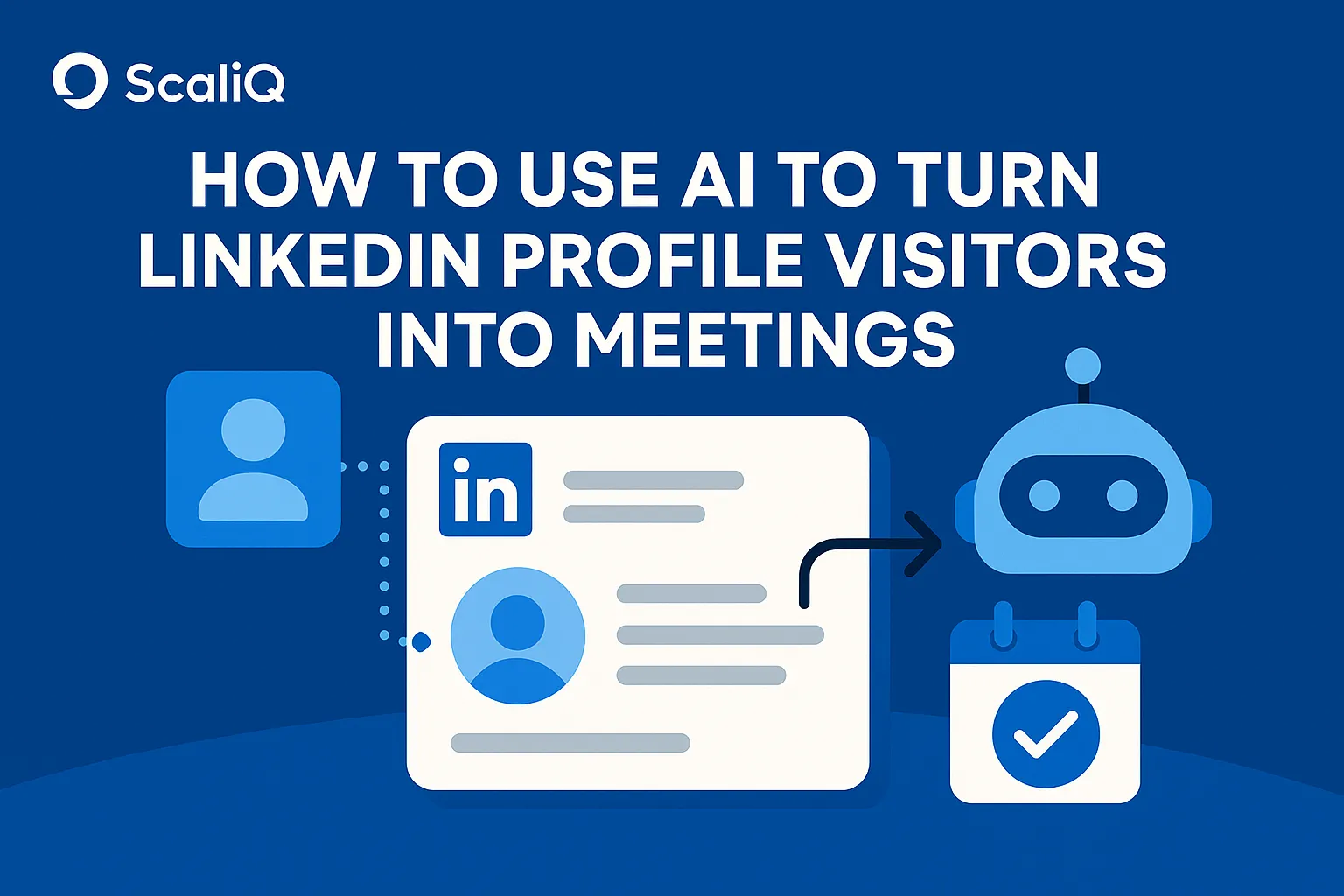
How to Use AI to Turn LinkedIn Profile Visitors Into Meetings
Most beginners don’t realize their hottest leads are already looking at their LinkedIn profile—yet 90% never follow up. They spend hours crafting cold emails or generic connection requests to strangers, completely ignoring the people who have already demonstrated active interest.
Data consistently shows that profile-view warm leads convert 3x higher than cold outreach. Why? Because the intent is already there. They found you. They read your headline. They are evaluating your expertise.
However, manually checking your "Who Viewed Your Profile" list and sending awkward "Thanks for viewing" messages is unscalable and often feels intrusive. The solution lies in a behavior-triggered AI workflow. By leveraging ethical automation, you can detect intent signals and initiate a personalized conversation the moment interest is highest, without being glued to your screen.
In this guide, we will break down exactly how to convert LinkedIn profile visitors into meetings using ScaliQ’s expertise in behavior-triggered AI workflows. You will learn how to set up a compliant, beginner-friendly system that turns passive lookers into booked appointments.
Why LinkedIn Profile Visitors Are Your Warmest Leads
A profile visit is rarely an accident. In the B2B world, a profile visit is a direct intent signal. It indicates curiosity, evaluation, or comparison shopping. When a prospect lands on your profile, they are likely checking your credibility after seeing a post, a comment, or a recommendation.
According to research by the CXL Institute, understanding buyer intent signals is critical for increasing conversion rates. Their insights suggest that engaging a prospect while they are in the information-gathering phase significantly boosts response rates compared to interrupting them when they are cold.
The Information Gap
While LinkedIn notifies you that someone viewed your profile, the platform provides limited insights on how to act on that data. You might see a name and a headline, but without a system to interpret that visit, the data is useless. This creates a gap that AI can fill.
Manual Outreach vs. Behavior-Triggered Workflows
• Manual Outreach: You check your views once a week. You send a generic message days after the prospect has lost interest. The opportunity is cold.
• Behavior-Triggered Workflows: AI detects the visit in real-time. It analyzes the visitor's profile against your Ideal Customer Profile (ICP). If they match, a personalized sequence begins immediately while you are top-of-mind.
The Core Behavior Triggers That Reveal Buyer Intent
Not all profile views are equal. A competitor spying on you is different from a VP of Sales checking your pricing. To successfully convert visitors, you must distinguish between casual browsers and serious buyers.
Behavior-triggered AI flows rely on scoring mechanisms to filter these leads. This ensures you only spend resources on high-intent prospects.
Key Intent Signals:
• Repeated Views: A prospect viewing your profile twice in one week is highly interested.
• Time Between Visits: Short intervals indicate urgent need.
• Job Title Relevance: A view from a decision-maker carries more weight than an entry-level employee.
• Engagement: Did they view your profile immediately after liking a post?
For a deeper understanding of what data is visible to you, refer to LinkedIn’s documentation on profile visibility.
Trigger 1 — Initial Profile Visit
This is the baseline signal. It indicates awareness.
• What it indicates: Discovery. They found you via search or content.
• Recommended Action: A low-friction connection request. Do not pitch. The goal is to secure the connection so they see your future content.
• Strategy: "Saw you stopped by my profile. I write about [Topic]—would love to keep in touch."
Trigger 2 — Multiple Visits in 48–72 Hours
This is a strong buying signal. The prospect is likely vetting you against a competitor or discussing your solution internally.
• Correlation: High active interest.
• Scoring: In an AI lead scoring model, a second visit within 3 days should trigger a "High Priority" alert.
• Action: If connected, send a value-add resource relevant to their industry.
Trigger 3 — Visitor Matches ICP Metadata
AI can instantly cross-reference the visitor’s headline and industry against your target criteria.
• Relevance: If the visitor is a "Founder" in "SaaS" (your target), the intent score multiplies.
• Segmentation: These leads should bypass general queues and enter a "VIP" workflow.
• Keywords: ai personalization linkedin, buyer intent signals.
A Beginner-Friendly Workflow to Automate Follow-Up
You do not need to be a developer to set this up. Modern tools allow you to build a "no-code" beginner linkedin visitor workflow that runs in the background.
Here is the core 5-step process: Detect → Score → Segment → Personalize → Send.
Step 1 — Detection & Real-Time Alert
The workflow begins when the AI detects a new entry in your profile views.
• How it works: The tool monitors your view history via authorized API or browser extension connectivity.
• Ethical Note: It is vital to only use tools that respect data privacy. As highlighted in Harvard’s ethical AI research, automated systems must prioritize transparency and user consent. We only process data that is publicly accessible to you as a user.
Step 2 — Scoring & Segmentation
Once detected, the visitor is scored.
• Cold (Score 1-3): irrelevant industry or student. Action: Ignore.
• Warm (Score 4-7): Right industry, lower title. Action: Add to general network.
• Hot (Score 8-10): Decision-maker in target industry. Action: Immediate sequence.
Step 3 — AI Message Personalization
Generic messages kill conversions. AI analyzes the visitor's profile to generate a context-aware opener.
• Template Logic: "Hi [Name], noticed you're leading sales at [Company]. I saw you checked out my profile—curious if you're looking into [Specific Solution]?"
• Compliance: According to FTC guidance on responsible AI use, automation should not be deceptive. Ensure your message sounds human but does not pretend to be a manual action if it isn't (e.g., don't say "I'm typing this right now").
Step 4 — Automated Follow-Up Sequence
If they accept your connection but don't reply, a gentle nudge is required.
• Day 0: Connection Request (Context: Profile View).
• Day 2: Value Drop (Case study or article).
• Day 5: Meeting CTA (Soft ask).
• Best Practice: Always include an opt-out or "not interested" option to maintain account health.
Step 5 — Meeting Conversion
The final step is the booking.
• The Flow: The AI detects a positive reply or interest signal and automatically serves a calendar link.
• Result: You wake up to a booked meeting without having engaged in the back-and-forth scheduling ping-pong.
AI Personalization Without Risking LinkedIn Restrictions
The biggest fear for beginners is getting their account restricted. This usually happens due to "spammy" behavior—sending too many messages too quickly or using forbidden scraping extensions.
To automate safely, you must align your AI workflow with the NIST Privacy Framework, ensuring you are managing risk by limiting data throughput and respecting platform terms.
Safe Personalization Techniques
• Use Public Metadata: Only personalize based on what is publicly visible (Name, Title, Company). Do not use tools that enrich data from non-public sources.
• Human Variation: AI should insert slight variations in greetings and sentence structure so no two messages are identical hash-matches.
• Keywords: ai linkedin personalization.
Avoiding Spammy Patterns
• Throttling: Never exceed 20-30 connection requests or messages per day if your account is new.
• The "Human" Pace: Good automation tools introduce random delays between actions (e.g., waiting 4-12 minutes between messages) to mimic human behavior.
• Relevance is Safety: High acceptance rates protect your account. By only targeting visitors (who already know you), your acceptance rate will naturally be high, signaling to LinkedIn that you are a trusted user.
How ScaliQ Outperforms Traditional Automation Tools
Many tools like Dripify, Skylead, or Expandi rely on static sequences. You upload a list, and the tool blasts them blindly. ScaliQ is different because it is behavior-triggered.
Real-Time Triggers vs. Static Sequences
Traditional tools act on historical data (lists you built last week). ScaliQ acts on live data.
• Competitors: Send a message to a prospect who might have changed jobs a month ago.
• ScaliQ: Sends a message to a prospect who viewed your profile 10 minutes ago. The difference in conversion is massive.
AI Scoring Engine
ScaliQ doesn't just automate the sending; it automates the thinking. Its AI scoring engine evaluates the quality of the profile visitor before deciding to engage. This prevents you from wasting daily limits on recruiters or competitors.
Safe, Compliant Personalization
ScaliQ is built with compliance at its core. It adheres to principles found in FTC and Harvard guidelines regarding ethical automation. It does not aggressively scrape; it interprets the signals you already have access to, ensuring your outreach remains safe and professional.
Tools & Resources to Support Your Workflow
While ScaliQ is the central engine for behavior-triggered workflows, a complete stack helps:
1. ScaliQ: For visitor detection, intent scoring, and AI-driven outreach.
2. Sales Navigator: For deeper filtering of who viewed your profile (highly recommended for the "Hot" segment).
3. CRM (HubSpot/Pipedrive): To store the data of converted leads.
Case Studies / Real-World Examples
Case Study 1 — Solopreneur Booking 5 Meetings/Week
Sarah, a freelance marketing consultant, struggled to find clients. She had decent traffic to her profile but zero inbound inquiries.
• Strategy: She implemented a simple workflow: If Visitor = "Marketing Director" → Send Connection Request referencing their company.
• Result: Within 30 days, she was booking 3-5 intro calls per week purely from people who had already looked at her profile.
Case Study 2 — Agency Turning Profile Views Into Demos
A B2B lead gen agency used ScaliQ to monitor their founder’s profile.
• Strategy: They set up a "High Intent" trigger. If a visitor viewed the profile twice in 48 hours, the AI sent a personalized video case study.
• Result: They converted 12% of repeat visitors into booked demos, generating $40k in pipeline in the first quarter.
Future Trends & Expert Predictions
The future of AI outreach is moving away from "bulk" and toward "hyper-responsive."
• Cross-Channel Follow-up: Future workflows will detect a LinkedIn view and trigger an email if the connection isn't accepted.
• Browsing Personas: AI will build psychological profiles based on how someone browses (speed of scroll, sections read) to tailor the pitch tone (analytical vs. emotional).
• Real-Time Analytics: Expect dashboards that predict revenue based purely on profile traffic trends.
Conclusion
Converting LinkedIn profile visitors isn't about luck; it's about speed and relevance. By moving from manual checking to a behavior-triggered AI workflow, you capture demand at the exact moment it appears.
The process is simple: Detect the view, Score the intent, Personalize the message, Follow Up consistently, and Convert the meeting.
Beginners can execute this safely by sticking to compliance-first tools and focusing on value rather than volume. Your next big client is likely looking at your profile right now—don't let them walk away.
Ready to turn invisible traffic into booked revenue? Try ScaliQ’s behavior-triggered workflow today.