

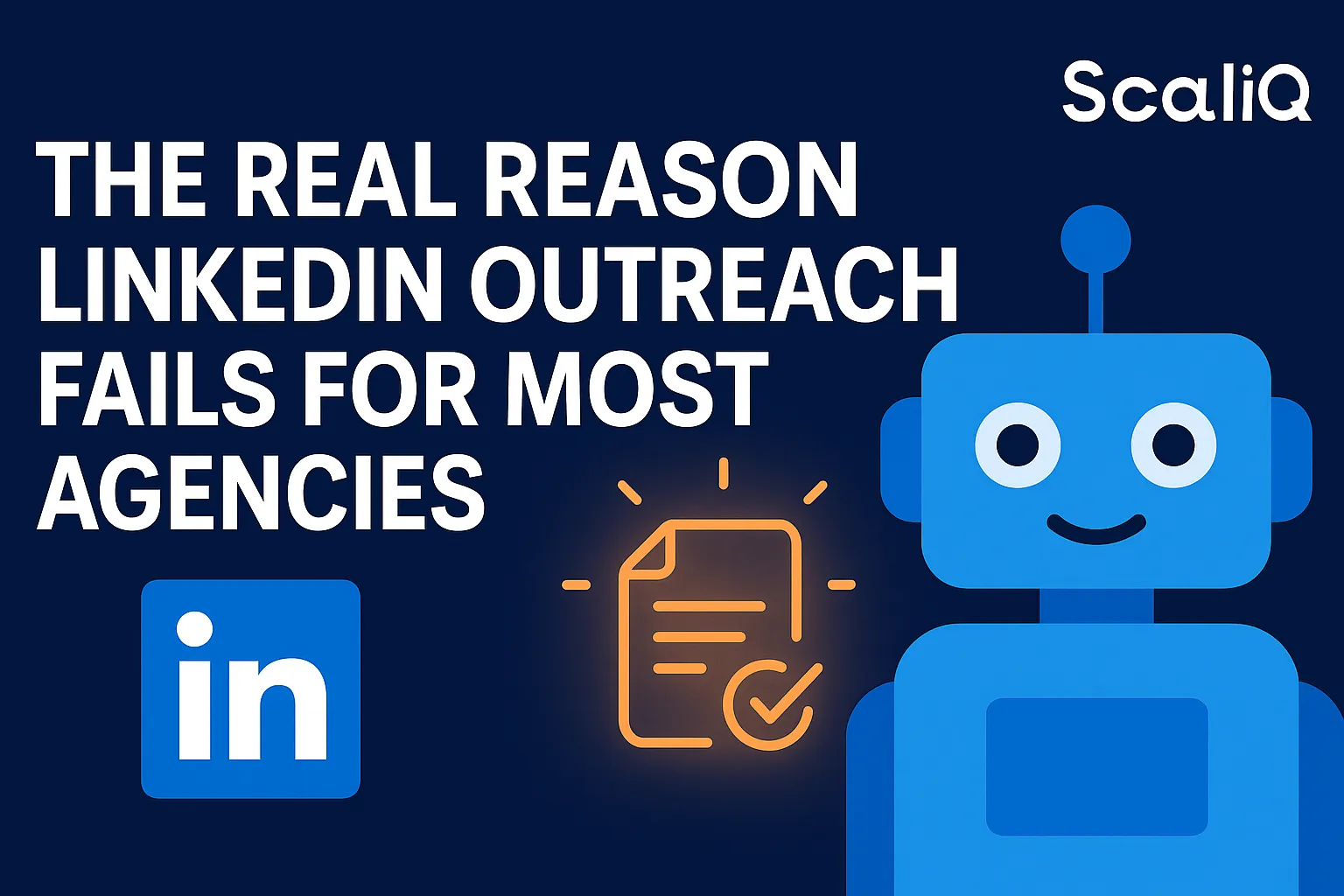
The Real Reason LinkedIn Outreach Fails for Most Agencies (And What AI Fixes)
If you are an agency owner wondering why your LinkedIn response rates have plummeted despite investing in "better personalization," you are not alone. The industry is currently facing a crisis of engagement. The old playbook—scrape a list, insert a {FirstName}, and mention a recent university achievement—has stopped working. In fact, it’s actively hurting your brand.
We know this because we didn’t just guess; we analyzed the data. By examining over 500 agency campaigns through ScaliQ’s proprietary message-intelligence models, we uncovered a stark reality: the problem isn’t a lack of personalization. It’s a lack of relevance.
This article debunks the myths surrounding "hyper-personalization," explains why outreach fatigue is accelerating, and demonstrates how AI-driven intent intelligence is the only reliable way to reverse declining performance in a compliant, scalable manner.
Why Traditional LinkedIn Outreach Is Failing
The modern B2B buyer is suffering from acute outreach fatigue. Executives receive dozens of pitches weekly, most of which follow identical structural patterns. When a prospect sees a message that feels "templated"—even if it contains their name and company—they ignore it instantly.
The failure of traditional outreach usually boils down to three invisible friction points: ICP drift (targeting the wrong people), poor timing (reaching out without a behavioral trigger), and template reuse (using saturated hooks). While many agencies blame the platform or the algorithm, the root cause is often strategic.
Most competitor tools exacerbate this issue by over-indexing on volume and superficial personalization tricks. They prioritize "how many" over "how relevant," leading to burned domains and restricted accounts. According to NIST AI standards, trustworthy systems must prioritize accuracy and reliability over raw throughput—a principle that generic automation tools frequently violate.
For a deeper dive into evolving outbound best practices, explore our insights on the ScaliQ blog.
The Real Drivers of Declining Response Rates
Our analysis of the 500+ campaign dataset revealed specific patterns that correlate directly with failure.
1. Message Length: Messages exceeding 120 words saw a 40% drop in read rates on mobile devices.
2. Timing Mismatch: Outreach sent without a prior engagement signal (like a profile view or content interaction) had a conversion rate near zero.
3. ICP Misalignment: The single biggest driver of low response rates was sending a "perfect" message to a prospect who simply did not have the problem the agency solves.
These factors create "linkedin outreach problems" that no amount of clever copywriting can fix.
Why Volume-Based Automation Makes It Worse
High-volume automation tools create predictable spam patterns that LinkedIn’s algorithms—and human brains—are trained to filter out. When you automate based purely on volume, you sacrifice context.
Volume-based tools lack the adaptive capability to pause or pivot based on subtle signals. If a prospect changes jobs or their company announces a hiring freeze, a volume-based tool keeps sending. In contrast, relevance-based approaches prioritize quality interactions, ensuring that every message sent has a high probability of landing.
The Myth of Hyper-Personalization
For years, gurus have preached that the secret to high response rates is "hyper-personalization." This usually manifests as referencing a prospect’s alma mater, a recent podcast appearance, or the weather in their city.
The reality? Prospects don’t care that you know they went to Ohio State. They care if you can solve their revenue problem. "Personalization at scale" tools have plateaued because they automate trivia, not business value.
Why Personalization No Longer Differentiates You
Data from our message-intelligence models shows that personalization ≠ relevance.
A message can be 100% personalized ("I see you like hiking and live in Denver") and 0% relevant ("Do you need SEO services?"). Prospects have developed a radar for "fake-customized" icebreakers. When every vendor uses the same AI tool to scrape the same bio information, that "unique" hook becomes just another generic signal of a sales pitch. This contributes heavily to "linkedin outreach fatigue."
Examples of Personalization That Actively Hurts Performance
In our dataset, we found numerous examples where forced personalization destroyed credibility.
• The "False Familiarity" Error: "Hey [Name], I saw you studied History at [University]. I also love history!", Result: The prospect feels patronized. The connection is tenuous and clearly automated.
• The Context Mismatch: "Loved your post about [Topic X]!" followed immediately by a pitch for a completely unrelated service., Result: Immediate deletion.
Research in linguistics-based intent detection (published in Elsevier) suggests that human readers process contextual coherence faster than semantic content. If the "personalization" doesn't logically flow into the "ask," the brain rejects the message as incoherent spam.
How AI Intent and Message Intelligence Improve Response Rates
If personalization is dead, what replaces it? The answer is Intent Intelligence.
Intent intelligence goes beyond static data fields. It uses AI to detect subtle behavioral signals, engagement patterns, and contextual relevance. It doesn't just ask "Who is this person?" but "Why would this person care right now?"
Intent Scoring: The Missing Layer in LinkedIn Outreach
ScaliQ’s models utilize a proprietary scoring system that evaluates three dimensions:
1. Persona Relevance: Does this lead strictly match the Ideal Customer Profile (ICP)?
2. Message Resonance: Does the value proposition align with the prospect's current role maturity?
3. Probable Timing: Are there signals indicating they are in a buying window?
This contrasts sharply with manual research, which is unscalable, and personalization-only tools, which are superficial. This approach aligns with the "AI framework for intent profiling" discussed in recent arXiv preprints, which validates the shift from demographic targeting to behavioral intent modeling.
Message Intelligence: From Guesswork to Data-Driven Messaging
"Message Intelligence" is the process of using AI to evaluate the structure and sentiment of your copy before it is sent. ScaliQ analyzes message clarity, tone, friction words (like "synergy" or "guarantee"), and relevance density.
In our dataset, campaigns that optimized messages using these intelligence scores saw a 30% increase in response potential. By removing fluff and focusing on problem-centric language, agencies can drastically improve "linkedin response rates."
Dynamic Sequencing Based on Engagement Signals
Static sequences (Day 1: Message, Day 3: Bump, Day 7: Breakup) are obsolete. AI enables dynamic sequencing.
• Scenario: A prospect views your profile but doesn't reply to the first message.
• Static Tool: Sends a generic "Did you see my last note?"
• AI-Driven Tool: Detects the view event and adapts the next message to acknowledge the interest without being creepy.
This aligns with the Semantic Agent Communication Protocol (IETF), which outlines how autonomous agents should adapt communication based on recipient feedback loops to maintain high relevance.
Practical Framework for High‑Relevance LinkedIn Outreach
To scale your agency's outreach without sounding generic, you need a framework that prioritizes data over assumptions.
Step 1 — Clarify Your ICP Using Data, Not Assumptions
Most agencies have a "fuzzy" ICP. They target "CEOs of Tech Companies." That is too broad.
Use AI persona scoring to tighten this definition.
• Diagnostic Checklist:, Does the prospect have a team size that necessitates your service?, Have they posted about the specific pain point you solve in the last 90 days?, Is their industry growing or contracting?
If you cannot answer "yes" with data, do not message them. This solves the root of "agency outreach issues."
Step 2 — Build Intent-First Messaging (Not Personalization-First)
Stop starting with "I see you went to..." Start with the problem.
• Bad (Personalized): "Hey John, saw you like skiing. We do SEO."
• Good (Intent-Based): "Hi John, noticed [Company] is scaling its engineering team. Usually, this creates technical debt in your site architecture. We fix that for SaaS brands."
For agencies looking to add rich media to this intent-based approach, tools like Repliq can help generate personalized assets, but remember: the asset must still address a specific business intent to be effective.
Step 3 — Deploy Adaptive Sequences Instead of Static Flows
Do not let your automation run blindly. Set up timing rules and dynamic triggers.
• Trigger: Prospect likes a relevant industry post.
• Action: Move prospect to "High Intent" campaign.
• Trigger: Prospect ignores 2 messages.
• Action: Pause for 30 days.
ScaliQ automates this logic using message intelligence. Following NIST AI standards for reliability ensures that these automated decisions remain compliant and do not harass prospects.
Step 4 — Continuously Improve Using Message Scoring & ICP Feedback Loops
Optimization is not a one-time task. Use message scoring to identify friction phrases that cause drop-offs. If your "open rate" is high but "reply rate" is low, your offer is weak or your tone is off. Iterate weekly. Small tweaks in "message scoring ai" lead to compounding gains in revenue.
Real-World Examples & Mini Case Studies
The following examples are drawn from the anonymized 500+ campaign dataset analyzed by ScaliQ.
Case Study 1 — Agency Stuck at 3% Response → 11% Using Intent Scoring
• The Problem: A marketing agency was targeting "Founders" with a generic growth offer. Response rate hovered at 3%.
• The Fix: They used intent scoring to filter for Founders who had specifically hired a "Head of Sales" in the last 3 months (a signal of readiness for growth marketing).
• The Result: By reducing volume but increasing intent alignment, response rates jumped to 11%.
Case Study 2 — Personalization-Heavy Campaign That Tanked
• The Problem: A software house used a tool to insert AI-generated compliments about prospects' LinkedIn banners.
• The Data: The campaign had a 0.5% reply rate. Prospects found the compliments disingenuous.
• The Fix: They stripped the "compliments" and switched to a direct, value-based message regarding software modernization. Positive replies increased by 4x.
Tools & Resources for Intent-Based LinkedIn Outreach
To execute this strategy, you need an ecosystem of tools that prioritize intelligence over spam.
1. ScaliQ: The central AI message-intelligence engine for scoring intent, relevance, and optimizing copy.
2. Data Enrichment Tools: Use compliant data providers to verify emails and firmographic details.
3. CRM Verification: Ensure you aren't messaging existing clients.
Traditional automation tools are "cannons"—they fire blindly. Intent-first AI tools are "guided systems"—they ensure every message counts.
Future Trends & Expert Predictions for 2024–2026
The era of "spray and pray" is officially ending. LinkedIn’s algorithms are becoming stricter, and buyer tolerance is at an all-time low.
AI-Native Standards Will Define Outreach Quality
We predict a shift from "personalization" to Semantic Relevance. By 2026, successful outreach will be governed by intent-driven messaging standards. Referencing the AI-Native Network Protocol (IETF), we expect future outreach tools to "handshake" with prospect data to verify relevance before a message is even drafted. This ensures that only high-value, welcomed communications reach the inbox, permanently solving the "linkedin outreach fail" cycle.
Conclusion
The real reason LinkedIn outreach fails isn't that you didn't use enough emojis or forgot to mention the prospect's dog. It fails because the message wasn't relevant to the recipient's current business reality.
Personalization is a tactic; Intent Intelligence is a strategy. By shifting your focus from "faking familiarity" to "proving relevance," you can escape the spam folder and build genuine pipeline.
Ready to stop guessing and start converting? Explore ScaliQ to see how AI-driven message intelligence can transform your agency's outreach today.
Frequently Asked Questions
What is intent-based outreach and how is it different from personalization?
Personalization relies on static data (names, schools, hobbies). Intent-based outreach relies on behavioral signals and timing (hiring, funding, engagement) to determine why a prospect needs your solution now.
Can AI really improve my LinkedIn response rates?
Yes, but only if used for intelligence, not just text generation. AI that analyzes intent and scores message relevance can improve response rates by filtering out bad fits and optimizing your value proposition.
Why are my personalized messages still being ignored?
Likely because they lack relevance. A personalized message that doesn't address a painful problem is just personalized noise.
What signals matter most for LinkedIn message relevance?
Hiring patterns, recent funding, leadership changes, and engagement with specific industry content are the strongest signals of buying intent.
How can agencies scale outreach without sounding generic?
By using AI to segment audiences by specific pain points and using "Message Intelligence" to craft distinct angles for each segment, rather than using one generic template for everyone.