


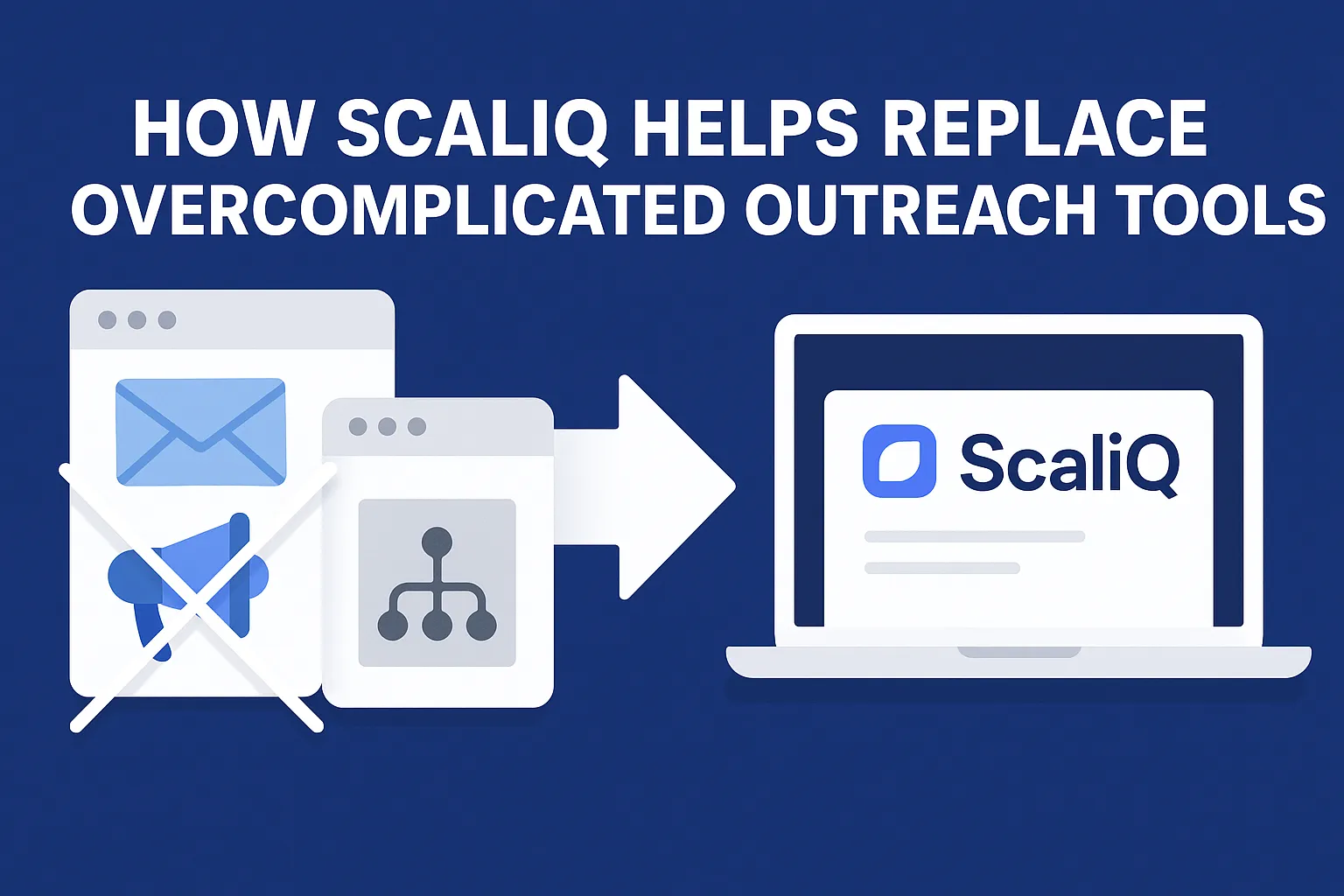
How ScaliQ Helps Replace Overcomplicated Outreach Tools (Simplify Your Stack)
If you are new to cold outreach, your browser tabs probably look like a chaotic mess. You likely have one tab open for finding leads, another for verifying emails, a third for writing personalized lines, and a fourth for actually sending the emails.
This fragmented approach is the standard advice given to beginners, but it often leads to confusion, skyrocketing monthly costs, and constant context switching. Instead of focusing on your message and your prospects, you spend your days managing integrations and troubleshooting broken workflows.
There is a better way. By consolidating your workflow, you can drastically reduce complexity and regain focus. In this guide, we will explore why modern outreach stacks have become so bloated, the hidden financial and cognitive costs of running too many tools, and how a unified platform like ScaliQ can simplify your outreach stack by replacing bulky, multi-tool setups.
Why Outreach Stacks Have Become Overly Complicated
The modern sales technology landscape is crowded. New users are frequently pushed toward "comprehensive" setups that mimic enterprise-level sales teams. The prevailing advice suggests you need a specialized prospecting tool, a separate enrichment provider, an AI personalization engine, a sequencer for sending, and deliverability tools to warm up your inbox.
For a solo founder or a small team, this is overkill. It results in overwhelming dashboards, steep learning curves, and a disjointed strategy where data gets lost between platforms. While competitors in the sales engagement space race to add more bells and whistles, the user experience suffers under the weight of unnecessary features.
This phenomenon isn't unique to sales tools. It is part of a broader trend known as "SaaS Sprawl," where companies accumulate more applications than they can effectively manage. According to an IBM overview of SaaS sprawl, this unmanaged growth of software usage leads to security risks, wasted spend, and operational inefficiency.
If you are looking for a way to cut through the noise, ScaliQ offers a refreshing contrast by prioritizing a streamlined, all-in-one workflow over feature bloat.
The Rise of Multi-Feature, Overbuilt Platforms
Many popular sales engagement platforms started simple but have evolved into complex behemoths. As they chase enterprise clients, they add layers of reporting, multichannel automation, and intricate permission settings.
Unfortunately, these features filter down to beginner plans, cluttering the interface. A user who simply wants to send 50 high-quality emails a day does not need complex attribution modeling or multichannel matrixes. They need clarity. Complex sales engagement platforms often confuse the core objective—starting conversations—with the mechanics of managing software.
The Cognitive Burden of Managing Too Many Tools
The cost of complexity isn't just financial; it's mental. When your workflow requires you to jump between a lead finder, a spreadsheet, and an email sender, you are constantly shifting your attention.
This "context switching" is a productivity killer. A study on multitasking and context switching highlights how juggling multiple information streams degrades performance and increases error rates (see: 2006.12636). For outreach professionals, this means you are more likely to make mistakes—like sending the wrong email to the wrong prospect—simply because your brain is fatigued from managing the tools rather than the relationships.
What a Simplified, Unified Outreach Workflow Looks Like
Imagine a "before and after" scenario. In the "before," you are a data entry clerk, moving CSV files between tabs. In the "after," you are a strategist operating from a single command center. A simplified outreach stack removes the friction, allowing you to move from idea to execution in minutes, not hours.
One Place for Prospecting, Personalization, and Outreach
The ideal unified outreach workflow follows a linear path within one interface:
1. Source: You identify your target audience using built-in filters.
2. Enrich: The system automatically finds valid contact details.
3. Personalize: AI analyzes the prospect's data to write relevant icebreakers.
4. Send: The email is scheduled immediately within the same view.
This is the definition of beginner-friendly cold outreach tools. There are no exports, no uploads, and no lost data.
How Consolidation Improves Deliverability
When your prospecting and sending tools are unified, your email deliverability often improves. Disjointed stacks can lead to "burst" sending behavior—where you upload a huge list once a week and blast them all at once because the manual process is too tedious to do daily.
A clean outreach setup encourages consistent, lower-volume daily activity. Sending 20–50 emails every single day is far better for domain reputation than sending 300 emails once a week. Unified tools make this consistency easy to maintain.
The Emotional Benefit: Less Overwhelm, More Confidence
When you trust your simple outreach workflow, you feel more confident. You know exactly where your leads are, what they are receiving, and when the follow-ups will happen. This clarity eliminates the "Sunday Scaries" of sales—the dread of opening a complex dashboard on Monday morning. You gain predictability and a faster learning loop.
How ScaliQ Replaces 3–5 Tools Without the Complexity
ScaliQ was designed specifically to solve the problem of fragmentation. It is not just another tool in the stack; it is a ScaliQ alternative to the entire bloated ecosystem. It replaces the need for separate subscriptions by bundling the essential functions beginners actually need, without the enterprise complexity.
Replace Prospecting Tools
Usually, you need a subscription to a database just to find companies. ScaliQ integrates prospecting automation directly. You can search for leads based on industry, role, and location within the platform, eliminating the need to pay for a third-party lead scraper or database.
Replace Personalization Tools
Personalization is often the most expensive add-on in a sales stack. ScaliQ includes personalization automation natively. It uses data points found during the prospecting phase to generate relevant, human-sounding opening lines. You don't need to hook up an external AI writer or pay per "credit" for personalization—it's part of the flow.
Replace Outreach Sequencers and Complex Automation Logic
Instead of a complex sequencer that requires a degree in logic to program, ScaliQ offers a simple outreach sequencer. You set up your email steps, define the delay between them, and hit active. It handles the scheduling and follow-ups automatically.
What Beginners Gain Immediately
By switching to a unified platform like ScaliQ, beginners gain:
• Faster Setup: Go from signup to sending in minutes, not days.
• Lower Costs: One subscription replaces 3–5 separate bills.
• Unified Data: Prospect data and email history live in one record.
• Focus: You spend time on messaging, not managing software.
Case Study Examples (Beginner-Friendly)
To illustrate the power of outreach workflow efficiency, let’s look at two hypothetical scenarios where tool reduction changed the game.
Solo Founder Cutting 4 Tools Down to 1
The Situation: Sarah, a solo founder of a design agency, was spending $250/month on ZoomInfo (lite version), an email verifier, and a separate sending tool. She spent 4 hours every Sunday manually formatting CSVs to prepare for the week.
The Solution: She switched to a unified stack. Now, she spends 30 minutes on Monday morning selecting her prospects inside one platform. The system handles the verification and sending automatically. She saved $200/month and reclaimed 15 hours of work per month. This is the power of solo founder outreach simplification.
Small Team Eliminating Integration Failures
The Situation: A two-person sales team was using a CRM, a scraper, and an outreach tool connected via Zapier. Frequently, the "Zap" would break, and leads would get emailed twice or not at all.
The Solution: By moving to a consolidated team outreach workflow, they eliminated the middleware. They now have a single source of truth. If a prospect replies, the sequence stops automatically—no integration required. They reduced errors by 100% and improved their sender reputation.
Tools & Resources for a Simple Outreach Setup
If you are evaluating your current stack, use this checklist to ensure you are building a simple outreach setup:
1. Consolidation Capability: Can this tool handle both finding and contacting leads?
2. Ease of Use: Can I set up a campaign in under 10 minutes?
3. Data Portability: Does it require me to export/import CSVs manually? (If yes, it adds friction).
4. Compliance: Does the tool respect privacy laws and Google Maps terms of service?
While there are many simple outreach tools available, ScaliQ is engineered specifically to tick these boxes for beginners who want to avoid the "enterprise trap."
Future Trends: Simpler, AI-Assisted Outreach
The future of sales tech is not "more features," it is "less friction." We are moving toward a simplified sales stack where AI acts as the bridge between tasks.
AI outreach tools are becoming smarter, capable of handling the grunt work (finding, verifying, personalizing) in the background. The trend is moving away from modular, disconnected apps toward holistic platforms that treat outreach as a single, fluid motion. ScaliQ aligns perfectly with this future, leveraging AI to remove the manual steps that used to require separate software.
Conclusion
The era of juggling 3–6 different tools to send a simple email campaign is ending. The hidden costs—both financial and cognitive—are too high for modern businesses to ignore. By choosing to simplify your outreach stack, you reduce overhead, minimize errors, and free up mental energy to focus on what matters: connecting with your market.
ScaliQ stands as a robust ScaliQ alternative to the complex, fragmented status quo. It offers a clean, unified environment where prospecting, personalization, and sending happen seamlessly.
If you are tired of broken integrations and expensive monthly subscriptions, it is time to rethink your workflow. Embrace simplicity and start building meaningful connections today.