

How ScaliQ AI Agents Manage Multi-Step Conversations Automatically
For Sales Development Representatives (SDRs), the morning routine often begins with a chaotic scramble. You open LinkedIn to find a mix of new connections, vague replies, and prospects asking complex questions. Hours are lost manually tracking who replied to what, remembering the context of previous messages, and deciding whether to push for a meeting or nurture the lead.
While email automation has existed for decades, LinkedIn remains a manual bottleneck. Traditional sequencing tools struggle here because they are rigid. A prospect’s casual reply of "Not now, maybe next quarter" often breaks a linear sequence, requiring human intervention to tag, reschedule, and draft a specific follow-up. When you multiply this by hundreds of prospects, personalization breaks, and opportunities slip through the cracks.
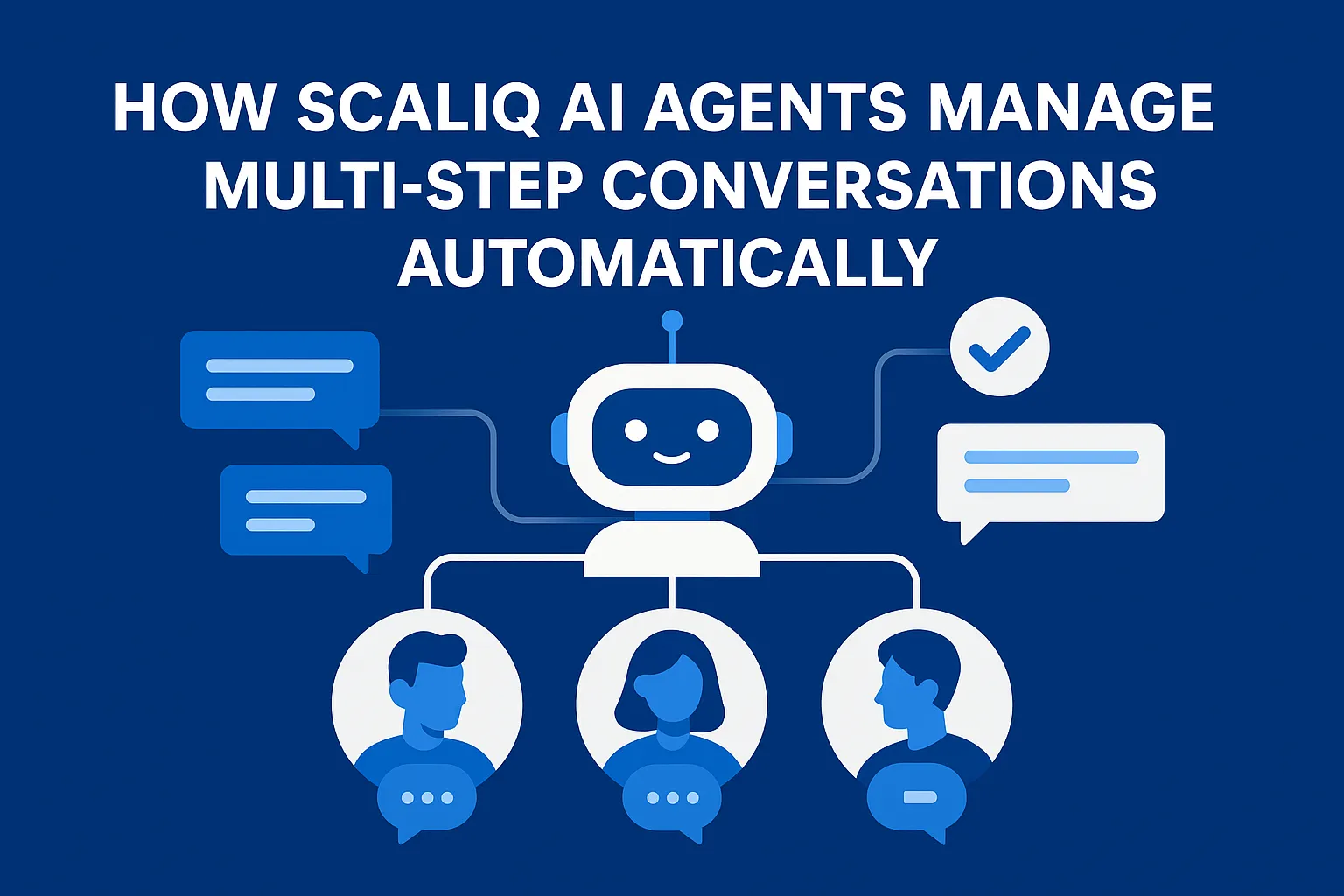
This is where multi-step AI outreach changes the game. Unlike basic automation scripts that fire off static templates, ScaliQ utilizes a multi-agent architecture designed specifically for LinkedIn AI thread management. By employing specialized AI agents that handle distinct roles—from sentiment analysis to message drafting—ScaliQ automates the entire AI conversation flow, ensuring that every reply gets a contextually accurate, timely response without human burnout.
Why Traditional Outreach Tools Fail on LinkedIn
Most sales engagement platforms were built primarily for email—a medium that is linear, formal, and slow-paced. When these rigid outreach sequencing tools are applied to LinkedIn, friction occurs immediately. LinkedIn is a chat-based environment; it is informal, rapid, and highly conversational.
Traditional tools operate on "if/then" logic based on time delays (e.g., "Send Message B three days after Message A"). However, they often lack the nuance to handle the dynamic nature of a chat thread. If a prospect replies with a question, a traditional tool might stop the sequence entirely, forcing the SDR to take over manually. This leads to manual follow-up tracking on LinkedIn, where SDRs must keep mental tabs on dozens of open threads.
Furthermore, reliability and compliance are major concerns. According to high-level standards from the NIST AI Agent Standards, reliable automated systems must demonstrate consistent behavior under varying input conditions. Traditional "single-track" automation fails this standard on LinkedIn because it cannot adapt to the variability of human conversation, often resulting in generic, robotic responses that damage brand reputation.
For a deeper dive into how automation is evolving for sales teams, read more on our blog: Blog
The Nature of LinkedIn Threads (Why They’re Hard to Automate)
To understand the challenge, one must look at the anatomy of a LinkedIn message. Unlike an email subject line and body, a LinkedIn thread is a continuous stream of consciousness. Prospects may send three short messages in rapid succession, use emojis, or reference a post you shared weeks ago.
This unstructured data is difficult for standard LinkedIn AI automation scripts to parse. A prospect might say, "Sure," which could mean "Sure, let's meet," or "Sure, send me a PDF." Without deep context awareness, a linear automation tool cannot distinguish between the two, leading to awkward misfires.
How AI Agents Manage Multi‑Step Conversation Flows
ScaliQ moves beyond simple scripting by utilizing a "conversation state machine." In computer science terms, a state machine allows a system to be in one of several different "states" (e.g., "Awaiting Reply," "Objection Handling," "Scheduling") and defines exactly what triggers a transition from one state to another.
In AI conversation flow management, ScaliQ’s agents continuously monitor the thread. When a reply is detected, the system doesn't just flag it; it classifies the intent using Natural Language Understanding (NLU). It determines if the sentiment is positive, negative, or neutral, and updates the state of the conversation accordingly. This allows automated conversation sequences to feel fluid and human, rather than robotic and pre-determined.
Step-by-Step View of an AI-Managed Flow
To visualize how AI detecting replies and branching conversations works, consider this five-step process managed by the AI:
1. Trigger: The system sends an initial personalized connection request or message based on the prospect's profile.
2. Detection: The AI monitors the inbox. Once a reply is received, it halts any scheduled "nudge" messages to prevent overlapping.
3. Classification: The AI analyzes the text. Is it a question? An objection? A meeting confirmation?
4. Drafting: Based on the classification, the Drafting Agent generates a response. If the prospect asked for pricing, the agent retrieves approved pricing language.
5. Scheduling: The Timing Agent decides when to send the reply to mimic natural human behavior (e.g., waiting 10 minutes rather than replying instantly).
Research from the Association for Computational Linguistics (ACL) on multi-step task-oriented dialogue highlights that maintaining context across multiple turns is the single biggest predictor of successful automated interactions. ScaliQ’s architecture is built on these principles, ensuring the AI remembers context from "Step 1" even when the conversation reaches "Step 5."
Dynamic Branching and Reply Detection Explained
The core of ScaliQ’s effectiveness lies in dynamic branching AI. In a static sequence, everyone follows the same path. In a dynamic flow, the path changes based on the user's input.
Reply detection AI allows the system to categorize responses into specific buckets, triggering different workflows:
• Positive Reply: Trigger "Booking Flow" (Suggest times, offer calendar link).
• Objection (e.g., "Too expensive"): Trigger "Value Proposition Flow" (Acknowledge concern, share case study).
• Delay (e.g., "Contact me in Q3"): Trigger "Nurture Flow" (Pause sequence, schedule follow-up for 90 days).
• No Response: Continue "Nudge Flow" (Gentle bump after 3 days).
Real-world SDRs use this logic intuitively. ScaliQ codifies this intuition into software, allowing the AI to make these branching decisions instantly and at scale.
Handling Edge Cases and Complex Branches
Human conversation is messy. Conversation workflow AI must handle "edge cases"—situations that don't fit the standard happy path.
• Multiple Replies: A prospect sends "Actually wait," followed 30 seconds later by "I do have time Tuesday." The AI must aggregate these messages into a single context rather than replying to them individually.
• Topic Switching: A prospect ignores the pitch and asks, "Do you know John Doe?" The AI must identify the topic switch and pivot, rather than forcing the sales pitch.
• Timeout Handling: If a prospect stops replying mid-negotiation, the system must decide whether to send a "break-up" message or a value-add article.
Research presented at AAMAS (Autonomous Agents and Multiagent Systems) suggests that multi-agent coordination is essential for resolving these conflicts. A single bot often gets "confused" by conflicting inputs, whereas a coordinated system can delegate the conflict resolution to a specialized logic agent.
Why Multi‑Agent Systems Outperform Single AI Bots
Early iterations of sales AI relied on a single Large Language Model (LLM) to do everything. The problem with single-bot systems is that they are "jacks of all trades, masters of none." They often hallucinate or lose track of instructions when asked to analyze sentiment, check calendar availability, and draft a witty message simultaneously.
Multi-agent SDR systems solve this by dividing labor. In AI outreach sequencing, specialization reduces error rates. One agent is optimized solely for reading and categorization (Input Processing), while another is optimized for persuasive writing (Output Generation). This separation of concerns results in higher accuracy, better compliance with brand tone, and significantly faster processing times.
Real Example of Agent-to-Agent Handoff
In multi-agent AI outreach, the workflow resembles a relay race:
1. Agent A (The Analyst): Reads the incoming LinkedIn message. It detects a "Soft Objection" regarding implementation time. It passes this data to Agent B.
2. Agent B (The Strategist): Consults the "Objection Handling Matrix." It selects the strategy: "Reassure with Fast Onboarding Fact." It passes this instruction to Agent C.
3. Agent C (The Copywriter): Drafts the actual response using the strategy from Agent B, ensuring it sounds like the specific SDR sending it.
4. Agent D (The Scheduler): Queues the message to be sent during the prospect's local business hours.
This framework aligns with autonomous agent research from UC Berkeley, which demonstrates that modular agent architectures significantly outperform monolithic models in complex, multi-step decision-making environments.
Competitor Gap Analysis (Without Naming Them)
Many tools currently on the market claim to offer LinkedIn AI automation tools comparison, but upon closer inspection, they reveal significant gaps. Most are simply "wrappers" around email sequencing tools. They might offer "AI personalization," but this is usually limited to generating a custom opening line based on a LinkedIn bio.
The critical missing capability in these tools is real-time, multi-turn reply detection. They treat a reply as the "end" of the automation. Once a prospect responds, the tool shuts off, dumping the conversation back onto the SDR. They lack the multi-step branching and multi-agent logic required to carry the conversation forward through negotiation and scheduling.
What Makes ScaliQ Uniquely Effective for SDR Teams
ScaliQ is not an email tool adapted for LinkedIn; it is a platform architected specifically for ScaliQ AI agents to navigate the nuances of social selling. Our system maintains a persistent "memory" of the conversation state, allowing it to handle conversations that span days or weeks without losing context.
By leveraging role-based agents, ScaliQ allows for scalable SDR workflows that go beyond simple outreach. It enables teams to automate the middle of the funnel—the back-and-forth messaging that typically consumes 60% of an SDR's day. This results in higher reply rates, as response times are optimized, and no lead is ever left on "read."
Ready to see how this works in your live environment? ScaliQ
The ScaliQ Multi-Agent Framework (Practical Breakdown)
To make AI agents LinkedIn automation practical, we break down the roles clearly:
• Agent 1: The Drafter. This agent is trained on your best-performing templates and your specific Value Proposition. It handles the creative aspect of automated multi-step outreach, ensuring messages feel personal and relevant.
• Agent 2: The Interpreter. This agent uses advanced sentiment analysis to "read the room." It doesn't just look for keywords; it assesses the prospect's emotional tone (e.g., annoyed, curious, enthusiastic).
• Agent 3: The Orchestrator. This agent acts as the traffic controller. It decides which branch of the workflow to activate based on Agent 2's analysis and tells Agent 1 what to write.
Real-World SDR Workflow Example
Consider a typical SDR AI automation scenario using ScaliQ:
1. Cold Connect: Agent 1 sends a connection request with a personalized note referencing the prospect’s recent promotion.
2. Acceptance: The prospect accepts but doesn't reply. Agent 3 waits 24 hours, then triggers Agent 1 to send a value-led question.
3. Engagement: The prospect replies, "That's interesting, but we use [Competitor X]."
4. Qualification: Agent 2 identifies "Competitor Mention." Agent 3 selects the "Competitor X Differentiator" branch. Agent 1 drafts a message highlighting specific advantages over Competitor X.
5. Conversion: The prospect agrees to a chat. Agent 3 identifies "Intent to Book" and sends the calendar link.
This entire LinkedIn conversation automation happens without the SDR needing to intervene until the meeting is booked.
Tools & Resources for Better AI Conversation Flows
To maximize the effectiveness of sales AI workflows, SDR teams must provide the AI with the right raw materials. Automation is only as good as the strategy behind it.
• Objection Matrices: Teams should prepare clear documentation on how to handle common objections (Price, Timing, Competitors).
• ICP Definitions: Clearly defined Ideal Customer Profiles help the AI prioritize which leads warrant longer, more complex nurturing flows.
• Message Variants: Providing the AI outreach toolkit with multiple ways to say the same thing ensures variety and prevents spam filters from flagging repetitive content.
Consult ScaliQ’s internal documentation for templates on structuring these assets effectively.
Future Trends & Expert Predictions
The future of ai outreach is moving toward full autonomy. We predict a shift from "human-in-the-loop" to "human-on-the-loop," where SDRs act as supervisors rather than operators.
As outlined in NIST AI Agent Standards and UC Berkeley frameworks, we expect to see deeper agent-to-agent delegation. Future systems will likely include "Researcher Agents" that autonomously browse the web for company news to inform adaptive AI conversations in real-time, creating hyper-relevant hooks that are indistinguishable from deep human research.
Conclusion
Traditional outreach tools are failing SDRs because they treat LinkedIn like email—static, linear, and rigid. ScaliQ solves this by deploying a multi-agent AI outreach system that understands the dynamic nature of conversation. By utilizing detecting replies, dynamic branching, and automated thread management, ScaliQ allows teams to scale their efforts without sacrificing the personal touch that drives conversions.
Don't let your LinkedIn leads stagnate in an inbox. Experience the power of intelligent AI conversation flow.
Book your ScaliQ demo today to transform your SDR workflow.