

Introduction
Every growth marketer knows the sinking feeling: you log in to check the progress of a lead generation campaign, only to be greeted by a restriction notice. "Your account has been temporarily restricted." In an instant, your pipeline freezes, and your outreach strategy grinds to a halt.
For years, scraping LinkedIn was a simple game of volume. But in 2026, the landscape has shifted dramatically. Traditional scrapers—relying on static scripts and basic proxies—are failing at record rates. LinkedIn’s dynamic anti-bot systems have evolved, utilizing advanced pattern recognition that can spot non-human behavior in milliseconds. If you are still using tools from 2023, you aren't just risking efficiency; you are risking your digital identity.
The future of data extraction isn't about brute force; it is about intelligence. Enter AI-driven, compliance-first scraping. By leveraging behavioral modeling, adaptive throttling, and rigorous compliance frameworks, modern tools can extract public data without triggering alarms.
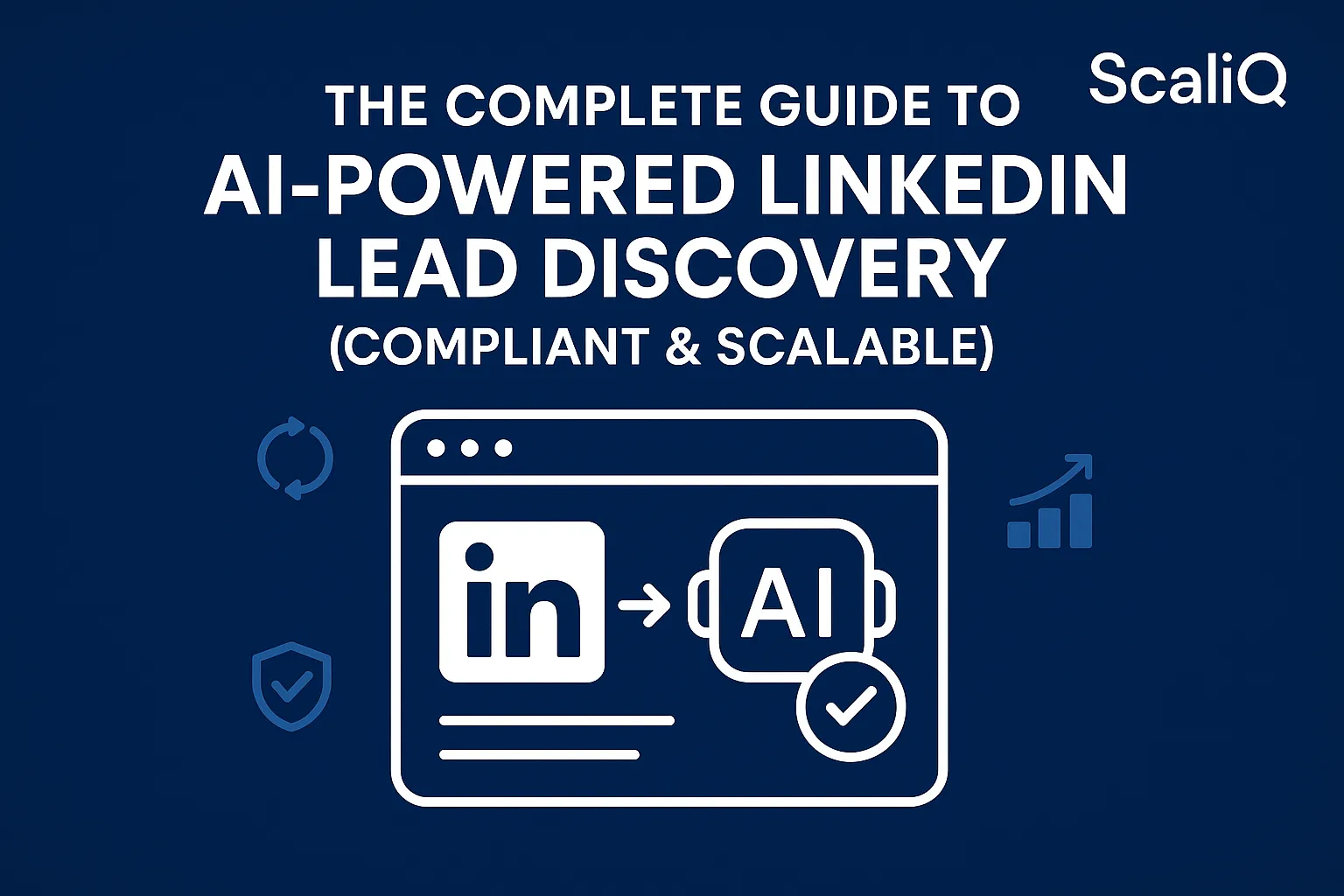
This guide explores how to navigate this new era of linkedin lead scraping ai. We will dismantle the mechanisms behind account bans, explain how AI mimics human behavior to ensure safe scraping linkedin, and introduce ScaliQ’s unique approach to keeping your accounts healthy while keeping your pipeline full.
Why LinkedIn Scraping Gets Accounts Blocked
To solve the problem of account restrictions, we must first understand the surveillance architecture protecting the platform. LinkedIn does not rely on a single metric to ban users; it uses a composite risk score derived from sophisticated detection models.
LinkedIn’s Anti-Bot & Anti-Automation Detection Models
Modern platforms employ "fingerprinting" techniques that go far beyond checking your IP address. They analyze the "rhythm-of-actions"—the microscopic timing between clicks, scrolls, and page loads.
Static scrapers create a detectable footprint because they are too perfect. They load pages in exactly 0.5 seconds, click the same X/Y coordinates every time, and navigate linearly without the chaotic "noise" of human browsing. LinkedIn’s security algorithms look for these rigid patterns. If your session lacks the variance of a human user—such as random mouse movements or variable reading times—the system flags the activity as linkedin automation. Once flagged, the account enters a "probationary" state where thresholds for avoid linkedin blocks when scraping become significantly tighter.
Common Behaviors That Trigger Blocks
Account restrictions are rarely random. They are usually triggered by specific, aggressive behaviors that signal non-human intent. The most common red flags include:
• Burst Queries: Sending hundreds of profile requests in a few minutes, far exceeding the reading speed of a human.
• Identical Network Requests: Sending headers and payloads that lack the natural variation of a browser session.
• Unnatural Timing: Performing actions at exact intervals (e.g., visiting a profile exactly every 10 seconds).
• 24/7 Activity: Scraping continuously without sleep breaks or "weekend" downtime.
For sales teams, these triggers result in unreliable tools and the constant anxiety that a campaign could die overnight. To practice linkedin scraping without getting blocked, one must eliminate these mechanical signatures.
Why Proxy Rotation Alone Isn’t Enough Anymore
A decade ago, rotating IP addresses (proxies) was the gold standard for evasion. If LinkedIn blocked one IP, the scraper would simply hop to another. Today, this is insufficient.
Modern anti-detection systems track the account behavior, not just the connection source. If a user logs in from 50 different residential IPs in one hour while performing the same repetitive task, the behavior itself is the red flag. Most legacy linkedin scraper tools still rely heavily on proxy rotation while ignoring the behavioral aspect, leaving users vulnerable to detection despite high proxy costs.
How AI Prevents Detection and Enhances Safety
The solution to sophisticated detection is sophisticated emulation. Artificial Intelligence allows scrapers to move away from rigid scripts and toward adaptive, fluid interactions that mirror human users.
AI Behavioral Modeling & Human-Like Interaction
Safe scraping requires simulating a digital identity. AI behavioral modeling introduces "chaos" into the scraping process. Instead of instantly extracting data, an AI agent might scroll halfway down a page, pause to "read," hover over a skill section, and then extract the data.
This approach aligns with research on bot detection, such as studies from Duke University on AI bot scraping, which highlight that introducing variable latency and non-linear navigation significantly reduces detection rates. ScaliQ leverages similar experience-driven behavioral algorithms. By varying click coordinates and dynamically adjusting wait times based on page load speed, ai scraping tools become virtually indistinguishable from a diligent recruiter manually browsing profiles.
Adaptive Rate Limiting & Smart Throttling
Static rate limits (e.g., "100 profiles per day") are outdated because they don't account for real-time network conditions. AI-driven adaptive throttling monitors the server's response time.
If LinkedIn’s server response slows down—often a precursor to a soft block or CAPTCHA—the AI detects this micro-signal and immediately throttles back. It might pause scraping for an hour or slow the speed by 50%. This reactive capability is crucial for safe scraping linkedin, ensuring the tool backs off before a red flag is raised, rather than after.
AI Risk Scoring & Account Health Monitoring
Imagine having a "Health Bar" for your LinkedIn account. AI Risk Scoring predicts the likelihood of a ban based on historical data.
The system analyzes interaction frequency, query complexity, and session stability to assign a real-time risk score. If the score creeps into the "Warning" zone, the system automatically halts operations to let the account cool down. This predictive approach solves the primary fear of users—waking up to a banned account—by enforcing compliant linkedin scraping protocols automatically.
Enrichment + Scraping: Safer Together
One of the most effective ways to stay safe is to scrape less. By combining scraping with data enrichment, you reduce the number of direct profile hits required.
Instead of visiting 1,000 profiles to find 100 valid emails, you can scrape basic public info and use enrichment databases to fill in the gaps. This reduces the "request volume" on your LinkedIn account significantly. Orchestrating this balance is critical. For example, tools like NotiQ serve as excellent workflow orchestrators, managing enrichment pipelines that minimize direct scraping load while maximizing data quality. This strategy defines the next generation of ai linkedin scraping tools.
Compliance-First Frameworks for LinkedIn Data Extraction
Scraping is not just a technical challenge; it is a legal and ethical one. Operating within a compliance framework is essential for long-term sustainability and brand reputation.
Understanding LinkedIn’s ToS & Acceptable Use Boundaries
While LinkedIn prohibits unauthorized scraping in its Terms of Service (ToS), the legal landscape regarding public data is nuanced. The key is distinguishing between "hacking" (accessing private data) and "indexing" (recording public data).
Safe scraping linkedin means strictly accessing data that is publicly visible to the logged-in user or available on the public web, without bypassing authentication barriers illicitly. It involves respecting the platform's integrity by not degrading their service with excessive load. Note: This is not legal advice, but a best-practice operational standard.
GDPR-Compliant Scraping Principles
For businesses operating in or targeting Europe, GDPR is non-negotiable. The concept of "Legitimate Interest" is often cited as the basis for B2B data collection.
According to guidance from the CNIL (French Data Protection Authority) and the IAPP (International Association of Privacy Professionals), web scraping must be transparent and necessary. Key principles include:
• Data Minimization: Only scraping what is needed.
• Notification: Informing prospects (usually via the first outreach email) where their data was sourced.
• Right to Opt-Out: Respecting removal requests immediately.
• Garante Guidelines: Adhering to Italian authority rulings on preventing indiscriminate mass collection without purpose.
Adhering to GDPR scraping and linkedin compliance standards protects your company from fines and reputational damage.
Privacy-First Data Processing (NIST Framework Concepts)
Security-by-design is a core tenet of the NIST (National Institute of Standards and Technology) privacy framework. In the context of scraping, this means your data handling pipeline should be secure from end to end.
ScaliQ aligns with these standards by ensuring that scraped data is encrypted, access-controlled, and processed with strict governance. Privacy-safe scraping isn't just about how you get the data, but how you protect it once you have it.
Zero-Footprint Scraping & Ethical Guardrails
Ethical scraping involves leaving "zero footprint." This means the target user should not feel the impact of your extraction.
AI helps achieve this by deduping requests. If a profile was scraped last week, the AI remembers and prevents a re-scrape, saving server resources and reducing intrusion. Ethical scraping focuses on high-precision targeting rather than "spray and pray" tactics. This zero-footprint scraping philosophy ensures that the ecosystem remains healthy for everyone.
Building a Scalable, Low-Risk Lead Generation Workflow
How do you implement this in the real world? Here is a step-by-step blueprint for building a high-volume, low-risk engine.
Step 1 – Define Query Scope & Minimize Data Loads
The safest scrape is the one you don't have to make. Start by refining your Sales Navigator or search queries to be hyper-specific. Excluding irrelevant profiles at the search level prevents your bot from wasting "health points" on bad leads. This precision is the foundation of effective lead generation scraping.
Step 2 – Scrape Using AI Behavioral Simulation
Once your targets are defined, initiate the extraction using an AI-driven tool. The workflow should include:
• Warm-up: Slowly increasing activity over days.
• Randomization: varying the time of day the scraper runs.
• Interaction Modeling: simulating profile views and scrolls.
This ensures your linkedin lead scraping ai operates under the radar.
Step 3 – Enrich Leads with AI to Reduce Scraping Volume
Do not rely on LinkedIn for every single data point. Scrape the core identity (Name, Company, URL) and then offload the heavy lifting to an enrichment provider for emails and phone numbers.
For a robust safety-first engine, ScaliQ offers an AI-powered scraping infrastructure designed specifically to balance extraction depth with account safety. Using ai lead enrichment in tandem with scraping reduces the direct load on LinkedIn by up to 60%.
Step 4 – Automate Validation, Cleanup & Risk Analysis
Raw data is rarely ready for outreach. Use AI to:
• Reverse-validate emails to prevent bounces (which hurt domain reputation).
• Remove duplicates across campaigns.
• Score quality based on ICP fit.
AI data cleanup ensures that only high-value contacts enter your CRM.
Step 5 – Send Leads to CRM, Sequences, or Outreach Tools
Finally, automate the handoff. The data should flow directly into your CRM or sequencing tool. A clean linkedin lead workflow moves data from "raw" to "actionable" without manual CSV handling, reducing human error and latency.
How ScaliQ’s AI Approach Differs from Traditional Tools
The market is flooded with scraping tools, but they are not created equal. Here is how the landscape divides.
Traditional Scrapers: Proxies, Schedulers, Fixed Patterns
Most legacy linkedin automation tools operate on a "Scheduler + Proxy" model. You set a fixed schedule (e.g., 9 AM to 5 PM) and a fixed speed (e.g., 1 profile per minute). They rely on rotating residential proxies to hide.
However, as we established, LinkedIn now detects the pattern, not just the IP. These tools are prone to "ban waves" because their behavior is mathematically predictable.
ScaliQ: AI Behavioral Modeling + Real-Time Risk Scoring
ScaliQ represents the shift to "Behavioral + Intelligence." Instead of fixed schedules, ScaliQ uses ai linkedin scraping tools to randomize activity.
• Identity Simulation: It navigates like a human, not a bot.
• Adaptive Throttling: It slows down when the network gets congested.
• Risk Scoring: It stops before you get blocked.
With a background in safety-first engineering, ScaliQ prioritizes asset protection over raw speed.
Compliance Dashboard & Anti-Detection Intelligence
ScaliQ is built for the enterprise. Its dashboard doesn't just show leads; it shows compliance metrics. It helps teams adhere to compliant linkedin scraping by visualizing data sources and adhering to principles outlined by authorities like CNIL and IAPP.
Safer Than Browser Automation Extensions
Many users rely on Chrome extensions for scraping. These are highly risky because they inject code directly into the browser DOM, which LinkedIn can easily detect via JavaScript checks. ScaliQ utilizes zero-footprint scraping methods that operate outside the detectable browser environment, making it significantly safer and helping you avoid linkedin blocks when scraping.
Conclusion
The era of "wild west" scraping is over. In 2026, successful lead generation requires a strategy that respects the platform's defenses and prioritizes account longevity.
By shifting from static scripts to linkedin lead scraping ai, businesses can maintain scalable pipelines without the constant fear of bans. The combination of behavioral modeling, adaptive throttling, and a rigorous compliance framework ensures that your data acquisition is not just effective, but sustainable.
ScaliQ stands at the forefront of this shift, offering a solution built for the realities of modern anti-bot environments. It is time to stop gambling with your LinkedIn accounts and start scraping with intelligence.
Ready to modernize your data workflow? Explore ScaliQ today or request a safety audit of your current scraping setup.