

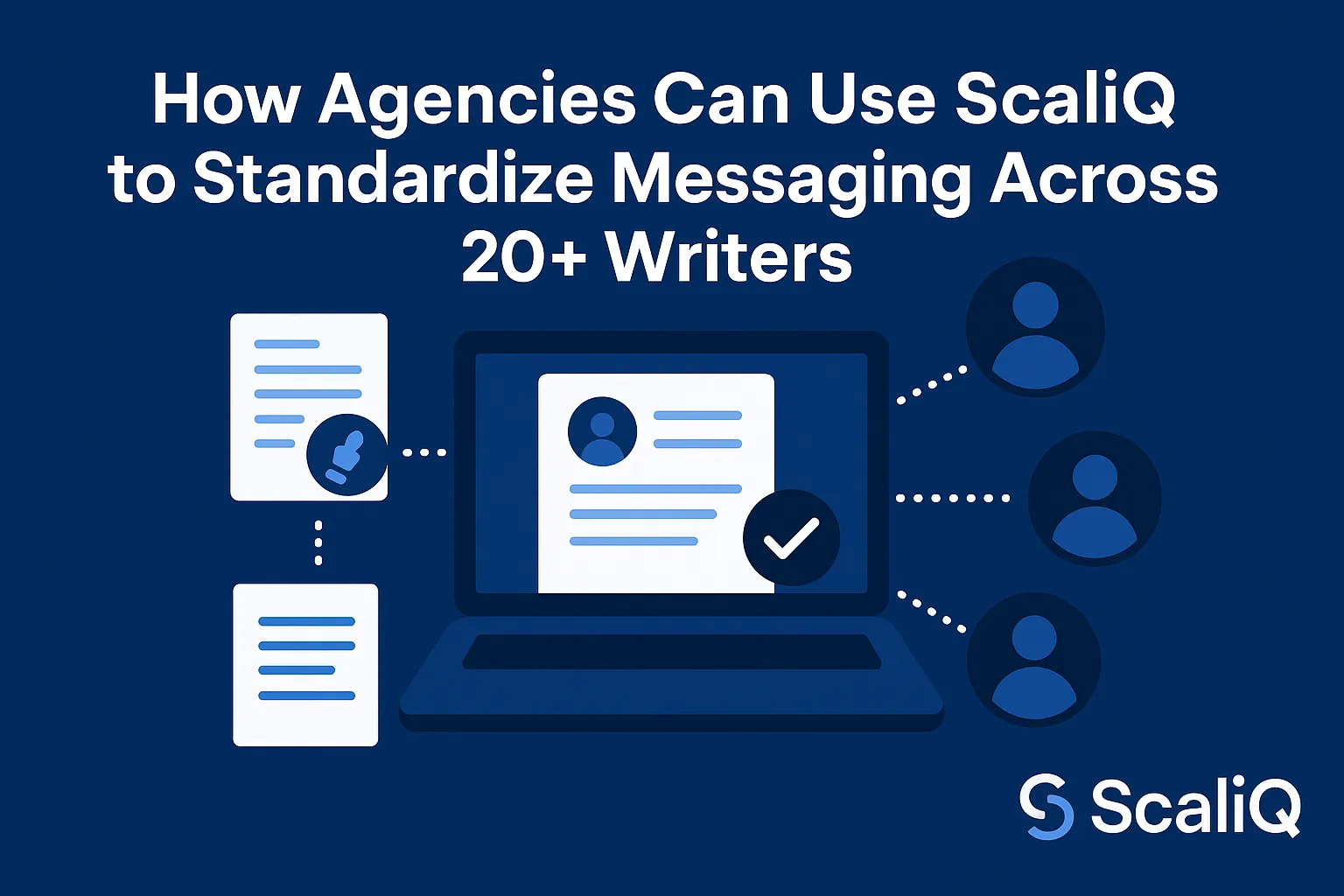
How Agencies Can Use ScaliQ to Standardize Messaging Across 20+ Writers
For most agencies, the greatest operational bottleneck isn't generating ideas—it is maintaining consistency. When you manage a team of 10, 20, or 30+ writers, a single "brand voice" document is rarely enough. Writers interpret guidelines differently, leading to tone drift, fragmented messaging, and hours lost every week on repetitive revisions.
The challenge of scaling content output without sacrificing quality is the primary barrier to agency growth. If your editors spend more time rewriting drafts than strategizing, your workflow is broken. AI governance offers a solution by shifting the focus from manual policing to automated rule enforcement.
This article provides a practical, workflow-driven guide for using ScaliQ to unify brand rules, eliminate tone drift, and streamline approvals for LinkedIn and multi-channel campaigns. We will explore how agency messaging standardization works in practice and how to deploy AI content standardization to ensure brand voice consistency at scale.
Why Agencies Struggle with Messaging Consistency
The operational reality of a large content team is often chaotic. Even with detailed style guides, the human element introduces variance. One writer might interpret "professional" as formal and academic, while another interprets it as corporate and concise. This results in message fragmentation, where a client's brand sounds different depending on who wrote the piece that day.
The real cost of this inconsistency is measurable. Editors become bottlenecks, trapped in a cycle of manual QA where they correct the same errors repeatedly. This limits the agency's ability to scale; adding more writers simply adds more editing debt. Furthermore, inconsistent messaging leads to brand dilution and lower campaign conversion rates.
Research into distributed teams highlights the difficulty of maintaining uniformity without automated assistance. According to a study on global content consistency, teams that rely solely on manual guidelines often face significant coherence issues as they scale. However, agencies implementing AI content standardization tools report saving 40–60% of their time on QA, significantly reducing the manual content QA workload and eliminating tone inconsistency across writers.
What AI Content Standardization Actually Looks Like
The Core Principles of AI Governance for Content
AI governance is distinct from simple AI writing. While writing assistants generate text based on prompts, governance systems enforce constraints. This involves rule-based tone enforcement, brand voice models, and structured messaging templates that act as guardrails for creativity.
ScaliQ operationalizes these rules by creating a governance layer that sits on top of the writing process. Instead of hoping a writer remembers to avoid passive voice or specific jargon, the system enforces it automatically. This shift from subjective interpretation to objective rule enforcement is critical for brand voice systems.
Recent research on brand consistency modeling demonstrates that structured, model-based approaches to content generation significantly outperform unstructured drafting in maintaining long-term brand alignment.
Automated QA and Rule Enforcement
In a governed workflow, AI acts as the first line of defense. Before a draft reaches a human editor, automated QA checks it against a rigorous set of criteria: tone, structure, clarity, and prohibited phrasing.
For example, if a client’s brand forbids the use of "synergy" or requires a specific reading level, the AI flags these issues immediately. This automated feedback loop allows writers to self-correct in real-time, reducing the volume of revisions reaching the editorial team by 30–60%. This directly addresses brand drift in agency content and streamlines content QA automation.
Templates, Style Rules, and Messaging Blocks
Standardization also relies on reusable frameworks. Agencies can develop messaging blocks for outreach and campaigns that ensure core value propositions remain intact, regardless of the writer.
For platforms like LinkedIn, where brevity and tone are paramount, ScaliQ allows agencies to lock in structural rules. Unlike generic tools that offer broad suggestions, a governance platform ensures that every piece of content—from a tweet to a white paper—adheres to the specific messaging templates defined for that client, ensuring multi-writer alignment.
Building a Scalable Multi-Writer Workflow
Centralized Rules and Voice Libraries
To scale effectively, an agency needs a "single source of truth." ScaliQ functions as this central repository. Instead of static PDF style guides that go unread, brand rules are digitized and active within the workspace.
When a new writer is onboarded, they don't just read the rules; they write within an environment that enforces them. This drastically reduces the learning curve and ensures immediate adoption of brand voice consistency. Account managers can update a rule once—such as a change in product terminology—and it instantly applies to all writers, eliminating the lag time of communicating updates via email.
According to AI governance framework research, centralized, enforceable rule sets are the most effective method for maintaining quality control in decentralized or large-scale content operations.
ScaliQ's Multi-Layer QA Flow (Example Workflow)
A best workflow for multi-writer content teams looks like this:
1. Draft: The writer creates content using approved templates.
2. AI Governance Check: ScaliQ scans the text for tone, prohibited words, and structural compliance.
3. Automated Fixes: The writer accepts AI-suggested corrections for objective errors (e.g., sentence length, passive voice).
4. Human Editor: The editor reviews a clean, compliant draft, focusing on strategy and nuance rather than basic grammar or style violations.
5. Final Approval: The content is marked ready for publication.
This flow transforms the editor from a janitor cleaning up messes to a strategist refining the message.
Eliminating Manual Review Bottlenecks
By automating the objective layer of editing, agencies remove the primary bottleneck in content operations. Account managers gain visibility into writer performance, seeing which writers consistently trigger governance flags and which adhere to guidelines.
As agencies grow, the need for sophisticated management tools increases. Agencies looking to implement these advanced controls can leverage specific tiers designed for scale. You can see where agencies can upgrade to unlock multi-team governance features at Pricing. This is essential for agency workflow automation that supports 20+ writers.
Ensuring Brand Voice Consistency for LinkedIn and Outreach
The Unique Challenges of LinkedIn Messaging
LinkedIn outreach presents a specific set of challenges. The tone must strike a delicate balance between professional and conversational. LinkedIn messaging AI must avoid sounding robotic, yet it cannot drift into being overly casual or sales-heavy.
Drift in outreach sequences is dangerous; inconsistent messaging in a follow-up can undo the trust built in an initial connection. Writers often struggle to maintain the exact persona required for C-level outreach across hundreds of messages.
ScaliQ’s LinkedIn-Specific Governance Layer
ScaliQ addresses this with a specialized governance layer for LinkedIn. Agencies can define specific rules for LinkedIn messaging standardization:
• Length constraints: Ensuring messages are concise enough for mobile viewing.
• Tone calibration: Enforcing a "helpful, not salesy" tone.
• Personalization boundaries: Dictating where and how variables should be used.
This ensures that even if ten different writers are crafting replies, the prospect experiences a unified, coherent voice.
Integration With Outreach Tools and External Platforms
Governance must extend beyond the drafting tool. Agencies need to connect their approved messaging blocks directly to their execution platforms. This integration ensures that the standardized content is what actually gets sent.
For agencies focused on scaling their outbound efforts, integrating governed content with robust sending platforms is vital. For more on agency outreach workflows and scaling, refer to Agency. This connection completes the loop between agency messaging workflows and LinkedIn outreach automation.
How ScaliQ Solves Tone Drift and QA Overload
Real-World Case Examples From Agencies
Agencies managing teams of 10–30 writers have used ScaliQ to fundamentally change their operations. In practice, these teams report a 40–60% reduction in revision rounds.
For example, a lead generation agency struggling with tone enforcement across a distributed freelance team used ScaliQ to implement strict "no-jargon" rules. Within weeks, the consistency of their output improved to the point where they could double their writer count without hiring additional editors.
Comparison to Typical AI Tools (High-Level)
Most AI writing tools focus on generation. They help you write faster. ScaliQ focuses on governance. It helps you write correctly.
• Typical AI: Generates generic text based on a prompt. Often drifts from brand voice.
• ScaliQ: Enforces specific brand alignment rules. Checks against negative constraints (what not to say).
ScaliQ stands out as a unique solution for AI tools for enforcing brand voice rules because it is built for the manager and the editor, not just the writer.
KPIs and Operational Outcomes
The impact of agency messaging standardization is measurable via clear KPIs:
• Reduced Revision Rate: Fewer rounds of back-and-forth.
• Faster Time-to-Approval: Content moves from draft to live faster.
• Message Uniformity: Higher consistency scores across campaigns.
• Campaign Performance: Consistent messaging correlates with better engagement.
These improvements directly impact agency ROI and content team performance.
Tools & Resources for Multi-Writer Content Governance
To immediately improve consistency, agencies should deploy the following assets alongside their governance software:
1. Governed Swipe Files: A library of pre-approved hooks, CTAs, and value propositions.
2. Negative Lexicons: A list of words and phrases that are strictly forbidden (e.g., "groundbreaking," "cutting-edge").
3. Tone Frameworks: Clear definitions of voice (e.g., "Confident but not Arrogant").
Creating these resources allows you to feed better data into your content governance tools and brand voice systems.
Future Trends & Expert Predictions
The future of AI governance trends lies in autonomy. We are moving from rule-based systems to autonomous content QA pipelines where AI agents will not only flag errors but contextually rewrite sections to match brand voice with near-perfect accuracy.
Multi-agent governance frameworks will likely emerge, where one AI agent drafts, another acts as the "Compliance Officer," and a third acts as the "Brand Editor." This future of content QA will allow agencies to scale to hundreds of writers while maintaining the intimacy and precision of a boutique firm.
Conclusion
Standardizing messaging across 20+ writers is no longer about hiring more editors—it is about implementing smarter infrastructure. Agency messaging standardization requires a shift from manual oversight to automated governance.
By using ScaliQ, agencies can reduce their QA workload, enforce strict AI content governance, and ensure that every piece of content—whether a blog post or a LinkedIn message—aligns perfectly with the client's brand. This is not just about writing; it is about operationalizing quality at scale.
If your agency is ready to eliminate tone drift and streamline approvals, it is time to test rule-based governance for your team.