

Introduction
The noise on LinkedIn has reached a fever pitch. Decision-makers are flooded with generic "I noticed we have mutual connections" messages that are instantly archived or ignored. In this saturated environment, traditional, static personalization—inserting a first name and company name—is no longer a competitive advantage; it is the bare minimum. Today, prospects respond only to messages that feel hyper-contextual, timely, and deeply aware of their current reality.
The problem for most marketers and sales development representatives (SDRs) is scale. You know that a prospect who just commented on a competitor’s pricing update is a high-intent lead, but manually monitoring thousands of prospects for these micro-moments is impossible. You struggle to identify which behaviors signal true intent versus casual browsing, and you simply don’t have the time to manually tailor every DM to match those signals.
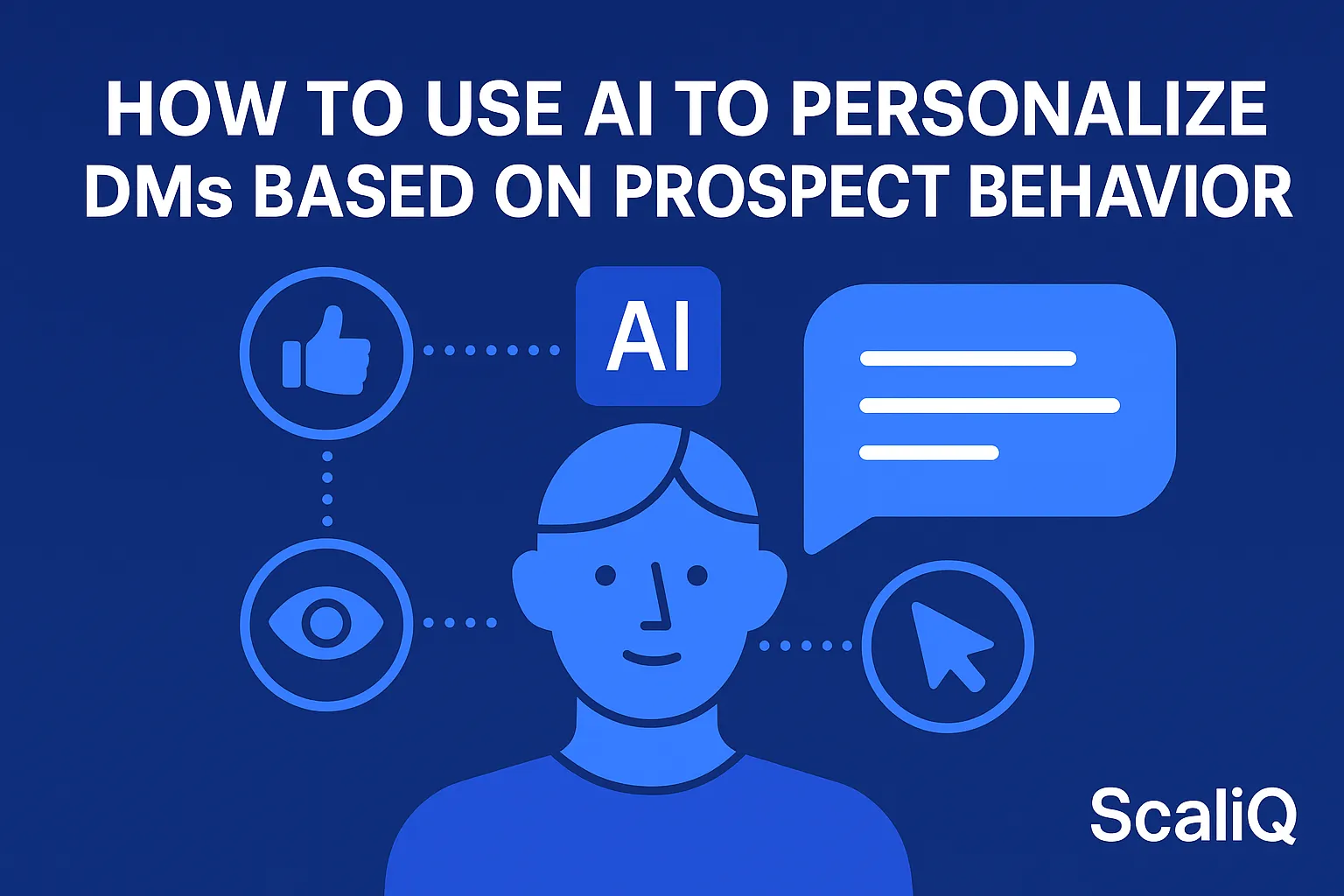
This is where AI behavioral DM personalization shifts the paradigm. Advanced AI models can now interpret real-time behavioral cues—from profile visits to specific comment sentiments—and generate adaptive, dynamic DMs that resonate with where the prospect is right now.
In this blueprint, we will explore exactly how behavioral signals work, how AI interprets them, and how you can build workflows to scale this adaptive outreach. We will also examine how ScaliQ’s behavioral AI modeling differs from standard enrichment tools.
For more insights on building advanced outreach strategies, explore our deep dives at Blog.
Why Behavioral Signals Matter in DM Personalization
Static profile data tells you who a person is; behavioral data tells you what they want. While a job title indicates authority, it does not indicate urgency. Behavioral signals are the strongest predictors of intent because they capture active interest and psychological readiness.
When a prospect interacts with content on LinkedIn, they leave a digital footprint that reveals their current priorities. A sudden increase in activity regarding "enterprise security" from a CTO, for example, is a far louder buying signal than the fact that they have held the title of CTO for five years. These micro-behaviors—profile views, post engagement, search activity, and comment sentiment—are the keys to unlocking high response rates.
Research validates this approach. According to a LinkedIn cross-domain behavioral signal research study (arXiv), analyzing user interactions across different domains significantly improves the prediction of future engagement. By leveraging these signals, you move from "cold" outreach to "warm" contextual conversations.
The Difference Between Behavioral and Enrichment Personalization
To master AI behavioral DM personalization, you must distinguish it from enrichment.
• Enrichment Personalization (Static): This relies on fixed data points., Example: "Hi [Name], I see you are the [Title] at [Company]. We help [Company] grow.", Limitation: It proves you can read a database, but it doesn't prove relevance today.
• Behavioral Personalization (Dynamic): This relies on time-sensitive actions., Example: "Hi [Name], I saw your comment on [Influencer]'s post about API latency issues. It sounds like you're tackling integration bottlenecks right now...", Advantage: It addresses a specific, current pain point.
Enrichment provides the address; behavior provides the reason to knock. AI models that focus on behavior drive higher conversion because they align the message with the prospect's immediate mental state.
How AI Interprets Prospect Activity and Intent
AI does not just "see" an action; it interprets the intent behind it. Modern Large Language Models (LLMs) and behavioral scoring algorithms ingest vast amounts of signal data—frequency of action, timing, sentiment, and topic relevance—to construct a profile of the prospect's interest level.
The AI applies a weighting logic to these signals. For instance, a passive profile visit might be weighted as "Low Intent," while a comment asking a specific technical question is weighted as "High Intent." This allows the system to prioritize who gets messaged first and what that message says.
According to research on machine learning interpretation of behavioral signals (arXiv), automated systems can now accurately classify user intent by correlating temporal patterns (when they act) with content interactions (what they act on). This moves outreach from a guessing game to a data-backed science.
Activity Signals AI Can Read
AI tools can monitor and analyze a variety of public engagement signals to trigger outreach:
• Engagement: Likes, shares, and reposts indicate general agreement or interest in a topic.
• Comment Analysis: AI parses the text of comments to understand if the prospect is agreeing, debating, or asking a question.
• Profile Pathways: Sequences of profile views (e.g., viewing your profile, then your company page, then you again) act as strong curiosity markers.
• Timing: The recency of the action is critical. AI knows that a signal from 2 hours ago is 10x more valuable than one from 2 weeks ago.
Linguistic Cues & Micro-Behaviors
Beyond simple clicks, AI analyzes how a prospect writes. This is where linguistic biomarkers come into play.
• Tone Detection: Is the prospect frustrated, enthusiastic, or analytical? AI detects these emotional undertones.
• Keyword Patterns: Repeated use of specific jargon (e.g., "scalability," "compliance," "ROI") signals what the prospect values most.
• Writing Style: AI can match the complexity and length of the outreach to the prospect's own communication style.
A study from Penn State on “behavioral cues in personalization” highlights that matching linguistic styles and acknowledging specific user inputs drastically increases trust and perceived relevance in digital communications.
Real Examples of Behavior‑Triggered Personalized DMs
To visualize the power of dynamic DM personalization, let’s look at how AI transforms generic messages into behavior-aware conversations.
Example 1 — Prospect Viewed Your Profile Twice
• Context: A prospect visits your profile but doesn't connect. They return the next day.
• AI Interpretation: High curiosity, potential hesitation.
• Tone: Warm, low-pressure, "opening the door."
The DM:
Example 2 — Prospect Commented on a Specific Industry Topic
• Context: Prospect comments on a thought leader's post about "The death of cold calling."
• AI Interpretation: Active engagement in sales strategy debates.
• Tone: Peer-to-peer, opinionated, expertise-aligned.
The DM:
Example 3 — Prospect Engaged With Competitor Content
• Context: Prospect likes a feature announcement from your direct competitor.
• AI Interpretation: Active evaluation phase; comparing solutions.
• Tone: Challenger-style, differentiating, curiosity hooks.
The DM:
Workflows for Scaling Adaptive Outreach
Implementing this requires a system that bridges signal detection with message generation. Below are workflows for scaling AI personalization without losing the human touch.
For visual examples of how multimedia can further enhance these workflows, check out Chatgpt Screenshots.
Workflow 1 — Behavior Signal Detection → Intent Score → DM Trigger
This workflow ensures you only spend API credits and time on high-potential leads.
1. Monitor: The AI tool scans a list of target accounts for public activity (posts, comments, profile changes).
2. Score:, Like = 1 point (Low intent), Comment = 5 points (Medium intent), Profile Visit = 10 points (High intent)
3. Trigger:, Score < 5: Do nothing (keep monitoring)., Score > 5: AI drafts a message referencing the specific action., Score > 15: Alert the sales rep for manual review and immediate send.
Workflow 2 — Multi-Signal Personalization at Scale
This workflow combines activity data with linguistic analysis for hyper-personalization.
1. Ingest: AI pulls the prospect's last 3 posts and their "About" section.
2. Analyze: It identifies the prospect's writing style (e.g., "Casual, uses emojis, short sentences").
3. Draft: The AI generates a DM that mimics this style while referencing the most recent post.
4. Send: The message is queued in your automation tool.
Workflow 3 — Real-Time Adaptive Messaging
This workflow handles changes in behavior mid-sequence.
1. Sequence Start: Standard value-add message sent.
2. New Signal: Prospect suddenly views your pricing page or LinkedIn company page.
3. Adapt: The AI pulls the prospect out of the standard sequence.
4. Pivot: A new, high-intent message is generated: "noticed you were checking out our pricing..."
5. Result: You address the immediate interest rather than sending a pre-scheduled, irrelevant follow-up.
How ScaliQ Differs from Enrichment-Based Tools
Many tools claim to offer "AI personalization," but they are often just wrapping standard enrichment data in GPT-generated text. ScaliQ takes a fundamentally different approach rooted in behavioral intent modeling.
Behavioral Signal Modeling vs Enrichment Fields
Standard tools fill in blanks: {{FirstName}} works at {{CompanyName}}. ScaliQ models behavior. It understands that a prospect who just hired a new VP of Sales is in a different buying window than one who hired them six months ago. ScaliQ’s engine extracts deep behavioral signals—hiring velocity, funding news sentiment, and engagement spikes—to determine when to reach out, not just who to reach out to.
Adaptive Tone and Message Structure
ScaliQ doesn't just insert data; it adapts the voice. If the prospect is a technical founder who writes in concise, data-heavy sentences, ScaliQ adjusts the generated DM to be direct and feature-focused. If the prospect is a creative director who uses storytelling, the AI pivots to a narrative style. This mirrors the psychological principle of mirroring, which builds instant rapport.
Why Existing Tools Only Offer Surface-Level Personalization
Most competitors in the space rely on static databases. They are excellent at finding emails but poor at predicting response readiness. They lack the real-time signal interpretation required to identify "intent." ScaliQ bridges this gap by focusing on the dynamic actions that precede a purchase decision, ensuring your DMs land exactly when the prospect is ready to listen.
Tools, Resources & Future Trends
As AI evolves, the tools available for behavioral personalization are becoming more sophisticated.
• Signal Scrapers: Tools that monitor LinkedIn and web activity for changes (ensure these are GDPR/CCPA compliant).
• Intent Data Providers: Platforms like Bombora or 6sense that track web consumption.
• AI Writing Assistants: Tools like ChatGPT or Claude for drafting, though they require manual prompting without a dedicated wrapper like ScaliQ.
Looking forward, the landscape of AI outreach is heading toward deeper psychological modeling. A pivotal study on “digital engagement behavior” suggests that future algorithms will predict user needs before they are explicitly stated based on navigation patterns alone.
Trend 1 — Real-Time Prospect Emotional Modeling
Future AI will not just read text but interpret the emotional state of the user based on typing speed, session duration, and interaction intensity, allowing for empathy-driven messaging at scale.
Trend 2 — Multi-Channel Behavior Integration
We will see a unification of signals where a prospect’s activity on LinkedIn, Twitter (X), and their company website is synthesized into a single "readiness score," triggering a unified outreach strategy across channels.
Trend 3 — Continuous Learning Message Models
AI models will self-correct in real-time. If a specific "hook" regarding a competitor receives a low reply rate in a specific industry, the model will autonomously stop using it and test a new angle without human intervention.
Conclusion
The era of "spray and pray" is over. In a digital world overflowing with content, attention is the scarcest currency. AI-driven behavioral personalization allows you to earn that attention by ensuring every DM you send is relevant, timely, and contextually accurate.
By shifting your focus from static enrichment to dynamic behavior, you align your selling process with the prospect's buying process. You stop interrupting and start contributing to the conversation they are already having.
ScaliQ stands at the forefront of this shift, offering the behavioral AI modeling required to turn passive data into active conversations. The blueprint is clear: listen to the signals, adapt with AI, and scale with integrity.