

Introduction
As outbound sales teams face increasing pressure to deliver pipeline growth with leaner resources, the interest in AI SDR automation has surged. Yet, manual prospecting remains a significant bottleneck. Sales Development Representatives (SDRs) often spend up to 70% of their time on repetitive, low-value administrative tasks rather than engaging with prospects. Among all channels, LinkedIn remains the most time-consuming, requiring meticulous research and personalized engagement to yield results.
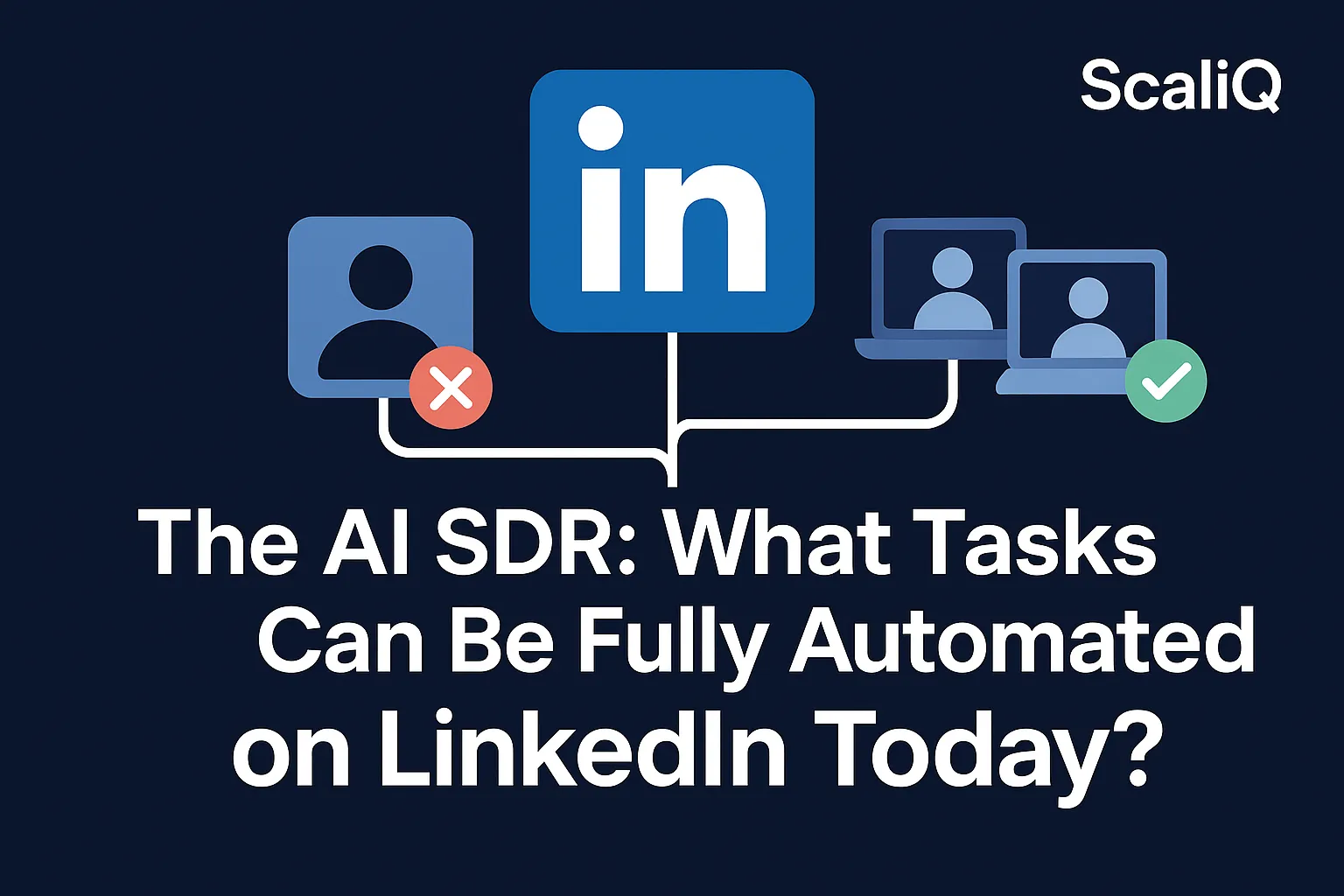
This article breaks down exactly what AI can fully automate on LinkedIn today, identifying the specific workflows that are ready for autopilot and distinguishing them from tasks that still require human oversight. We will explore how modern multi-agent SDR systems—like those developed by ScaliQ—deliver safer, higher-volume workflows than traditional, linear automation tools. By understanding the capabilities and limits of the "AI SDR," sales leaders can build efficient, compliant, and high-performing outbound engines.
What AI Can Automate in the LinkedIn SDR Workflow
The landscape of automated SDR tasks has shifted from simple "connect and pitch" bots to sophisticated workflows that mimic human behavior. Today, AI can handle a significant portion of the prospecting lifecycle, from identifying the right accounts to delivering hyper-personalized messages. However, distinguishing between "LinkedIn-safe" behavior and risky automation is critical for long-term success.
Unlike single-agent tools that execute linear commands (e.g., "visit profile" then "send connection"), multi-agent systems orchestrate complex decisions. They can evaluate if a prospect matches the Ideal Customer Profile (ICP) before deciding to engage, ensuring resources are focused only on high-potential leads.
To maintain the integrity of the platform, all automation must align with the LinkedIn Professional Community Policies. These policies emphasize authentic engagement and prohibit the use of bots that artificially amplify engagement or scrape data in violation of terms. Modern AI prospecting tools navigate this by simulating human pacing and relying on legitimate data access points.
Fully Automatable Tasks on LinkedIn Today
Several core components of the SDR workflow are now mature enough for full automation. These tasks rely on structured data and clear logic rules, making them perfect candidates for ai sdr linkedin systems:
• Automated Lead List Extraction: AI can efficiently process search results from Sales Navigator filters, organizing potential leads into structured lists without manual copy-pasting.
• AI-Driven Pattern Recognition for ICP Matching: Beyond basic job titles, AI analyzes profile descriptions and company data to match prospects against nuanced ICP criteria (e.g., "B2B SaaS companies scaling engineering teams").
• Automated Enrichment: Systems can instantly pull public data to enrich lead profiles with verified emails, company size, and tech stack information.
• Auto-Generation of Personalized Outreach: Generative AI can draft initial connection requests and follow-up messages based on the prospect's profile data, ensuring relevance at scale.
Partially Automatable Tasks
While ai sdr tasks are extensive, some areas function best as "co-pilots" requiring human verification:
• Context-Sensitive Personalization: While AI can reference a recent post, verifying that the reference is tonally appropriate often benefits from a quick human glance.
• Sequence Branching: Determining whether to move a prospect to a "nurture" sequence or a "break-up" sequence can be automated, but complex branching logic often requires initial human approval to set the parameters.
• CTA Tuning: AI linkedin personalization is powerful, but aligning the Call to Action (CTA) with the specific emotional tone of a conversation usually requires periodic human tuning to maximize conversion rates.
Tasks That Cannot Be Fully Automated (Yet)
Despite the hype, certain ai sdr limitations remain. These tasks rely on high emotional intelligence (EQ) and strategic judgment:
• Sensitive Conversations: High-stakes negotiations or discussions involving sensitive business pain points require a human touch to build trust.
• High-Level Qualification: While AI can qualify based on data (revenue, size), qualifying based on intent signals during a complex conversation is still a human-led activity.
• Account-Based Strategic Messaging: Crafting a multi-threaded strategy for a Fortune 500 account requires a level of creative strategy that current AI supports but does not replace.
Limits, Compliance, and What Still Requires Human Oversight
Automation is a force multiplier, but it introduces risks if not managed within a compliance framework. Understanding linkedin automation limits is essential to protect your company's reputation and your team's accounts.
Adhering to the LinkedIn Professional Community Policies is the baseline. Additionally, outbound teams must consider FTC business guidance regarding truthful advertising and CCPA data privacy requirements when handling personal data enriched from public sources.
LinkedIn-Safe Automation Patterns
To avoid flagging algorithms, linkedin-safe automation must mimic human behavior. This involves:
• Human-Like Timing: Randomizing delays between actions (e.g., viewing a profile and sending a request) rather than executing them instantly.
• Interaction Pacing: Adhering to daily limits for connection requests and messages. Safe automation tools monitor these thresholds dynamically, pausing activity before limits are reached.
• Variability: Avoiding identical "copy-paste" behavior by utilizing AI to vary message structure and phrasing for every single interaction.
What Still Requires Human Review
Even with advanced ai sdr limitations decreasing, human oversight remains a critical safety valve:
• Edge-Case Personalization: If a prospect has a unique or ambiguous job title, AI might misinterpret their role. Human review ensures accuracy.
• Sensitive Lead Qualification: In regulated industries (e.g., healthcare, finance), automated qualification must be double-checked to ensure compliance with industry-specific laws.
• Message Content Judgment: AI might generate a technically correct message that lacks the "vibe" of your brand. Manual prospecting alternatives often involve a "human-in-the-loop" model where the AI drafts, and the human approves.
How Multi-Agent SDR Automation Works
The future of ai outbound workflows lies in multi-agent orchestration. Unlike standard automation tools that perform a single linear task, multi-agent sdr workflow automation involves a network of specialized AI "agents" working together.
Think of it as a virtual sales pod. One agent is responsible for research, another for writing, and another for compliance checking. They pass information back and forth, creating a workflow that is far more robust and intelligent than a simple script.
According to the NIST AI Risk Management Framework, managing AI risk requires mapping, measuring, and managing system outputs. Multi-agent systems align with this by compartmentalizing tasks—if one agent flags a compliance risk, the workflow halts before an error occurs.
Agent Roles in a Modern AI SDR System
In a comprehensive ai sdr linkedin setup, distinct agents handle specific responsibilities:
• Sourcing Agent: Scans Sales Navigator and public databases to identify leads matching the ICP.
• Enrichment Agent: Verifies contact details and gathers company firmographics.
• Qualification Agent: Scores leads based on fit and intent signals.
• Personalization Agent: Analyzes prospect content (posts, bio) to craft unique message hooks.
• Outreach Agent: Executes the sending of messages and connection requests, adhering to safety limits.
Cross-Agent Handoffs and Workflow Orchestration
The power of ai outbound workflows comes from the handoffs. For example, the Sourcing Agent finds a lead and passes it to the Enrichment Agent. If the Enrichment Agent cannot find a verified email, the workflow might branch: instead of emailing, the system instructs the Outreach Agent to prioritize a LinkedIn InMail. This contextual memory and decision-tree logic ensure that actions are always relevant to the data available, significantly increasing conversion rates and safety.
When to Use AI vs Human SDRs
For founders and sales leaders, the question isn't "AI or Humans?" but rather "Which tasks for whom?" Harvard Business School research on sales efficiency suggests that separating transactional tasks from relational tasks boosts overall productivity.
AI-First Workflows
AI excels at high-volume, repetitive, and data-heavy tasks. Use ai prospecting for:
• Top-of-Funnel Research: Scanning thousands of profiles to find the 100 that fit.
• Initial Outreach: Sending the first 2-3 touchpoints to gauge interest.
• Follow-Ups: Automating "bump" messages to unresponsive leads.
• Low-Complexity Qualification: Filtering out leads that are clearly too small or outside the target geography.
Human-First Workflows
Human sdr tasks should focus on high-value interactions where empathy and nuance drive the deal:
• Enterprise Account Penetration: Navigating complex organizational charts.
• Objection Handling: Addressing specific, unique concerns raised by a prospect.
• Closing & Negotiation: Converting an interested lead into a booked meeting or signed contract.
• Relationship Building: Nurturing long-term relationships with key stakeholders.
ROI and Real-World Workflow Examples
Implementing multi-agent sdr automation transforms the economics of outbound sales. By offloading the grind of research and initial outreach, teams can increase their volume by 10x while improving the quality of engagement.
Example Sequence 1: Automated ICP → Connect → Personalized Message → Follow-Up
1. Agent A (Sourcing): Identifies a Marketing Director at a Series B SaaS company via Sales Navigator.
2. Agent B (Outreach): Sends a connection request with a blank or generic friendly note (often higher acceptance).
3. Agent C (Personalization): Upon acceptance, analyzes the prospect's recent post about "AI in Marketing" and generates a message referencing it.
4. Agent B (Outreach): Sends the personalized message 4 hours after acceptance.
5. Outcome: High acceptance rate, contextual engagement, zero manual effort.
Example Sequence 2: Multi-Agent Lead Research → Custom Personalization → Compliance-Safe Outreach
1. Agent A (Research): Scrapes company news to find a recent funding announcement.
2. Agent B (Content): Drafts a congratulatory note tying the funding to a specific pain point (e.g., "scaling sales teams").
3. Agent C (Compliance): Checks if the prospect has been contacted recently to avoid spamming.
4. Outcome: LinkedIn-safe automation that feels bespoke and timely.
Example Sequence 3: AI Qual + Human Review + AI Sequencing
1. Agent A (Qual): Builds a list of 50 high-value targets.
2. Human SDR: Reviews the list, removing 5 competitors and approving 45.
3. Agent B (Sequence): Enrolls the 45 leads into a multi-channel sequence (LinkedIn + Email).
4. Outcome: The human SDR spends 10 minutes on review instead of 4 hours on prospecting.
Tools, Resources, and the Future of AI SDR Automation
The ecosystem for ai sales automation is evolving rapidly. The best tools prioritize "safety by design," integrating compliance checks directly into the workflow.
The Next Evolution: Autonomous Outbound Agents
We are moving toward fully autonomous agents. Future ai sdr trends point to systems that don't just follow a sequence but adapt it in real-time.
• Real-Time Persona Detection: Agents that adjust their tone (formal vs. casual) based on the prospect's own writing style.
• Autonomous Sequencing: Ai outbound workflows that self-correct. If a subject line isn't working, the agent A/B tests a new one automatically without human intervention.
• Compliance-Aware Behavior: Agents that autonomously update their sending limits based on platform algorithm changes.
Conclusion
The era of manual LinkedIn prospecting is ending. Today, ai sdr linkedin technologies allow teams to fully automate list building, enrichment, and initial personalization, while intelligent multi-agent systems handle the complexity of workflow orchestration. While human oversight remains essential for high-stakes conversations and compliance, the bulk of the "grunt work" can now be offloaded to AI.
By embracing multi-agent SDR systems, companies can scale their outbound efforts safely and efficiently, freeing their human talent to do what they do best: build relationships and close deals.
Ready to see how a multi-agent workforce can transform your pipeline? Explore how ScaliQ is redefining outbound automation.