

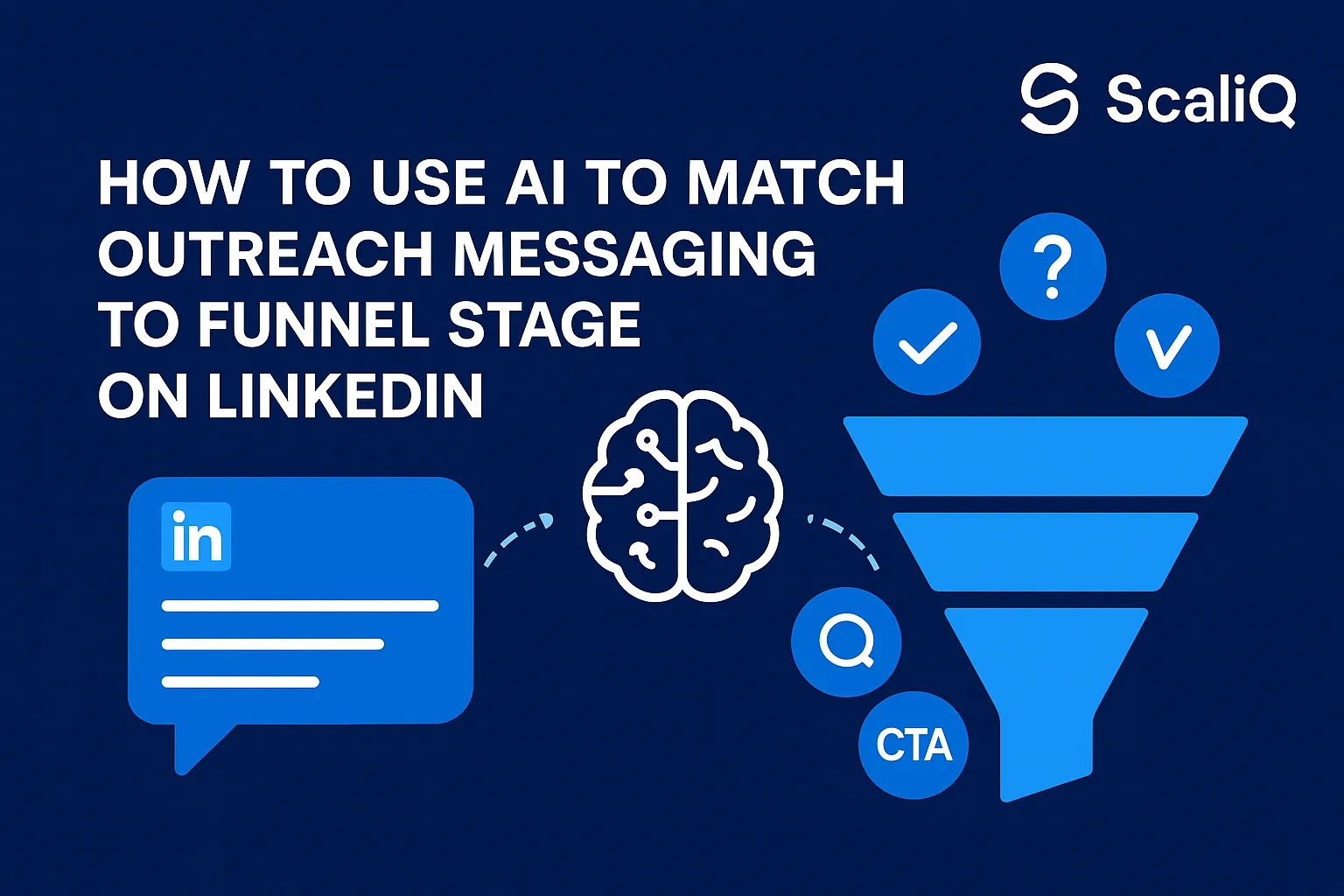
How to Use AI to Match Outreach Messaging to Funnel Stage on LinkedIn
It is time to challenge a pervasive assumption in modern B2B sales: better LinkedIn outreach does not come from writing a cleverer first line.
While most teams rely on AI to generate superficial outbound hooks—scraping a recent post, a job change, or a company milestone—this approach fundamentally misses the mark. It creates surface-level relevance but fails entirely to match the prospect’s actual buying stage. The result? Mistimed asks, weak positive reply rates, and plummeting meeting conversions. AI LinkedIn outreach messaging by funnel stage is the necessary evolution.
This guide provides a definitive framework for using AI not just as a copywriter, but as a signal-driven orchestration layer. You will learn how to detect a prospect’s funnel stage and automatically select the exact pain points, proof assets, and calls-to-action (CTAs) required to drive conversion. Designed for advanced B2B outbound leaders, SDR managers, and growth teams already utilizing enrichment, CRM data, and intent signals, this article breaks down stage detection, messaging by awareness, consideration, and decision phases, operational workflows, and advanced measurement.
Drawing on ScaliQ’s extensive experience developing stage-aware messaging systems for more relevant outbound conversations, this framework shifts your strategy from generic AI funnel personalization to orchestrated, intent-driven execution. To explore the broader ecosystem of AI outbound, personalization, and workflow execution, you can dive deeper into Blog, Repliq.Co, and Www.Notiq.Io.
Why Generic LinkedIn Personalization Underperforms
There is a massive chasm between superficial personalization and contextual personalization. Superficial personalization uses AI to insert a token—a university, a recent award, or a generic compliment—before launching into a standard pitch. Contextual personalization aligns the core message, value proposition, and CTA with the buyer's current readiness to engage.
When outreach ignores buyer readiness, the failure modes are predictable and costly. Awareness-stage prospects receive aggressive, hard meeting asks that trigger immediate defensiveness. Consideration-stage prospects receive generic, high-level education they already know. Decision-stage prospects receive vague curiosity hooks instead of the concrete proof they need to evaluate a vendor. These misalignments directly cause low reply quality, weak positive response rates, and poor meeting conversion.
According to peer-reviewed research on personalization effectiveness, relevance is fundamentally tied to timing and context, not just customized variables. Furthermore, Gartner research on buying-group relevance reinforces that messaging must reflect stakeholder context and decision dynamics to break through the noise. Unlike generic AI copy generation tools that merely polish prose, signal-driven orchestration closes this market gap by dynamically aligning the message strategy with the buyer journey messaging reality. Moving from manual, template-based efforts to orchestrated workflows—a transition supported by tools found at Blog, Repliq.Co, and Www.Notiq.Io—is non-negotiable for modern outbound success.
What Generic Personalization Usually Gets Wrong
Generic personalization relies on shallow token insertion rather than a cohesive message strategy. Sales teams over-index on crafting the perfect first line, mistakenly believing that "personalized" automatically means "timely" or "relevant."
The real lever in cold outreach AI is matching the message goal to the prospect's stage. Surface-level customization might say, "I saw your post about Q3 growth—we help companies scale." Stage-aware outreach, however, recognizes that this prospect is actively researching scaling bottlenecks and delivers a targeted insight about operational efficiency. Intent-based messaging prioritizes the why now over the what I know about you.
Why LinkedIn Makes This Problem More Visible
LinkedIn’s platform constraints magnify the flaws of generic messaging. With limited character space in connection requests and InMails, a lower tolerance for irrelevant asks, and a stronger need for contextual credibility, every word must earn its place.
LinkedIn lead generation often targets prospects before they have expressed explicit buying intent. Because you are interrupting their feed or inbox, stage inference and CTA selection become infinitely more important than pure copy polish. A perfectly written prospecting message sequencing flow will still fail if it asks for a 30-minute demo from someone who doesn't yet realize they have a problem. Effective linkedin cold message personalization ai requires strategic restraint.
How to Infer Funnel Stage from Buyer Signals
To execute stage-aware outreach, AI must function as a classification layer that ingests multiple signal types to determine whether a prospect is in the awareness, consideration, or decision stage. AI should not just write the message; it must first decide which message to write.
Stage inference combines firmographic, behavioral, engagement, and intent signals. Because no single signal is perfectly reliable, AI assigns a stage likelihood based on the aggregate of these inputs. This multi-signal approach drastically reduces mistimed outreach and creates smarter account-based personalization. As outlined in Gartner’s B2B buying journey framework, buying journeys are nonlinear and require nuanced, multi-signal interpretation. To accurately track how to infer funnel stage, teams must map these signals against LinkedIn’s funnel stage definitions and KPIs.
The Four Signal Categories AI Should Use
1. Firmographic Signals (Account-Level): Company size, growth stage, hiring patterns, tech stack installations, and market segment. These indicate fit but not necessarily timing.
2. Behavioral Signals (Contact & Account-Level): Website visits, content consumption, form activity, and engagement with high-value pages (like pricing or demo pages). These indicate interest.
3. Engagement Signals (Contact-Level): LinkedIn post interactions, profile views, historical email response data, and connection request acceptance. These indicate receptivity.
4. Intent/Context Signals (Account-Level): Third-party topic research, account-level activity spikes, recent triggering events (e.g., funding, leadership changes), and buying committee movement. These indicate urgency.
Combining these intent signals for outbound messaging allows AI to accurately categorize prospects and deploy true intent-based messaging.
Stage Inference Criteria for Awareness, Consideration, and Decision
To operationalize ai funnel personalization, use the following stage inference criteria:
• Awareness-Stage Indicators: Weak explicit intent, early-stage research behavior, broad pain relevance based on persona, and no clear signs of active vendor evaluation.
• Consideration-Stage Indicators: Category engagement, solution comparison behavior, stronger contextual relevance, and demonstrable interest in specific approaches or frameworks.
• Decision-Stage Indicators: High-intent page visits (pricing/demo), direct engagement with proof assets, procurement or multi-stakeholder involvement, and clear timing pressure or triggering events.
By feeding these criteria into a scoring model, AI can accurately dictate the buyer journey messaging strategy.
What Signals Matter Most on LinkedIn vs Off-Platform
Accurate stage inference requires distinguishing between native LinkedIn signals and external system signals. LinkedIn-only personalization—relying solely on profile views or post likes—is often too narrow.
Stronger orchestration comes from unifying social context with external CRM data, enrichment platforms, and intent sources. By combining off-platform behavioral data with on-platform engagement, AI can build a holistic view of the buyer. To see how multiple signal sources are unified before stage classification, integrating workflows via Www.Notiq.Io provides the necessary infrastructure for comprehensive linkedin outreach personalization.
Messaging Frameworks for Awareness, Consideration, and Decision Stages
Once the stage is inferred, the message must adapt. This framework maps the prospect's stage to the appropriate pain framing, proof type, CTA strength, and message structure.
Understanding this matrix is the key to successful sales funnel personalization examples. There is a vast difference between cold, warm, and high-intent LinkedIn outreach, and your messaging frameworks by funnel stage must reflect that reality.
Awareness-Stage Messaging
The objective in the awareness stage is to create relevance and curiosity, not to force a conversion. Prospects here are not looking to buy; they are looking to understand their own problems.
Focus on pain framing, pattern recognition, and low-friction CTAs. The best proof types are market observations, problem framing, short insights, or light social proof. The CTA should ask for perspective, offer a relevant idea, or suggest a short exchange only if the context supports it. Never use heavy ROI claims, detailed case studies, or direct meeting pressure at this stage.
• Hook: Center around a business problem or trigger, not just a generic compliment.
• Relevance: Connect the pain directly to the prospect’s specific context or role.
• CTA: Keep the ask lightweight and non-assumptive.
• Example Framework: Signal → Pain Hypothesis → Relevance → Soft CTA ("Are you seeing this trend as well?").
This structured approach to linkedin cold message personalization ai ensures cold outreach ai feels consultative rather than aggressive.
Consideration-Stage Messaging
In the consideration stage, the objective shifts from problem acknowledgment to helping the buyer evaluate approaches. The prospect knows they have a pain; now they are exploring solutions.
Shift the message from basic pain awareness to solution framing and category-level proof. Utilize proof assets like use cases, framework snippets, industry benchmarks, or short examples of how similar teams solve the issue. CTAs can be moderately stronger: invite a discussion, share a highly relevant example, or ask if solving this specific problem is a current priority. AI should dynamically select proof points based on the prospect’s likely use case.
Use short case references, outcome patterns, or workflow examples. Relevance outweighs the sheer volume of proof. Generic statements like "we help companies like yours" drastically underperform compared to use-case-specific evidence. AI sales messaging optimization relies on inserting proof points in outreach that directly mirror the buyer's specific consideration criteria.
Decision-Stage Messaging
The objective for decision-stage prospects is to reduce friction and increase confidence. These buyers have demonstrated high intent and are actively evaluating vendors or preparing for action.
Because intent is high, decision stage outreach can utilize stronger, more direct CTAs. Leverage heavy proof assets: detailed case studies, ROI framing, implementation clarity, and stakeholder-relevant outcomes. The message structure must be direct and specific. Reverting to broad educational messaging here will kill momentum and frustrate the buyer.
Strong intent signals—such as pricing page visits or aggressive engagement with bottom-of-funnel content—justify a stronger ask. AI should choose between roi outreach messaging, implementation proof, or risk-reduction proof depending on the prospect's specific context. A direct CTA (e.g., "Worth a brief chat this week to review how we implemented this for [Competitor]?") is highly effective for high-intent prospects.
A Simple Stage-by-Stage Messaging Matrix
To execute account-based personalization effectively, use this skimmable matrix to guide your funnel stage linkedin messaging:
Advanced teams use tools like Repliq.Co to turn this stage logic into multiple tailored message variants seamlessly.
How to Operationalize Stage-Aware Outreach in SDR Workflows
Moving from strategy to execution requires embedding stage-aware outreach directly into your SDR workflows. Teams must capture signals, classify stages, generate message variants, and trigger the next step inside a compliant, automated sequence.
AI plays a critical role in every layer: enriching data, classifying the stage, drafting the copy, assisting with QA, and managing the sequence. The goal is repeatable, scalable systems across all reps and accounts, not one-off acts of creativity. This operational rigor, a hallmark of ScaliQ’s authority in building stage-aware messaging systems, far outperforms manual spreadsheet-based personalization or isolated AI copy tools. You can explore the orchestration of CRM, enrichment, and signal-based workflow steps at Www.Notiq.Io, and view the broader stack for execution at Blog, Repliq.Co, and Www.Notiq.Io.
The Stage-Aware Outreach Workflow
A practical AI personalization workflows model follows these exact steps:
1. Collect: Aggregate account and contact signals compliantly.
2. Normalize: Standardize data across CRM and enrichment tools.
3. Classify: AI assigns a funnel stage likelihood.
4. Strategize: Select the stage-specific message goal.
5. Generate: AI drafts message variants based on the matrix.
6. Review: Human QA to ensure accuracy and tone.
7. Deploy: Launch the prospecting message sequencing.
8. Capture: Record outcomes to train the model.
What Inputs the AI System Should Ingest
The quality of ai funnel personalization depends entirely on upstream inputs. AI systems should ingest CRM stage fields, historical behavioral data, LinkedIn activity, firmographics, compliant enrichment data, account notes, and third-party intent signals. Clean data hygiene and field standardization are mandatory; AI cannot orchestrate account-based personalization effectively if the underlying CRM data is fractured.
How Many Message Variants You Actually Need
Avoid the trap of generating endless message permutations. Too many variants create operational chaos and inconsistency; too few result in irrelevance.
A practical structure limits variants to a matrix of: Stage × Segment/Use Case × CTA Strength. This provides enough linkedin outreach personalization to remain highly relevant without overwhelming SDR teams. Focused message sequencing drives higher ai sales messaging optimization than infinite, unmanageable copy variations.
Guardrails to Avoid Automated-Sounding Outreach
To avoid over-personalization and maintain authenticity in linkedin messages, strict guardrails are required:
• Constrain AI prompts strictly by the stage goal.
• Limit forced personalization (e.g., forcing a mention of a college mascot).
• Avoid overconfident assumptions about the prospect's internal problems.
• Require strict alignment between the claim, the proof, and the CTA.
• Mandate human review for edge cases.
Ethical automation and compliance with LinkedIn's terms of service are paramount. Cold outreach ai must remain accurate, restrained, and professionally human.
Case Examples of Stage-Matched LinkedIn Messaging
To make this framework tangible, here is how messaging changes across stages. These sales funnel personalization examples highlight the stark difference between generic and stage-aware outreach.
Example 1 — Awareness-Stage Prospect
Context: A VP of Sales at a mid-market SaaS company. Firmographic fit is high, but there are no strong buying intent signals. Generic AI Message: "Saw you went to Ohio State—Go Buckeyes! We help VPs of Sales increase revenue by 30%. Got 15 mins to chat?" (Fails: Unrelated token, aggressive CTA). Stage-Aware Message: "Noticed your team is expanding into the EMEA market this quarter. Usually, when teams scale regions that quickly, maintaining outbound consistency becomes a bottleneck. Are you seeing any friction there, or is the current process holding up?" Why it works: Focuses on problem relevance based on a firmographic signal and uses a soft, conversational CTA appropriate for awareness stage outreach.
Example 2 — Consideration-Stage Prospect
Context: A Director of RevOps who recently downloaded a whitepaper on CRM data hygiene and engaged with category-specific content. Stage-Aware Message: "Saw you’re exploring frameworks for CRM data routing. When [Similar Company] was evaluating their routing logic last year, they implemented a signal-based workflow that cut manual SDR research time in half. I have a short breakdown of the exact ruleset they used—worth sending over?" Why it works: Shifts to consideration stage messaging by introducing relevant proof (a similar company's workflow) and uses a moderate CTA offering a valuable asset without demanding a meeting.
Example 3 — Decision-Stage Prospect
Context: A VP of Marketing whose team has visited your pricing page three times this week and who recently connected with your CEO on LinkedIn. Stage-Aware Message: "Looks like your team is actively evaluating intent-driven outbound models. Given your focus on Q3 pipeline generation, we recently helped [Competitor] implement our orchestration layer, resulting in a 40% lift in positive reply rates within 30 days. Worth a brief chat this week to see if that implementation timeline aligns with your Q3 goals?" Why it works: Leverages intent-based messaging for decision stage outreach. It uses specific ROI proof and a direct, strong CTA because the buyer's urgency justifies it. Delayed outreach here would kill momentum.
How to Measure Whether Stage-Matched Outreach Is Working
Reply rate alone is a deeply flawed metric for evaluating stage-aware messaging quality. Advanced outbound teams track metrics that reflect both contextual relevance and actual business impact. By establishing feedback loops, message performance continuously informs future stage classification and variant selection.
Measurement must align with LinkedIn’s funnel stage definitions and KPIs and adhere to AMA guidance on measurable marketing metrics to ensure outcome-based reporting.
The Core KPI Stack
A robust measurement hierarchy captures different layers of message-stage fit:
1. Reply Rate: Indicates basic inbox placement and hook visibility.
2. Positive Reply Rate: The true measure of relevance and tone.
3. Meeting-Set Rate: Validates that the CTA matched the buyer's readiness.
4. Meeting-Show Rate: Indicates the perceived value of the meeting.
5. Conversion to Opportunity: Proves the outreach targeted actual pipeline potential.
6. Pipeline Impact: The ultimate metric for business value.
How to Audit Message-to-Stage Fit
To audit stage-matched outreach performance, compare the message intent against downstream response quality. Did the CTA match the actual buyer readiness? Tag all outreach by inferred stage in your CRM. This allows you to analyze intent-based messaging performance by stage and segment, quickly identifying if your consideration-stage messaging is inadvertently triggering objections meant for decision-stage pitches.
Testing Frameworks for Continuous Improvement
Continuous ai sales messaging optimization requires structured experimentation. Test pain framing, proof types, and CTA strength strictly within their respective stages. Furthermore, test the signal thresholds used for classification—perhaps a pricing page visit alone isn't enough to trigger a decision-stage sequence without accompanying engagement data. Optimize your prospecting message sequencing for conversion quality, not just send volume.
Future Trends in AI Funnel Personalization on LinkedIn
The future of B2B outbound is shifting rapidly from static, persona-based messaging to real-time contextual personalization. AI agents and sophisticated orchestration layers are increasingly unifying intent data, engagement signals, and message generation in milliseconds.
From Copy Generation to Message Orchestration
The next evolution is not asking AI to "write me a better message." It is demanding that AI "choose the right message based on live signals." The winning systems in signal-based outbound will seamlessly coordinate detection, decisioning, and execution. As AI personalization workflows mature, stage-aware outreach will become the baseline expectation, rendering generic sequence templates obsolete.
Why Human Oversight Will Matter More, Not Less
As AI handles more classification and drafting, human review, judgment, and message governance will become paramount. Buyers are increasingly sensitive to AI-generated outreach. Maintaining authentic outreach, ensuring linkedin outreach personalization remains compliant, and safeguarding brand integrity will serve as massive competitive advantages. AI outreach quality depends on the human operator defining the strategy.
Conclusion
Better LinkedIn outreach does not come from scraping a random profile detail; it comes from aligning your message with the buyer's readiness. When AI is utilized to infer funnel stage and match the exact pain, proof, and CTA to that stage, positive reply rates and pipeline generation soar.
By identifying signals, inferring stage, matching the messaging matrix, operationalizing through strict SDR workflows, and measuring downstream impact, advanced outbound teams can turn AI from a simple copywriter into a strategic orchestration layer. Stage-aware orchestration is the ultimate leverage point.
Evaluate your current LinkedIn messaging system today. Identify where generic personalization is causing mistimed asks, and begin transitioning your team toward signal-driven execution. ScaliQ’s proven frameworks for developing stage-aware messaging systems ensure your outbound conversations remain highly relevant and deeply impactful. To build your internal SDR playbook and orchestrate these workflows, explore further resources at Blog, Repliq.Co, and Www.Notiq.Io.