

Introduction
Most SaaS teams do not have a LinkedIn messaging problem—they have a conversion system problem. Generic outreach may successfully generate replies and clicks, but it routinely creates poor-fit trial signups that never actually activate. When your pipeline is clogged with users who log in once and disappear, your acquisition motion is leaking time, budget, and resources.
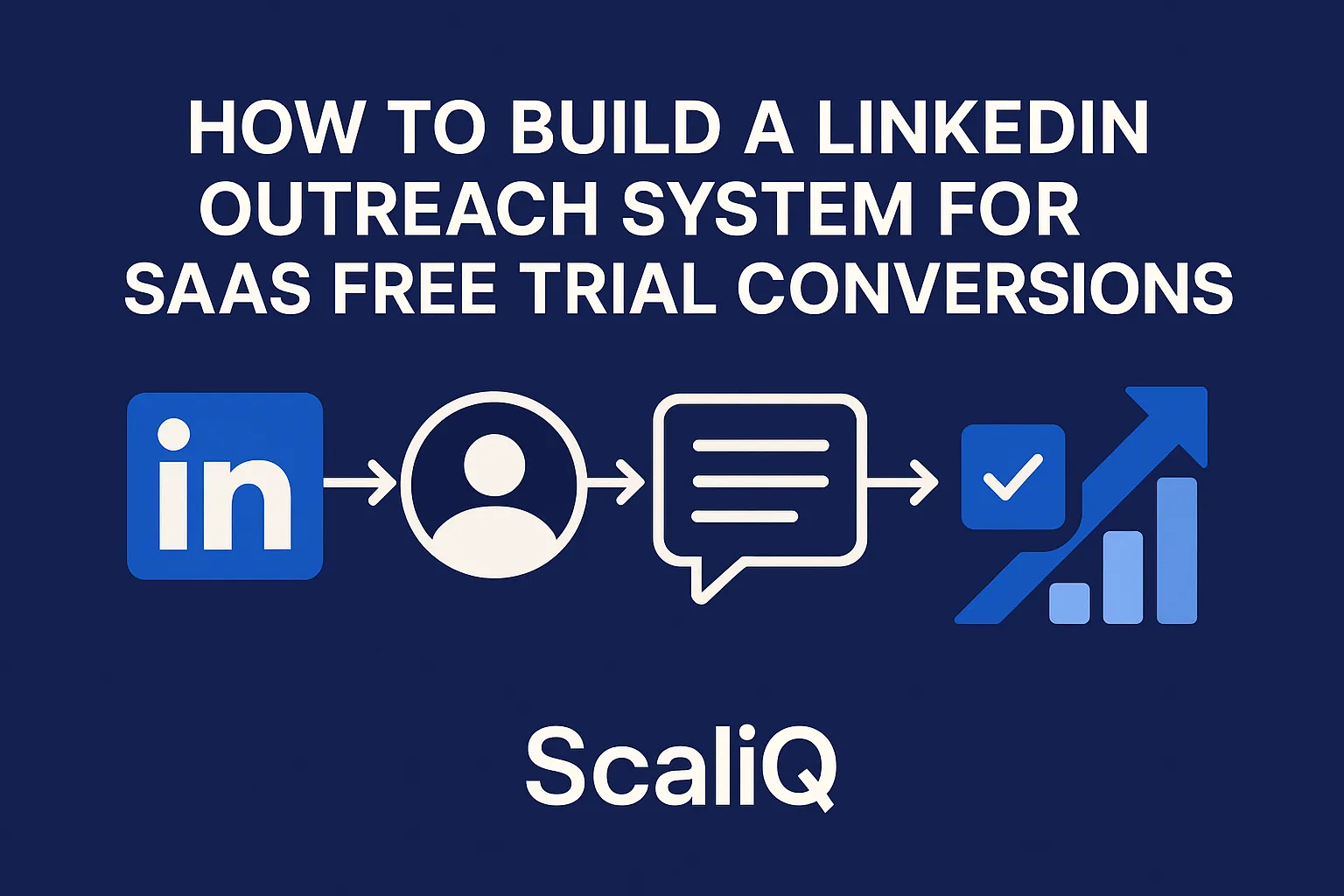
This guide provides a repeatable system to master LinkedIn outreach for SaaS free trial conversions. We will demonstrate how to build a unified workflow that improves signup quality, accelerates product activation, and drives measurable trial-to-paid outcomes. Designed for intermediate SaaS marketers and growth teams who already understand basic prospecting, this playbook moves beyond simple copywriting tips into operational strategy.
Generating a true ai trial conversion is not just about writing a clever hook. It requires connecting Ideal Customer Profile (ICP) targeting, signal-based personalization, Call-to-Action (CTA) qualification, onboarding alignment, and full-funnel measurement. By leveraging ScaliQ’s tested LinkedIn workflows—which are strictly tied to trial signups and product activation—teams can build a scalable engine. ScaliQ acts as the system layer for scaling personalized saas free trial linkedin outreach, ensuring that every message sent is directly tied to downstream trial generation and user activation.
Why Most LinkedIn Outreach Fails for SaaS Trials
To fix a broken acquisition channel, you must first diagnose the core breakdowns that prevent LinkedIn outreach from driving qualified free trial growth.
Most teams optimize for replies, not activated trials
Reply rate alone is a dangerously misleading success metric for Product-Led Growth (PLG) and trial-led SaaS motions. A campaign can look highly successful at the top of the funnel—boasting a 15% reply rate—while still producing low-fit signups and weak activation downstream.
There is a massive difference between raw trial volume and an activation-qualified lead. If a prospect signs up just to end a conversation but lacks the intent or use case to explore the product, your trial-to-paid conversion will plummet. While competitor content often stops at prospecting, reply rates, or booked meetings, true saas conversion funnel optimization requires optimizing for the downstream trial activation strategy saas relies on to generate revenue.
Generic messaging creates poor-fit traffic
Weak segmentation leads to low reply rates LinkedIn outreach campaigns are notoriously known for, ultimately resulting in irrelevant conversations. Even "personalized LinkedIn messaging" fails when it is not tied to a specific role, pain point, or trigger event. Mentioning a prospect's university or recent post is superficial; it does not validate that they have a problem your software solves.
This disconnect between targeting and messaging is the primary driver of poor-fit trial signups. Relying on batch-and-blast habits not only damages your domain and profile reputation over time, but it also degrades the overall quality of your channel.
Outbound and onboarding are usually disconnected
There is a common handoff gap between outbound sales teams and the product or lifecycle teams managing the post-signup experience. Trials sourced from LinkedIn outbound efforts require a much clearer onboarding path than generic self-serve traffic.
When a prospect clicks a link based on a specific promise made in a direct message, that promise must match the first-run product experience. If the disconnect between outbound and product onboarding is too wide, the user experiences immediate friction, leading to massive trial drop-off after signup. Closing this gap is essential for successful free trial user acquisition.
Scaling personalization without quality control backfires
AI sales outreach has revolutionized prospecting, but scaling personalization without sounding automated requires strict quality control. AI is highly effective for research, drafting, and data enrichment, but human review remains critical for ensuring relevance and tone.
Over-automated messages that sound synthetic or generic actively repel high-value prospects. Furthermore, aggressive automation risks violating LinkedIn invitation restrictions. Unlike volume-first LinkedIn automation for SaaS that simply blasts generic templates, workflow-oriented platforms like ScaliQ's features prioritize personalization depth, verification, and conversion-system visibility.
Who Should Get a Free Trial CTA vs a Demo CTA
One of the most frequent mistakes in product-led growth outreach is offering the wrong Call-to-Action. Knowing when to push a self-serve trial versus a sales-led demo is a critical qualification framework.
Use product complexity and onboarding friction as the first filter
How do you qualify who should receive a free trial CTA versus a demo CTA? The first filter is product complexity. Simpler, faster time-to-value products are ideal for free trial CTAs in LinkedIn outreach. If a user can experience the "aha" moment in under five minutes, push the trial.
Conversely, products requiring complex setup, API integrations, or cross-departmental stakeholder buy-in convert better with a demo CTA. Implementation friction directly affects downstream activation likelihood.
Decision Logic:
• If time-to-value is < 10 minutes and requires no engineering -> Then Free Trial CTA.
• If time-to-value requires data migration or team invites -> Then Demo CTA.
This fundamental trial activation strategy saas teams use ensures prospects aren't abandoned in a complex setup phase.
Match the CTA to persona seniority and buying intent
Hands-on operators generally respond better to a free trial, while strategic buyers and executives prefer a demo-led path. Role, job function, and decision-making authority must dictate your offer.
For example, a growth marketer or RevOps specialist wants to test the UI and features directly (Trial). A VP of Sales or Founder wants to know the ROI and implementation timeline (Demo). Because multi-stakeholder SaaS buying environments require mixed outreach paths, your linkedin outreach strategy for saas must adapt. Understanding how buying committees want sellers to engage is vital for B2B SaaS trial signups and stakeholder-aware LinkedIn prospecting for SaaS.
Use signals to identify likely trial intent
Which LinkedIn signals indicate likely trial intent? Look for hiring sprees, recent funding, tech-stack changes, leadership role changes, growth pressure, or visible workflow gaps mentioned in posts.
Signal-based outreach improves relevance before personalization even begins. If a company just hired three new SDRs, a pain point regarding onboarding speed is highly relevant. However, beware of a free trial CTA offered too early; establish context and confirm the pain point before dropping a signup link.
Build qualification rules before you write messages
Before sequencing starts, define your ICP fit, use-case fit, urgency, and expected activation likelihood. Create a simple qualification matrix to route prospects to a free trial CTA, demo CTA, nurture sequence, or disqualify them entirely.
This step drastically reduces wasted outreach volume, cures unclear measurement from outreach to activation, and improves the quality of free trial user acquisition. Teams rely on Sales Navigator lead filters to build these precise lists. Operationalizing these decisions is exactly where a system like ScaliQ excels, turning outbound for SaaS trials into a predictable science.
The LinkedIn Outreach System for Trial Conversions
Here is the end-to-end outreach engine, moving from targeting and enrichment to messaging and CTA timing.
Step 1: Build the right account and lead list
Start with absolute ICP clarity: industry, company size, role, use case, and likely trigger event. The best LinkedIn prospecting for SaaS relies on segmentation based on pain point and product use case, not just job titles.
Better list quality improves both reply rates and downstream activation. Always include negative filters (e.g., excluding consultants or companies under a certain revenue threshold) to avoid low-likelihood trial users that skew your LinkedIn lead generation metrics and waste your linkedin outreach strategy for saas.
Step 2: Enrich leads with context that actually matters
Manual prospect research is slow, but shallow personalization is useless. Enrichment must include company context, likely pain points, trigger signals, relevant workflows, and product fit.
Referencing a profile headline with no strategic relevance will not convert. Enrichment informs both your first message and your CTA decision. AI sales outreach personalization can rapidly speed up this research, but it is only effective if the personalized LinkedIn messaging is grounded in useful, problem-centric context.
Step 3: Create persona- and pain-point-specific message tracks
Never use one universal script. Build separate sequences by persona, use case, and funnel stage. Every message must earn attention, establish relevance, create curiosity, and then present the right CTA.
What messaging converts best for SaaS free trial outreach on LinkedIn?
• Direct Trial Offer (For Operators): "Noticed you're scaling the SDR team. Most RevOps leaders struggle with ramp time. We built a tool that cuts ramp by 30%—want a link to try it free?"
• Problem-First (For Managers): "Saw the recent funding. Usually, this means ambitious pipeline targets. Are you currently automating your lead routing?"
• Demo-First (For Executives): "Congrats on the Series B. Leaders in your space use our platform to consolidate their tech stack. Open to a brief overview?"
These linkedin outbound sequence examples keep saas free trial linkedin outreach highly relevant.
Step 4: Use a friction-aware sequence, not an immediate trial ask
Many SaaS teams ask for the trial too early, before value and fit are established. A free trial CTA offered too early feels like spam. What is the best LinkedIn outreach sequence for free trial offers? A sequenced approach:
1. Connection request (no pitch).
2. Contextual opener based on a signal.
3. Problem/value follow-up.
4. Trial or demo CTA based on their response to the problem.
Keep follow-ups useful rather than repetitive. Instead of "just bumping this," share an insight. This friction-aware outbound for SaaS trials dramatically increases conversion rates.
Step 5: Add supporting assets that increase trial acceptance
Support conversion inside the conversation by utilizing lightweight assets: use-case pages, short walkthroughs, activation checklists, or customer examples.
These assets reduce friction and help the prospect visualize what success looks like, directly boosting free trial user acquisition. Frame these assets by persona and pain point to ensure relevance. These materials are perfect for product-led growth outreach and saas conversion funnel optimization. For deeper insights on creating these assets, explore the RepliQ blog.
Step 6: Sync outreach workflows with CRM and handoff rules
After a positive reply, operational setup is mandatory: CRM logging, CTA outcome tagging, source attribution, and ownership rules. How do you measure reply-to-trial and trial-to-activation performance from LinkedIn without CRM sync? You cannot.
Define strict handoffs between outbound, lifecycle, sales, and customer-facing teams. Document exactly when an outreach-sourced trial should receive a manual sales follow-up. Closing this operational gap is a major differentiator for ScaliQ's tested workflows, ensuring seamless saas conversion funnel optimization.
How to Connect Outreach to Onboarding and Activation
Bridging the missing middle between signup and product value ensures your LinkedIn-sourced trials actually activate.
Align the outreach promise with the first-run product experience
The message framing used in LinkedIn must match the onboarding path the user sees after signup. If you pitched an SEO automation feature, but the user is dropped into a generic dashboard requiring them to set up a CRM integration first, they will churn.
This mismatch creates confusion and causes trial drop-off after signup. Tailor the landing page, trial flow, or welcome experience to the exact pain point used in outreach. Fixing the disconnect between outbound and product onboarding is the foundation of a successful trial activation strategy saas teams need.
Define activation milestones before campaigns go live
Before scaling outreach, teams must know their core activation event. Map activation by segment: is it the first workflow created, the first integration connected, the first teammate invited, or the first output delivered?
These milestones must inform your CTA language and post-signup emails. Generating activation-qualified leads matters far more than raw signup volume. If users do not hit these milestones, your trial-to-paid conversion will remain stagnant regardless of how many trials your trial activation strategy saas campaign generates.
Segment onboarding by source, persona, and use case
LinkedIn-sourced trial users should enter segmented onboarding paths, not a generic one-size-fits-all journey. How do you turn LinkedIn prospects into activated trial users? By reinforcing the original reason they clicked.
If a prospect signed up via a product-led growth outreach campaign targeting "invoicing pain points," their onboarding should feature use-case walkthroughs and role-specific checklists focused strictly on invoicing. This dramatically improves reply-to-activation efficiency and overall free trial user acquisition.
Decide when sales should step in during the trial
Not every trial user requires the same intervention model. Define rules for sales assistance based on activation signals, lack of progress, account value, or buying committee complexity.
Outreach context improves these interventions by giving sales a highly relevant reason to follow up. If a B2B SaaS trial signups user stalls at step two, a sales rep can reach out referencing their original LinkedIn conversation. This Product-Qualified Lead (PQL) thinking answers the question of how do you turn LinkedIn prospects into activated trial users while protecting trial-to-paid conversion rates.
Create a closed feedback loop between outreach and product data
Activation outcomes must reshape your targeting, messaging, CTA decisions, and sequence logic. The best-performing segments are not the ones that reply—they are the ones that activate and convert.
Establish a recurring review cadence across growth, outbound, and product teams. If a specific campaign generates high replies but zero activations, the messaging is fundamentally misaligned with the product. Solving this unclear measurement from outreach to activation is what separates elite saas conversion funnel optimization from basic trial-to-paid conversion efforts.
Metrics, Automation, and AI for Scalable Performance
To scale successfully, you must measure the system properly and use automation without losing quality.
Track the full funnel, not just top-of-funnel activity
A modern measurement stack must track connection acceptance, reply rate, positive reply rate, trial starts, activation rate, PQL rate, and trial-to-paid conversion.
How do you measure reply-to-trial and trial-to-activation performance from LinkedIn? By using segment-level reporting broken down by persona, pain point, CTA type, and signal source. A proper dashboard supports budget and traffic-growth decisions, moving beyond vanity metrics. Accurate LinkedIn conversion tracking is essential for monitoring trial-to-paid conversion accurately.
Connect LinkedIn activity to signup and activation data
Link your outreach source data directly to trial signup, onboarding progress, and product events. Consistent campaign naming, CRM fields, and product analytics tagging are non-negotiable.
Utilize imported conversions and proper attribution hygiene. Setting up your Insight Tag conversion setup correctly ensures you have operational visibility. Without this setup, teams suffer from unclear measurement from outreach to activation, making saas conversion funnel optimization impossible.
Use AI where it increases leverage, not where it harms trust
Appropriate AI sales outreach use cases include research synthesis, first-draft personalization, segmentation support, and workflow prioritization. However, fully automated messaging that reduces relevance or introduces factual errors harms trust.
Always maintain a human-review layer for high-value prospects. Scaling personalization without sounding automated requires intent. Unlike automation-first approaches focused purely on sending efficiency, ScaliQ's features provide an AI-assisted workflow model that enhances ai sales outreach personalization without sacrificing authenticity.
Build an operating cadence for continuous improvement
Scalable performance comes from iteration, not just volume. Implement weekly reviews for leading indicators (acceptance/replies) and monthly reviews for lagging indicators (activation and trial-to-paid performance).
Examine performance by segment, sequence, CTA type, and onboarding path. Use these findings to refine qualification rules and handoff logic. This cadence is the backbone of a resilient linkedin outreach strategy for saas and a highly effective trial activation strategy saas conversion funnel optimization system.
Differentiate from generic automation playbooks
Typical manual scraper or volume-based outreach approaches focus on vanity metrics. A true system leverages activation-aware messaging, CTA qualification logic, CRM/product feedback loops, and crystal-clear conversion visibility.
The goal of outbound for SaaS trials and product-led growth outreach is higher-quality traffic and trial outcomes, not just pushing more messages through a LinkedIn automation for SaaS tool. Complying with platform rules while focusing on downstream revenue is the ultimate competitive advantage.
Conclusion
LinkedIn outreach for SaaS free trial growth works best when treated as a full conversion system, not a mere copywriting trick or volume-based automation tactic. To succeed, teams must diagnose why outreach fails, rigorously qualify trial versus demo CTAs, build highly segmented outreach workflows, connect messaging promises directly to product onboarding, and measure product activation through to revenue.
The critical mindset shift is optimizing for activation-qualified leads and downstream conversion quality, rather than celebrating vanity reply metrics or raw, unqualified signup volume. Evaluate your current outreach motion today: is it truly connected to your onboarding and product usage data?
By aligning your LinkedIn outreach for SaaS free trial conversions with a robust trial activation strategy saas framework, you guarantee higher trial-to-paid conversion rates. To see how top teams build and scale personalized LinkedIn outreach systems tied directly to trial conversion and activation, explore ScaliQ.