

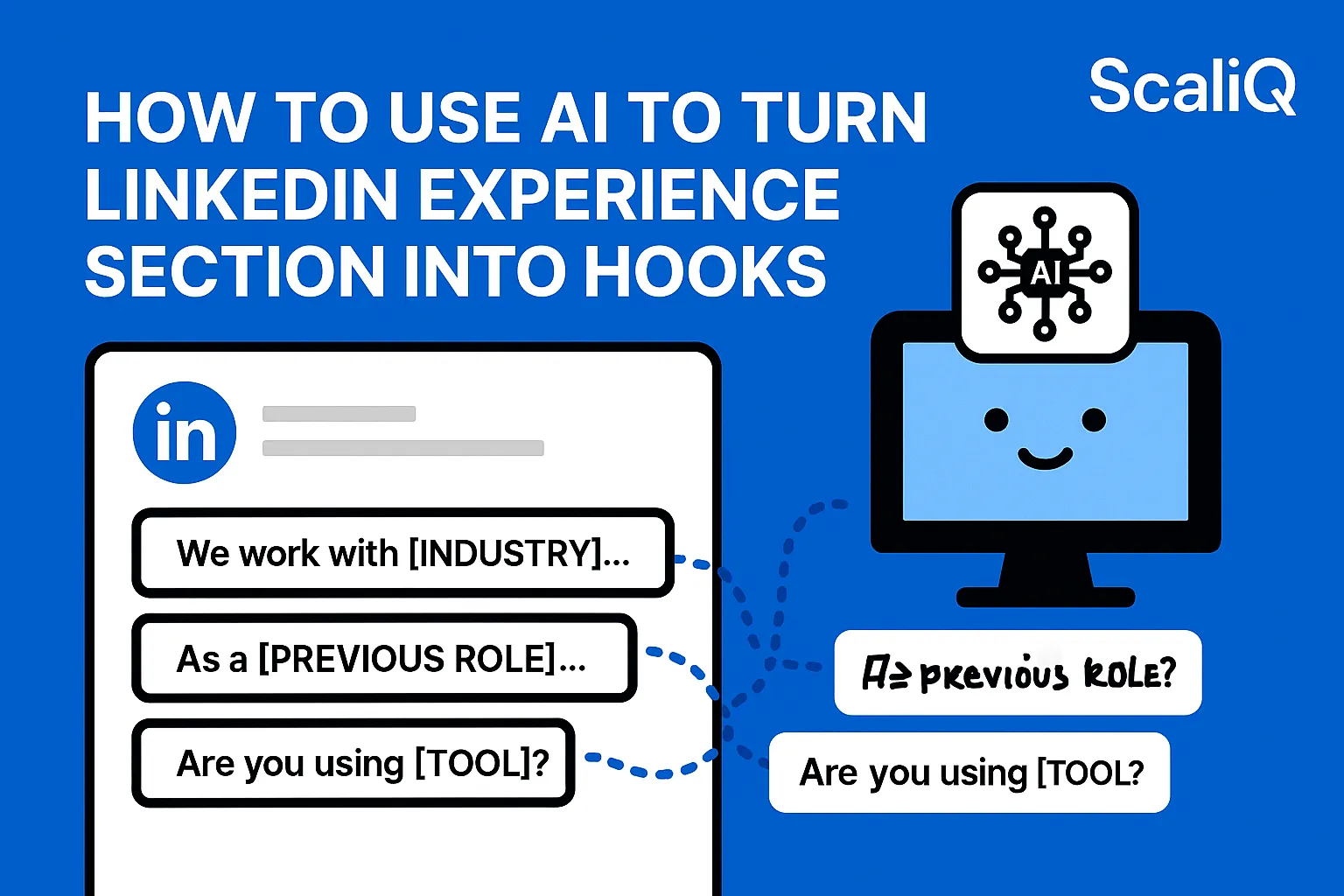
How to Use AI to Turn LinkedIn Experience Section Into Hooks
Manual LinkedIn research takes too long, yet generic AI first lines still sound painfully fake. If you have ever stared at a prospect's profile trying to craft the perfect opening sentence, only to end up with a robotic "I see you work at [Company]," you are not alone.
Most beginners know personalization matters, but they struggle to identify which details in a prospect’s experience section are actually worth using. More importantly, they do not know how to turn those details into a natural, conversational opener. This guide solves that problem. We will show you how to spot the best career signals, paste them into a simple AI workflow, and generate hooks that feel relevant instead of robotic.
By mastering LinkedIn experience section personalization with AI, you can write personalized outreach hooks that actually get replies. ScaliQ provides a focused, simple way to transform public LinkedIn experience data into useful outreach context far faster than manual research. For more insights on blending automation with authentic messaging, check out our related outreach and AI personalization content.
Why LinkedIn Experience Data Matters for Outreach
The Experience section is arguably the most valuable real estate on a prospect's profile for cold outreach personalization. While headlines and summaries are often aspirational, job history provides concrete, actionable context. It reveals role changes, domain expertise, leadership growth, and likely operational priorities.
When you anchor your outreach in these facts, you connect your message to relevance, not flattery. The goal is to use public professional context thoughtfully to show you understand their world, not to impress them with overly detailed stalking. Broad, manual prospect research often burns hours of your day without meaningfully improving message quality. By focusing strictly on structured career data, you optimize your workflow for speed and impact.
Understanding the official LinkedIn Experience section guidelines validates why this data is such a reliable input: it is chronologically structured and standardized. Furthermore, personalized matching research supports the fact that tailored outreach improves relevance and engagement potential, moving you away from the "spray and pray" approach of traditional AI sales outreach and toward genuine connection.
Why experience beats generic profile compliments
Lines like “Loved your background” or “Impressive experience in the industry” feel empty because they apply to everyone. Buyers increasingly ignore generic AI intros. Specific career signals create stronger openers because they give the reader a concrete reason to continue reading. When you reference a specific transition or sustained focus in a niche, you signal that this email was meant specifically for them. In cold email first-line personalization, specificity matters far more than volume.
What makes this useful for beginners
If you are new to sales prospecting personalization, you do not need a complex, expensive enrichment stack to get started. A simple process is all it takes: identify one strong signal from the profile, ask AI for several hook options, and edit for tone. This straightforward approach allows beginners to use an AI first line generator for cold email effectively, drastically improving outreach quality without a steep learning curve.
Which Career Signals Create the Best Hooks
Not every bullet point in a prospect's job history is useful. To figure out which experience-section signals are most useful for outreach hooks, you need to focus on high-value career facts. According to O*NET occupational descriptors, role history reveals meaningful skill and responsibility patterns.
The best sales email hooks from LinkedIn profile data come from concrete facts—promotions, tenure, domain expertise, hiring experience, and category moves—not assumptions about a prospect's personal motivations. Always use one strong signal per opener rather than stuffing multiple details into a single crowded sentence.
Promotions and role progression
Promotions signal trust, organizational growth, and the likely ownership of bigger, more complex problems. When using AI to generate promotions LinkedIn hooks, avoid sounding congratulatory for no reason (e.g., "Congrats on the promotion!"). Instead, reference the change in responsibility.
• Mini-example: Notice if a prospect moved from "Marketing Manager" to "VP of Marketing." This matters because their focus shifted from execution to strategy and budget allocation.
• Hook angle: "Noticed you recently took over the VP role—guessing your focus has shifted heavily toward scaling the marketing tech stack."
Tenure and long-term focus
Long tenure suggests deep operational knowledge, loyalty, or having navigated multiple company stages. This is an excellent angle for founders, recruiters, and SDRs targeting experienced operators. However, avoid unsupported assumptions like, "You must be frustrated by legacy systems after 8 years."
• Mini-example: A prospect has been at the same logistics company for seven years.
• Hook angle: "Seeing your 7-year run at [Company], you've likely seen every iteration of their supply chain process."
Domain expertise and category depth
Repeated experience in one specific niche is a powerful opening angle, especially when your outreach offer connects directly to that specialization. Tie the hook to a relevant challenge in their domain, but keep it light and non-presumptive.
• Mini-example: A prospect has worked exclusively in FinTech compliance across three different companies.
• Hook angle: "Noticed your deep background in FinTech compliance—curious how you're handling the recent shifts in data privacy regulations."
Hiring, leadership, or team-building experience
Hiring activity or leadership progression hints at scaling challenges, process complexity, and operational pain points. This angle is highly effective for recruiters, agencies, and B2B sales outreach. Mention this without sounding invasive or over-interpreting their daily stress.
• Mini-example: A prospect's experience section mentions "Grew the engineering team from 5 to 30."
• Hook angle: "Saw you scaled the engineering team to 30+ recently; usually, that kind of growth breaks internal communication processes."
Category moves and unusual career paths
Moves across different industries, functions, or company sizes create highly memorable, human-sounding openers. Unusual transitions make better hooks than generic success statements because they highlight a unique professional narrative. Keep the line observational, not psychoanalytic.
• Mini-example: A prospect moved from public school teaching to B2B SaaS sales.
• Hook angle: "Fascinating jump from education into SaaS sales—I imagine your background in classroom management translates surprisingly well to managing a pipeline."
A Simple AI Workflow for Generating First Lines
You do not need to be a prompt engineer to succeed with AI LinkedIn hooks. By following a repeatable, step-by-step system, you can collect experience text, extract signals, choose the best angle, generate options, and review them manually.
This lightweight workflow is designed for speed to relevance and better message quality, bypassing the need for complex tooling. A generative AI and personalized persuasion study highlights that tailored, AI-assisted messaging can significantly improve engagement when executed correctly.
For a simple way to turn raw LinkedIn experience data into usable hook suggestions even faster, explore how ScaliQ streamlines this exact process.
Step 1 — Copy the Experience section and isolate useful signals
To begin, copy the publicly available text from the prospect's Experience section. Paste the job titles, time spans, employers, and notable progression patterns into your AI tool. Ignore low-signal fluff like generic company descriptions or buzzword-heavy summaries. Focus purely on specific career facts. Extract 1 to 3 standout signals (like a recent promotion or a decade of industry tenure) before asking the AI to write anything.
Step 2 — Ask AI to summarize the strongest outreach angles
Next, instruct your AI to identify the top three most relevant signals for personalization. Use a prompt that asks for concise, evidence-based observations. Explicitly tell the AI to avoid assumptions, compliments, and exaggerated praise.
• Prompt idea: "Review this LinkedIn experience data. Identify the top 3 objective career signals (e.g., promotions, tenure, category moves) that could be used for a B2B outreach email. Do not invent details or use flattery."
Step 3 — Generate 5 hook variations from one signal
Take the single strongest signal identified in Step 2 and ask the AI to generate multiple opener styles: curiosity-based, relevance-based, pattern-based, or pain-point-adjacent. Keep the hooks short, conversational, and easy to read aloud.
• Prompt idea: "Using the prospect's recent promotion to VP of Sales, write 5 short, conversational email opening lines. Keep them under 20 words. Do not say 'congratulations.' Focus on the likely shift in their daily responsibilities."
Step 4 — Add human review before sending
Never send raw AI output. Human review is critical to ensure factual accuracy, a natural tone, and relevance to your offer. Review your hooks against the NIST generative AI risk guidance to ensure responsible oversight and accuracy. Delete any hook that sounds overengineered, too "smart," or crosses the creepiness threshold. The best cold email first-line personalization always feels understated and natural.
Examples of Weak vs Experience-Based Openers
To master LinkedIn personalization examples, you need to see the difference between generic fluff and hooks rooted in actual experience-section signals. Below are realistic before-and-after examples tailored for different outreach personas.
Example set 1 — Promotion-based hook
• Weak Opener: "I saw your profile and was really impressed by your impressive experience and recent promotion. Congrats!"
• Experience-Based Opener: "Noticed you recently stepped up into the Director of Operations role—guessing your focus has shifted heavily toward optimizing vendor costs this quarter."
• Why it works: It drops the templated flattery and immediately aligns with the expanded responsibilities that come with the new title.
Example set 2 — Tenure and specialization hook
• Weak Opener: "Looks like you've been at [Company] for a long time. You must be dealing with a lot of outdated software."
• Experience-Based Opener: "Seeing your 6-year run in [Company]'s compliance team, you've likely navigated every major shift in data privacy regulations since GDPR."
• Why it works: It highlights long-term category focus as a strength rather than making a negative, unsupported assumption about their pain points.
Example set 3 — Career pivot or unusual path hook
• Weak Opener: "Your career journey is so inspiring and unique."
• Experience-Based Opener: "Noticed your transition from civil engineering into product management—curious if that structural background changes how you approach software roadmaps."
• Why it works: Unusual transitions sound highly human. This career pivot hook is light, observational, and proves the sender actually read the profile.
Example set 4 — Role-specific prompt ideas
The same experience section can produce completely different hooks depending on your goal.
• For SDRs: "Write a hook focusing on their recent move to a mid-market company, tying it to the challenge of scaling internal communication."
• For Founders: "Write a hook observing their 10-year tenure in logistics, asking a peer-to-peer question about supply chain bottlenecks."
• For Recruiters: "Write a hook noting their progression from junior to lead developer in just two years, highlighting their rapid growth."
• For Agencies: "Write a hook referencing their experience building marketing teams from scratch, tying it to the difficulty of maintaining brand consistency."
How to Scale Personalization Without Sounding Generic
Moving from one-off personalization to a repeatable workflow is the ultimate goal. Scale comes from structured inputs and strict review rules, not from blasting raw AI outputs to thousands of prospects. To avoid the robotic tone and inaccurate assumptions common in poor AI sales outreach, you must standardize your approach.
By utilizing ethical AI enrichment and simple execution, you bypass the time-burning manual research and scraper-heavy workflows that often result in generic messaging. For teams looking to integrate scalable personalization systems into their broader outreach stack, tools like Repliq can serve as excellent supporting resources.
Build a repeatable signal-to-hook process
Standardize what you look for every time you open a profile: promotions, tenure, specialization, hiring, and category moves. Use the same review checklist for every hook generated. Consistency in your workflow improves message quality far more than endless prompt experimentation.
Avoid the three biggest mistakes
1. Overpersonalization: Trying to weave three different jobs, a university, and a hobby into one sentence.
2. Unsupported Assumptions: Guessing that a prospect is angry, frustrated, or failing just because they have a certain job title.
3. Irrelevant Compliments: Praising a prospect for something basic just to have an excuse to reach out.
"Creepy" personalization usually stems from too much detail or false confidence. A simple, relevant observation will always outperform a dramatic, over-engineered hook.
Keep compliance, accuracy, and trust in the loop
Public profile data must be used responsibly. Stick to legal, publicly accessible information workflows. Avoid sensitive inferences or anything that feels invasive. AI is here to assist your message drafting, not replace your professional judgment. Refer back to the NIST generative AI risk guidance to ensure your automated outreach remains trustworthy, accurate, and compliant.
Best Practices and Expert Takeaways
To successfully execute LinkedIn experience section personalization with AI, keep these core principles in mind. The best hook is always specific, relevant, brief, and grounded in visible career facts.
The Personalization Do/Don't Checklist:
• DO: Focus on objective career facts (promotions, tenure, pivots).
• DO: Keep hooks under 25 words.
• DO: Read every AI-generated hook aloud to check for a natural tone.
• DO: Use automation for speed, but rely on human review for quality.
• DON'T: Use generic compliments like "Impressive background."
• DON'T: Make negative assumptions about their current tech stack or pain points.
• DON'T: Stuff multiple career details into a single opening line.
• DON'T: Send raw AI outputs without verifying factual accuracy.
ScaliQ’s primary differentiator is simplicity—helping users move directly from raw experience data to usable outreach context without an overly complex setup.
Conclusion
The LinkedIn Experience section is a goldmine of useful outreach signals, but only if you know what to extract and how to translate it into natural language. By focusing on concrete career facts like promotions, tenure, and domain expertise, you can craft personalized outreach hooks that genuinely resonate.
Remember the core workflow: identify one strong career signal, use AI to generate multiple hook options, and manually review for relevance and tone. Better AI sales outreach does not require more words; it requires better signal selection.
Ready to turn LinkedIn experience data into high-converting outreach hooks faster than ever? See the workflow in action with ScaliQ today.