

The LinkedIn “Momentum Builder” Strategy for Conversation Flow
Many LinkedIn conversations don’t fail at the first message; they fail because momentum drops between touchpoints. For B2B sales and growth operators, LinkedIn is fundamentally a relationship channel. The quality of a prospect’s reply rarely depends on a single direct message (DM). Instead, it hinges on what happens before and after the DM.
If you are already prospecting on LinkedIn but want a more natural, repeatable process, you need a system that transitions seamlessly from public engagement to private conversation. Enter the “Momentum Builder” strategy—a practical blueprint designed to move prospects through a logical conversation flow without sounding pushy or automated.
In this guide, we will explore why conversations stall, introduce the Momentum Builder framework, walk through the exact sequence from engagement to DM, outline follow-up timing and revival plays, and show you how to scale personalization. With deep expertise in designing flow structures that maintain conversation energy across multiple touchpoints, ScaliQ understands that a winning LinkedIn conversation flow strategy relies on relevance, timing, and sustained engagement.
Why LinkedIn Conversations Stall
When LinkedIn conversations stall, teams instinctively blame their copywriting. But a stalled thread is usually a system problem, not just a copy problem. Most sales operators focus entirely on "what message to send," completely ignoring the context, timing, and sequencing required to make that message land effectively.
Common friction points occur right after a connection acceptance, following a brief first reply, or when a rep makes an overly aggressive ask too early in the relationship. Generic, transactional outreach kills momentum because it completely skips the necessary relevance and social context. Public engagement, profile signals, and DM pacing all dictate whether a conversation feels natural or forced. Building authentic rapport in B2B sales interactions requires a logical progression, moving from mutual awareness to value-driven dialogue.
The 5 Most Common Reasons Momentum Dies
To fix low reply rates on LinkedIn outreach, you have to diagnose exactly where the drop-off occurs. Here are the five most common failure points:
1. No warm-up before the DM: Jumping straight into an inbox without any prior public interaction feels abrupt.
2. Vague or generic connection requests: Sending a blank request or a templated "I see we work in the same industry" note provides zero context.
3. Messages that ask for too much too soon: Requesting a 30-minute demo in the first message creates immense friction.
4. Rigid follow-up cadence with no signal awareness: Bumping a thread every three days regardless of whether the prospect has viewed your profile or engaged with your content.
5. No revival plan once the thread goes quiet: Letting a lead die completely just because they missed one message.
There is a massive difference between "activity volume" and "conversation progression." Sending 100 blind pitches might yield high activity metrics, but it destroys sales conversation momentum and ruins potential LinkedIn lead generation conversations. Adhering to LinkedIn messaging best practices means prioritizing progression over sheer volume.
Why Static Cadences Underperform on LinkedIn
There is a distinct difference between a rigid cadence and a fluid conversation system. A traditional cadence dictates that you send Message A on Day 1, Message B on Day 3, and Message C on Day 7. While this works in traditional email outreach, static cadences underperform on social platforms.
ScaliQ’s momentum-based approach contrasts sharply with typical frequency-first outreach logic. A LinkedIn-native outreach sequence must adapt to real-time signals: comments, profile views, acceptance timing, and content engagement. If a prospect views your profile but doesn't reply, your next move should be different than if they never opened the message at all. The best alternatives to rigid outreach cadences on LinkedIn involve a buyer engagement strategy that treats the platform like a dynamic networking event, not a static mailing list.
The Momentum Builder Framework
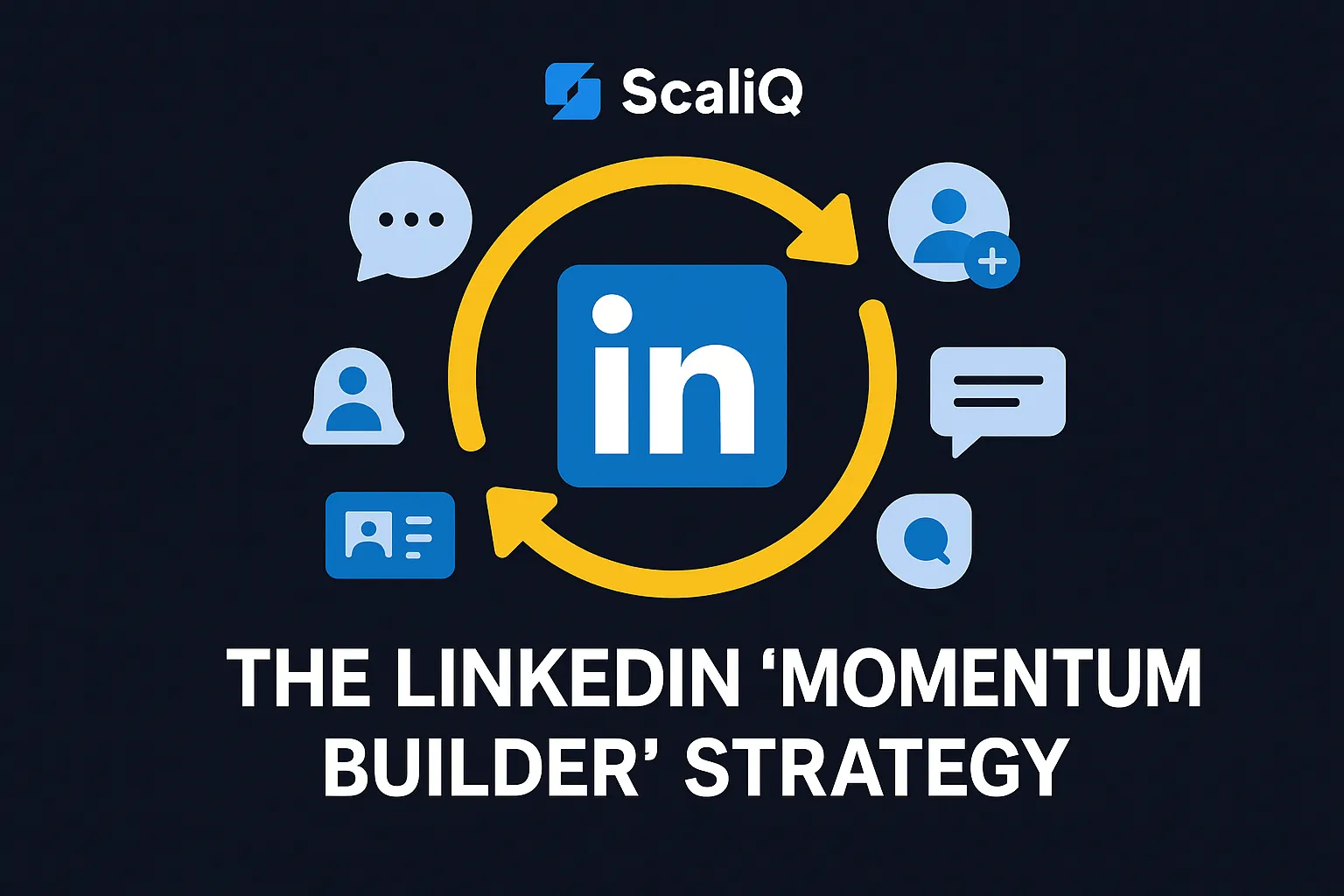
The Momentum Builder is a signal-based conversation flow strategy that utilizes micro-actions to increase familiarity, relevance, and reply quality over time. Instead of relying on a rigid script, it functions as a human-feeling system designed to sustain sales conversation momentum.
The progression is intentional: engage publicly → create visibility → connect → send a low-friction DM → follow up based on signals → revive stalled threads when appropriate. This framework reflects practical flow design for sustained engagement. For more tactical breakdowns on executing this, you can explore the ScaliQ blog.
Stage 1 — Visibility Before Outreach
Before you ever send a message, you need to create context. Comments, profile views, and content interactions build familiarity. When your name pops up in a prospect's notifications a few times before you send a connection request, the friction of that request drops significantly.
In practice, this warm-up looks like leaving a thoughtful comment on their recent post, reacting to an article they shared, or visiting their profile after seeing them engage in a mutual group. The goal is not gaming attention; it is creating genuine context. Understanding how LinkedIn post content drives B2B engagement is a core component of modern social selling on LinkedIn. This approach sets the foundation for how to start a LinkedIn conversation effectively.
Stage 2 — Low-Friction Connection Request
A successful connection request relies on three elements: relevance, brevity, and the absolute absence of a premature sales ask. Depending on the context signal, a plain connection request is sometimes enough—especially if you just had a great back-and-forth in a comment section. However, if you need to establish context, a note is required.
• Bad Request: "Hi [Name], I see we are both in B2B SaaS. I'd love to connect and explore synergies between our companies."
• Better Request: "Hi [Name], loved your breakdown on churn reduction in the comments of Sarah's post today. Connecting to follow your updates."
This aligns with LinkedIn messaging best practices and ensures your LinkedIn outreach sequence starts on the right foot, making it much easier to figure out what to say after someone accepts your LinkedIn connection request.
Stage 3 — Context-Rich First DM
The first DM should continue the thread created by prior engagement, not restart the relationship from zero. It should be short, specific, and relevance-rich—tied directly to the person’s post, role, or a visible priority.
Keep the ask incredibly light. Offer a perspective, ask a relevant question, or provide a free resource. Do not pitch an immediate demo. When executing LinkedIn prospecting conversations, high-quality LinkedIn DM engagement relies on lowering the barrier to entry. (e.g., "Thanks for connecting! I saw your team is hiring for outbound roles right now—are you finding it difficult to source reps with social selling experience?")
Stage 4 — Signal-Based Progression
Not every prospect should move through your sequence at the same speed. You must decide your next move based on behavioral signals.
Signals to watch include:
• Quick acceptance of your connection request
• Profile views immediately after you engage
• Comment replies to your public interactions
• Message opens or warm, brief responses
• Complete silence after prior engagement
Adjusting your pace based on these cues is the core of a modern buyer engagement strategy. Tracking these behaviors ensures your LinkedIn follow-up strategy is timed perfectly, leveraging B2B social selling activities and outcomes to optimize response rates through signal-based engagement.
From Engagement to DM Sequence
To operationalize this strategy, you need a stage-by-stage playbook. Here is the exact sequence of actions that build natural momentum on LinkedIn without relying on generic template dumps.
Step 1 — Start With a Relevant Public Touch
Leaving a comment that simply says "Great post!" adds no value. To effectively leverage social selling on LinkedIn, your comments must add perspective. Focus on prospects who are already discussing priorities related to your offer or market problem.
If a prospect posts about the challenges of data compliance, comment with a brief, actionable insight about how you've seen teams navigate that specific regulation. This public interaction creates a cleaner, highly contextual entry point for later messaging, serving as the bedrock of LinkedIn relationship building and LinkedIn content engagement.
Step 2 — Use Profile Activity as a Soft Signal
Profile views and repeated content interactions indicate recognition or curiosity. If a prospect views your profile after you comment on their post, that is a soft signal.
Clarify for your team that these are not hard intent signals—a profile view does not mean they want to buy your software. However, it helps you decide whether to connect now or keep warming them up. Frame this as a judgment call rather than guesswork, utilizing these cues to refine your buyer engagement strategy and dictate your conversation flow LinkedIn.
Step 3 — Send the Connection Request
When sending the connection request, ensure it features clear relevance, a shared topic or trigger, and absolutely no hard pitch.
• Example tied to content engagement: "Hey [Name], really enjoyed your perspective on Q3 forecasting in your latest post. Would love to connect and follow your content."
• Example tied to role-based relevance: "Hey [Name], I'm connecting with a few RevOps leaders in the logistics space to see how they are handling data enrichment this year. Would be great to connect."
These LinkedIn message examples fit perfectly into a compliant, non-intrusive LinkedIn networking strategy and LinkedIn outreach sequence.
Step 4 — What to Say After Acceptance
High-intent users frequently ask: what to say after someone accepts your LinkedIn connection request? The answer depends on the context.
• Acknowledgment message: If they accepted a blank request after you commented on their post, say: "Thanks for the connection, [Name]. Really enjoyed our back-and-forth on the marketing thread earlier."
• Content-based opener: "Thanks for connecting! I saw your article on team scaling—curious if you've found a good workaround for the onboarding bottleneck you mentioned?"
• Problem-based opener: "Appreciate the connection. I notice your team is expanding into the EMEA market—are you currently navigating the new compliance regulations there?"
This drives LinkedIn follow up after connection accepted and ensures high-quality LinkedIn DM engagement.
Step 5 — Move Toward a Meaningful Reply, Not an Instant Meeting
The first real goal of outreach is conversation progression, not calendar conversion. Low-friction asks lower resistance and drastically improve response quality.
Examples of low-friction asks:
• “Curious if this is a priority for your team right now?”
• “Saw your post on X—how are you approaching it?”
• “Happy to share a teardown of how we solved this if it's useful?”
Unlike template-heavy outreach that jumps aggressively to demos, this method builds sales conversation momentum and generates higher-quality LinkedIn lead generation conversations.
Follow-Up Timing and Revival Plays
One of the biggest pain points in outbound sales is knowing when to follow up, when to pause, and how to restart a stalled thread. You must reframe follow-ups as a continuation of context, not a repetition of your previous ask.
When to Follow Up vs When to Wait
Follow-up timing should reflect the strength of the prior signal. Avoid overly rigid prescriptions and use practical judgment.
• No reply after acceptance: Wait 2-3 days. If they accepted quickly, they are active; send a light, context-rich observation.
• No reply after first DM: Wait 4-5 days. Do not bump the message. Bring a new insight.
• Warm reply then silence: Wait 2 days, then reply with a resource that answers the concern they raised.
• Continued content engagement but no private response: Pause the DMs. Keep engaging publicly until they signal readiness.
Understanding how to follow up when someone stops replying ensures your LinkedIn follow-up strategy maintains sales conversation momentum without alienating the prospect.
3 Revival Plays for Stalled Threads
When LinkedIn conversations stall, use these scenario-based recovery frameworks:
1. Revive with a new insight: "Hey [Name], I saw this report on [Industry Trend] and thought of our conversation last month. Page 4 specifically touches on the compliance issue you mentioned."
2. Revive with a relevant trigger: "Saw your team just announced the new product line—congrats! Imagine [Problem X] is top of mind right now?"
3. Revive by reducing friction: "Hey [Name], I know things get busy. If a call is too much right now, I can just send over a 2-minute video breaking down the workflow. Let me know if you want the link."
Do not do this: "Hey [Name], just bubbling this up to the top of your inbox!" This offers zero value and highlights that your LinkedIn conversations die after first message because you have nothing new to say.
What a Good Follow-Up Sounds Like
A good follow-up prioritizes brevity, relevance, and forward motion.
• Pushy follow-up (Bad): "Hey, did you see my last message? Let me know when you have 15 minutes to chat."
• Context-based follow-up (Better): "Hey [Name], noticed your team is still hiring for that RevOps role. We just published a guide on onboarding ops reps faster—happy to drop the link here if it's helpful."
Eliminating repetitive bumps in favor of value-add messages solves low reply rates on LinkedIn outreach and adheres to LinkedIn messaging best practices.
Scaling Personalization Without Losing Authenticity
Scaling personalization does not mean writing a bespoke essay for every prospect from scratch. It means systemizing the right inputs and decision points. Authenticity comes from relevance and timing, not from overly long custom copy.
To combat robotic LinkedIn messaging and generic LinkedIn outreach, teams must learn how to personalize LinkedIn messages at scale by leveraging individual-driven LinkedIn profiles and B2B engagement. Tools like RepliQ can also be highly relevant when creating personalized outreach assets, customized messaging, or video-based touches to support this workflow.
Personalization Inputs That Actually Matter
Focus on relevance density, not personalization theater (like mentioning their college mascot). The highest-value signals to personalize from include:
• Recent content they posted or shared
• A specific comment thread they participated in
• Their exact role and function priorities
• A company change or initiative mentioned publicly
• Mutual context or a shared niche problem
Using these inputs ensures your personalized LinkedIn messaging drives real LinkedIn prospecting conversations.
Build Repeatable Message Blocks, Not Rigid Templates
Instead of writing full templates, build modular message components. This preserves flexibility while improving efficiency across many active conversations.
• Opener tied to context: "Saw your comment on [Topic]..."
• Light value statement: "We've been helping teams in [Industry] navigate that exact bottleneck by..."
• Low-friction question: "Curious how you are handling [Specific workflow] right now?"
• Optional next step: "Happy to share a quick resource if you're open to it."
This modular approach is one of the best alternatives to rigid outreach cadences on LinkedIn, optimizing your conversation sequencing.
When to Add Richer Personalization
Not every prospect requires a highly customized video. Higher-effort personalization is justified in specific moments:
• Tier 1, high-value target accounts
• Prospects showing strong, repeated engagement signals
• Revival attempts after prolonged silence
• Accounts exhibiting nuanced problem awareness
Escalating to richer personalization, such as customized assets or short personalized videos, is a highly effective buyer engagement strategy that boosts LinkedIn DM engagement.
Tools, Workflow Design, and Team Implementation
To turn this strategy into a repeatable operating system, intermediate teams must track conversation progression instead of merely counting sends, accepts, and replies. Organizing prospects by momentum stage rather than generic “contacted/not contacted” labels ensures your LinkedIn conversation flow strategy actually scales.
A Simple Momentum Tracking Model
To gain better coaching insight than standard send-volume reporting, organize your CRM or tracking tools by these stages:
• Unseen
• Publicly engaged
• Connected
• First DM sent
• Replied
• Active conversation
• Stalled
• Revived
This model measures true sales conversation momentum and provides a clear picture of your buyer engagement strategy.
Team Rules for Maintaining Conversation Quality
Establish strict guardrails to prevent your team from reverting to volume-based spam:
• Don’t over-message; respect the prospect's inbox.
• Don’t pitch before mutual context exists.
• Don’t reuse obvious templates unchanged.
• Do adjust your pace based on prospect behavior.
Quality control is the biggest gap in competitor-style cadence thinking. Enforcing these rules eliminates robotic LinkedIn messaging and ensures your LinkedIn follow-up strategy remains effective.
Future Trends & Expert Predictions for LinkedIn Conversation Momentum
The future of B2B outreach is shifting rapidly from volume-based activity to signal-based engagement. As inboxes become more crowded, the winning teams will be those who measure conversation progression rather than just top-of-funnel activity metrics.
Expect a growing reliance on AI-assisted research to identify engagement signals faster, allowing for dynamic personalization based on real-time data. Richer outreach assets, such as personalized micro-demos or tailored industry teardowns, will replace generic whitepapers. To succeed in social selling on LinkedIn tomorrow, your LinkedIn engagement strategy must prioritize compliance, relevance, and the intelligent interpretation of buyer signals.
Conclusion
LinkedIn outreach yields vastly superior results when treated as a momentum system rather than a static outreach cadence. By breaking down the process into logical stages—public engagement, context-rich connection, low-friction DMs, signal-based follow-up, and thoughtful revival—you create a process that teams can actually scale.
The practical benefits are undeniable: better reply quality, more natural conversations, and a pipeline built on genuine relevance rather than sheer volume. A successful LinkedIn engagement strategy and LinkedIn follow-up strategy rely on maintaining energy across every touchpoint.
To explore how to build these conversation-flow systems and implement them into your own workflows, discover ScaliQ and read more tactical articles on outreach and engagement on the ScaliQ blog.