

The Profile Signals That Shape B2B Credibility
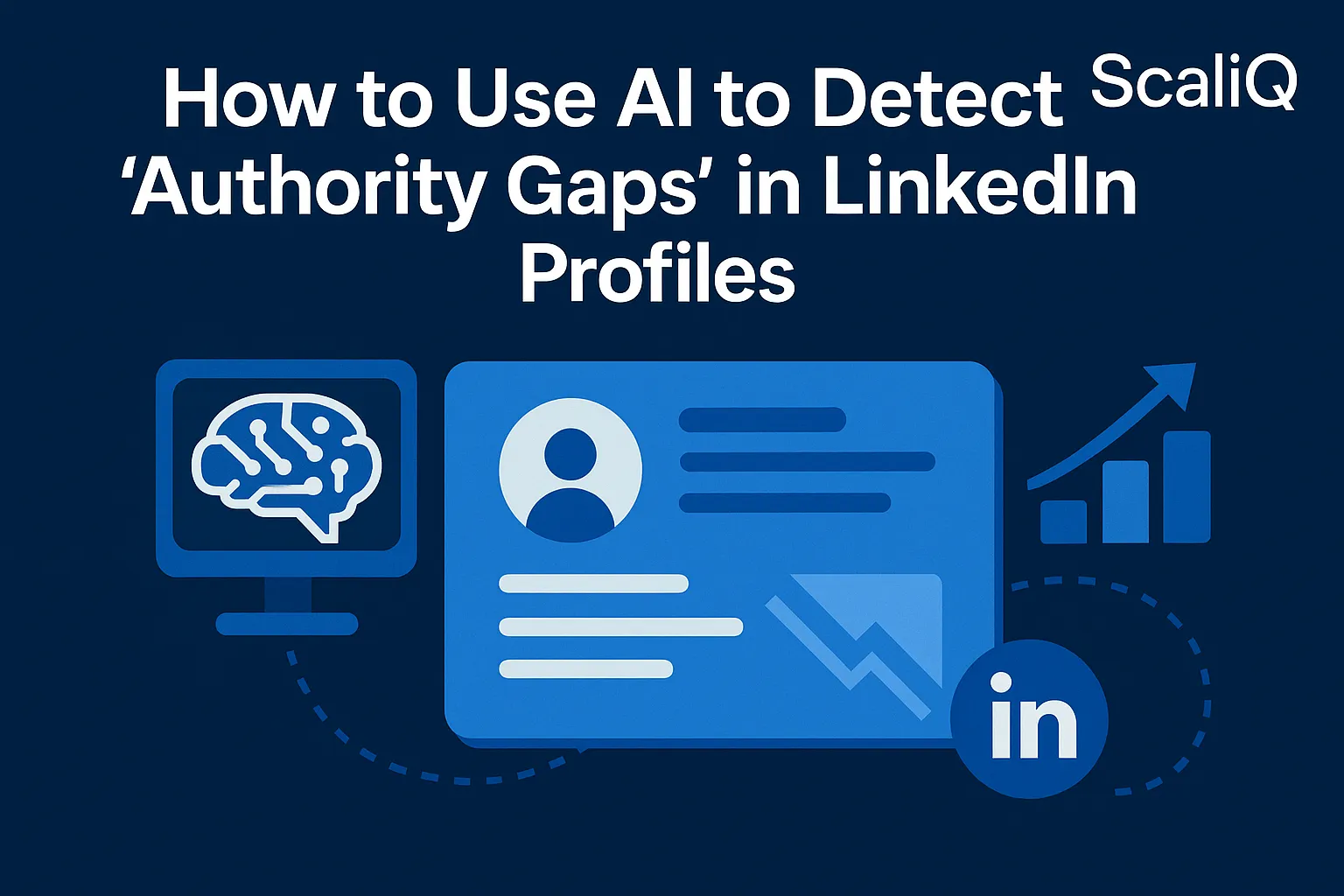
Authority is rarely judged by a single section of your profile; it is inferred from a cluster of signals. Buyers scan your headline, about section, experience, featured assets, and external validation to build a complete picture of your credibility. When optimizing for B2B trust, you must move beyond generic linkedin profile optimization and focus on what each section must actively prove about your linkedin profile authority. Consistent messaging across platforms is vital, as noted in government guidance on trust-building via LinkedIn, which emphasizes the importance of consistency and expertise in professional social profiles. These are the best linkedin profile sections for b2b credibility.
Headline and niche specificity
Vague, role-based headlines (e.g., "Account Executive at TechCorp") severely weaken authority, even if they sound professional. A generic linkedin headline forces the buyer to guess how you can help them. Stronger headlines clarify exactly who you help, what outcome you drive, and what differentiates your approach. This is not about keyword stuffing; it is about audience relevance. Vague linkedin positioning destroys trust, whereas a highly specific headline is the first step in robust linkedin authority building.
About section and claim clarity
The About section must convert high-level claims into a coherent positioning narrative. Weak copy is polished but non-specific, confident but interchangeable. It relies on buzzwords without substance. Stronger copy includes clear problem framing, a unique category perspective, measurable outcomes, and distinct proof cues. This section should serve as the anchor for your linkedin profile authority, personal branding, and outreach positioning.
Experience section and quantified outcomes
Job titles alone rarely establish authority; results, scope, and context do. To pass a linkedin credibility audit, your experience section must emphasize quantified outcomes, vertical context, and execution proof. Instead of listing daily duties, highlight pipeline impact, conversion improvements, growth metrics, or named project types. Closing the claim to proof gap linkedin requires showing exactly how you achieved results, transforming standard credibility signals into undeniable proof of competence.
Featured section, proof assets, and external validation
The featured section often creates the fastest trust lift because it makes your expertise immediately inspectable. Proof assets—such as case studies, teardown posts, customer testimonials, media mentions, and webinars—reduce the friction between a claim and a buyer’s need to verify it. Studies on online trust, including research on how LinkedIn recommendations affect credibility, show that social proof is judged through strict warranting logic. A social proof linkedin profile strategy is essential. For examples of content assets that build visible authority, explore the thought leadership linkedin strategy resources on the Repliq Blog.
Consistency across LinkedIn, outreach, and website messaging
Authority drops instantly when your profile promises one thing, your outreach says another, and your company website positions the brand differently. Buyers detect inconsistent linkedin and website messaging as risk, exaggeration, or a lack of strategic clarity. This is a conversion issue, not just a branding issue. To align linkedin profile with outreach messaging, the positioning outreach strategy must be unified. ScaliQ specializes in ensuring this exact alignment, bridging the gap between profile presentation, outreach execution, and the broader company narrative.
A Prioritized Framework to Fix Claim-to-Proof Gaps
Turning diagnosis into action requires a practical, high-impact repair framework. This priority sequence emphasizes fast trust gains first: niche clarity, quantified outcomes, proof visibility, and messaging alignment. Whether you are a solo operator or conducting team-wide audits, this framework—rooted in ScaliQ’s GTM and outreach-intelligence perspective—will show you how to find authority gaps in a linkedin profile and execute a winning positioning outreach strategy for linkedin profile optimization.
Step 1 — Clarify who you help and what outcome you create
Start with audience and outcome specificity before rewriting any copy. Unclear ICPs and generic value propositions weaken every other authority signal. Move from broad claims like "Driving business success" to niche-specific, outcome-oriented positioning like "Helping Series B FinTechs reduce churn by 20%." Fixing vague linkedin positioning is the foundation of expert positioning linkedin and true linkedin profile authority.
Step 2 — Replace abstract claims with measurable proof
Convert abstract statements into concrete indicators of impact. Instead of "helping companies scale," use metrics, notable project examples, vertical context, and proof-backed differentiators. Proof can be quantitative (revenue generated), qualitative (customer quotes), or third-party validated (awards). Closing the claim to proof gap linkedin relies entirely on these specific credibility signals to build a social proof linkedin profile.
Step 3 — Upgrade visible trust assets
Featured items, recommendations, testimonials, media mentions, and case studies produce the biggest visible trust lift. Distinguish strong proof from weak proof: favor specific outcomes over generic praise, contextualized evidence over vanity logos, and buyer-relevant insights over broad thought leadership. A linkedin profile lacks social proof without these assets. For inspiration on creating educational proof that supports a thought leadership linkedin strategy, review the resources on the Repliq Blog to aid your linkedin authority building.
Step 4 — Align profile messaging with outreach and website narrative
Your profile must reinforce the exact same promise the prospect sees in your outbound campaigns and on your website. Check for the same ICP language, the same problem framing, the same core offer, and the same trust evidence. This is a conversion optimization issue. Inconsistent linkedin and website messaging kills deals. To perfectly align linkedin profile with outreach messaging, explore deeper positioning outreach strategy content on the ScaliQ Blog.
Step 5 — Build a repeatable audit workflow for teams
Standardize profile reviews across founders, AEs, SDRs, and GTM leadership. Implement a shared rubric, an AI prompt set, a benchmarking set, and a regular review cadence. Repeatability turns profile improvement into a scalable GTM advantage. Utilizing an ai linkedin profile audit for founders and sales teams ensures your linkedin credibility audit is consistent, allowing you to continuously benchmark linkedin profile against competitors.
Tools, Inputs, and Resources to Make the Audit More Reliable
To implement this framework consistently, you need the right practical building blocks. Analyzing a profile in a vacuum is insufficient; you need context. By gathering the right data, you can create an audit worksheet or scorecard that becomes a reusable team asset for your linkedin credibility audit, ai profile analysis, and efforts to benchmark linkedin profile against competitors.
Suggested audit inputs
The raw materials needed for a meaningful review include:
• The complete LinkedIn profile text (Headline, About, Experience).
• Visible featured assets and recommendations.
• Current website positioning and landing page copy.
• Active outreach copy (cold email templates, InMail scripts).
• Selected competitor profiles for benchmarking.
Without context from outreach and website positioning, you cannot accurately align linkedin profile with outreach messaging or gauge true linkedin profile authority.
Suggested scoring outputs
A reliable audit should generate specific, actionable outputs, such as:
• A total authority score (e.g., out of 100).
• Section-by-section gap notes detailing missing proof.
• A list of priority fixes ranked by impact.
• Identified proof opportunities (e.g., "Add a case study to the featured section").
• Competitor benchmarks showing where peers outperform you.
These outputs clearly define the authority gaps linkedin and form the basis of a rigorous linkedin credibility audit.
Future Trends in AI-Led LinkedIn Positioning
The future of GTM strategy relies heavily on AI-driven personal brand audits and LLM scoring for credibility and differentiation. We are seeing a tighter integration between outbound personalization and profile optimization, creating authority-building systems that align LinkedIn perfectly with website and GTM messaging. These trends do not replace human judgment; they increase the importance of evidence-backed positioning. As ai linkedin optimization evolves, a thought leadership linkedin strategy will require deeper, verifiable proof. ScaliQ’s strategic angle connects profile authority directly to trust formation and conversion, making it the premier platform for modern linkedin authority building.
Conclusion
Most LinkedIn underperformance is not a formatting problem; it is an authority-gap problem. Authority gaps appear when your claims, proof, positioning, and buyer expectations are fundamentally out of sync. To fix this, you must define the gap, audit the right signals, use AI to score and benchmark your profile, fix high-impact proof issues, and align your profile with your outreach and website messaging. Review your profile not just as a personal brand asset, but as a live conversion asset in your GTM motion. By mastering your positioning outreach strategy, you eliminate authority gaps linkedin and amplify your sales outreach credibility signals. For GTM teams looking to systematize this process, ScaliQ is the strategic home for AI-driven outreach intelligence, outbound trust, and positioning insight.
(Author Note: ScaliQ provides a GTM-oriented perspective on AI, positioning, and outbound trust, leveraging data-driven intelligence rather than generic LinkedIn advice to drive real revenue outcomes.)