

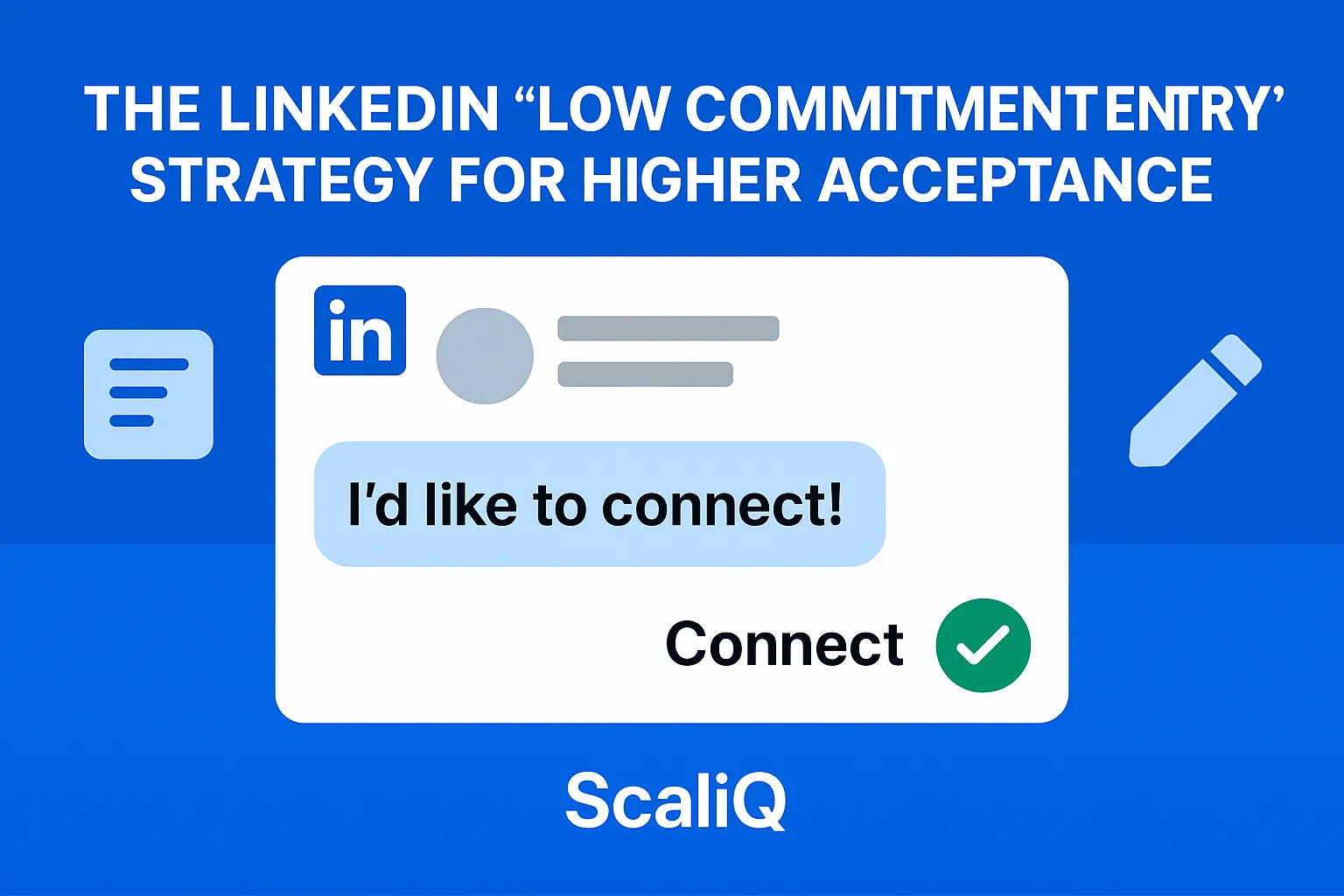
The LinkedIn “Low Commitment Entry” Strategy for Higher Acceptance
Many LinkedIn connection requests fail before the real conversation even starts—not because the offer is bad, but because the first message asks for too much too soon.
Beginners often treat the connection request like a sales message, attempting to pitch a product or book a meeting in the very first interaction. In reality, the true job of a connection request is simply to earn permission for a future conversation. This makes acceptance optimization the foundational step in any LinkedIn connection request strategy. Before you can worry about reply optimization, booking meetings, or converting leads, you must first get the prospect to accept your request.
In this beginner’s guide to LinkedIn low commitment outreach, we will explore what this reduced-friction approach means, why traditional requests get ignored, and how to implement a simple, effective framework. We will also provide real-world templates, before-and-after rewrites, and actionable advice on what to send after someone accepts.
At ScaliQ, our perspective is built on practical outreach systems and reduced-friction first-touch messaging. Rather than relying on aggressive pitches, we focus on building relationships through compliance and relevance. For more beginner-friendly playbooks and related outreach guidance, visit Blog.
What Low-Commitment LinkedIn Outreach Means
A low-commitment entry is a short, low-pressure first touch that offers a lightweight reason to connect. The initial goal of this first touch messaging is not to book a call, push a product demo, or close a sale. Instead, it is designed solely to start a relevant professional connection.
The core of this LinkedIn low commitment outreach strategy is reducing friction. By asking for less upfront, you create less pressure, demand less cognitive load, and present less risk for the recipient. This low friction outreach approach is highly versatile and works effectively across multiple use cases, including cold prospecting, peer networking, strategic partnerships, and recruiting.
This behavioral logic is supported by the APA definition of the foot-in-the-door technique, which explains why a smaller, less demanding first ask is often easier for individuals to accept. Furthermore, Texas A&M’s sample LinkedIn outreach guidance emphasizes the importance of introducing yourself clearly, explaining your relevance, and keeping the initial request incredibly simple.
Low-Commitment vs. High-Friction Outreach
To improve your message acceptance rate, you must immediately recognize the difference between high-friction and low-commitment messages.
High-friction outreach typically includes long paragraphs, calendar links, immediate asks, vague personalization, or direct pitching. It forces the recipient to make a buying decision before they even know who you are. Conversely, low-commitment outreach is concise, highly relevant, human-sounding, and easy to say yes to.
Consider this quick contrast:
• High-Friction (Sell Immediately): "Hi [Name], we help companies like yours scale. Do you have 15 minutes this Tuesday for a quick demo? Here is my calendar link."
• Low-Commitment (Connect First): "Hi [Name], noticed your recent post on scaling operations. I follow this space closely and would love to connect to follow your updates."
Low commitment does not mean low intent. It simply means better sequencing. You are still executing cold outreach on LinkedIn, but you are focusing on acceptance optimization first.
Why This Strategy Works for Beginners
Beginners do not need deep, advanced copywriting skills to see a massive reply rate improvement. Instead, they need better first-step discipline.
This lightweight framework works because it reduces the temptation to over-explain your product or over-sell your services in the first message. When you rely on personalized connection requests anchored in relevant context rather than fully custom, lengthy essays, your LinkedIn prospecting becomes much easier to scale.
Why LinkedIn Connection Requests Get Ignored
Poor acceptance is often caused by unnecessary friction in the message, not just bad targeting. When a recipient receives a connection request, they quickly scan it for three elements: relevance, trust, and pressure.
While the message itself is a critical factor, your profile credibility and targeting also play a massive role in your LinkedIn acceptance rate tips. Understanding what mistakes lower acceptance rates in LinkedIn outreach will help you self-correct and normalize these common beginner errors.
Asking for Too Much Too Early
The biggest mistake in first touch messaging is asking for a demo, call, or meeting inside the initial connection request. This creates immediate resistance. A recipient has not yet agreed to a relationship with you, making a hard call-to-action (CTA) feel completely premature.
Language that increases pressure—such as "book time," "quick call," or "15 minutes this week?"—sabotages your acceptance optimization and hurts your overall LinkedIn lead generation efforts.
Sounding Generic or Automated
Shallow personalization can actually feel worse than no personalization at all if it looks obviously copied and pasted. One-size-fits-all templates destroy trust.
Signs of generic, automation-like messaging include vague compliments ("I love your profile!"), broad claims, and canned intros. With inbox fatigue at an all-time high, professionals are scrutinizing cold outreach on LinkedIn more than ever. Current automation trends increasingly prioritize personalization quality signals over sheer send volume.
This is where ScaliQ’s approach differs from typical automation-first tools. We prioritize message quality and deep relevance, ensuring your low friction outreach sounds human rather than like a mass-blasted template.
Long Messages and Unclear Relevance
Long messages create cognitive load. Short messages perform better because they are easier to read, require lower effort to process, and generate lower suspicion.
When studying how to write LinkedIn outreach messages, remember that relevance must be obvious within the first sentence or two. You must answer "Why me?" and "Why now?" without turning the note into a pitch. Looking at successful LinkedIn connection request examples, the best ones respect the reader's time, which directly boosts the message acceptance rate.
Weak Profile Trust Signals
Your message acceptance rate is directly tied to your profile readiness, not just your copy. Core trust signals include a professional photo, a clear and descriptive headline, relevant experience, and mutual context (such as shared connections).
People often inspect your profile before deciding whether to accept your request. Even the best LinkedIn connection request strategy will underperform if your profile looks unfinished, spammy, or overly salesy. From ScaliQ’s system-level perspective, successful LinkedIn prospecting depends on the full first impression—your profile and your message working together.
The Framework for High-Acceptance First-Touch Messages
To master LinkedIn low commitment outreach, beginners need a repeatable, simple method. This framework is centered entirely on friction reduction and relevance: Context → Relevance → Light Reason → No Pressure.
Each step is practical, easy to implement in under a minute per contact, and designed to help you sound human without writing fully custom outreach from scratch every time. This is the core of true acceptance optimization and a winning LinkedIn connection request strategy.
Step 1 — Start with Real Context
Always anchor your message in a specific, real detail. Use one relevant context clue: a shared industry, a recent post they made, their specific role, their company’s recent news, or a mutual professional interest.
Avoid fake personalization or overly clever openers that feel forced. Context should feel natural. These relevance signals are the foundation of effective personalized connection requests and successful LinkedIn prospecting.
Step 2 — Make the Reason to Connect Lightweight
Reduce the pressure of the request while preserving its professional purpose. Phrase your intent as wanting to learn, connect, share perspectives, or stay in touch.
Language that opens the door instead of forcing a next step is the hallmark of low commitment outreach. However, "lightweight" does not mean vague; your first touch messaging must still provide a logical reason for the LinkedIn connection request strategy.
Step 3 — Keep the Message Short and Human
To improve readability and reduce resistance, keep your message incredibly short. Use plain language and absolutely no jargon-heavy pitches. Remove unnecessary qualifiers, long introductions, and feature explanations.
End with a soft close, such as "thought it made sense to connect." This low friction outreach approach aligns with the University of Louisville networking message example, which strongly supports the recommendation for brief, professional outreach. If you are wondering how long should a LinkedIn connection request be, the answer is: as short as possible while remaining relevant. This directly impacts your message acceptance rate.
Step 4 — Avoid the Pitch Until After Acceptance
Sequencing discipline is vital. Separating the connection step from the conversation step builds trust.
Do not include pricing, pitch decks, product demos, calendar links, or aggressive CTAs in your first note. After acceptance, your message sequence can gradually move toward business relevance. As noted by UCLA on informational interview outreach, first-touch outreach should focus on professional connection and advice-gathering, not immediate asks. This patience is the key to acceptance optimization, determining the best first message after connecting on LinkedIn, and driving long-term reply rate improvement.
Templates and Before-and-After Rewrites
Understanding the framework is one thing; applying it is another. Below are beginner-friendly templates for various use cases. By diagnosing the friction in the "before" examples, you can see exactly why the low commitment outreach rewrites perform better.
Example 1 — Cold Prospecting
High-Friction Version: "Hi [Name], our software helps sales teams book 30% more meetings. I’d love to show you how it works. Do you have 10 minutes next Tuesday for a quick call? Here is my link."
Low-Commitment Rewrite: "Hi [Name], noticed you’re leading the outbound team at [Company]. I follow the B2B sales space closely and would love to connect to follow your updates."
Why this improves acceptance optimization:
• Removed the immediate pitch and calendar link, instantly lowering resistance.
• Anchored the message in real role/company context.
• Provided a soft, logical reason to connect without demanding their time.
• Transforms aggressive LinkedIn lead generation into compliant cold outreach on LinkedIn.
Example 2 — Peer Networking
High-Friction Version: "Hi [Name], I see we are both in marketing. I am looking to expand my network and would love to get on a virtual coffee chat to discuss synergies."
Low-Commitment Rewrite: "Hi [Name], really enjoyed your recent post on content distribution. I'm also in the marketing space and thought it made sense to connect and stay in touch."
Why this works: This personalized connection requests template benefits from curiosity and professional relevance over an agenda-heavy virtual coffee ask. It keeps the first touch messaging conversational, respectful, and perfect for LinkedIn networking.
Example 3 — Partnerships or Collaborations
High-Friction Version: "Hi [Name], we offer complementary services to your agency. We should partner up to share leads. Let me know when you are free to discuss a revenue-share agreement."
Low-Commitment Rewrite: "Hi [Name], looks like we both work heavily with SaaS founders in the logistics space. Thought it would be great to connect with a fellow agency leader."
Why this works: It signals relevance (shared audience/space) without turning the request into a formal proposal. The ask is kept strictly at the "connect" level, making it ideal for low friction outreach and partnership-focused LinkedIn prospecting.
Example 4 — Recruiting or Hiring Outreach
High-Friction Version: "Hi [Name], I am recruiting for a Senior Developer role at a top tech company. The salary is highly competitive. Are you open to new opportunities? Send me your resume."
Low-Commitment Rewrite: "Hi [Name], really impressed by your engineering background at [Company]. I’m always looking to connect with top talent in the React space. Thought I’d reach out to follow your work."
Why this works: It avoids sounding transactional. By emphasizing respect and low pressure, these LinkedIn outreach messages feel more human and less mass-sent, vastly improving the message acceptance rate for recruiting outreach.
To effectively scale this kind of relevant, reduced-friction personalization without sacrificing message quality, explore our workflow capabilities at ScaliQ. Additionally, tools like Repliq.Co can serve as a complementary personalization layer when building scalable, human-sounding outreach.
What to Do After Someone Accepts
Acceptance is a green light for a conversation, not permission to instantly pitch. To maintain trust, you must transition from connection to dialogue in a way that matches your low-commitment philosophy.
When to Follow Up
Beginners often ruin their acceptance optimization by messaging a prospect the exact second they accept the request. Instead, establish a simple follow-up rhythm.
Patience and relevance are key. A short thank-you or a context reminder works well a day or two after acceptance. Do not rush into an automated sequence. When wondering when should you follow up after LinkedIn connection is accepted, remember that a natural delay feels much more human in your LinkedIn follow up.
What the First Post-Acceptance Message Should Say
Your bridge message should thank them, reference the original reason for connecting, and open a low-pressure next step.
Ask a simple, relevant question, share a brief industry insight, or invite a light exchange. This message must feel conversational, not campaign-driven. Texas A&M’s sample LinkedIn outreach guidance reinforces that respectful, relevant professional follow-up is the best first message after connecting on LinkedIn, directly contributing to reply rate improvement and effective first touch messaging.
How to Transition Toward a Business Conversation
To move from connection to conversion without losing trust, you must wait for engagement signals before suggesting a call or sharing a stronger CTA.
Your next ask should feel earned by relevance, not forced by sequence timing. Do not drop a pitch deck immediately after they accept. This trust-first flow stands in stark contrast to the aggressive habits of manual scrapers or automation-led outreach. By utilizing AI enrichment, data verification, and strict relevance, you execute a compliant, highly effective form of LinkedIn lead generation that ensures ongoing reply rate improvement and long-term acceptance optimization.
Best Practices and Expert Takeaways for Acceptance Optimization
Acceptance optimization is an overlooked growth lever. Better first-touch design improves everything that follows in your pipeline.
Focus on audience targeting, profile readiness, message brevity, and light personalization working together. Scalable outreach must optimize for message quality, not just send volume.
Pre-Send Checklist:
• Is my profile fully optimized and trustworthy?
• Is my message under three sentences?
• Did I include a specific relevance signal?
• Did I remove all pitches, links, and meeting requests?
These principles align with NACE career readiness and networking competencies, ensuring your communication remains professional and effective. For more insights into messaging workflows and personalization, visit Blog.
By mastering this LinkedIn low commitment outreach, you ensure a consistently high message acceptance rate.
Conclusion
The first LinkedIn message should never try to win the meeting; it should only try to win the connection.
By pulling the core levers of outreach—reducing the ask size, increasing relevance, keeping messages short, and ensuring your profile supports trust—you will see immediate results. Acceptance optimization through friction reduction is a significantly smarter beginner strategy than leading with a pitch.
Stop asking for too much too soon. Improve your outreach workflow today and explore ScaliQ’s approach to making first-touch messaging more relevant, human, and easier to accept. Master your LinkedIn connection request strategy through true LinkedIn low commitment outreach.