

Introduction
Advanced outbound teams often waste thousands of touchpoints on prospects who were never relevant in the first place. The sheer volume of noise in B2B data means that for every 100 emails sent, only a fraction land in the inbox of a buyer who is actually ready to engage.
The core problem lies in qualification methods. Manual LinkedIn qualification relies heavily on surface-level data—job titles, company size, and industry codes—while completely ignoring the behavioral or semantic intent signals that actually predict a purchase. A "Head of Growth" at a Series A startup might be your perfect customer, or they might be completely focused on retention, making your acquisition tool irrelevant. Static filters cannot tell the difference.
This guide reveals how AI relevance scoring—powered by reply-trained neural models—identifies true high-fit prospects at scale. By moving beyond basic filtering to deep semantic analysis, modern sales teams are reducing waste and increasing reply rates.
We will explore how tools like ScaliQ utilize AI-driven scoring engines to parse unstructured data, ensuring your outreach is strictly reserved for high-relevance targets.
Why Traditional LinkedIn Qualification Fails
The traditional playbook for LinkedIn prospecting is breaking under the weight of modern data complexity. Most outbound teams still rely on manual verification or basic boolean search filters, methods that were designed for a less saturated digital environment.
Reliance on Surface-Level Firmographics
Typical qualification workflows depend almost exclusively on rigid firmographic data: job titles, industries, and employee count ranges. While this provides a baseline, it creates a massive mismatch between title-based filtering and real buying intent.
A title like "Marketing Manager" is semantically ambiguous. In one organization, this role manages paid ads; in another, it focuses solely on brand comms. Traditional lead scoring treats these two profiles as identical. By failing to analyze the context of the role, teams flood their pipelines with false positives—prospects who look right on paper but have zero alignment with the solution being offered.
High Manual Research Load
To compensate for weak data, Sales Development Representatives (SDRs) are forced to manually review profiles. This process is incredibly inefficient. SDRs often lose hours per day clicking through LinkedIn profiles, scanning "About" sections, and checking recent posts just to verify if a prospect is active.
This manual bottleneck destroys outbound efficiency. Instead of focusing on crafting high-quality messages or managing active deals, reps are stuck acting as human data filters. The result is lower volume, burnout, and ultimately, poor reply rates because the research cannot keep pace with the necessary scale.
Why Behavioral & Semantic Signals Are Missed
The most valuable data on LinkedIn is unstructured. It lives in the nuances of a prospect's profile summary, their comment history, and their posting behavior. These are critical B2B intent detection signals that static databases miss entirely.
Manual review cannot scale to capture these insights across thousands of leads. A human might miss that a prospect just commented on a competitor's post about pricing, or that their profile explicitly mentions "scaling outbound operations." Advanced frameworks for user behavior analysis highlight the necessity of mapping these interactions to intent. According to NIST user behavior analysis guidelines, understanding these complex interaction patterns is key to accurately predicting user objectives, a principle that applies directly to qualifying B2B buyers.
How AI Relevance Scoring Models Work
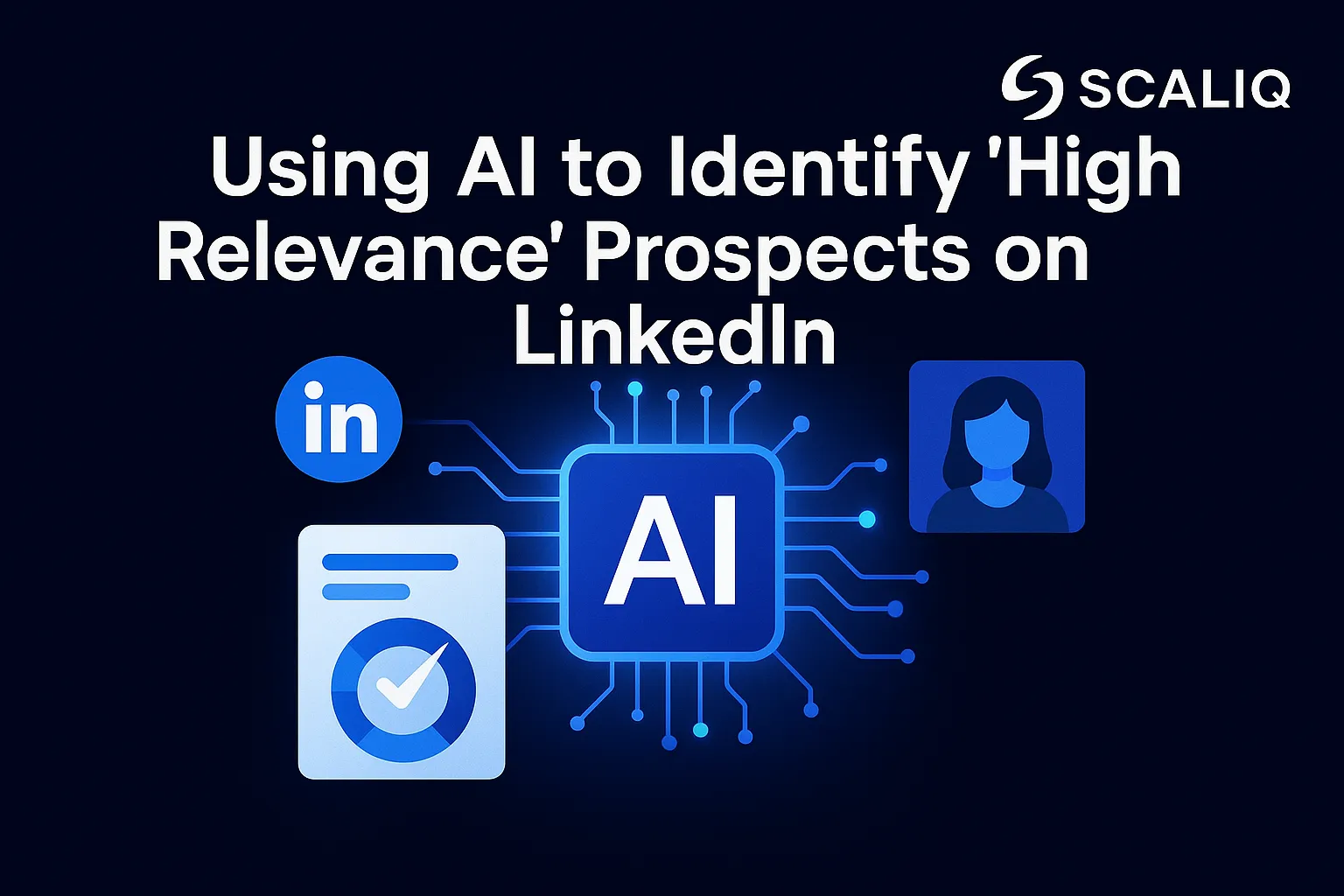
To solve the qualification crisis, advanced teams are turning to AI relevance scoring. This is not simple automation; it is a deep technical process where neural models interpret multiple signals to evaluate buyer fit with high precision.
Neural Models Trained on Large Reply Datasets
The most effective scoring engines are not just trained on static profile data; they are trained on outcomes. ScaliQ, for example, trains its relevance models using thousands of real outreach replies.
By analyzing which prospects actually replied positively and which marked emails as spam, the model learns to predict relevance based on historical success. This approach aligns the scoring mechanism with the ultimate goal: engagement. These reply-trained neural models can discern subtle patterns that correlate with positive sentiment. Recent research into the LinkedIn SAGE relevance evaluation framework demonstrates how graph-based neural networks can significantly outperform traditional methods in predicting link relevance and user interest.
Semantic Matching Using LLM Embeddings
AI relevance scoring utilizes Large Language Model (LLM) embeddings to perform semantic matching. Instead of looking for exact keyword matches (e.g., "Sales"), the AI converts the prospect's entire profile text into a vector—a mathematical representation of meaning.
It then compares this vector to the Ideal Customer Profile (ICP) definition. For instance, if your ICP involves "managing cloud infrastructure," the AI can identify a prospect whose profile says "overseeing AWS migration and server stability," even if the specific keywords differ. This semantic relevance scoring ensures that fit is determined by actual job responsibilities rather than arbitrary job titles.
Multi-Signal Scoring Architecture
Robust automated multi-signal scoring does not rely on a single data point. It uses a weighted architecture that aggregates:
1. Firmographics: Company size, growth rate, tech stack.
2. Behavioral Data: Recent activity, posting frequency.
3. Semantic Data: Profile bio context, job description nuance.
4. Engagement Data: Interaction with relevant topics.
The model runs an inference flow where each signal contributes to a final "fit score" (e.g., 0 to 100). If a prospect matches firmographically but shows zero semantic alignment in their bio, the score drops, saving the SDR from a wasted email.
Real-Time Scoring Pipeline
Data decays rapidly. A prospect relevant six months ago may have changed roles today. AI prospecting tools utilize a real-time scoring pipeline. When a lead is processed, the system scrapes compliant, public data sources to retrieve the freshest signals available.
New signals—such as a recent promotion or a new company post—update the score dynamically. This allows outbound teams to prioritize prospects who are peaking in relevance right now, rather than working off a stagnant list exported months ago.
Accuracy, Data Quality, and Real-Time Scoring
For advanced users, the reliability of the model is paramount. AI scoring is only as good as the data it ingests and the logic it applies.
Data Quality’s Impact on Scoring Accuracy
Public profiles are often noisy. They contain typos, outdated job roles, or sparse descriptions. High-quality AI scoring engines mitigate this through confidence weighting.
If a profile is sparse, the AI assigns a lower confidence score, flagging it for manual review or excluding it from high-tier automation. Conversely, rich profiles with detailed descriptions receive higher confidence weights. This handling of data quality ensures that the model doesn't "hallucinate" relevance where data is missing.
Model Evaluation Metrics
To trust the system, teams need to understand the metrics. Key evaluation metrics include:
• Precision: The percentage of identified "high-fit" leads that are actually relevant.
• Recall: The ability of the model to find all relevant leads in a dataset.
• Semantic Alignment Score: How closely the prospect's text matches the ICP embedding.
• Reply-Likelihood Correlation: The statistical relationship between a high score and a positive reply.
Continuous Learning and Feedback Loops
Static models fail; adaptive scoring models win. ScaliQ employs a continuous learning loop. Every time an outbound campaign runs, the results (replies, bounces, ignores) are fed back into the system.
If a specific segment of "high-score" leads yields a low reply rate, the model adjusts its weights, learning that perhaps a certain industry vertical or job title nuance is less receptive than predicted. For more on how reply data fuels better outreach strategies, visit the Repliq blog, which discusses the intersection of data feedback and personalization.
How ScaliQ Outperforms Generic Lead Scoring Tools
Not all scoring tools are created equal. There is a distinct gap between generic enrichment platforms and specialized, neural-based relevance engines.
Relevance-First vs Volume-First Scoring
Most legacy tools operate on a volume-first basis. They sell access to millions of contacts and encourage "spray and pray" tactics. ScaliQ flips this model to relevance-first.
Instead of maximizing the number of emails sent, the goal is to maximize the relevance of every single touchpoint. This approach inherently protects domain reputation and improves conversion rates. It is the difference between filter-based selection (quantity) and neural-based selection (quality).
Semantic + Behavioral Intent, Not Just Firmographics
Generic enrichment tools stop at firmographics. They tell you who the prospect is, but not what they are interested in.
ScaliQ integrates behavioral intent scoring. It doesn't just know that a prospect is a CTO; it knows that this CTO is actively posting about "AI integration challenges." This layer of behavioral insight allows for timing outreach when the buyer is most psychologically receptive.
Reply-Trained Neural Models as a Competitive Moat
The defining competitive advantage of ScaliQ is its use of reply-trained neural models. Competitors often use generic "business fit" algorithms that are not specific to outbound success.
ScaliQ’s models are fine-tuned specifically on the nuances of cold outreach. They understand the difference between a prospect who looks good on paper and one who actually replies to cold emails. This specific training data creates a "moat" of accuracy that generic LLMs cannot replicate without access to proprietary campaign performance data.
Transparent Technical Scoring Logic
"Black box" AI is dangerous for sales teams. If you don't know why a lead was scored highly, you can't trust the system. ScaliQ focuses on explainable scoring models.
Users can see the signal contribution: "Score 85/100 – High match due to 'SaaS' industry, 'VP' seniority, and semantic match on 'outbound automation' in bio." This transparency allows operators to refine their ICP definitions and trust the automation.
Tools, Resources, and Future Trends
The landscape of AI prospecting is evolving rapidly. Here is where the technology is heading.
Recommended Technical Papers & Standards
For teams building internal tools or deeply vetting vendors, understanding the underlying tech is crucial. Reviewing research on semantic models (like SESA and SAGE) and adhering to NIST standards for behavioral analysis provides a solid foundation for evaluating AI capabilities.
Predictive Outreach Timing
The next frontier is predictive outreach. We are moving from "Is this prospect relevant?" to "Is this the right time to contact them?"
Future models will ingest news triggers, funding announcements, and hiring velocity to predict the exact window of opportunity. If a company just hired a VP of Sales, the model will trigger an alert that the window for sales enablement tools is open.
Cross-Platform Intent Modeling
Currently, most scoring is platform-specific. The future lies in cross-platform intent modeling. This involves fusing signals from LinkedIn activity, email engagement, and website visitor identification (deanonymization).
By correlating a LinkedIn comment with a visit to your pricing page, AI will build a unified view of buyer intent that is far more accurate than any single channel could provide.
Conclusion
The era of volume-based prospecting is ending. In its place, a precision-based approach driven by AI relevance scoring is taking over. By leveraging neural models that understand context, behavior, and semantics, advanced outbound teams can finally stop wasting time on bad data.
ScaliQ represents the forefront of this shift, offering a scoring engine that is not just smart, but reply-trained—built specifically to solve the problem of outbound noise. The blueprint is clear: prioritize relevance, leverage hidden intent signals, and let AI handle the heavy lifting of qualification.
For teams ready to modernize their workflow, the next step is to test these models against your current data. You will likely find that your "best" leads were hiding in plain sight, waiting for a system smart enough to find them.