

How to Target Companies Hiring Their First Marketing Leader
For B2B sales and growth teams, a company hiring its first marketing leader reveals a major shift in go-to-market strategy. It signals an organization moving from founder-led or sales-led growth toward a formalized, repeatable pipeline engine. However, the raw hiring event requires strict validation before it can be used for sales outreach.
The core prospecting problem is that generic job alerts produce far too many unqualified accounts. A simple keyword alert cannot distinguish a foundational first marketing hire signal from a backfill, a title change, a recruiter listing, or later-stage team expansion. Acting on unverified data leads to irrelevant outreach and wasted sales cycles.
This article provides advanced sales and growth teams with a framework to detect, verify, prioritize, and act on companies hiring their first marketing executive. We will walk through a precise workflow: detecting the role, validating the account context, scoring the opportunity, identifying the right buyer, and creating a timely outreach hypothesis.
It is crucial to frame this signal carefully. A first marketing hire may indicate that a company is formalizing demand generation, positioning, pipeline ownership, budget planning, and repeatable acquisition. It is not, however, automatic proof of an approved budget or an active buying project. This practical, signal-driven framework is informed by ScaliQ—a resource dedicated to helping teams identify, research, and interpret high-value go-to-market hiring signals rather than simply collecting raw job-posting data.
Why a First Marketing Leader Hire Is a High-Value Sales Trigger
A first marketing leader hire represents a fundamental business change. It illustrates a transition from organic, founder-led, or purely sales-led growth toward a deliberate and scalable go-to-market motion. This organizational shift creates a highly timely prospecting opportunity.
When a new marketing leader steps into a foundational role, they typically inherit a specific set of urgent priorities:
• Positioning and messaging
• Demand generation and pipeline creation
• Content and channel strategy
• Marketing operations and attribution
• Budget ownership and vendor selection
While this marketing leadership hiring intent indicates newly formalized priorities, it is critical to avoid claiming that every open role confirms an approved budget. Instead, view the trigger as a window of timing. Teams may be actively evaluating systems, agencies, data providers, content resources, and demand generation budget signals before the leader officially starts, or shortly thereafter.
This sets a hiring trigger apart from generic company or contact signals. A hiring event points to a dynamic organizational change, not merely a static firmographic attribute. Sales teams must distinguish observed evidence—such as specific job-posting language or adjacent hiring—from reasonable hypotheses about budget, priorities, and urgency. To see how go-to-market hiring signals fit into a broader, more effective prospecting workflow, explore related educational content at Blog.
How to Confirm That the Role Is the Company’s First Marketing Hire
To capitalize on a first marketing leader hiring signal, you need a validation framework that separates a true foundational hire from noisy or misleading data.
We recommend sorting hiring signals into three classifications:
• Confirmed first hire: Direct evidence exists that the company is establishing marketing leadership or building the function for the very first time.
• Likely first hire: Several contextual indicators suggest the role is foundational, but the public evidence remains incomplete.
• Unconfirmed or low-confidence signal: The role may simply be a replacement, an expansion hire, a recruiter listing, or an internal title change.
Begin by reviewing the job posting for language that explicitly suggests a foundational mandate. Look for phrases such as:
• “Build the marketing function”
• “Establish the marketing strategy”
• “First marketing hire”
• “Create the demand-generation engine”
• “Work directly with the founder or CEO”
Next, check the existing team structure and employee history. You are looking for evidence of few or no current marketing employees, the absence of an established CMO, VP Marketing, or Head of Marketing, and signs that marketing responsibilities were previously founder- or sales-owned. The addition of a new leadership layer is a strong indicator.
You must also validate the company context using available account research. Assess the company stage and maturity, product readiness, existing sales capacity, funding or expansion context (where available), and recent hiring across sales, growth, content, or operations.
Job-posting data alone is insufficient for first marketing hire prospecting. Duplicate listings, recruiter-posted roles, stale openings, and ambiguous titles easily create false positives. For high-value accounts, human validation is highly recommended, particularly when public employment history or job-posting evidence is incomplete. This framework differentiates itself from basic job-board monitoring: the goal is not merely to find companies hiring first marketing leader roles, but to interpret whether the role represents a true foundational business change.
First Marketing Hire vs. Replacement, Expansion, or Title Change
The key distinction lies between creating a marketing function from scratch and replacing an existing leader.
Replacement indicators include a previous CMO, VP Marketing, or Head of Marketing remaining visible in the company’s employment history. The job description will likely focus on maintaining or scaling an established team, and multiple specialized marketing roles will already be present.
Expansion indicators appear when the company already has a marketing leader, and the new role reports into an established department. The job description will focus on adding a specialty, such as demand generation, product marketing, or marketing operations, rather than building the department.
Ambiguous cases require careful review. “First marketing executive” might mean the first executive-level hire, not the first marketing employee. “Build the team” might describe expansion rather than initial function creation. Additionally, a fractional or interim executive may not represent a permanent buying cycle. Properly interpreting these first CMO job postings clarifies true marketing executive hiring signals from routine turnover, ensuring your marketing leadership hiring intent data is accurate.
Adjacent Hires That Strengthen the Signal
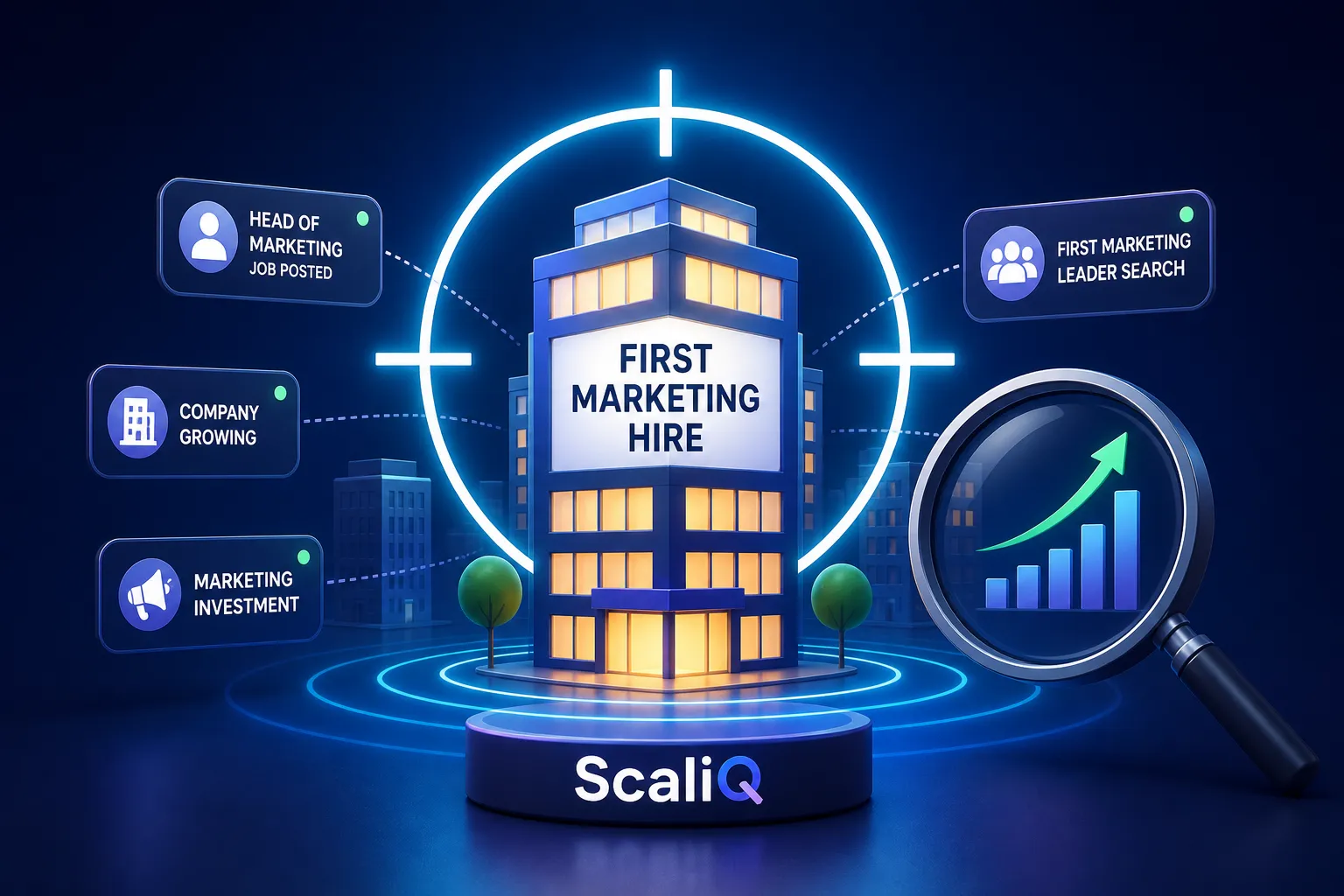
A leadership posting becomes significantly more credible when paired with related go-to-market hiring signals. Adjacent hiring activity often indicates a broader go-to-market build.
Look for adjacent roles such as:
• SDR or sales development roles
• Content marketing
• Growth marketing
• Demand generation hiring
• Marketing operations
• Revenue operations
When a company hires a marketing leader alongside sales development and marketing operations roles, it strongly supports the hypothesis that the organization is preparing for repeatable pipeline generation. However, adjacent roles should strengthen—not replace—the need to validate the company stage, role seniority, and hiring recency. These B2B intent signals provide context, but core validation remains essential.
A Scoring Framework for Prioritizing First Marketing Hire Signals
To turn a broad list of hiring companies into a focused, ranked account set, sales teams need a transparent scoring model. This model should be built around five dimensions:
1. Signal confidence: Is this a confirmed, likely, or unconfirmed first marketing leadership hire?
2. Recency: Is this a pre-hire active posting, a recently filled role, or an older, stale signal?
3. Role seniority: Is the title a CMO, VP Marketing, Head of Marketing, or another leadership designation?
4. Company fit: Does the account align with your Ideal Customer Profile (ICP) regarding company stage, industry, geography, and product maturity?
5. Supporting evidence: Are there adjacent hires, increased sales capacity, or other expansion activities?
Prioritizing timing is just as critical as prioritizing fit:
• Before the role is filled: Contact the founder, CEO, recruiter, or executive sponsor with a hypothesis about the function being built.
• During the hiring process: Use the job description and company context to refine the likely mandate.
• First weeks after the hire: Contact the new marketing leader with relevant observations and a discovery-oriented message.
• Later in the cycle: Reassess whether the trigger is still timely or if the account has already selected its vendors and systems.
Always record the evidence behind each score rather than relying on an unexplained "intent number." This scoring framework is a prioritization aid, not absolute proof of purchase intent. Document your evidence and review high-priority accounts manually.
Sample Account-Priority Table:
This approach transforms a raw LinkedIn sales trigger into actionable marketing leadership hiring intent, streamlining account prioritization.
High-Confidence, Medium-Confidence, and Low-Confidence Examples
Using only the evidence available in the account context, here is how classifications break down:
• High-confidence example: The job posting uses foundational language ("build from scratch"), there is no visible marketing leadership in the company's history, the company stage aligns perfectly, and there is supporting go-to-market hiring (e.g., open SDR roles).
• Medium-confidence example: The company is hiring a senior marketing role, but there is limited team-history evidence and the job description is ambiguous about whether they are building or expanding.
• Low-confidence example: There are clear replacement indicators (a previous CMO just left), the listing is stale, it was posted by an external recruiter, or an established marketing department already exists.
The classification directly changes your outreach timing and target persona. A high-confidence first marketing hire signal allows you to target the CEO immediately, while a low-confidence signal for a B2B company hiring CMO roles may require you to pause and monitor these sales prospecting triggers from job changes before acting.
The Trigger-to-Action Workflow for Prospecting
Converting a validated hiring event into a repeatable account-research and outreach process requires discipline. The workflow consists of five steps:
1. Detect the marketing leadership hiring event.
2. Validate whether it is a first hire, replacement, or expansion role.
3. Enrich the account with company, team, and go-to-market context.
4. Form a specific business hypothesis.
5. Select the buyer, timing, channel, and next action.
When building your account brief, collect the exact role title and job-posting language, role status and recency, the reporting line or likely executive sponsor, the existing marketing and sales team composition, adjacent open roles, the company stage, and the likely marketing mandate.
Create a “why now?” statement for each account. For example: “This company appears to be formalizing demand generation and may be evaluating the people, systems, and processes required to create repeatable pipeline.” The output of this first marketing hire prospecting workflow must be an action recommendation, not an undifferentiated list of companies. For a deeper dive into organizing these events into a repeatable signal-driven prospecting workflow, ScaliQ offers comprehensive guidance on LinkedIn hiring trigger prospecting.
Choosing the Right Person to Contact
The target persona changes depending on the hiring stage.
• Before a leader is hired: Target the Founder, CEO, COO, recruiter, or executive sponsor.
• During the search: Target the executive sponsor or hiring stakeholder, where identifiable.
• After the leader starts: Target the new CMO, VP Marketing, Head of Marketing, or first marketing executive.
• When execution roles are also opening: Target Revenue operations, sales leadership, demand generation, or growth stakeholders.
Do not contact the job candidate or new leader without understanding whether they actually own budget decisions. Map each persona to a likely business concern: a Founder or CEO is focused on moving beyond founder-led growth; a new marketing leader is focused on building the function and prioritizing the first 30–90 days; a sales leader wants pipeline consistency; and an operations leader is concerned with systems and attribution. Properly mapping the persona is the key to successful new marketing leader prospecting and CMO hiring prospecting based on a marketing leadership hiring signal.
Turning the Signal Into an Outreach Hypothesis
Generic messages such as “I saw you are hiring” will fail. Build your message around the observable hiring event, the likely business transition, a specific conditional hypothesis, and a relevant question.
Suggested first marketing hire outreach angles include:
• “Are you building the demand-generation function from the ground up?”
• “Is the new marketing leader expected to establish pipeline reporting and attribution?”
• “Are you evaluating the systems and vendors needed to support the next stage of growth?”
Use language that reflects uncertainty appropriately, such as “It looks like,” “You may be,” or “If the role is intended to…” Tailor the message to the role’s stated mandate instead of assuming that every new marketing leader has the exact same priorities. Ensure your new CMO outreach features accurate, non-deceptive personalization. Never imply private knowledge or certainty that cannot be supported by public account evidence when doing sales trigger outreach.
False Positives, Data Quality, and Responsible Signal Use
To protect your workflow from noisy data and establish trustworthy prospecting practices, you must actively filter out false positives.
Common false positives include:
• Replacement or backfill searches
• Fractional or interim marketing leadership
• Recruiter or agency listings
• Duplicate job postings
• Stale or already-closed roles
• Title inflation
• Roles that merely support an existing marketing organization
Before activating an account, run through a verification checklist: Is the posting current? Is the company publishing the role directly? Does the role’s language indicate function-building? Is there evidence of existing marketing leadership? Are adjacent roles consistent with a broader go-to-market build? Is the account a fit for your ICP?
Publicly visible data still requires responsible handling when used for profiling, enrichment, and outreach. Transparency is critical. The FTC lead-generation consumer protection workshop highlights the importance of transparent, non-deceptive lead-generation practices. Furthermore, refer to the ICO guidance on collecting and generating leads when utilizing publicly available information for profiling and responsible lead generation based on B2B intent signals and marketing hiring data.
Compliance Considerations for Email Activation
Identifying a hiring signal and contacting someone based on it are two separate steps with separate compliance considerations.
When executing compliant B2B outreach, readers must verify:
• Sender identity
• Truthful subject lines
• Clear commercial intent
• Required business contact information
• Accessible opt-out mechanisms
• Applicable jurisdictional requirements
Familiarize yourself with CAN-SPAM compliance requirements to ensure truthful sender information, accurate subject lines, physical-address disclosures, and opt-out mechanisms. If your workflow involves third-party, purchased, or shared contact data, you must also adhere to regulations regarding third-party marketing data to maintain strict lead-generation compliance.
How This Approach Compares With Generic Prospecting Workflows
It is important to differentiate a first-marketing-hire framework from broad contact searches, basic job alerts, and generic intent scoring.
• Manual LinkedIn or job-board monitoring: Finds roles but requires significant, time-consuming interpretation and prioritization.
• Contact databases: Provide excellent contact coverage but generally lack the contextual "why" behind a hiring event.
• Broad intent-data platforms: Can surface account interest or topic consumption but may not explain the specific organizational change driving that interest.
• Signal-driven research workflows: Combine event discovery, account validation, scoring, and a recommended next action into one cohesive motion.
The practical distinction lies in the methodology. Finding a marketing title is easy; confirming a first marketing function, understanding the likely business mandate, and selecting the correct buyer and outreach angle is hard.
Platforms such as Clay, Apollo, LinkedIn Sales Navigator, and LinkedIn Jobs can undoubtedly support parts of the discovery, enrichment, filtering, or monitoring process. However, a methodology gap remains: tools identify data points, but teams still need a clear framework for interpreting and activating the signal. This is where ScaliQ provides a differentiating angle, offering signal-driven account research focused on the actual business change behind the hiring event. For additional insights on adjacent prospecting, research, or outreach workflow resources, visit Repliq.Co, which complements this hiring intelligence and account research workflow.
A Practical Account Brief Template
To give your sales team a reusable structure for turning a raw hiring event into sales-ready research, utilize a standardized account brief.
Include the following fields:
• Account: Company name and website
• Hiring signal: Role title, source, status, and date observed
• Signal classification: Confirmed, likely, or unconfirmed first marketing hire
• Evidence: Job-posting language, team composition, employee history, and adjacent hiring
• Company context: Stage, product maturity, sales capacity, and relevant expansion indicators
• Likely mandate: Demand generation, positioning, pipeline, attribution, team building, or another stated priority
• Target persona: Founder, CEO, executive sponsor, new marketing leader, or operations stakeholder
• Outreach hypothesis: Why the company may be evaluating a relevant solution now
• Recommended action: Research further, contact now, monitor, or disqualify
• Confidence and next review date: How certain the signal is and when it should be reassessed
Illustrative Account Brief Example:
• Account: NovaTech Solutions (novatech.example.com)
• Hiring Signal: VP of Marketing (LinkedIn, Active, Oct 28)
• Signal Classification: Confirmed first marketing hire
• Evidence: Posting states "Build our first marketing engine"; current team has 0 marketers; CEO currently handles marketing.
• Company Context: Series A, established product, recently hired 3 SDRs.
• Likely Mandate: Demand generation and pipeline creation.
• Target Persona: CEO (Pre-hire phase).
• Outreach Hypothesis: With 3 new SDRs and a VP search underway, they are likely evaluating pipeline infrastructure to move beyond founder-led sales.
• Recommended Action: Contact CEO now with a hypothesis-driven message.
• Confidence/Review: High confidence. Review again in 14 days if no response.
By making the evidence trail visible, this account brief template ensures readers can distinguish verified observations from assumptions, proving far more effective for go-to-market account research than a simple list of companies with a first marketing hire signal.
Measuring Whether the Hiring-Signal Workflow Works
To evaluate signal quality and sales usefulness, you must measure performance beyond just the sheer number of alerts collected.
Track the following metrics:
• Number of signals detected
• Percentage classified as confirmed, likely, or false positive
• Time from signal detection to account activation
• Research time per qualified account
• Outreach response rate by hiring stage
• Meetings or opportunities influenced by the signal
• Conversion by target persona
• Performance of different outreach hypotheses
Volume alone is a weak measure. A smaller list of well-validated, highly contextualized accounts is vastly more valuable than a massive list of unqualified hiring companies. Encourage your teams to review false positives regularly and update classification rules over time. This measurement strategy aligns with the broader B2B trend toward multi-signal account prioritization metrics rather than relying on isolated sales trigger measurement.
Conclusion: Make the First Marketing Hire Signal Actionable
A first marketing leader hire is a powerful indicator of a company scaling its go-to-market operations, but it requires a disciplined framework to be useful.
To recap the framework: Detect the hiring event. Confirm whether it is genuinely foundational. Add company, team, and adjacent-hiring context. Score the account by confidence, recency, seniority, and fit. Choose the right persona and form a specific business hypothesis. Finally, activate timely, accurate, and compliant outreach.
Remember, a first marketing leader hire is best treated as a trigger for research—not automatic proof of budget or purchase intent. The strategic opportunity is that this first marketing hire signal places sales teams near the very beginning of a new marketing planning cycle, long before priorities, systems, and vendors are fully established and locked in.
To explore a more structured, signal-driven approach to identifying and prioritizing companies undergoing go-to-market change, utilize ScaliQ. ScaliQ focuses on interpreting public business signals, validating account context, and helping teams make more relevant prospecting decisions—ensuring you act on verified insight rather than treating uncertain data as fact.