


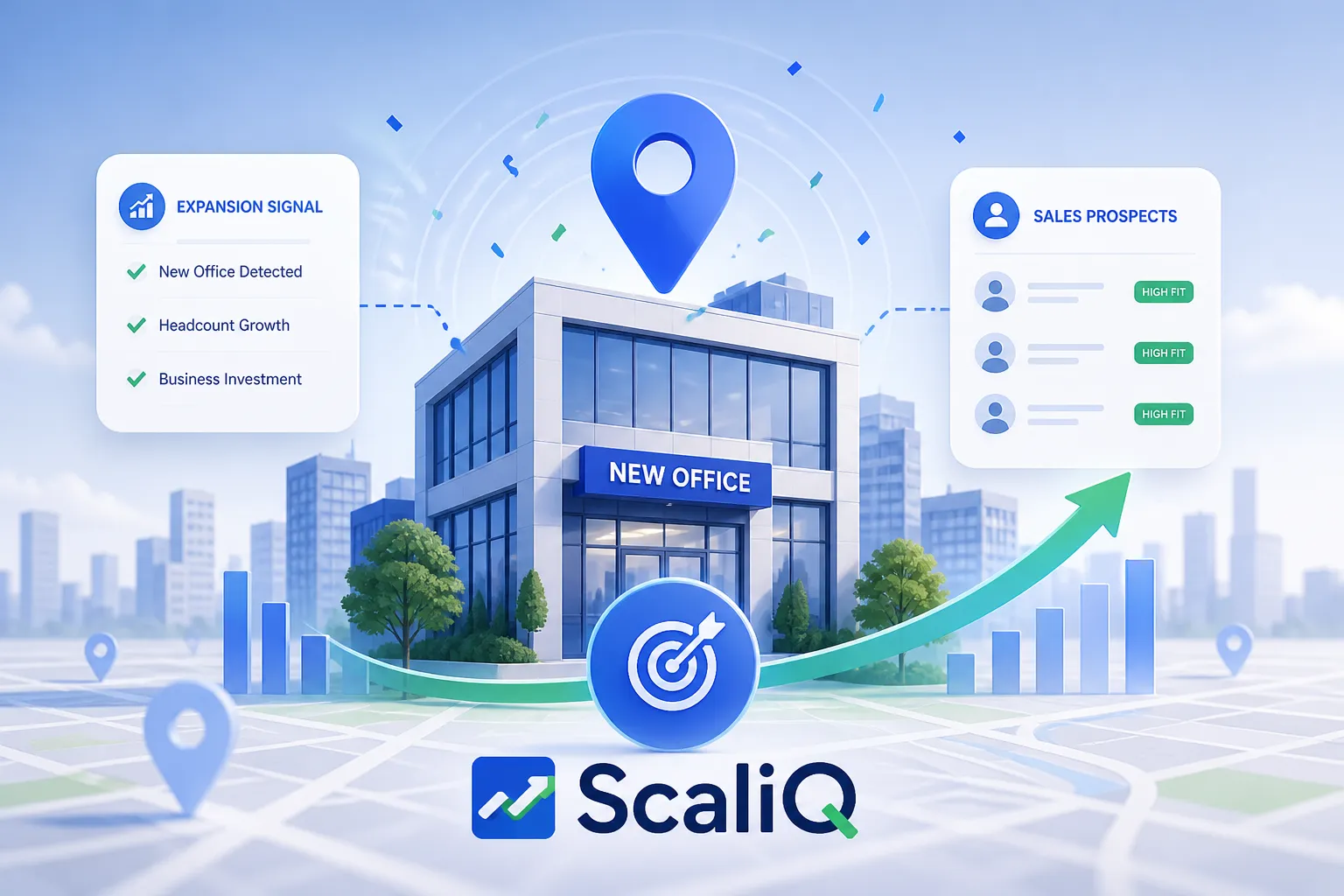
How to Use New Office Locations as a LinkedIn Sales Trigger
Company expansion news is one of the most visible indicators of corporate momentum. When a business announces a new office, it acts as an observable growth signal that routinely reveals emerging requirements across hiring, infrastructure, vendor management, facilities, IT, and regional operations. However, while sales teams frequently notice these announcements, they often lack a repeatable process for transforming a news headline into a qualified account and a highly relevant LinkedIn conversation.
The core challenge in company expansion prospecting is recognizing that an office opening is merely a starting signal—it is not definitive proof that a company is ready to buy. Without proper validation, outreach based solely on a new address can come across as generic, mistimed, or irrelevant.
To effectively leverage a new office sales trigger, revenue teams must adopt a structured workflow: detect the location, validate the expansion with corroborating data, identify the precise operational stakeholders, score the opportunity, and deploy highly personalized outreach. For intermediate and advanced sales professionals, this guide focuses on the practical research and messaging frameworks required to execute this strategy, moving beyond generic social-selling advice.
As a growth-focused resource, ScaliQ advocates for interpreting office openings alongside hiring trends and operational context, ensuring your LinkedIn outreach is driven by validated business intelligence rather than superficial observations.
What a New Office Reveals About a Company’s Buying Needs
A new office location is rarely just a real estate transaction; it is a catalyst for commercially relevant business requirements across multiple departments. When a company expands its physical footprint, it triggers a cascade of operational needs.
A new office may indicate:
• Headcount growth or an aggressive regional hiring push.
• New workplace, facilities, physical security, and IT infrastructure requirements.
• The need for additional vendors, service providers, and localized operational support.
• Strategic market entry, expanded regional coverage, or international expansion.
• Consolidation, strategic relocation, or a fundamental change in the company's operating model.
The likely buying need depends entirely on the type of expansion and the company’s current growth stage. To generate high-quality business expansion leads, sales professionals must distinguish between a monumental headquarters move, a strategic regional office, a lightweight satellite location, a shared coworking address, or a simple office relocation.
The Four Expansion Scenarios to Identify First
The same office opening signal can imply vastly different prospecting angles depending on the nature of the facility. Do not assume that every new address represents net-new growth. Document the specific office type before selecting your outreach angle:
• New headquarters: A headquarters expansion or relocation typically suggests broad, company-wide requirements spanning workplace design, IT infrastructure, executive recruiting, and complex operational deployments.
• Regional office: Opening a regional hub often indicates localized hiring initiatives, a push for regional market coverage, and a need for local facilities management and regional vendors.
• International location: Cross-border expansion creates unique geographic, compliance, localization, and operational coordination challenges that require specialized vendor support.
• Office relocation: Moving from one building to another within the same city may indicate vendor consolidation, capacity changes, or a redesigned workplace model rather than a net-new expansion intelligence signal.
Treat the Office Opening as a Hypothesis, Not a Conclusion
Effective account-based prospecting requires distinguishing between a visible business event, evidence that the event creates a relevant operational problem, and evidence that a specific stakeholder owns that problem.
According to INTERNAL_AUTHORITY_SOURCE: Yale research on organizational B2B buying, business events must be interpreted within a broader organizational buying process. A trigger event alone does not guarantee a purchase; it initiates a complex internal evaluation.
Therefore, convert the signal into a hypothesis. Instead of assuming a need, frame your research like this:
• “Because the company is opening a regional office, they may be hiring locally and need support for employee onboarding or workplace operations.”
• “The new headquarters suggests the IT team may need to upgrade their security and vendor infrastructure.”
Never write outreach that claims to know the prospect’s exact needs without supporting evidence. Use company expansion prospecting to formulate an educated guess, allowing the prospect to confirm or correct your hypothesis.
How to Validate a New Office Sales Trigger Before Prospecting
To prevent wasting time on weak, outdated, or misleading location data, establish a practical validation process. Before initiating location-based prospecting, record the core evidence:
• Company name and precise location.
• The announcement or discovery date.
• The source of the location information.
• Whether the address appears new, relocated, temporary, or remains unclear.
• The relevant business function most closely connected to the expansion.
Location data must be cross-checked with company and employee information before launching an outreach sequence. Assign a confidence level—high, medium, or low—based on the amount and quality of supporting evidence you uncover.
Combine the Office Signal With Supporting Growth Evidence
An office opening signal becomes exponentially more powerful when combined with converging business signals. Look for:
• New or increasing job postings specific to the new geography.
• Active hiring for local leadership or operational roles.
• Executive leadership changes driving the expansion.
• Recent funding rounds or other company growth announcements.
• Changes in department structure or the introduction of a new regional team.
Multiple related signals make an account highly actionable. However, distinguish corroborating evidence from unrelated company news. For public companies, verify expansion details through official disclosures where relevant, such as INTERNAL_AUTHORITY_SOURCE: SEC Form 8-K corporate event filings. Keep in mind that while major moves appear in filings, minor office openings may not, requiring you to rely on hiring and expansion intelligence.
Determine Whether the Location Represents Meaningful Expansion
Not all real estate moves generate sales prospecting trigger events. Use this qualification checklist to verify the opportunity:
• Is the location associated with a strategically new region or market?
• Is the company actively recruiting for that specific geography?
• Are the relevant decision-makers visible and active on LinkedIn?
• Does the expansion align with your target customer profile?
• Is the signal recent enough to support timely, relevant outreach?
A stale directory listing, a shared coworking address, or a minor satellite location deserves a lower priority in your pipeline. Apply a simple confidence framework:
• High confidence: A verified new location accompanied by relevant hiring, leadership changes, or a major company announcement.
• Medium confidence: The location appears credible but currently lacks strong supporting evidence of active investment.
• Low confidence: The address is unverified, outdated, or entirely disconnected from any visible business activity.
Compare Manual Research With Scalable Signal Workflows
Manual LinkedIn research is highly effective for deep account-based prospecting, but it struggles to scale. Conversely, broad sales intelligence platforms (like Clay, Crunchbase, or Apollo) can identify companies and contacts at scale, but they often lack the interpretation layer necessary to explain why or when to contact them based on a specific physical expansion.
This is where a dedicated workflow bridges the gap. ScaliQ provides a differentiated angle: a location-specific, growth-focused process that turns an observable event into a qualified LinkedIn hypothesis. It focuses on the interpretation layer—connecting location evidence to account fit, stakeholder relevance, and outreach timing. Even with advanced trigger event selling tools, human review remains essential before outreach, especially when source data is incomplete or the expansion’s exact purpose is unclear.
How to Identify the Right LinkedIn Stakeholders After an Office Opening
Mapping the operational implications of an expansion to the correct people is vital. The executive who proudly announces the new office on LinkedIn is rarely the person who owns the resulting business requirements. You must separate local operational stakeholders from corporate decision-makers.
Instead of messaging everyone at the account, identify one primary contact and one or two relevant supporting contacts to maintain a highly targeted approach to LinkedIn prospecting.
Match the Outreach Persona to the Expansion Need
Use this stakeholder-mapping framework to align your outreach with the company expansion prospecting signal:
• Recruiting or people growth: Target recruiters, talent acquisition leaders, HR directors, or regional people operations managers.
• Facilities and workplace: Look for facilities leaders, workplace operations directors, office managers, or general operations leaders.
• IT and infrastructure: Identify IT leaders, systems owners, physical security leaders, or local technology managers.
• Procurement and vendors: Focus on procurement officers, finance directors, operations leads, or department heads responsible for supplier decisions.
• Regional operations: Reach out to general managers, country leaders, regional executives, or local operations directors.
Job titles vary significantly by company size and geography. Whenever possible, map the problem owner, the economic stakeholder, and the local user to ensure your LinkedIn account prospecting covers the right bases.
Use LinkedIn to Confirm Relevance, Not Just Find a Name
When reviewing potential contacts, evaluate their profiles to confirm relevance. Review:
• Their current title and department.
• Their geographic relationship to the new office location.
• Any recent role changes or expanded responsibilities.
• Public posts, articles, or company updates related to the expansion.
• Evidence that they are actively involved in hiring, operations, facilities, IT, or regional growth.
This evidence improves personalization without implying access to private information. Document the specific reason each contact is relevant before sending a message. To streamline this process, use ScaliQ to seamlessly connect company growth signals with deep account and stakeholder research.
Build an Expansion Prospecting Score to Prioritize Accounts
To manage multiple office opening signals effectively, build a repeatable scoring model. This allows sales teams to rank opportunities by relevance, urgency, and evidence quality, ensuring you spend time on the best business expansion leads.
Score accounts based on:
• Account fit: Strict alignment with your ideal customer profile (ICP).
• Signal recency: How recently the location or expansion was announced or identified.
• Evidence strength: The volume and quality of corroborating signals (e.g., job postings, funding).
• Operational relevance: The likelihood that the expansion creates a specific problem your offering can solve.
• Stakeholder clarity: The ability to easily identify and verify a relevant decision-maker or influencer.
Remember, this score is strictly for prioritization; it is not a definitive claim that the company is actively buying.
A Practical Three-Tier Prioritization Framework
Organize your expansion intelligence into three actionable tiers:
• Tier 1 — Contact now: A recent, highly credible office opening with strong ICP fit, robust supporting signals, and a clearly identified stakeholder.
• Tier 2 — Monitor and research: A plausible expansion with partial evidence or uncertain timing. Record the next research action rather than forcing immediate outreach.
• Tier 3 — Do not prioritize yet: Weak, stale, unverified, or poorly aligned location information.
This framework prevents sales teams from treating every new address as equally valuable, preserving time for high-probability accounts.
Know When a Trigger Has Aged Out
Sales trigger events have a shelf life. An office opening signal loses value when:
• The announcement is no longer recent (e.g., six months old).
• Local hiring activity has flatlined or stopped entirely.
• The office appears fully operational, meaning relevant vendor decisions are likely complete.
• The location is no longer associated with active company growth.
Always refresh the account context before following up on older signals. Measure your time-to-contact and track outcomes by trigger type to understand exactly how quickly your team needs to act when an expansion is detected.
Turn the Expansion Signal Into Relevant LinkedIn Outreach
The ultimate goal of this research is to translate data into messages that create a credible business reason to respond. Your LinkedIn outreach must be relevant without sounding intrusive or overly automated.
Establish this core message structure:
1. Mention the observable expansion context.
2. Connect it to a plausible business implication (your hypothesis).
3. State why the recipient may be relevant to that implication.
4. Offer a concise, low-pressure next step.
"Congratulations on the new office" is insufficient. It lacks a useful business connection. Base your outreach on an evidence-backed hypothesis rather than an unsupported assertion.
Message Framework for a Headquarters Expansion
When addressing a headquarters expansion, focus on the broader operational changes the move creates. Connect your message to likely areas such as workplace operations, hiring surges, infrastructure overhauls, vendor consolidation, or internal coordination—but only where your research supports the angle.
Use a concise observation followed by a question about how the company is handling the relevant expansion requirement.
Message Framework for a Regional Office
For a regional office, emphasize local hiring, regional operations, market coverage, or local vendor coordination. Personalize the message around the recipient’s geography or role only when it is publicly evident on their LinkedIn profile. Avoid implying that opening a small regional office automatically signifies a massive, company-wide buying initiative.
Message Framework for an International Expansion
International expansion creates immense coordination and operational complexity. Focus your messaging on the challenges of entering a new geography. Distinguish between a confirmed local operation with active hiring and a merely listed legal address. Adapt the message to either the local leader executing the move or the corporate stakeholder overseeing it.
Message Framework for an Office Relocation
An office relocation should never be described as net-new growth unless supporting evidence confirms an expansion in headcount or capacity. Explore angles such as workplace redesign, vendor consolidation, operational transitions, or capacity planning. Use neutral language when the exact purpose of the move is unclear.
Follow-Up Without Becoming Intrusive
Follow-ups should add value, not annoyance. Suggest a short, context-based follow-up that introduces a new relevant observation rather than repeating the original pitch. Avoid excessive automation, repetitive congratulations, or sending identical messages to multiple employees at the same company.
Always include a stop condition: if the contact does not engage or indicates the topic is irrelevant, cease outreach. For teams looking to scale personalized LinkedIn outreach while preserving account-specific context and human review, Repliq.Co is a powerful related resource.
Common Mistakes When Using New Office Locations as Sales Triggers
Failing to properly qualify a new office sales trigger leads to failure modes that destroy trust, relevance, and conversion potential. Avoid these common pitfalls to ensure your sales prospecting trigger events translate into meaningful action.
Mistake 1 — Treating Every New Address as Growth
Coworking spaces, minor relocations, temporary popup locations, and stale directory listings routinely create false positives. Always validate the location’s purpose and recency before assigning it expansion prospecting value.
Mistake 2 — Contacting the Most Visible Executive First
The CEO or VP who posts the ribbon-cutting photo on LinkedIn rarely owns the day-to-day procurement for facilities, IT, recruiting, or operations. Effective stakeholder mapping based on the likely business implication is non-negotiable.
Mistake 3 — Sending a Generic Congratulations Message
A simple congratulatory note does not establish relevance, urgency, or business acumen. To generate a reply, you must add one evidence-based hypothesis and one role-specific question that ties the expansion to a potential operational challenge.
Mistake 4 — Using Too Many Signals Without a Clear Point
Listing a company's recent funding, hiring metrics, leadership changes, and exact location data in a single message feels like surveillance. Use only the specific evidence necessary to make your core message credible and relevant.
Mistake 5 — Ignoring Compliance and Data Accuracy
Compliance-conscious prospecting is critical. Distinguish publicly available professional information from sensitive or improperly scraped data. Ensure accurate claims, maintain transparent business identity, respect outreach frequency, and handle opt-outs professionally. When integrating email follow-ups into your workflow, adhere to the FTC commercial email compliance guidance regarding truthful headers, physical-address requirements, and clear opt-out obligations. (Note: This applies to commercial email, not as a blanket rule for every individual LinkedIn interaction, but ethical standards should remain high across all channels).
A Repeatable New Office-to-LinkedIn Workflow
To turn these concepts into action, use this repeatable 10-step workflow for company expansion prospecting, whether targeting a single account or a larger list:
1. Detect a new office or expansion signal.
2. Record the location, date, source, and office type.
3. Validate the signal with hiring, leadership, funding, geography, or operational evidence.
4. Confirm account fit against your ICP.
5. Identify local and corporate stakeholders on LinkedIn.
6. Score the account by fit, recency, evidence, relevance, and stakeholder clarity.
7. Create one specific business hypothesis based on the data.
8. Write a concise, role-specific LinkedIn message.
9. Follow up thoughtfully or pause when evidence is weak.
10. Track replies, meetings, conversions, and trigger aging.
Expansion Trigger Research Worksheet
To operationalize location-based prospecting, use this checklist format for your accounts. (You can explore more templates and workflows at Blog).
• Company and target account segment:
• New location and office type:
• Date discovered and source:
• Supporting growth signals:
• Likely operational impact:
• Primary stakeholder:
• Secondary stakeholder:
• Trigger confidence (High/Med/Low):
• Outreach hypothesis:
• Recommended contact date:
• Follow-up status and outcome:
This worksheet is ideal for repurposing into a sales enablement sheet or account-based prospecting resource for your team.
What to Measure
Tracking the right sales trigger performance metrics improves qualification and relevance rather than simply increasing message volume. Measure:
• Number of validated expansion signals identified.
• Time from signal discovery to first contact.
• Positive reply rate.
• Meetings booked by expansion type (HQ, Regional, etc.).
• Conversion rates by stakeholder persona.
• Performance of single-signal versus multi-signal accounts.
• Outcomes driven by different message angles.
Conclusion — Turn Expansion Signals Into Better-Timed Conversations
A new office location is a powerful window into a company's evolving needs, revealing potential changes in hiring, infrastructure, vendors, facilities, IT, and operations. However, a new office sales trigger is only as valuable as the research behind it.
The complete process requires discipline: validate the signal, combine it with corroborating evidence, map the correct operational stakeholder, and formulate a relevant business hypothesis. Timing and credibility will always yield better results than sending high-volume, generic outreach. Begin with a small, highly qualified set of target accounts, apply the research worksheet, and refine your approach before scaling.
For revenue teams looking to master this process, ScaliQ is a premier growth-focused resource designed to interpret office openings as timely growth signals, seamlessly connecting physical expansion data with hiring and operational context. Explore ScaliQ today to build repeatable workflows that turn expansion intelligence into revenue.
Frequently Asked Questions
How can a new office location become a sales trigger?
A location becomes a useful new office sales trigger when it indicates a meaningful operational change and is supported by corroborating evidence, such as active hiring, new regional leadership, or company growth activity. It should always be treated as a prospecting hypothesis, not definitive proof of purchase intent.
How do you find companies opening new offices on LinkedIn?
You can execute LinkedIn prospecting for growing companies by monitoring company pages, tracking changes in employee locations, reviewing company updates and relevant posts, noting leadership changes, and analyzing regional job activity. Always validate these discoveries with additional public company information before initiating outreach.
Which decision-makers should you contact after an office opening?
Select stakeholders based on the likely operational need: recruiting, facilities, workplace operations, IT, procurement, finance, or regional leadership. Effective stakeholder mapping requires distinguishing the local operator managing the new office from the corporate owner who controls the budget for the relevant function.
When should sales teams contact a company after it announces a new location?
Timing depends on signal recency, evidence strength, hiring activity, and whether the operational need is likely still active. Prioritize recent, well-supported expansion prospecting signals for immediate contact, while monitoring uncertain or partially verified accounts for further developments.
What signals should be combined with a new office announcement?
Combine the location data with hiring activity, specific job roles, leadership changes, funding rounds, company announcements, the presence of local employees, regional management structures, and operational milestones. Emphasize relevance and evidence quality over blindly collecting every possible company growth signal.
How can expansion prospecting avoid sounding intrusive?
To ensure compliance-conscious prospecting, reference only relevant, publicly available information. Use cautious, hypothesis-based language, and avoid overly detailed, surveillance-style messages. Keep your personalized LinkedIn outreach concise, ensure human review before sending, follow up respectfully, and adhere to clear stop conditions if the prospect is unresponsive.
How can teams prioritize multiple office-opening opportunities?
Teams should use a scoring model based on account fit, signal recency, evidence strength, operational relevance, and stakeholder clarity. This account-based prospecting approach helps identify the best business expansion leads. Measure outcomes by trigger type to continuously refine your prioritization model over time.