

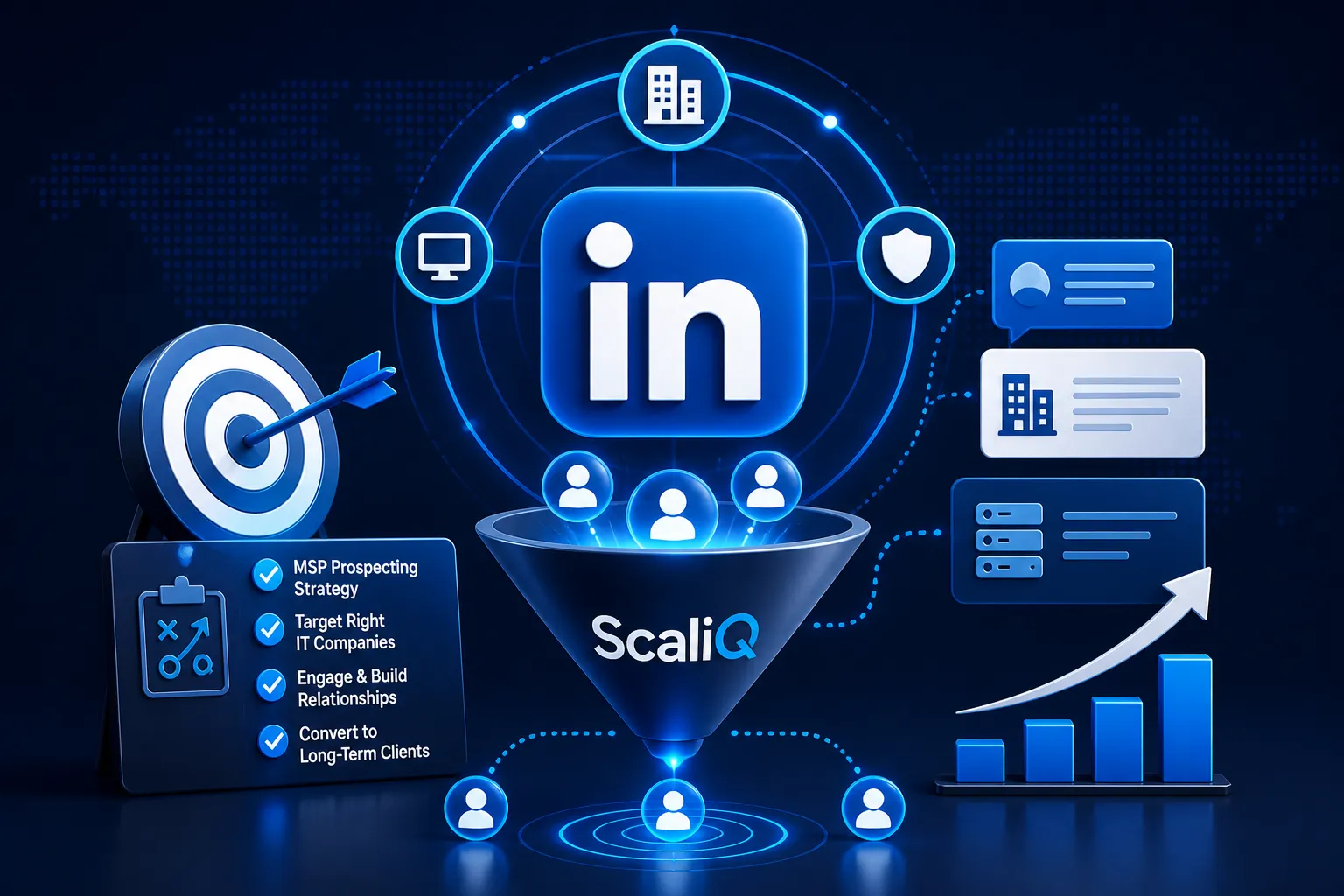
LinkedIn Prospecting for Outsourced IT Support Companies
Many outsourced IT providers struggle with outbound sales because they contact broad audiences without knowing whether a company actually needs fully outsourced IT, co-managed support, or a project-based engagement. Sending generic connection requests to every local business owner rarely yields high-quality managed IT leads. Instead, LinkedIn prospecting should be treated as an account-research and qualification process—a strategic methodology used to understand a prospect’s operational environment before initiating contact.
This guide provides a practical system for identifying, segmenting, researching, contacting, and qualifying managed IT prospects. By moving away from volume-based spam and toward targeted account intelligence, intermediate-level MSP and outsourced IT sales teams can build a more predictable pipeline. The core of this system relies on precise segmentation criteria: evaluating a prospect’s employee count, office footprint, internal IT resources, technology complexity, hiring activity, and growth signals.
Establishing a technical, service-focused perspective is essential. ScaliQ approaches this by segmenting prospects based on these exact operational metrics—employee count, office footprint, internal IT resources, and technology complexity—ensuring that outreach is highly relevant to the prospect's current infrastructure. Mastering this IT support LinkedIn outreach strategy transforms cold connections into meaningful diagnostic conversations, ultimately driving more qualified outsourced IT prospecting outcomes.
What Makes a LinkedIn Prospect Valuable for an MSP?
A valuable managed IT lead is much more than a contact record or a new LinkedIn connection. To build a sustainable pipeline, MSP sales teams must understand the distinct differences between a company that fits the ideal customer profile (ICP), an engaged contact who occasionally likes your posts, and a qualified managed IT opportunity with a genuine business need.
Identifying an opportunity requires looking for operational signals that may indicate a need for outsourced or co-managed IT. These signals often include rapid employee growth or hiring activity, the opening of multiple offices or distributed teams, limited visible internal IT capacity, increasing technology complexity, or emerging requirements around cybersecurity, compliance, cloud infrastructure, and business continuity.
However, a prospecting team should avoid assuming that a company has a specific IT problem without verification. Hypotheses must be separated from verified facts; an expanding office footprint may indicate a need for better network management, but it does not guarantee it. Effective managed service provider lead generation relies on cautious, diagnostic language rather than presenting unconfirmed IT risks as definitive facts.
It is also vital to contrast high-fit, high-urgency accounts with high-fit accounts that may not currently have an immediate buying trigger. The latter requires long-term nurturing rather than an immediate sales push. As highlighted in the University of Liverpool’s systematic review of B2B social media, relationship-oriented prospecting consistently outperforms volume-based outreach by fostering trust and demonstrating sustained value to managed IT leads over time. Implementing this mindset is critical for successful MSP prospecting.
Match the Prospect’s Situation to the Right IT Service Model
Not every prospect is looking to hand over the keys to their entire infrastructure. Proper IT services sales prospecting requires matching the account's context to the right service model. Sales teams must learn to distinguish among fully outsourced IT support, co-managed IT services, project-based technology consulting, and break-fix or limited support requirements.
Internal IT headcount, specialist gaps, office locations, and support expectations can guide your initial positioning. For instance, an organization with a robust internal helpdesk but no cybersecurity specialists is a prime target for co-managed IT services prospects, not a total infrastructure takeover. Avoid forcing every account into a fully outsourced IT narrative; instead, tailor the approach to their visible operational gaps.
How to Segment Accounts for Managed IT Prospecting
Segmentation is the foundation of a repeatable LinkedIn prospecting workflow. Without it, outreach becomes generic and easily ignored. Creating account tiers based on fit, urgency, and likely service complexity allows outsourced IT prospecting teams to allocate their time efficiently.
Each operational signal affects prioritization differently:
• Employee count: This helps estimate the potential scale of support and endpoint complexity. A 20-person firm has vastly different needs than a 500-person enterprise.
• Office footprint: Identifying single-location, regional, multi-office, and distributed organizations dictates whether the prospect needs localized helpdesk support or complex, wide-area network management.
• Internal IT resources: Determine whether the company appears to have no dedicated IT team, a small generalist team, or a larger internal function. This directs whether you pitch fully outsourced or co-managed services.
• Technology complexity: Look for indicators of cloud adoption, remote work policies, compliance needs (like HIPAA or CMMC), specialist systems, or complex user environments.
• Hiring and growth activity: Use hiring and expansion as possible timing signals, not definitive proof of need.
To organize this data, use a simple prioritization framework:
• Tier 1: Strong fit plus a relevant trigger (e.g., rapid hiring without adding internal IT staff).
• Tier 2: Strong fit but no immediate trigger.
• Tier 3: Unclear fit or insufficient information.
MSP marketing strategies should include a suggested account-research worksheet containing fields for company size, locations, IT leadership, internal IT team, technology signals, trigger events, likely service model, and the next action. Keep in mind that employee count and technology signals are merely prioritization inputs—they are not proof of a prospect’s budget, security posture, or internal operational problems. Successful LinkedIn lead generation for MSPs relies on validating these inputs through conversation.
Use LinkedIn Sales Navigator for Account Discovery
LinkedIn Sales Navigator is a powerful tool to support account and lead research through highly relevant company and professional filters. Practical research categories include filtering by company size and geography, building targeted industry and account lists, and sorting by seniority and functional responsibility.
Sales teams can monitor recent role changes or company activity, utilizing saved searches and alerts where appropriate to spot trigger events. However, it is crucial to remember that Sales Navigator is strictly a discovery and research platform; it does not replace the need for qualification or service-specific messaging. For a complete understanding of platform capabilities, refer to LinkedIn’s official Sales Navigator resource. Using this tool strategically enhances managed service provider lead generation by ensuring B2B IT decision-maker outreach is directed at the right accounts.
Build a Worked Segmentation Example
Consider a fictional example of how an MSP could compare three distinct prospects:
1. A single-office company with 40 employees and a small internal IT team of one generalist.
2. A growing multi-office company with 150 employees and limited visible IT capacity.
3. A larger organization with 400 employees, an established IT department, and a potential need for co-managed security services.
The same service provider would use vastly different outreach angles for each segment. For the first, the focus might be on backup support for the solo IT manager. For the second, the messaging could center on standardizing technology consulting lead generation and onboarding across locations. For the third, the focus shifts entirely to co-managed IT services prospects, highlighting specialized cybersecurity or cloud migration capabilities.
This example demonstrates prioritization logic rather than revealing sensitive prospect data. To implement a technical, service-focused approach to organizing and prioritizing MSP account research, ScaliQ offers structured workflows that ensure IT support company marketing efforts are directed accurately based on these exact segmentation variables.
How to Find IT Decision-Makers and Buying-Committee Members
Contacting only one executive title often results in missing the actual buying process entirely. In B2B IT decision-maker outreach, purchasing decisions are rarely made in a vacuum. To succeed in IT support LinkedIn outreach, you must map common stakeholders and address their likely concerns:
• CIO, CTO, or IT Director: Focused on capacity, architecture, security, reliability, and technical oversight.
• COO or Operations Leader: Prioritizes business continuity, employee productivity, and support responsiveness.
• CFO or Finance Leader: Concerned with predictable costs, risk exposure, and efficient resource allocation.
• Business Owner or Managing Director: Looks for growth enablement and reduced operational distraction.
• Internal IT Manager: Cares about workload management, specialist support, vacation coverage, and escalation capacity.
When the account structure supports it, recommend mapping two or more relevant stakeholders. Use their specific role responsibilities, tenure, recent company updates, and shared context to improve the relevance of your messaging.
Crucially, warn your team against contacting unrelated employees (such as junior marketing staff or HR assistants) simply to increase activity volume. This damages brand reputation and rarely leads to qualified meetings. As noted in Elon University’s research on social media prospecting, understanding prospect research, digital identity, indirect communication, and privacy concerns is critical when determining how to find IT decision makers on LinkedIn without crossing professional boundaries.
How to Build Relevant LinkedIn Outreach Messages
The primary goal of the first message is to establish relevance, not to attempt to explain every MSP service your company offers. A highly effective B2B LinkedIn outreach strategy utilizes a structured approach:
1. Personalize using one verified business or role detail.
2. Connect that detail to a plausible operational consideration.
3. Ask a low-friction diagnostic question.
4. Avoid unsupported assumptions or exaggerated claims.
Different messaging angles should be deployed based on the account research. For instance, rapid hiring or growth requires a different tone than multi-office or distributed operations. Overloaded internal IT teams need a message of support, while cybersecurity, compliance, or continuity priorities demand a focus on risk management and cloud or technology transformation activity.
When writing these messages, keep the opening concise and conversational. Lead with a business problem or a useful observation. Avoid generic phrases such as “I help companies with IT,” which instantly commoditizes your offering. Furthermore, never imply that a prospect has experienced downtime, a data breach, or compliance failure unless they have publicly confirmed it. Instead, offer a useful resource, a diagnostic question, or a relevant conversation rather than an immediate hard sell.
According to Newcastle University’s B2B social media and trust research, credibility, a professional social presence, and relevance must be carefully balanced against intrusive or overly aggressive outreach to successfully generate managed IT leads.
Suggested Message Frameworks for Common MSP Segments
Rather than relying on rigid, word-for-word scripts, use these short template directions for common outsourced IT sales pipeline segments (note that these templates require account-specific editing):
• Growing company: Reference their recent hiring or expansion and ask how their current IT support capacity is being managed during this growth phase.
• Multi-office organization: Note their distributed footprint and ask how the company maintains consistent support and access controls across various locations.
• Internal IT team: Position the MSP as additional specialist or coverage capacity, not an automatic replacement, asking how they handle escalations or after-hours coverage.
• Limited visible IT function: Note the size of the company and ask who currently owns day-to-day support and technology planning.
These frameworks elevate IT services sales prospecting by ensuring the prospect feels understood rather than targeted by a mass MSP prospecting campaign.
Contrast Service-Led Outreach With Generic Automation
A researched, MSP-specific workflow stands in stark contrast to broad, automated connection campaigns. Generic automation relies on volume, often resulting in burned bridges and ignored messages. Service-led outreach differentiates itself through deep account context, technical relevance, rigorous human review, and superior qualification quality. By focusing on the prospect's actual environment, outsourced IT prospecting becomes a tool for building genuine relationships rather than just another source of digital noise in managed service provider lead generation.
How to Create a Follow-Up Sequence Without Becoming Spammy
Following up is where most outsourced IT sales pipeline is generated, but it must be done carefully. A multi-step sequence should give each follow-up a distinct, value-driven purpose:
1. Initial connection or introduction based on verified context.
2. A concise diagnostic question related to their operational reality.
3. A useful checklist, observation, or educational resource that helps them solve a minor problem.
4. A final low-pressure follow-up with a clear stop condition.
Follow-up timing should be tested by the MSP rather than presented as a universal rule; what works for a busy CIO may not work for a small business owner.
It is vital to include strict stop conditions to maintain professionalism in your IT support LinkedIn outreach. Cease outreach if the prospect declines, asks not to be contacted, if the account is clearly not a fit, if the outreach becomes repetitive without adding new value, or if the prospect does not engage after the planned sequence.
Be prepared to respond appropriately to common outcomes. A positive but vague reply requires a clarifying question. A referral to another stakeholder should be met with gratitude and a tailored message to the new contact. A “not now” response should be categorized for future nurturing. Emphasize permission-aware, human-reviewed outreach and avoid high-volume repetitive activity. Aligning with Apra’s ethical prospecting and privacy guidelines ensures your use of public data, transparency, identity disclosure, and responsible social media research respects prospect privacy.
For further insights on executing this research, personalization, and follow-up workflow effectively, explore related educational content on the ScaliQ blog.
How to Qualify and Measure Managed IT Leads
To accurately gauge the success of your IT services lead generation, you must distinguish activity metrics (like connection requests sent) from pipeline metrics (like revenue generated).
Track the following stages systematically:
• Target account identified.
• Relevant contact found.
• Connection accepted.
• Reply received.
• Qualified conversation.
• Discovery meeting booked.
• Sales opportunity created.
• Revenue attributed.
Qualification criteria for an MSP opportunity must be strict. A lead is only qualified if there is a clear business or operational challenge, relevant stakeholder involvement, a potential fit for outsourced, co-managed, or project-based services, reasonable timing or an identifiable trigger, and a willingness to discuss the current environment or desired outcome.
Implement an ROI dashboard covering list quality, acceptance rate, reply rate, qualified reply rate, meeting rate, opportunity rate, customer acquisition cost, pipeline, and closed revenue. (Note: Internal benchmarks should be used illustratively to set baseline expectations). Warn your team that high connection volume or superficial engagement does not necessarily indicate a qualified managed IT leads pipeline.
Connect LinkedIn Prospecting to a Website Conversion Path
What happens after a prospect clicks through your LinkedIn profile or message link? They should be directed to a focused service page or educational resource that offers a clear explanation of the relevant MSP service model. This destination must provide proof, process, or qualification information that can be supported by your sales team, ending with a low-friction next step, such as a consultation or diagnostic conversation.
Consistent messaging between your LinkedIn outreach and the destination page is critical for effective IT support company marketing and technology consulting lead generation. For readers evaluating a service-focused prospect segmentation and research workflow, ScaliQ provides the infrastructure to align outreach with conversion.
Tools, Workflows, and Ethical Prospecting Practices
A mature outsourced IT prospecting system relies on specialized workflow layers:
• LinkedIn or Sales Navigator for account and contact discovery.
• Research and enrichment tools for context validation.
• Human review for technical relevance and message quality.
• CRM or reporting systems for follow-up, qualification, and attribution.
While comparing alternatives, LinkedIn Sales Navigator provides native account discovery and relationship research. Platforms like Apollo offer broader data and sales-engagement workflows, while ZoomInfo or UpLead provide contact and account intelligence. However, specialized service workflows offer deeper MSP segmentation, research, personalization, and qualification.
Evaluate tools based on data freshness, account-context quality, personalization capability, human-review requirements, compliance, platform-policy fit, and downstream qualified pipeline—not just activity volume. ScaliQ differentiates itself in MSP marketing strategies by focusing heavily on employee count, office footprint, internal IT resources, and technology complexity.
It is essential to note that AI-assisted research or message drafting should always remain subject to verification and human review. Automation is not a substitute for accurate research, permission-aware communication, or experienced sales judgment. As part of a broader ecosystem for prospect research, outreach execution, and service delivery, platforms like RepliQ can also be evaluated for their fit within your specific operational workflow. All prospecting practices must prioritize legal, publicly accessible information workflows, strictly adhering to platform terms and privacy regulations.
Conclusion: Build a More Relevant MSP Prospecting System
Transforming LinkedIn lead generation for MSPs requires a disciplined, step-by-step workflow:
1. Define the ideal managed IT account.
2. Segment by employee count, office footprint, internal IT resources, and technology complexity.
3. Map the buying committee.
4. Research verified business signals.
5. Write a concise, pain-aware message.
6. Follow up with useful context and clear stop conditions.
7. Measure qualified pipeline rather than vanity engagement.
LinkedIn is most valuable when it supports genuine account understanding and relationship development. Stop relying on generic outreach and start diagnosing operational realities. Outsourced IT providers are invited to assess their current prospecting segmentation and identify gaps in their account research. By partnering with platforms like ScaliQ, which utilizes a highly technical, service-focused segmentation approach, MSPs can consistently generate higher-quality managed IT leads and outsourced IT prospecting outcomes.
Frequently Asked Questions
How can outsourced IT support companies generate managed IT leads on LinkedIn?
Outsourced IT providers can generate managed IT leads by utilizing an account-based workflow: defining the ICP, segmenting accounts, identifying decision-makers, researching triggers, personalizing messages, following up thoughtfully, and measuring qualified outcomes rather than vanity metrics. This structured outsourced IT prospecting approach ensures high relevance.
What should an MSP include in a LinkedIn prospecting message?
An effective IT support LinkedIn outreach message should include one verified personalization point, one relevant business context, one diagnostic question, and a low-pressure next step. MSP prospecting efforts should actively warn against unsupported assumptions and generic service pitches.
How do IT support companies find the right decision-makers on LinkedIn?
Finding the right contacts requires stakeholder mapping across IT, operations, finance, and business leadership. B2B IT decision-maker outreach is most effective when you identify multiple relevant stakeholders when the account structure warrants it, rather than relying on a single point of contact. Knowing how to find IT decision makers on LinkedIn ensures your message reaches the actual buying committee.
How often should an MSP follow up with LinkedIn prospects?
Follow-up cadence should be tested based on audience, message value, and response behavior. A successful B2B LinkedIn outreach strategy emphasizes varied follow-up value, permission awareness, and clear stop conditions rather than a fixed universal schedule. Quality over quantity is key in IT support LinkedIn outreach.
What employee count and technology signals indicate a strong managed IT prospect?
Employee count, office footprint, internal IT capacity, hiring activity, and technology complexity can indicate fit or urgency for technology consulting lead generation. However, these signals require validation through conversation and do not definitively prove a company’s IT problems without further managed service provider lead generation qualification.
Is LinkedIn Sales Navigator enough for MSP lead generation?
While LinkedIn Sales Navigator for MSPs is excellent for discovery and research, it is not enough on its own. Complete IT services lead generation also requires distinct segmentation, accurate service positioning, rigorous qualification, structured follow-up, and pipeline measurement.
How can an MSP avoid spammy LinkedIn outreach?
To avoid spammy outreach, rely on relevant targeting, limited personalization based on verified information, mandatory human review, permission-aware communication, useful follow-ups, and strict stop conditions. Understanding how to avoid spammy LinkedIn outreach ensures your IT support LinkedIn outreach protects your brand reputation.
Which metrics show whether LinkedIn prospecting is producing qualified pipeline?
Focus on qualified replies, discovery meetings booked, sales opportunities created, total pipeline value, closed revenue, and customer acquisition cost. These metrics are far more indicative of successful outsourced IT sales pipeline generation and managed IT leads than sheer connection volume alone.
Author Note: ScaliQ is a technical, service-focused prospecting and research partner tailored for outsourced IT support companies. ScaliQ’s unique segmentation lens prioritizes employee count, office footprint, internal IT resources, and technology complexity to ensure outreach relevance. All examples provided are illustrative models for strategic implementation. All data extraction and research methodologies discussed strictly emphasize legal compliance, public data use, and adherence to platform terms of service.