

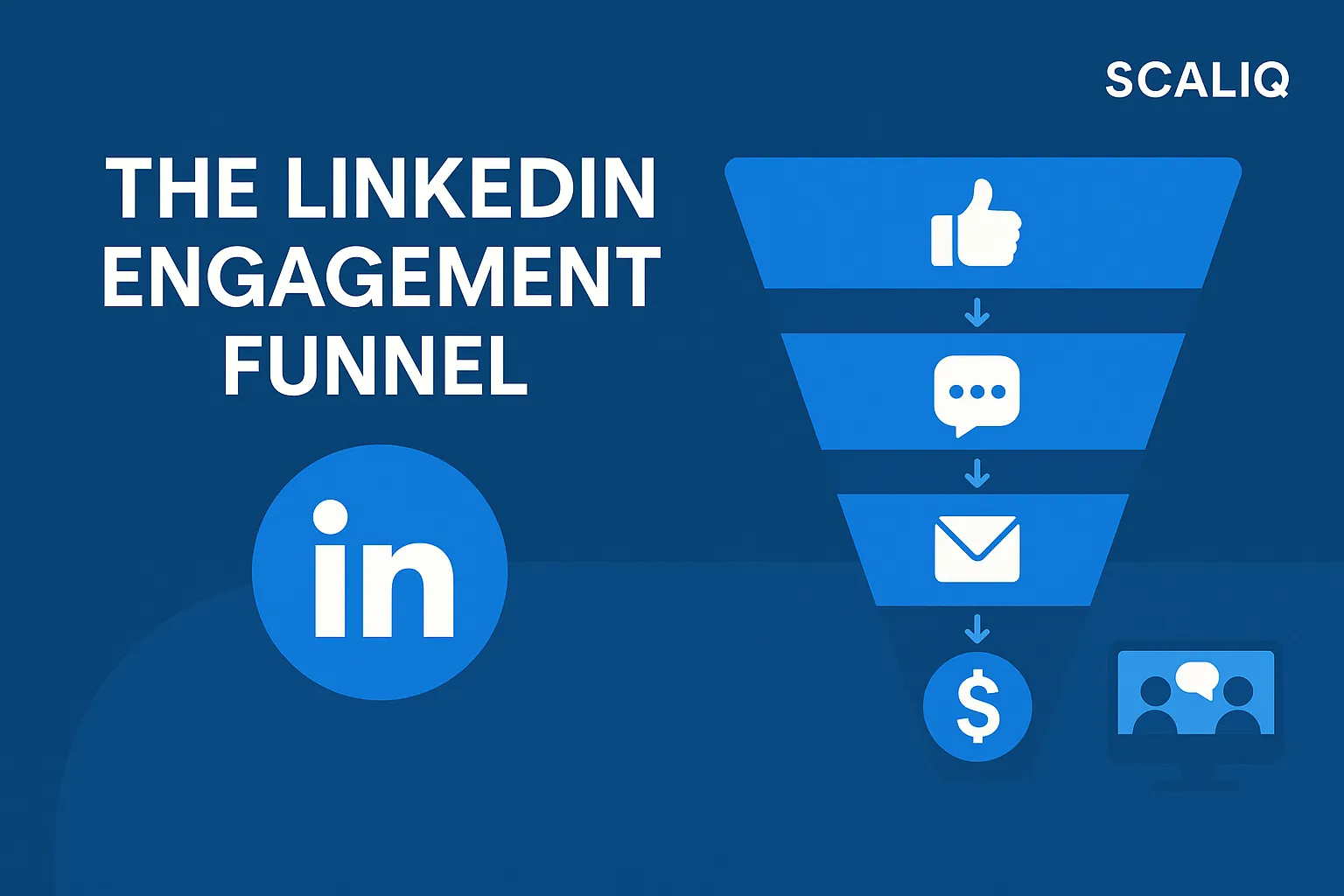
The LinkedIn Engagement Funnel: From Like → Comment → DM → Deal
Most LinkedIn prospecting fails for one simple reason: reps ask before they’ve earned attention.
In modern B2B sales, cold-first outreach often creates immediate friction. Buyers are overwhelmed by generic pitches flooding their inboxes. Engagement-first outreach, by contrast, builds familiarity, context, and trust long before the direct message is ever sent.
This guide will show you how to turn scattered LinkedIn activity into a repeatable, high-converting funnel that moves seamlessly from visible engagement to warm conversations and measurable pipeline. Grounded in ScaliQ’s tested engagement-based outbound experience across thousands of campaigns, this is not a generic social selling article. It is a precise operational guide complete with stages, triggers, examples, timing rules, and KPIs.
Designed for intermediate B2B sales and revenue operators, this playbook provides a system that multiple reps can execute consistently to master the linkedin engagement funnel. For readers who want deeper outbound workflow tactics right away, you can explore ScaliQ's blog, dive into ScaliQ's core features, or discover adjacent messaging strategies on the Repliq blog.
What a LinkedIn Engagement Funnel Is
A linkedin engagement funnel is a structured, revenue-oriented workflow designed to build trust and context before a pitch. Rather than treating LinkedIn as a database for random activity or cold pitching, this funnel uses engagement as the critical warming layer between brand awareness and direct outreach.
As the performance of generic outbound continues to decline, revenue teams are rapidly shifting toward signal-based prospecting. Engagement-led outbound replaces the friction of a cold interruption with a relationship-driven approach. The full funnel follows a logical progression: Like → Comment → DM → Call → Opportunity → Deal.
This social selling funnel works because it aligns with fundamental relationship-building principles on professional networks. As supported by OECD research on online social networks and trust, visible, transparent interactions significantly increase trust between parties prior to direct communication.
Why engagement works better than pitching too early
Public interactions like likes, comments, follows, and profile views act as early intent signals. While they do not necessarily indicate immediate buying intent, they are highly accurate conversation readiness signals.
Engaging publicly lowers the perceived risk for the buyer before a private message occurs. When a rep finally sends a DM, the prospect already recognizes their name and face, shifting the dynamic from a "cold interruption" to "context-rich outreach." Because the outreach is anchored in a shared topic, relevant engagement-based outbound drastically improves reply quality, not just raw reply volume, making LinkedIn relationship building far more effective for LinkedIn lead generation.
The difference between activity and a true funnel
There is a vast difference between scrolling LinkedIn and executing a social selling workflow. Random usage relies on hope; a true funnel relies on a repeatable system with strict entry criteria, defined actions, and clear conversion points.
In a functional LinkedIn outbound prospecting system, each stage has a clear trigger, an assigned owner, and an exit KPI. Revenue teams require this level of rigorous process to accurately measure social selling metrics and roi, moving beyond generic posting advice into predictable pipeline generation.
When this model works best
This linkedin social selling strategy is highly effective for mid-ticket to high-ticket B2B offers, consultative sales, account-based outreach, founder-led sales, and SDR/AE motions. It thrives when prospects are active on the platform and buying decisions are heavily reliant on trust.
However, nuance is required. Not every prospect will engage publicly or post content. Therefore, this linkedin outbound workflow should complement your broader outbound strategy, acting as a highly effective linkedin prospect nurturing channel rather than a total replacement for all other outreach methods.
The Like to Comment to DM Workflow
To succeed, teams must operationalize the full journey. This social selling workflow is an executable playbook that moves reps from identifying lightweight signals to initiating real conversations.
Unlike common automation-first tools that strip away human context, this workflow relies on careful timing and deep personalization. Drawing from ScaliQ’s extensive campaign experience, every stage here is designed to naturally earn the next step.
Stage 1 — Identify the right prospects and content
Before utilizing your LinkedIn commenting strategy, you must build a target list based on Ideal Customer Profile (ICP) fit. Only after establishing ICP fit should you layer on the engagement opportunity.
Reps should look for active posters, thoughtful commenters, and individuals demonstrating visible subject-matter expertise on topics tied to your offer. Content affinity is crucial—reps should engage where their perspective naturally adds value. Chasing vanity engagement from irrelevant audiences will only waste time and dilute your LinkedIn lead generation efforts.
Stage 2 — Start with low-friction signals: likes, follows, profile views
Early signals serve as awareness-building touches, not conversion events. A simple "like" creates baseline familiarity but is rarely enough to justify an immediate DM.
Follows and profile views act as supporting indicators of relevance. The practical rule for this stage of the linkedin engagement funnel is to use low-friction signals for signal accumulation. They are the foundation of your LinkedIn engagement strategy, not standalone permission to pitch.
Stage 3 — Leave comments that create conversation momentum
A high-value comment is specific, additive, highly relevant to the original post, and easy for the prospect to reply to. Strong comments build visible expertise not just with the prospect, but with the entire network reading the thread.
Avoid generic praise like "Great post!" or disguised pitching. Instead, focus on adding value.
Examples of strong comments:
• Insight add-on: "Great breakdown. I’d also add that tracking the retention rate of these cohorts often reveals where the actual churn happens."
• Pattern recognition: "I've noticed this exact same shift. Over the last three quarters, teams moving away from [Strategy A] to [Strategy B] are seeing much faster onboarding times."
• Thoughtful question: "Fascinating approach to QBRs. How do you handle the transition when a new champion takes over the account mid-cycle?"
To systemize your LinkedIn engagement strategy and social selling workflow, reps can use these repeatable frameworks:
• “Agree + add a practical nuance”
• “Highlight a missed implication”
• “Turn their point into a buyer-side observation”
• “Ask a smart follow-up question that invites response”
Stage 4 — Know when to move into the DM
The transition to a direct message must feel like a natural continuation of your public interaction. Moving to the DM is justified after repeated engagement, a direct reply to your comment, reciprocal profile view activity, or deep topic-level relevance tied to a known pain point.
Remember: a comment reply is vastly stronger than a passive like, and repeated interactions always trump single-touch signals.
Use this readiness model for your linkedin dm outreach best practices:
• Green light: The prospect replied to your comment, liked multiple posts of yours, viewed your profile, or engaged repeatedly around a highly relevant topic. Move to DM.
• Yellow light: One or two passive engagements (likes) but no clear interaction depth. Keep nurturing.
• Red light: No prior signal, no context, or engagement on a purely personal/irrelevant post. Do not DM yet.
Stage 5 — Send a context-rich DM that feels earned
The best LinkedIn DM outreach opens with context, establishes relevance, and offers a light next step. It is never a pitch deck.
Always reference the original post or discussion thread naturally. Use consultative language to maintain topic continuity and prove that this is a linkedin warm outreach framework, not a disguised cold blast.
DM Examples:
• After a comment exchange: "Hey [Name] - loved our back-and-forth on your post about sales cycles today. It got me thinking about how we handle [Challenge]. Are you currently solving that internally, or open to a quick resource I put together on it?"
• After repeat likes on a topic: "Hi [Name], noticed you engaging with a few of my recent posts on [Topic]. Always great to connect with someone who sees the shift happening in [Industry]. How is your team currently adapting to [Specific change]?"
• After visible profile-view reciprocity: "Hey [Name], saw you stopped by my profile after I commented on your post yesterday. Thought it made sense to officially connect. Really enjoyed your perspective on [Topic]."
• Opening context: Mention the specific post, shared idea, or public discussion.
• Relevance bridge: Connect that idea to a common business challenge or industry pattern.
• Soft CTA: Invite a quick exchange, offer to share a free resource, or ask a brief, low-friction question.
Stage 6 — Move from DM to call to opportunity
Transitioning from a casual conversation to a qualified sales opportunity requires subtlety. You must qualify the prospect by asking about their current processes, priorities, or timing without breaking the trust you just built.
Keep the conversation asynchronous until a specific pain point is acknowledged. Once interest is clear, suggest a call. This is the concept of "earned escalation"—each step in your social selling funnel must follow demonstrated interest. To seamlessly operationalize these transitions, follow-ups, and rep workflows without losing the vital human touch, teams can leverage ScaliQ's feature set to maintain momentum.
How to Identify Intent and Outreach Timing
Not all engagement is created equal. To succeed in engagement-based prospecting, teams must prioritize prospects using observable intent-like signals.
By utilizing a practical scoring logic, revenue teams can dramatically reduce premature outreach, improve message timing, and connect engagement directly to commercial outcomes—a principle supported by a recent meta-analysis on social media engagement and sales.
High-intent vs low-intent engagement signals
To refine your LinkedIn engagement strategy, categorize signals into tiers:
• Low intent: One-off likes on broad topics.
• Moderate intent: Repeat likes, follows, and profile views over a short period.
• High intent: Thoughtful comments, direct replies to your comments, and topic-specific repeat engagement.
Signal clusters (e.g., a profile view followed by a comment) matter significantly more than isolated events. Furthermore, topic relevance is just as critical as frequency; a single comment on a highly technical pain-point post is worth more than ten likes on a generic motivational post.
A simple intent scoring model for revenue teams
To prioritize your engagement-based outbound, implement a lightweight scoring framework. This can be tracked manually or via your linkedin outbound workflow tooling.
Example Scoring Inputs:
• Repeat engagement frequency (e.g., 3+ interactions in 14 days)
• Comment depth (generic vs. insightful)
• Recency (interactions within the last 48 hours)
• Profile view reciprocity (did they look back at you?)
• Alignment to core pain-point topics
The goal of this social selling workflow is prioritization, not false precision. Use the score to dictate who gets your attention today.
Outreach timing: when to wait, when to act
Timing should always feel responsive and natural, never automated.
• Scenario A: A prospect replies to your comment today. → Action: Send a context-rich DM within 24–48 hours while the topic is fresh.
• Scenario B: A prospect likes your posts repeatedly over two weeks but hasn't commented. → Action: Engage publicly on their content first before moving to the DM.
• Scenario C: You leave a thoughtful comment, but receive no response or like. → Action: Continue observing. Do not force outreach.
Always look for relevance windows around trending post topics or visible buying triggers (like a new role or company funding) to time your linkedin warm outreach framework perfectly.
Signals that a prospect is not ready yet
Forcing a DM when a prospect isn't ready damages your brand perception and destroys future trust. Warning signs include purely passive engagement, a lack of reciprocity, engagement on irrelevant/personal content, or a long period of silence after a previous interaction.
If the signals are weak, preserve your optionality. Stay visible in their feed and comments rather than pushing a pitch too early in the linkedin prospect nurturing process.
How to Scale Engagement Without Sounding Automated
The biggest operational challenge for revenue teams is standardizing this workflow across multiple reps without making it feel robotic.
While automation has its place, human judgment is essential for relationship building. Small, authentic actions compound over time, a dynamic proven by research on how likes and comments trigger reciprocal engagement. Here is how to scale your engagement-based outbound safely.
Standardize the process, not the personality
To scale a social selling workflow, create shared stages, triggers, and SLAs (Service Level Agreements) for follow-ups, while leaving room for the rep’s unique voice.
Provide your team with comment and DM frameworks, not rigid copy-paste scripts. Define minimum personalization inputs (e.g., "You must reference one specific line from their post") before any DM is sent, ensuring your LinkedIn engagement strategy remains authentic.
What can be automated safely
Automation is highly effective for the operational backend of LinkedIn outbound prospecting. You can safely automate:
• Tracking engaged prospects.
• Surfacing relevant post interactions.
• Reminding reps to follow up at the right time.
• Organizing signals by target account or persona.
AI-assisted personalization can help draft ideas or summarize long posts, but the final comment or DM must preserve human context. Over-automation is instantly recognizable through unnatural timing, robotic tone, and generic references.
What should stay human
Public comments, timing decisions, and message nuance must require contextual human judgment.
Human review matters most at the critical threshold: moving from public engagement to private outreach. Reps must adapt their language based on the prospect’s tone, the specific post type, and the broader buying context to master LinkedIn relationship building.
Team playbooks for multi-rep execution
A scalable linkedin outbound workflow requires a clear operating model. Define exactly:
• Who monitors signals: (e.g., Marketing or automated tooling).
• Who engages publicly: (e.g., SDRs or Founders).
• Who owns the DM: (e.g., SDRs handing off to AEs upon reply).
• Who logs outcomes: (e.g., Reps updating the CRM).
Role-based handoffs ensure consistency. Consistency is the sole factor that turns ad-hoc engagement into a scalable LinkedIn lead generation source. For teams looking to systemize this execution further, explore deeper tactical playbooks on the ScaliQ blog.
Common mistakes that make engagement feel fake
The fastest way to ruin your linkedin comment strategy for lead generation is premature pitching, leaving low-value comments ("Great share!"), sending copy-paste DMs, jumping onto irrelevant topics just to be seen, or overreacting to a single like with a hard pitch.
Unlike typical automation-first approaches in the market that spam inboxes, this framework relies on context, signal quality, and precise timing. By leveraging compliant AI enrichment, verified data, and smart workflow orchestration, teams can scale authentic engagement without falling into the trap of generic spam.
KPIs That Connect Engagement to Pipeline
To prove the value of your linkedin engagement funnel, you must connect LinkedIn activity directly to meetings, opportunities, and revenue.
Avoid vanity metrics (like total post views) and instead define stage-level KPIs. Understanding the difference between raw measures and actionable metrics is crucial, as outlined in the NIST framework for metrics and measures. Track both leading and lagging indicators to measure true social selling metrics and roi.
Leading indicators at the engagement stage
Track these early-stage metrics to gauge the health of your engagement-based prospecting:
• Relevant prospect engagements per week
• Repeat engagers (prospects interacting 2+ times)
• Comment reply rate
• Profile-view reciprocity
• Engaged target accounts (account-level penetration)
Quality of engagement always matters more than gross interaction volume. Segment these metrics by ICP, individual rep, campaign, and content topic to refine your LinkedIn engagement strategy.
Mid-funnel conversion metrics
As prospects move through the social selling funnel, track:
• Warm DMs sent (triggered by engagement)
• DM reply rate
• Conversation-start rate (meaningful back-and-forths)
• Meeting-booked rate from engaged prospects
Compare your warm DM performance against your pure cold outreach baselines. This internal benchmarking is where the undeniable value of LinkedIn lead generation via engagement becomes visible to leadership.
Revenue metrics that matter
Ultimately, engagement-based outbound must generate revenue. Track:
• Opportunities created from engaged accounts
• Opportunity conversion rate from engaged prospects
• Pipeline sourced
• Pipeline influenced
• Closed-won revenue from engagement-led accounts
Use standard Revenue Operations language. Differentiate between sourced pipeline (engagement was the first touch) and influenced pipeline (engagement accelerated an existing deal) to accurately report on social selling metrics and roi.
How to log LinkedIn engagement inside CRM or workflow systems
Without structured logging, teams cannot learn which signals actually predict meetings or deals. As recommended by SBA guidance on CRM for tracking leads and outreach, reps must capture meaningful engagement events systematically.
Log the specific trigger events, the dates DMs were sent, conversation outcomes, and the next scheduled actions. This turns linkedin prospect nurturing from a guessing game into a measurable social selling workflow.
A sample dashboard for the funnel
Keep reporting simple. Build an operational dashboard with widgets for:
• Engaged Prospects (Total count)
• Signal Score (High/Med/Low)
• Last Touch (Date/Type)
• Warm DM Sent (Y/N)
• Replied (Y/N)
• Meeting Booked (Count)
• Opportunity Created ($ Value)
• Revenue Outcome (Closed-Won $)
This creates a highly visible, simple ops layer for your linkedin outbound workflow, preventing it from becoming an overly complicated BI project.
Conclusion
LinkedIn works best when treated as a staged engagement funnel, not a shortcut to instant pitching.
The core sequence is undeniable: earn attention publicly, deepen relevance through thoughtful comments, move to the DM only when signals justify it, and rigorously track conversion through to pipeline. The modern sales edge is no longer just "being on LinkedIn"—it is having a repeatable operating model equipped with timing rules, message frameworks, and strict KPI discipline.
Audit your current outreach today. Where are your reps moving too early? Which high-intent signals are they ignoring? Apply this Like → Comment → DM framework to one specific prospect segment this week and measure the reply quality against your cold outbound baseline.
Grounded in tested engagement-led outbound across thousands of campaigns, this framework is designed for teams that refuse to compromise between personalization and scale. To operationalize this engagement-led outbound system for your team, explore ScaliQ's platform, or discover more messaging strategies on the Repliq blog.