

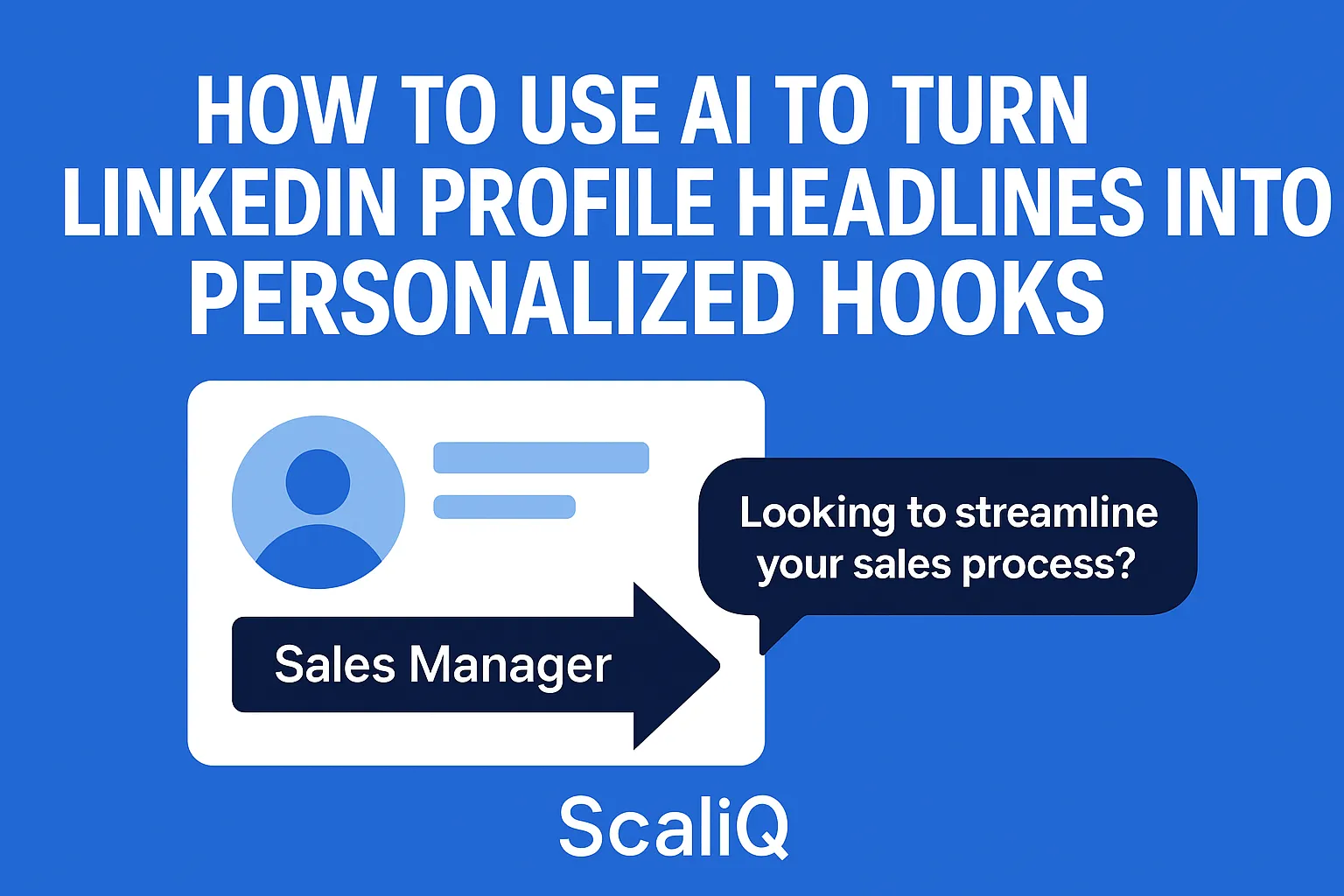
How to Use AI to Turn LinkedIn Profile Headlines Into Personalized Hooks
Most cold outreach first lines fail because they sound personalized on the surface but are entirely generic underneath. Beginners often look at a LinkedIn profile headline and see only a job title, resulting in opening lines like, "I saw you're the VP of Sales, so I thought I'd reach out." This approach falls flat because it states the obvious without offering any real value or relevance.
This article will show you how to turn that short line of text into highly useful signals about a prospect's role, goals, specialization, and likely pain points. From there, you will learn how to use AI to generate better, highly targeted outreach hooks. At ScaliQ, we have built our expertise by extracting personalization signals from over 50,000 public profiles, proving that you do not need deep technical setups to achieve high-quality personalization.
This guide provides a practical, transparent workflow you can use immediately. We will cover how to read headlines effectively, how to prompt AI for the best results, what strong personalized outreach hooks look like, and how to scale your efforts without sounding robotic. For more outbound personalization examples, to see ScaliQ in action, or to review adjacent personalization workflows, you can explore Blog, check out our ScaliQ, or visit Repliq.Co.
Why LinkedIn Headlines Are Powerful Personalization Signals
When executing sales prospecting personalization, finding accurate public data quickly is essential. The LinkedIn headline is one of the fastest, most concentrated public signals available for outreach personalization. It is a high-visibility profile element that acts as a professional billboard, summarizing exactly how a prospect wants to be understood by their industry.
For beginners, LinkedIn profile headline analysis is the perfect starting point. Headlines are short, easy to collect, and often contain enough context to create a highly relevant opener. Unlike broader, manual prospect research methods that require digging through company reports or listening to hour-long podcasts, headlines provide immediate, actionable data.
However, there is a strict difference between using a headline as a signal and simply copying it back as a shallow compliment. The goal is not to say, "I love your headline!" but to understand the business priorities behind it. LinkedIn itself recognizes the importance of this text; you can see how frequently it is displayed across the platform by reviewing how LinkedIn profile appearances work. Furthermore, the introduction of the LinkedIn headline AI assistant reinforces that the platform treats the headline as a critical, optimized field.
What a Headline Can Reveal at a Glance
A well-crafted headline reveals much more than a job title. Through AI-powered prospect research, a single line can help you infer the prospect's role, target market, specialization, growth focus, audience, and overall positioning.
Even short headlines hint at core business priorities. Words like "scaling," "hiring," or "pipeline" point directly to growth initiatives, while "efficiency," "operations," or "retention" point to optimization. The goal of LinkedIn profile headline analysis is not to achieve 100% certainty about a prospect's day-to-day life, but to build a highly plausible hypothesis for your opening line personalization.
Why Generic Headline-Based Personalization Fails
The most common mistake in first-line personalization is repeating the headline back to the prospect or praising it vaguely. Opening with, "I was impressed by your headline about scaling SaaS teams," feels automated and insincere, even if it includes a "personalized" detail.
Weak cold email personalization relies solely on the job title or verbatim text. Strong personalized outreach hooks, on the other hand, connect a headline phrase to a likely goal or challenge. They use the headline as a bridge to a relevant business conversation, rather than treating it as a cheap trick to grab attention.
How to Read LinkedIn Headlines for Role, Goals, and Pain Points
To succeed at LinkedIn headline personalization, you need a beginner-friendly framework for decoding text into usable outreach signals. The most effective lens is to identify the prospect's role, target market, specialization, desired business outcome, and implied challenge.
Treat headlines as public clues that guide your messaging, not as definitive proof of a company's internal strategy. This transparent, signal-first approach solves the common beginner pain point of not knowing what parts of a profile actually matter, and it builds trust far better than relying on black-box AI suggestions during LinkedIn data enrichment.
Signal 1 — Role and Seniority
Words like Founder, SDR, VP of Sales, Consultant, or Operator drastically shape the angle of your opener. Seniority changes what matters to the prospect. Leaders care about strategic outcomes and revenue; managers care about execution and team performance; individual contributors (ICs) care about workflow efficiency and hitting personal targets.
• For a VP of Sales: "Noticed your focus on scaling enterprise revenue..." (Strategic outcome)
• For an SDR: "Saw you're driving outbound for the enterprise team..." (Execution and workflow)
By adjusting B2B outreach copywriting based on role, your opening line personalization instantly becomes more relevant.
Signal 2 — Market, Audience, or Niche
Headlines often reveal exactly who the prospect serves. Look for industry markers like SaaS, agencies, healthcare, ecommerce, or B2B teams. Spotting these niche cues helps make your cold email personalization feel tailored.
Using the prospect's market language allows you to frame a problem they likely face. If a headline says "Helping Ecommerce Brands Scale," your personalized outreach using LinkedIn should acknowledge the unique challenges of ecommerce growth, rather than pitching a generic marketing service.
Signal 3 — Goals, Priorities, and Implied Pain Points
Train yourself to look for outcome-oriented words: growth, revenue, pipeline, automation, recruiting, customer success, or expansion. These words imply common challenges. A focus on "pipeline generation" suggests they are actively battling lead quality or outbound efficiency.
However, exercise caution. Use AI-powered prospect research to form hypotheses, but do not make exaggerated assumptions from thin data. If a headline says "Building the future of AI," do not assume their primary pain point is server costs unless you have additional data to back it up.
A Simple Headline-Decoding Framework Beginners Can Reuse
To make LinkedIn headline personalization repeatable, use this simple mini-framework before writing your first-line personalization:
• Who are they? (Role/Seniority)
• Who do they serve? (Market/Audience)
• What is their goal? (Desired Outcome)
• What makes that hard? (Implied Pain Point)
Once these signals are clear, you can learn how to personalize cold emails with AI by feeding these exact points into a prompt to generate usable hook options.
A Simple AI Workflow for Generating Outreach Hooks
Turning headline text into 2–3 relevant outreach hooks does not require complex coding. This beginner-friendly workflow moves from input and interpretation to prompting and review.
It is vital to remember that AI should generate hypotheses and drafts, not final messaging without human review. This workflow is significantly faster than manual personalization, but it remains grounded in real public signals. Responsible use of AI in outreach requires human oversight, a standard supported by the NIST generative AI risk framework and the OECD AI Principles, which emphasize transparency, accountability, and quality control.
Once you master this manual prompting, you can explore ScaliQ to see how to transition into a fully scalable personalization workflow.
Step 1 — Input the Headline and Extract Key Signals
Your first prompt should classify the headline rather than asking for a finished opener immediately. Breaking the data down during LinkedIn profile headline analysis improves the final output because it makes the AI's reasoning visible.
Ask the AI to extract: Role, Audience, Priority, Likely Pain Point, and Messaging Angle. This structured LinkedIn data enrichment prevents the AI from hallucinating details.
Step 2 — Ask AI to Infer Business Context Carefully
Next, prompt the AI to make restrained, plausible inferences. Instruct the AI to use language like "likely," "may indicate," or "suggests a focus on."
This restraint ensures the AI hooks outreach output feels credible and observant, rather than overconfident and robotic. Sales prospecting personalization fails when you tell a prospect what their problems are; it succeeds when you align with the priorities they have already made public.
Step 3 — Generate 2–3 Hook Variations
Never settle for a single AI output. Generate multiple opening line personalization angles:
1. Pain-point based: Focuses on the friction of achieving their headline goal.
2. Goal-based: Focuses on the strategic outcome they are driving toward.
3. Niche-based: Focuses on their specific industry or target audience.
Having a small set of cold outreach hooks examples allows you to choose the one that best fits your specific offer.
Step 4 — Review for Specificity, Tone, and Relevance
Editing AI output is where the quality of cold email personalization is preserved. Pass the generated hooks through a simple QA filter:
• Does it sound human?
• Is it tied to the headline?
• Does it avoid vague compliments?
• Does it avoid overclaiming?
For teams standardizing B2B outreach copywriting, this review step is non-negotiable.
Beginner Prompt Template
Use this exact prompt template as an AI first line generator for cold email:
This prompt teaches you how to personalize cold emails with AI by forcing the tool to show its work before giving you the final opening line personalization.
Examples of Weak vs Strong Personalized Opening Lines
To truly master first-line personalization, you must see the difference between generic automation and signal-based relevance. At ScaliQ, we prioritize the logic that connects a public headline signal to the final opener. Here are side-by-side cold outreach hooks examples to illustrate what works.
Example 1 — Generic Compliment vs Signal-Based Hook
Weak: "I loved your headline about driving growth, you are doing great work!" Strong: "Noticed your focus on driving enterprise pipeline—curious if you're experimenting with intent data this quarter?"
• Signal used: "Driving enterprise pipeline" (Goal).
• Mistake avoided: Vague praise.
• Why it feels human: It connects their public goal to a specific, relevant industry tactic, inviting a natural conversation about LinkedIn headline personalization.
Example 2 — Job-Title Reference vs Intent-Based Hook
Weak: "Saw you're a VP of Sales, so I wanted to connect." Strong: "Saw you're leading the mid-market sales expansion—are you actively scaling the SDR team to support that?"
• Signal used: "Mid-market sales expansion" (Specialization/Market).
• Mistake avoided: Relying solely on the job title.
• Why it feels human: It uses AI hooks outreach to infer the next logical step of an expansion (hiring SDRs), making the personalized outreach using LinkedIn highly contextual.
Example 3 — Over-Automated AI Line vs Natural Human-Sounding Hook
Weak: "As a visionary leader in the B2B SaaS space optimizing revenue operations, you must require synergistic automation platforms." Strong: "Noticed you're heading up RevOps for the SaaS team—how much of your week is spent manually routing leads?"
• Signal used: "RevOps in SaaS" (Role/Niche).
• Mistake avoided: Robotic, buzzword-heavy jargon.
• Why it feels human: It uses clear, direct wording. Following plain language communication guidance is critical for B2B outreach copywriting; strong personalized outreach hooks sound observant, not overly clever. For an adjacent approach to this kind of natural outreach, you can also explore Repliq.Co.
How to Scale Headline-Based Personalization Without Sounding Robotic
Scaling sales prospecting personalization is not about generating more words; it is about standardizing better signal extraction and strict quality assurance. When teams prioritize speed over message quality, they end up with robotic, non-compliant spam.
The bridge from beginner experimentation to operational consistency lies in building a repeatable process based on ethical, public-data LinkedIn data enrichment.
Build a Small Set of Reusable Hook Types
Create specific categories for your first-line personalization: outcome-focused, niche-focused, challenge-focused, and positioning-focused.
These templates should guide the angle of the AI hooks outreach, not force identical wording. By standardizing the type of hook rather than the exact text, you improve consistency across your sales reps without flattening the authenticity of your cold email personalization.
Use Headline Signals as One Layer, Not the Whole Message
Headlines are powerful starting points, but they work best when validated against broader public-profile context. Avoid over-personalization. Making assumptions based on thin data can make your message feel invasive or disjointed.
Know when to stop at LinkedIn headline personalization and when you need deeper AI-powered prospect research to enrich the profile with additional public signals.
Add a Simple Quality-Control Checklist
Before rolling AI-generated hooks into a live sequence, apply a quality-control checklist. Ensure every line meets standards for relevance, clarity, tone, specificity, and compliance with public-data use.
Review a sample of outputs manually. Experimentation matters—monitor which hook types generate the highest reply quality, not just the highest volume. For more guidance on outbound testing and scaling these workflows, visit Blog.
Best Practices and Expert Tips for Beginners
To successfully turn LinkedIn headlines into personalized outreach hooks, you must balance specificity with restraint. Drawing on ScaliQ’s experience analyzing over 50,000 profiles, we know that the best hooks connect a visible signal to a plausible business context without overstepping. Keep these principles in mind as you refine your AI hooks outreach.
Do This
• Focus on visible public signals: Base your opening line personalization only on what the prospect has chosen to share.
• Ask AI to classify before it writes: Use AI-powered prospect research to break the headline into role, niche, and goals first.
• Generate multiple variations: Always draft 2–3 cold outreach hooks examples and pick the strongest one.
• Keep the first line short and plain: Write for humans, avoiding jargon and fluff.
Avoid This
• Don't mirror the headline back: Repeating text is not cold email personalization.
• Don't over-assume from limited data: Keep your B2B outreach copywriting grounded in plausible reality.
• Don't let AI write unchecked first lines: Human review is essential for first-line personalization.
• Don't optimize only for speed: Faster outreach is useless if your message quality drops.
Conclusion
LinkedIn headlines are one of the fastest, most effective ways to personalize outreach—if you know how to decode them. By reading the headline for signals regarding role, market, and goals, you can use AI to infer likely business context. From there, generating multiple hooks and reviewing them for clarity ensures your outreach remains authentic and compliant.
Beginners do not need hours of deep manual research to improve their first lines; they simply need a better, signal-first framework. By leveraging public data ethically, you can dramatically increase your relevance. If you are ready to turn this manual LinkedIn headline personalization into a highly scalable, automated workflow, explore the ScaliQ to see how ScaliQ transforms public prospect signals into actionable, high-converting outreach hooks based on insights from over 50,000 profiles.