

Introduction: Why Acquisitions Create Sales Triggers—but Not Automatic Buying Intent
An acquisition can fundamentally alter a company’s trajectory. Overnight, ownership structures shift, reporting lines are redrawn, technology stacks are scrutinized, and budgets are reallocated. While these shifts create undeniable sales triggers, a public announcement alone rarely proves the existence of a current, actionable sales opportunity.
For advanced B2B sales and revenue operations teams, this presents a significant challenge: acquisition news is incredibly easy to monitor, yet interpreting its operational and commercial relevance is remarkably difficult. An alert about a merger does not automatically mean a company is ready to buy your software or services.
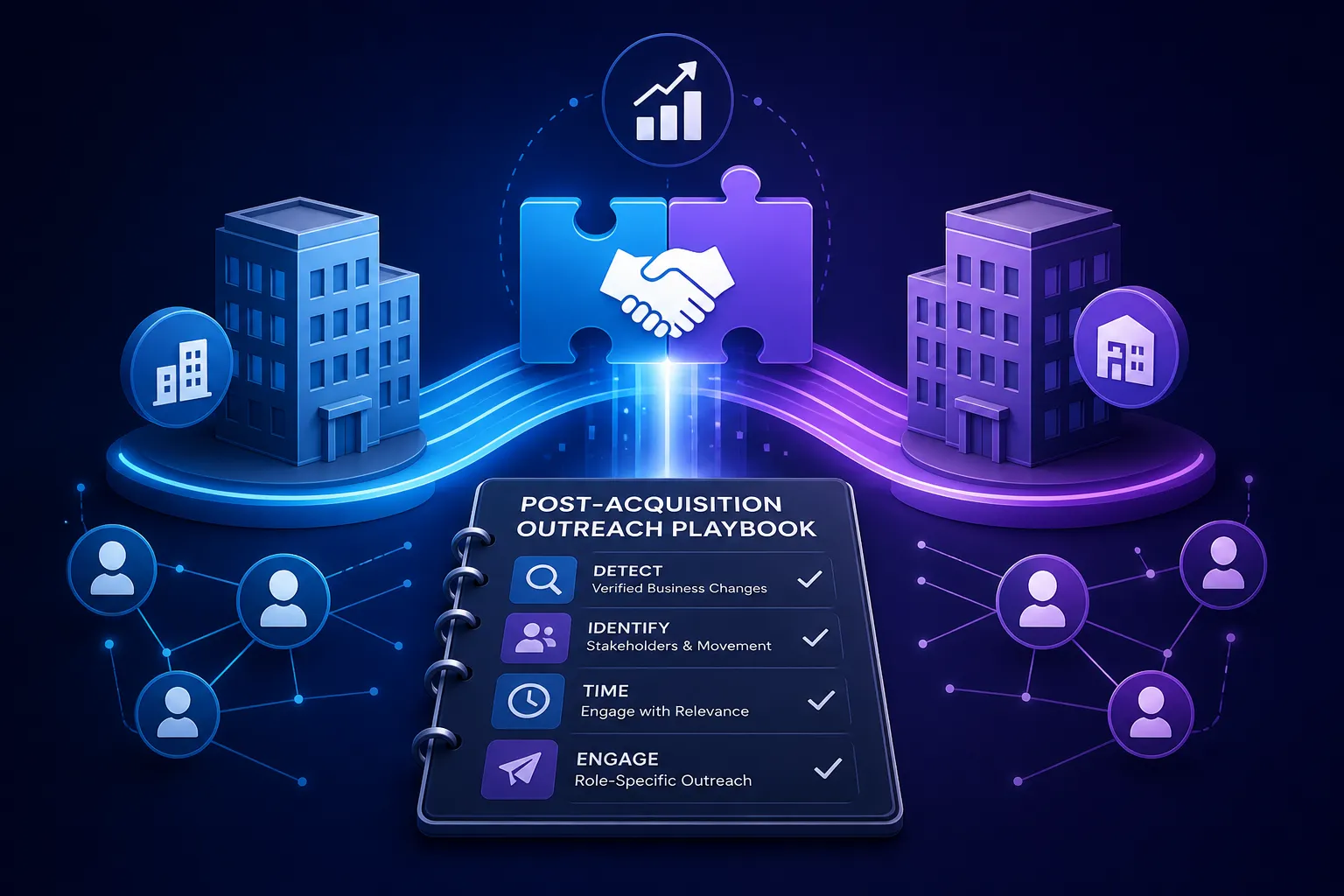
This playbook provides a repeatable workflow for navigating post-acquisition prospecting. It bridges the gap between raw news and revenue generation by detailing how to verify the event, identify the right decision-makers, choose responsible timing, craft role-specific LinkedIn outreach, and measure the resulting pipeline.
Unlike generic M&A news-monitoring guides, this framework connects verified business changes with stakeholder movement, specific integration stages, and evidence-based outreach hypotheses. By distinguishing between the acquiring company, the acquired company, the integration management office, and functional owners, revenue teams can execute outreach that is highly relevant, deeply respectful, and commercially effective. Connecting acquisition intelligence, stakeholder movement, and responsible outreach timing is the core of ScaliQ’s expertise, ensuring your campaigns rely on practical frameworks rather than unsupported assumptions about deal value or immediate conversions.
Identify and Qualify Acquisition Sales Triggers
To succeed in M&A prospecting, revenue teams must establish a strict qualification layer that separates a noteworthy news headline from a commercially relevant event. An acquisition announcement should be treated as a starting point for research—not an automatic green light to launch automated LinkedIn messages to every executive and employee. A highly useful trigger combines verified transaction data with strategic fit, operational impact, stakeholder changes, or a specific, relevant business problem.
Not Every Acquisition Announcement Is a Commercial Trigger
A press release rarely tells the whole story. The initial announcement may not explicitly reveal whether the transaction is a strategic merger, a financial play by private equity, a geographic expansion, an acqui-hire, a technology-focused integration, or an effort to consolidate competing operations.
To distinguish between a public event and a qualified sales trigger, revenue teams must ask critical questions:
• Has the transaction merely been announced, or has it been signed, approved, and legally closed?
• Is there verifiable evidence that systems, teams, vendors, processes, or operating models will change?
• Does the combined account match your target customer profile and a known use case?
• Is there a specific stakeholder whose role or scope is directly connected to the potential problem your product solves?
Avoid the trap of treating every acquisition as immediate evidence of budget availability or buying intent. Instead, document what is known and record uncertainty rather than filling gaps with assumptions. Public filings are invaluable for this validation; reviewing the SEC guidance on 8-K acquisition disclosures can help teams understand how material corporate events are formally reported and verified.
Build an Acquisition-Trigger Qualification Framework
Instead of inventing arbitrary numerical scores, build a practical classification framework that evaluates triggers across key dimensions:
• Event status: Is the deal announced, under regulatory review, approved, legally closed, or is integration actively underway?
• Strategic fit: What is the relationship between the transaction and your target audience’s industry, company size, geography, or operating model?
• Operational relevance: Are there impending changes to technology, workflows, compliance, procurement, staffing, or data architecture?
• Stakeholder movement: Have there been leadership appointments, expanded responsibilities, new integration roles, or altered reporting structures?
• Evidence confidence: How strong and recent are the sources supporting the trigger?
Based on these dimensions, categorize accounts into three practical classifications:
1. Monitor: The event is relevant, but there is insufficient evidence for outreach.
2. Research: The event is credible and presents a plausible operational hypothesis that requires validation.
3. Activate: The event is verified, a relevant stakeholder is identified, supporting signals exist, and there is a timely reason to engage.
When activating a trigger, document the hypothesis clearly: "Because [verified change] occurred, [role] may be evaluating [operational issue]; ask [diagnostic question] without assuming [unverified outcome]." Retain the source, date, transaction stage, confidence level, and reviewer name for every activated trigger to ensure accuracy and accountability.
Triangulate Evidence Before Outreach
A robust sales trigger combines the core acquisition event with supporting evidence. This triangulation proves operational relevance. Look for signals such as:
• Leadership appointments or executive job changes.
• Hiring activity specifically related to integration, transformation, technology, or operations.
• Public references (in earnings calls or press interviews) to consolidation, standardization, expansion, or restructuring.
• Verifiable changes to technology stacks, vendors, or internal processes.
• The formation of new business units, geographic expansions, or shifts in functional ownership.
Supporting signals should validate relevance, not manufacture certainty where none exists. While CRM records, LinkedIn Sales Navigator, Crunchbase, enrichment platforms, and workflow tools supply valuable data, ScaliQ’s differentiated value lies in the interpretation, timing, and orchestration layer that sits above this data. Never imply that any listed source confirms an operational change unless that source explicitly supports the claim.
Time Outreach Across Announcement, Closing, and Integration Stages
Effective M&A prospecting organizes campaigns around the acquisition timeline rather than relying on a fixed, arbitrary follow-up date (e.g., "wait 30 days"). The same message that is highly relevant during integration planning can appear premature, presumptuous, or insensitive if sent the day of the announcement. Understanding transaction stages dictates whether you should monitor, research, engage, pause, or shift your campaign branch.
Stage 1: Announcement and Regulatory Review
The initial announcement creates market awareness, but it often precedes regulatory approval, legal closing, and operational integration.
Use this stage for account research, event verification, stakeholder mapping, and low-pressure relevance testing. This is not the time for an aggressive sales sequence. Messaging should acknowledge only the confirmed public event and ask whether a relevant operational topic is on the prospect’s radar—without assuming that integration has already begun.
Implement strict pause conditions for transactions subject to intense regulatory review, market uncertainty, or public sensitivity. It is vital to distinguish between a proposed transaction and a completed deal. The FTC merger-review timing and closing rules highlight the strict legal boundaries between a proposed transaction, regulatory review, and a finalized deal. Avoid language like "now that your teams are being consolidated" unless that consolidation has been publicly verified and legally permitted.
Stage 2: Transaction Close and Transition
Legal closing confirms a new level of transaction certainty, but it still does not prove that a particular department is ready to buy.
During the transition phase, research who is responsible for integration, transformation, procurement, technology, and functional harmonization. Outreach can now evolve from "I noticed the announcement" to a more specific—yet still conditional—hypothesis about post-close priorities.
Messaging must diverge here: the acquirer and the acquired company have vastly different responsibilities, concerns, and influence during transition. If the organization has not publicly indicated its integration priorities, or if stakeholder roles remain ambiguous, branch the campaign into a waiting period. For context on this critical window, review the Federal Reserve acquisition transition guidance, which describes the delicate period between public announcement, legal consummation, and full integration.
Stage 3: Integration Planning and Operational Consolidation
Integration planning often creates more concrete sales relevance than the initial announcement. Teams are actively evaluating processes, systems, vendors, reporting structures, data architectures, and change-management requirements.
Target Integration Management Office (IMO) leaders, transformation owners, functional executives, operations leaders, and technology stakeholders where their roles are verified. Messages should be built around a specific operational question rather than a generic pitch or a hollow congratulatory statement.
Branch campaigns based on the type of integration hypothesis: systems consolidation, process standardization, cross-company reporting, or stakeholder coordination. Crucially, campaigns must never assume layoffs, internal disruption, sudden budget releases, or employee dissatisfaction. As noted in an academic review of postmerger integration, integration involves complex strategic, cultural, and temporal considerations. Furthermore, Wharton research on post-acquisition communication networks reveals that communication patterns and internal influence evolve gradually, rather than shifting instantly upon announcement.
Stage 4: Stabilization and Expansion
Later-stage outreach focuses on observed operating priorities, expansion, standardization, or unresolved integration work, provided there is enough public or prospect-provided evidence.
Refresh your stakeholder maps during this phase, as reporting lines and responsibilities frequently shift as integration matures. Messaging can become highly specific once a prospect publicly describes a priority or responds to an earlier inquiry. If there has been a long pause in communication, include a requalification step before continuing a sequence. Timing must always be dictated by relevance and evidence, not merely the age of the press release.
Map Acquirer, Acquired-Company, and Integration Stakeholders
Acquisition-led prospecting requires an account graph or hierarchy, not just a single company record and a flat list of contacts. Proper stakeholder mapping prevents duplicate outreach, incorrect assumptions, and narrow targeting by tracking how influence moves between the parent company, the acquired business, the integration team, and functional departments.
Build the Parent–Subsidiary Account Hierarchy
Create linked CRM records for the following entities:
• The acquiring company.
• The acquired company or subsidiary.
• Relevant business units and geographies.
• The Integration Management Office (IMO) or transformation program.
• Shared functional teams.
Retain essential fields across these records: transaction status, announcement date, verified close date, source links, integration hypotheses, related stakeholders, and suppression status. Documenting which facts are verified, inferred, or unknown ensures the account record remains transparent and auditable. This hierarchy prevents duplicate records and allows revenue teams to coordinate outreach across parent and subsidiary accounts seamlessly, ensuring clear CRM ownership when multiple reps might approach the same buying group.
Identify Stakeholders Whose Influence May Change
Build a practical stakeholder matrix detailing the role, likely concern, evidence required for verification, appropriate timing, and outreach objective. Ensure you cover:
• Acquirer executives and strategy leaders.
• Acquired-company executives and functional leaders.
• IMO and transformation leaders.
• Technology, operations, finance, procurement, HR, and compliance owners.
• Newly appointed leaders or role movers.
• Publicly identifiable advisors or integration partners.
Job titles alone do not prove buying authority. Validate the individual's scope, reporting relationships, and direct connection to the trigger. Identify both those who are gaining influence and those whose previous influence may be diminishing. Human review of role changes is essential before campaign activation, particularly when LinkedIn profiles appear incomplete, outdated, or ambiguous.
Match the Message to the Role and Integration Hypothesis
Never send the exact same acquisition message to everyone. Map each stakeholder to a distinct hypothesis:
• Acquirer executive: Focus on scale, governance, strategic alignment, and visibility across the combined organization.
• Acquired-company leader: Focus on continuity, local priorities, operational fit, and preserving business momentum.
• Integration leader: Focus on coordination, milestones, dependencies, and cross-company execution.
• Functional owner: Focus on process, systems, data, vendor, and workflow implications.
• Procurement or finance stakeholder: Focus on standardization, vendor rationalization, or approval processes—only when supported by evidence.
Encourage a diagnostic question that allows the recipient to correct your assumption. Record the reason each person was selected and the evidence supporting the role match. Always frame your hypothesis as a possibility, not as inside knowledge about the organization’s confidential plans.
Build Evidence-Based LinkedIn Messaging and Campaign Branches
Transforming qualification and timing into a practical LinkedIn campaign architecture requires branching by event stage, stakeholder role, and evidence confidence. A strong message references a verified change, connects it to a plausible business issue, and invites a low-pressure conversation.
Campaign Branch for Acquirer Stakeholders
For acquirer stakeholders, message frameworks should include:
• A neutral reference to the public transaction or a confirmed post-close development.
• A role-specific observation about managing change across a combined organization.
• A conditional operational hypothesis.
• A concise question asking whether the topic is relevant.
Avoid congratulatory language if the recipient’s exact role, responsibilities, or organizational impact is unclear. Separate your branches for executives, integration leaders, and functional owners rather than relying on seniority alone. Follow-ups should add useful context or a diagnostic question instead of lazily repeating the original pitch.
Campaign Branch for Acquired-Company Stakeholders
Acquired-company stakeholders are often navigating uncertainty, altered reporting lines, and continuity concerns. Use highly respectful language that recognizes the public event without implying disruption, job risk, loss of autonomy, or dissatisfaction.
Focus entirely on the prospect’s verified remit and current business context, not on assumptions about how the parent company intends to operate. Offer an easy way for them to decline or redirect the conversation if they are no longer responsible for that functional area. Implement strict suppression conditions if a contact appears to have left the organization, changed roles, or is directly affected by a sensitive transition. Human review is mandatory before sending messages to acquired-company employees during disruptive integration periods.
Campaign Branch for Integration and Functional Leaders
This is your most specific campaign branch, built around a verified integration responsibility or operational signal. Use diagnostic questions such as:
• Which processes need to work seamlessly across the two organizations?
• How are your teams evaluating standardization or consolidation?
• Is [Issue X] part of the current integration roadmap, or outside its current scope?
Offer a useful perspective, a checklist, or a diagnostic discussion rather than immediately demanding a product demonstration. Separate messaging for technology, operations, finance, procurement, and HR, because the implications of integration differ wildly by function. Ensure you have sufficient evidence before moving from research to direct outreach.
Responsible Messaging, Suppression Rules, and Human Review
Create a strict checklist of conditions that automatically pause or prevent automated outreach:
• The transaction status is unclear or contradicted by reliable sources.
• The contact’s role or employment status cannot be verified.
• The message relies on assumptions about layoffs, budget cuts, internal conflict, or strategic priorities.
• The event is highly sensitive, and the proposed value is not clearly relevant.
• Another internal team is already engaging the account.
• The person has opted out, requested no contact, or signaled the topic is irrelevant.
Require human approval for the first message in high-sensitivity or high-uncertainty cases. Automation can assist with monitoring, summarization, account updates, and drafting suggestions, but humans must review the evidence, tone, targeting, and timing.
Responsible orchestration sharply contrasts with automation-first workflows that scale generic messages without verifying the transaction. Adhere strictly to applicable platform rules, privacy expectations, internal policies, and recipient preferences.
Measure Acquisition-Triggered Pipeline Responsibly
Revenue teams must distinguish acquisition-triggered performance from ordinary outbound activity. Attribution begins before the first message is sent, requiring a consistent definition of what qualifies as an acquisition-triggered campaign and measuring both commercial outcomes and the quality of the decision to engage.
Define Attribution Before Launch
Before outreach begins, document the trigger record in your CRM. This must include:
• The verified acquisition event and source.
• The announcement, approval, or close status.
• Supporting business signals.
• The account hierarchy and stakeholder relationship.
• The outreach stage and campaign branch.
• Trigger confidence and the name of the human reviewer.
Define acquisition-triggered activity strictly: it is activity that would not have occurred—or would have been prioritized differently—without the verified event and related evidence. Separate the acquisition trigger from concurrent signals (like a routine leadership change). Create consistent rules for sourced, influenced, and co-influenced pipeline, and never claim the acquisition caused a deal unless the evidence firmly supports that conclusion.
Track Quality Beyond Replies and Meetings
A high reply count can indicate poor targeting if the responses are negative, confused, or unrelated to the acquisition hypothesis. Implement a measurement framework covering:
• Trigger verification rate.
• Contact-role match rate.
• Positive reply quality.
• Qualified meetings and opportunity creation.
• Sourced or influenced pipeline.
• Time from trigger verification to response or opportunity.
• Conversion rates segmented by event stage and stakeholder type.
• Suppression, correction, or inappropriate-outreach rates.
Compare acquisition-triggered campaigns against ordinary outbound campaigns using the same definitions and time windows. Review performance by campaign branch to identify whether announcement-stage, close-stage, or integration-stage outreach yields the most relevant conversations.
Learn From False Positives and Inappropriate Timing
Create a post-campaign review process that asks hard questions:
• Was the acquisition status correct?
• Was the account hierarchy accurate?
• Was the contact still in the relevant role?
• Did the message make an unsupported assumption?
• Was the timing appropriate?
• Did the recipient have to correct the sender’s understanding?
Use negative outcomes to refine suppression rules, tighten evidence requirements, improve stakeholder mapping, and adjust message branches. Record examples of respectful pauses and "not now" responses as valuable operational learning, rather than only counting successful meetings. Transparent reporting of uncertainty, false positives, and inappropriate outreach is a core component of responsible performance measurement.
Practical Acquisition-Led LinkedIn Campaign Checklist
Use this checklist to operationalize your workflow.
Verify the Event
• Confirm the acquiring and acquired entities.
• Record the announcement and, where available, close or approval status.
• Capture reliable source links and publication dates.
• Classify the event as monitor, research, or activate.
• Document exactly what remains unknown.
Map the Accounts and Stakeholders
• Link parent, subsidiary, business unit, and integration records.
• Identify executives, integration leaders, functional owners, and role movers.
• Check current employment and role relevance.
• Assign ownership and suppress duplicate outreach.
• Record the evidence behind each stakeholder selection.
Select Timing and Campaign Branch
• Choose announcement, close, integration, or stabilization stage.
• Define the operational hypothesis.
• Select the relevant role-specific branch.
• Identify pause conditions.
• Assign human review where uncertainty or sensitivity is high.
Draft and Review the Message
• Reference only verified public information.
• Use conditional language for the business hypothesis.
• Ask a diagnostic, role-relevant question.
• Avoid assumptions about layoffs, budgets, priorities, or internal disruption.
• Add an easy opt-out, redirect, or pause path.
Attribute and Improve
• Tag the campaign and trigger in the CRM.
• Track replies, meetings, opportunities, and pipeline separately.
• Review false positives and inappropriate timing.
• Compare event-stage and stakeholder-branch performance.
• Update the playbook based on verified learning.
To operationalize this workflow, ScaliQ provides specialized resources for acquisition intelligence, stakeholder movement, event interpretation, and responsible outreach orchestration. For broader execution workflows, tools like Repliq can assist with outreach scaling, provided they are paired with rigorous verification and human review. Explore more strategies in ScaliQ’s articles and supporting guidance on event-driven prospecting.
Conclusion: Turn M&A News Into Relevant, Responsible Conversations
Winning post-acquisition pipeline requires more than scraping news headlines. It demands a rigorous workflow: verify the acquisition, qualify its commercial relevance, map the account hierarchy, identify stakeholder movement, select the correct integration stage, create a role-specific hypothesis, and measure the resulting pipeline separately.
The best acquisition-led outreach does not exploit uncertainty or treat news as automatic buying intent. Instead, it uses public evidence to ask a timely, useful, and correctable question. ScaliQ’s differentiated approach connects post-acquisition integration needs, stakeholder changes, account intelligence, and responsible outreach timing, ensuring your team chooses exactly when and how to act.
Evaluate your current acquisition-monitoring workflow today. Stop blasting generic congratulations and start turning verified business changes into better-timed, account-based actions.
Credibility Note: This guide relies on practical frameworks, transparent evidence, responsible timing, and mandatory human oversight to ensure legal, compliant, and ethical data use.