

Introduction: Why LinkedIn Prospecting Requires a Risk-Led Approach
Commercial insurance prospecting is a complex, multi-stakeholder process. For commercial insurance brokers and brokerage teams, finding qualified corporate insurance leads is a daily challenge compounded by crowded executive inboxes, opaque renewal timing, fragmented buying committees, and incomplete prospect data.
Generic LinkedIn lead generation often fails in this environment. When an outreach message does not connect to a company’s specific industry exposures, growth stage, or operational risks, it is quickly dismissed as spam. Corporate stakeholders—whether they are CFOs, risk managers, operations leaders, or HR directors—expect a broker to understand their business context before asking for their time.
This article provides a repeatable, risk-focused workflow covering account selection, persona mapping, trigger research, outreach, qualification, compliance, and measurement. ScaliQ serves as a practical resource for creating more structured commercial insurance prospecting processes, helping brokers move away from high-volume messaging and toward high-value conversations.
Disclaimer: The risk-focused perspective and recommendations provided in this guide should always be reviewed against your brokerage’s jurisdiction, internal policies, and compliance obligations.
Define the Right Corporate Insurance Accounts Before Prospecting
Effective commercial insurance prospecting requires that account selection comes long before contact collection or outreach. A broad list of companies is far less useful than a prioritized account list tied directly to identifiable business risks.
By defining exactly which accounts fit your brokerage's expertise, you can practice true insurance broker account-based marketing. Documenting the specific reason each account fits before searching for individual contacts ensures your commercial lines prospecting efforts are highly targeted and relevant. For additional structured prospecting and workflow guidance, brokers can explore specialized resources to refine their targeting strategies.
Build an Insurance-Specific Ideal Customer Profile
An insurance-specific ideal customer profile (ICP) defines the firmographic and risk characteristics that make an account commercially relevant. To build this profile, segment your target market by:
• Industry and commercial lines relevance: Differentiate exposures among manufacturing, professional services, construction, technology, and healthcare sectors.
• Company size, geography, and operating footprint: Note how multi-state or international operations change compliance and coverage requirements.
• Business model and risk complexity: Assess how the company generates revenue and where its vulnerabilities lie.
• Growth stage, workforce size, and number of locations: Rapid growth often signals evolving risk profiles.
• Coverage needs: Determine the likely need for property and casualty, cyber, employee benefits, executive liability, or specialty coverage.
Your ICP must reflect your brokerage’s distinct expertise, geographic reach, and available insurance solutions. It should encompass traditional insurance needs as well as emerging risk areas like cyber risk, supply-chain disruption, business interruption, climate exposure, and executive liability. Generating qualified corporate insurance leads starts with knowing exactly what a good client looks like.
Prioritize Accounts Instead of Treating Every Prospect Equally
Not all B2B insurance lead generation prospects should be treated equally. Implement a simple prioritization model based on:
• Commercial fit: How closely does the company match your ICP?
• Risk complexity: Does the account require the sophisticated solutions your brokerage provides?
• Evidence of a relevant business trigger: Is there a public signal indicating a shift in their risk profile?
• Potential buying authority: Can you identify and reach the true decision-makers?
• Availability of a credible reason to connect: Do you have a valid, business-centric reason to start a conversation?
High-fit accounts without a timely or relevant signal may belong in a nurture segment rather than an immediate outreach queue. Maintain separate priority tiers—such as immediate research, nurture, and disqualify—to keep your insurance broker prospecting focused and efficient.
Map the Corporate Insurance Buying Committee
Corporate insurance decisions rarely happen in a vacuum; they involve multiple stakeholders with distinct priorities. Targeting a single executive based purely on job title often produces weak or incomplete prospecting results.
To succeed in account-based prospecting for longer commercial insurance sales cycles, you must map economic buyers, technical influencers, operational stakeholders, and potential internal champions. The same account will require completely different messages for finance, risk, operations, HR, and procurement audiences.
Practical Persona-Mapping Example: Consider a mid-sized manufacturing company. The CFO is focused on the total cost of risk and budget predictability. The Risk Manager is evaluating exposure visibility and claims history. The Operations Executive is concerned with supply chain resilience and facility downtime. Meanwhile, the HR Leader is managing workforce safety and employee benefits. Each requires a tailored outreach approach.
CFOs and Finance Leaders
When conducting CFO prospecting, focus on the financial implications of risk. Finance stakeholders prioritize:
• Total cost of risk and budget predictability.
• Business interruption and balance-sheet protection.
• Claims impact and insurance program efficiency.
• The financial consequences of uninsured or underinsured exposures.
Avoid leading with a product list or a generic "save money" claim. Instead, frame your insurance decision-maker outreach around a business question—for example, asking how a recent acquisition or growth initiative might affect their overall risk costs.
Risk Managers and Operations Leaders
Risk manager prospecting requires speaking the language of exposure and control. Risk managers prioritize exposure visibility, claims history, resilience, and coordination across business units. Operations leaders, on the other hand, respond to issues involving facilities, supply chains, workforce safety, downtime, and business continuity.
Use operational language rather than assuming every stakeholder owns the final insurance purchasing decision. Ask questions that explore how risks are currently identified, escalated, and reviewed within their specific departments.
HR, Benefits and Procurement Stakeholders
HR leaders heavily influence employee benefits prospecting, workforce risk management, and employment practices liability. Procurement teams influence vendor evaluation, process requirements, pricing discussions, and stakeholder coordination.
Map these stakeholders alongside finance and risk contacts rather than treating them as interchangeable. Tailor your B2B insurance lead generation content to workforce resilience, benefits complexity, vendor governance, or buying-process concerns based on the specific persona.
Use LinkedIn to Identify High-Intent Business Triggers
Generic outreach fails because it lacks context. By using LinkedIn to identify high-intent business triggers, you replace cold pitches with timely, evidence-based reasons to contact a corporate prospect.
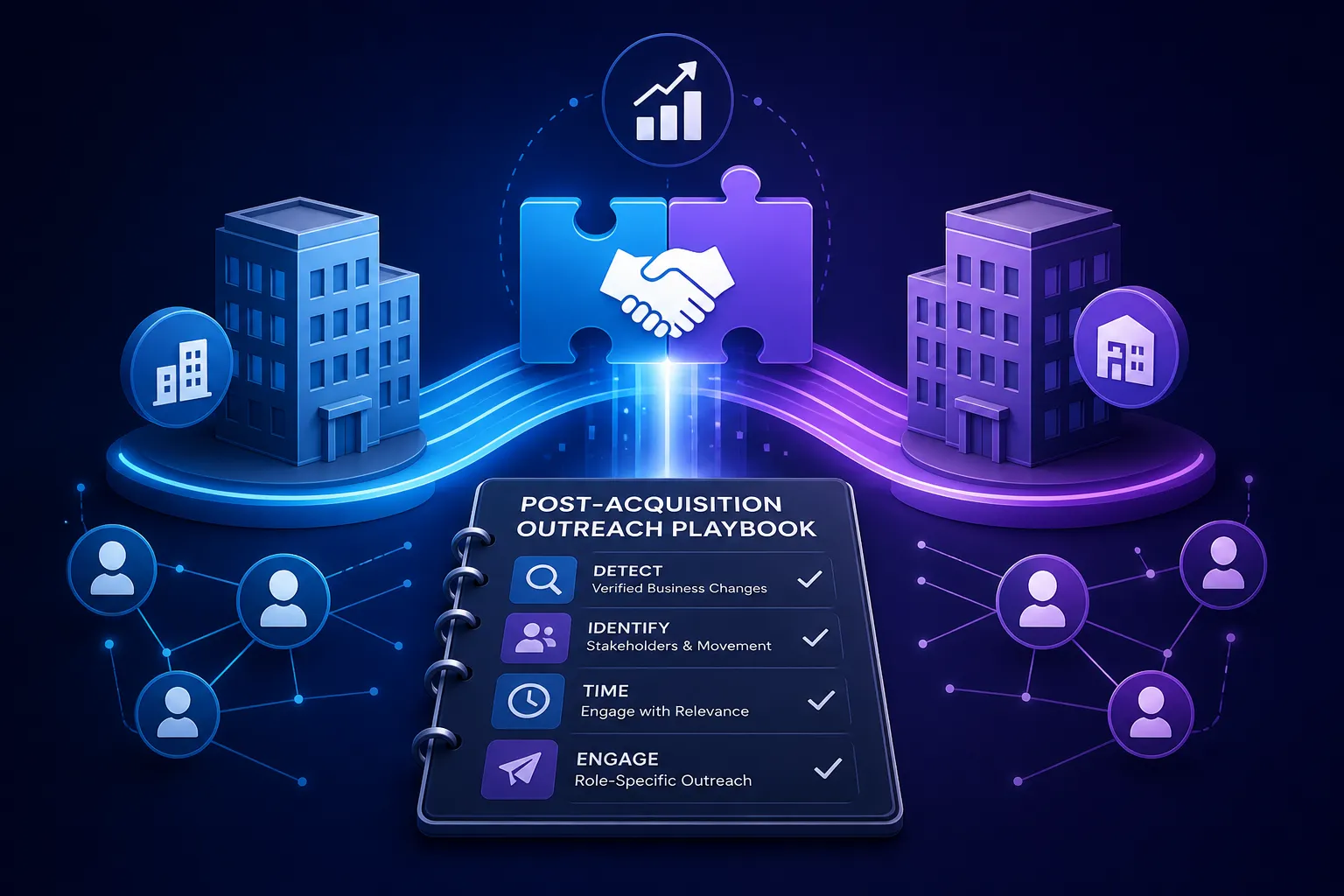
A trigger event playbook for commercial insurance lead generation strategies should monitor for:
• Hiring surges or workforce growth.
• Acquisitions, funding rounds, or ownership changes.
• Geographic expansion or new facilities.
• New products, services, or market entries.
• Leadership changes.
• Regulatory developments.
• Public incidents or industry-wide risk events.
Remember: a trigger is not proof that a company is actively reviewing its insurance. It is simply a reason to research further and form a relevant question.
Build a Trigger-to-Risk Hypothesis
To connect a business signal to a potential risk conversation without overstating the prospect’s situation, use this framework:
1. Identify the public business signal: (e.g., A press release announcing a new manufacturing plant).
2. Ask which operational or financial exposures may be affected: (e.g., Property, business interruption, employee safety).
3. Identify the stakeholder most likely to understand that exposure: (e.g., The Operations Leader or Risk Manager).
4. Prepare a useful observation or question: (e.g., "Noticed the expansion into Texas. How is your team managing the supply chain continuity risks associated with the new facility?")
5. Validate the assumption during conversation: Present your hypothesis as a question to validate, not as an unverified claim.
Avoid presenting assumptions as facts or implying knowledge of confidential risk information. Your goal is to spark a dialogue, not to audit their policies via LinkedIn messages.
Use Content Before Direct Outreach
Before sending a direct message, publish educational content to create familiarity and demonstrate expertise. B2B insurance marketing content should cover:
• Emerging commercial risks and coverage gaps.
• Claims lessons and prevention strategies.
• Regulatory changes affecting specific industries.
• Business continuity planning.
• Cyber, supply-chain, and workforce risk.
Original broker insight and practical examples will always outperform generic, AI-generated insurance commentary. Quality content acts as commercial insurance referral marketing, warming up your prospects before you ever send a connection request.
Build a Trust-Based LinkedIn Outreach Workflow
Moving from account research to a permission-based conversation requires a disciplined, step-by-step process. Using a platform like ScaliQ can help organize structured account research and seamlessly transition from prospect intelligence to qualified conversations.
The workflow is as follows:
1. Select and prioritize the target account.
2. Map relevant stakeholders.
3. Review public business and professional information.
4. Identify a timely trigger or relevant risk theme.
5. Engage with their useful content where appropriate.
6. Send a concise, personalized connection request.
7. Follow up with an insight or question—not an immediate product pitch.
8. Qualify interest before proposing a meeting.
9. Record the interaction and next step.
The goal is to secure a qualified commercial conversation, not to maximize the number of connection requests sent.
Position the Broker Profile for Corporate Buyers
A corporate insurance buyer should immediately understand four things from your LinkedIn profile:
• Who you help.
• Which industries or risk areas you understand.
• What types of business problems you discuss.
• What evidence supports your expertise.
Use clear, professional language suited for CFO, risk, operations, and HR audiences. Prove your expertise through relevant experience, anonymized case examples, educational content, and transparent limitations.
Write Persona-Specific Connection Requests
Your commercial insurance prospecting scripts must be highly tailored. The connection request should reference a relevant business context without pretending to know the prospect’s insurance situation. Avoid exaggerated claims, generic flattery, attachments, and immediate meeting requests.
• For a CFO: Reference growth, cost predictability, or financial resilience.
• For a Risk Manager: Mention exposure visibility or program complexity.
• For an Operations Leader: Focus on facilities, continuity, or supply-chain risk.
• For an HR Leader: Highlight benefits administration or workforce risk.
Follow Up With Insight and Permission
Design a short follow-up sequence based on relevance and timing rather than message volume. Offer value before asking for time.
Adaptable Example (For Broker Review): "Hi [Name], following up on my previous note. When companies expand their footprint like [Company] recently did, we often see new complexities in business interruption planning. Is this something your team is currently reviewing, or is it handled by another department?"
Offer a concise risk checklist, a relevant claims question, an industry-specific observation, or a useful article. If the prospect does not respond, send a respectful close-the-loop message. Always honor opt-outs, objections, and requests not to be contacted to maintain LinkedIn outreach compliance.
Use Technology Without Replacing Human Judgment
Technology aids in prioritization, enrichment, workflow consistency, and record-keeping, but it should never independently make sensitive assumptions or send unchecked messages.
While generic database and sequencing tools (like Apollo, ZoomInfo, or Expandi) focus on high-volume, automated outreach, a risk-focused workflow—such as the one supported by ScaliQ—prioritizes insurance-specific qualification, human validation, compliance awareness, and relationship-led communication. AI-assisted prospecting is a tool to enhance your research, not a replacement for your professional judgment.
Qualify Corporate Insurance Leads Before Booking a Meeting
A LinkedIn connection, profile view, or content like is not automatically a qualified lead. Before booking a meeting, you must qualify the prospect based on fit, relevance, timing, authority, and their willingness to continue the conversation.
Create an Insurance-Specific Lead-Scoring Model
Define your qualification criteria before outreach so that mere activity is not confused with pipeline quality. Score accounts and contacts across:
• Firmographic fit (industry, size, revenue).
• Industry and risk complexity.
• Presence of a relevant business trigger.
• Stakeholder influence or buying authority.
• Engagement with relevant content.
• Stated timing or renewal context.
• Ability to reach a meaningful next step.
Insurance lead scoring supports prioritization; it does not produce false certainty. Record the evidence behind each score and update it as new information emerges.
Ask Better Discovery Questions
During initial conversations, use open-ended discovery questions to explore their risk landscape rather than leading them toward a predetermined product. Ask:
• How does the company currently review its insurance program?
• Which recent business changes have altered your risk profile?
• Who actively participates in insurance decisions?
• Do upcoming renewals, expansions, or contract requirements create a timing factor?
• Which exposures or claims concerns currently receive the most attention from leadership?
Recognize Low-Fit or High-Risk Situations
Knowing when to pause or disqualify outreach is vital for maintaining your reputation and compliance. Disqualify or pause when:
• The contact has no relevant role or influence.
• The account does not fit your brokerage’s market or appetite.
• The risk hypothesis cannot be supported by public information.
• The prospect has explicitly asked not to be contacted.
• The message would require sensitive, unverified, or legally protected information.
Document the reason for pausing and, where appropriate, place the account into a compliant nurture or referral path.
Measure LinkedIn Prospecting Through Pipeline Outcomes
Connection counts, impressions, and response rates are insufficient metrics for commercial insurance prospecting. To understand your true LinkedIn lead-generation ROI, you must connect activity to qualified commercial opportunities and revenue contribution.
Use a Practical Prospecting Dashboard
Build a funnel and track your metrics using a practical prospecting dashboard. Your tracking table should include:
• Account and industry.
• Contact role and buying influence.
• Trigger event identified.
• Risk hypothesis used.
• Outreach date and channel.
• Response status.
• Qualification stage.
• Next action.
• Opportunity generated and revenue outcome.
This dashboard will expose bottlenecks. For instance, if you have strong engagement but weak qualification, your targeting may be off. If you have meetings but no opportunities, your discovery questions may need refinement.
Improve Quality Before Increasing Volume
When seeking to improve performance, test one variable at a time: persona, industry, trigger type, content theme, message structure, or follow-up timing.
A smaller, well-researched account list will consistently yield more qualified corporate insurance leads than indiscriminate, high-volume outreach. Tie your measurement back to trust, brand reputation, compliance, and long-term relationship value.
Compliance, Privacy and Reputation Controls
Responsible LinkedIn lead generation must be a central part of your workflow, not an afterthought. Public availability of information does not automatically grant unrestricted permission for every form of marketing use.
Implement a pre-send checklist covering:
• Accurate identity and professional representation.
• Relevant, truthful claims.
• Appropriate use of publicly accessible information.
• Data minimization and secure handling.
• Respect for objections and opt-outs.
• Review of message frequency and follow-up.
• Human approval of personalization and sensitive risk statements.
Follow LinkedIn Platform Requirements
All prospecting must adhere to platform rules. Review the LinkedIn User Agreement regarding account use, messaging, and applicable laws.
Brokers must strictly adhere to LinkedIn automation restrictions. Avoid prohibited software, bots, unauthorized browser extensions, or automated scraping behaviors. No automation tool is inherently compliant; compliance depends entirely on your workflow, data practices, platform rules, and applicable laws.
Review Email and Privacy Requirements Before Moving Off LinkedIn
When moving conversations off LinkedIn and into email, additional legal frameworks apply. Publicly available contact details on social media do not resolve email marketing obligations.
Ensure compliance with the FTC’s CAN-SPAM compliance guide, which mandates commercial email identification, truthful sender information, physical address inclusion, and clear opt-out mechanisms.
For brokers operating in or targeting the UK/EU, adhere to the ICO’s direct marketing guidance and PECR email marketing rules regarding lawful marketing, profiling, and handling objections.
Caveat: Brokers should always obtain jurisdiction-specific legal or compliance advice before implementing any outreach campaigns.
Case Scenarios: Applying Risk-Led Prospecting Across Industries
These anonymized scenarios demonstrate how to progress from an account signal to a persona, risk hypothesis, message angle, and qualification question. They are designed to illustrate reasoning, not to imply guaranteed outcomes.
Manufacturing Company Expanding Production
Signal: A manufacturing firm announces a new production facility and a 15% increase in hiring. Hypothesis: The expansion could strain current property limits, increase business interruption exposures, and create new workforce safety risks. Outreach Angle:
• CFO: Focus on budget predictability regarding the new facility's risk costs.
• Operations Leader: Focus on supply-chain continuity during the transition.
• Risk Manager: Focus on updating exposure visibility across multiple sites.
Qualification Question: "With the new facility coming online, how is your team evaluating the updated business interruption exposures across your expanded footprint?"
Technology Company Entering New Markets
Signal: A mid-sized software company announces expansion into the European market. Hypothesis: International expansion introduces complex regulatory environments, new contractual requirements, cyber risk variations, and executive liability concerns. Outreach Angle:
• Finance: Discuss the financial impact of multinational compliance.
• Operations/Legal: Focus on contractual risk transfer and vendor requirements.
Qualification Question: "As you expand internationally, how are you reviewing your executive liability and cyber risk programs to address new jurisdictional requirements?"
Professional Services or Healthcare Organization Growing Its Workforce
Signal: A regional healthcare network acquires two new clinics, rapidly growing its staff. Hypothesis: Growth impacts employee benefits administration, professional liability, workforce risk, and operational continuity. Outreach Angle:
• HR Leader: Discuss benefits complexity and workforce retention.
• Operations: Discuss operational continuity and patient safety protocols.
• Finance: Discuss the integration of professional liability policies.
Qualification Question: "When integrating new clinics, how does your team typically consolidate employee benefits and professional liability programs to ensure no coverage gaps?" (Note: Exercise careful language around regulated or sensitive sectors; always subject outreach to internal review).
Tools, Workflow Options and Practical Resources
A successful commercial insurance lead generation strategy relies on a disciplined operating stack, not just software selection. A basic operating stack consists of:
• LinkedIn research and account monitoring (utilizing native saved searches and alerts).
• A documented account and contact list.
• Content planning tools.
• Lead qualification fields.
• CRM or pipeline tracking.
• Compliance review and approval steps.
While native LinkedIn capabilities support account discovery, platform rules must be verified before implementation. A broker-led method centered on risk interpretation and human validation will always outperform broad prospecting databases or fully automated CRM-led workflows. For brokers looking to refine their research and operational workflows, RepliQ can serve as an additional resource for organizing prospect data responsibly and effectively.
One-Page Corporate Insurance Prospecting Checklist
Before sending any outreach, verify:
1. Account fit confirmed against ICP.
2. Relevant stakeholder(s) mapped and identified.
3. Business trigger documented.
4. Risk hypothesis written as a question to be validated.
5. Broker profile and recent content reviewed for relevance.
6. Message personalized, fact-checked, and concise.
7. Compliance considerations (platform rules, privacy laws) reviewed.
8. Follow-up sequence and opt-out handling defined.
9. CRM stage and next action recorded.
Suggested Content Assets for Continued Prospecting
Repurpose the concepts in this article into practical assets for your brokerage:
1. A CFO outreach checklist.
2. A risk-manager trigger-event playbook.
3. A LinkedIn message template pack (adaptable examples only).
4. A corporate insurance lead-scoring worksheet.
5. A compliance review checklist.
6. A short video explaining risk-led prospecting to your sales team.
7. A social post comparing activity metrics (connections) with pipeline metrics (revenue).
Conclusion: Turn LinkedIn Activity Into Qualified Commercial Opportunities
Generating corporate insurance leads on LinkedIn requires relevance and trust—not simply connection volume or automated sequences. By defining target accounts, mapping the buying committee, identifying business triggers, creating educational content, and conducting permission-based outreach, brokers can consistently turn platform activity into qualified commercial opportunities.
The true value lies in broker expertise: interpreting business changes, asking responsible discovery questions, and guiding complex risk conversations. Audit your current LinkedIn workflow today using the account, persona, compliance, and measurement checklists provided above.
To explore a broader approach to structured prospecting and workflow organization, ScaliQ offers practical, risk-focused frameworks designed specifically for commercial insurance professionals to streamline their pipeline generation responsibly.