

How AI Can Clean Your LinkedIn Pipeline Automatically (No CRM Needed)
For many sales professionals and solopreneurs, the LinkedIn inbox is where opportunities go to die. You have a dozen conversations happening simultaneously, but without a rigorous system, that "warm" lead from Tuesday gets buried under spam by Friday. The mental load of remembering who to follow up with—and when—eventually causes the pipeline to break.
Traditional advice suggests connecting a CRM to manage this chaos. But for small teams and agile founders, CRMs often add friction rather than flow. They require manual data entry, constant syncing, and tab-switching that kills momentum.
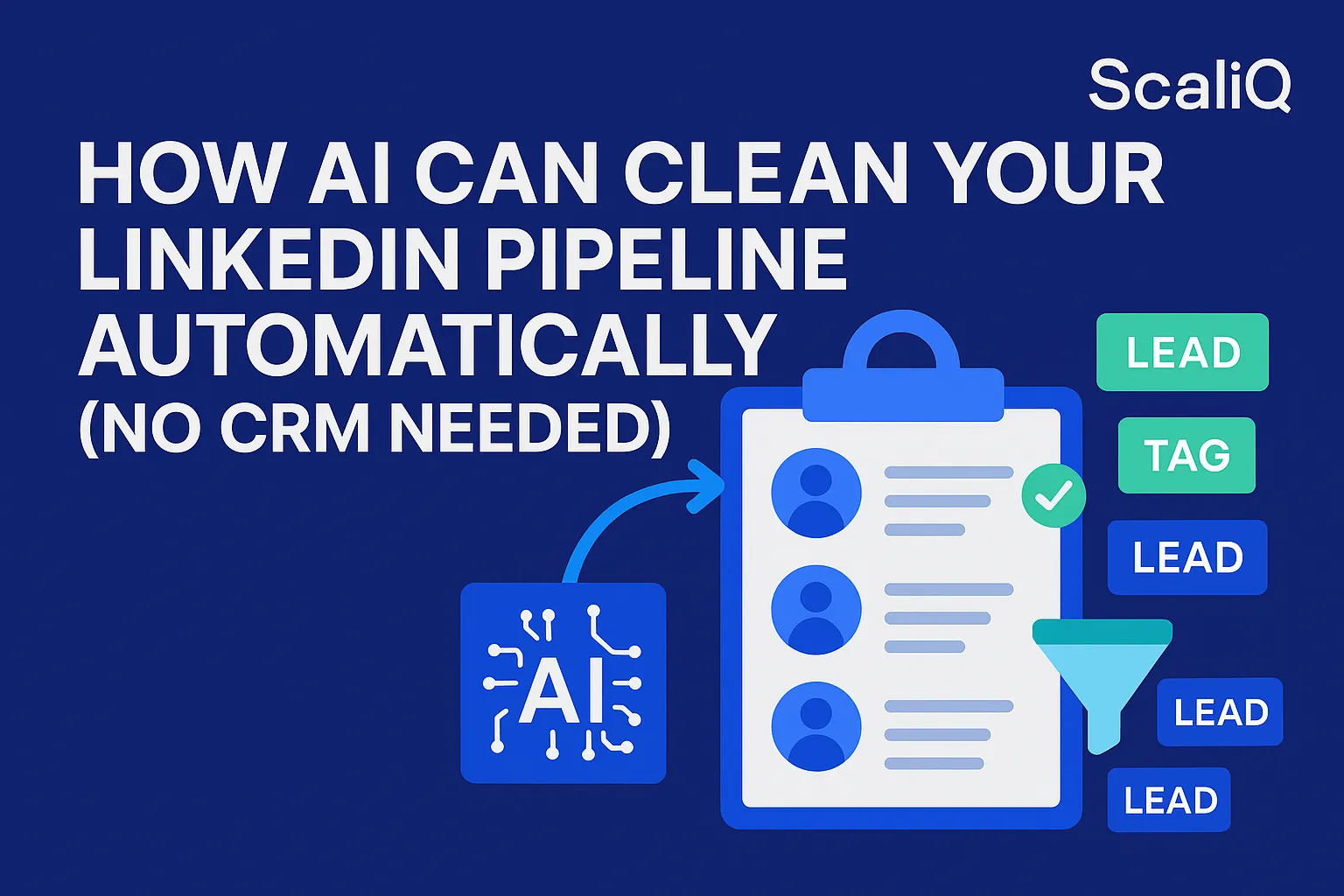
There is a better way. By leveraging linkedin pipeline ai and advanced automation, you can now tag, sort, and qualify leads directly within the platform—no external CRM required. This article explores how ai sales pipeline management is evolving to offer a "zero-admin" workflow, utilizing tools like ScaliQ’s proprietary tagging models to keep your pipeline pristine automatically.
Why LinkedIn Pipelines Break Without Automation
To understand the solution, we must first diagnose why the manual approach fails. The breakdown isn't usually due to a lack of effort; it is a structural failure of trying to manage dynamic conversations with static, manual tools.
The Hidden Cost of Manual Tagging and Lead Tracking
The primary culprit of a disorganized linkedin pipeline is the reliance on human memory and manual tagging. When you are managing 50+ active conversations, the cognitive load required to categorize each prospect becomes unsustainable.
You might mentally tag a prospect as "interested," but if you don't write it down immediately or update a spreadsheet, that context is lost the moment a new message arrives. This creates a "leaky bucket" where high-potential leads slip through simply because they weren't labeled correctly in the moment. The manual linkedin tagging problem results in inconsistency; some leads are tracked perfectly, while others vanish, leading to unpredictable revenue revenue.
Why Traditional CRMs Fail LinkedIn-First Workflows
For many, the knee-jerk reaction to chaos is to buy a CRM. However, traditional CRMs are often fundamentally mismatched with the speed of social selling. They are built for static records, not fluid conversations.
Using a CRM requires you to constantly move data from LinkedIn to an external database. This introduces "administrative overhead"—the time spent clicking, copying, and pasting instead of selling. For a crm alternative for linkedin prospecting, you need a system that works where you work. Competitors like Pipedrive or complex integrations often force you out of the LinkedIn environment, breaking your flow and turning prospecting into a data-entry job. True linkedin crm automation should eliminate this friction, not add to it.
Message Overload and Losing Warm Prospects
When you succeed at outreach, you are punished with message overload. An inbox flooded with responses—ranging from "not interested" to "let's book a call"—becomes impossible to visually scan.
In this noise, warm prospects fall through the cracks. A prospect might ask a specific question that signals intent, but if that message is buried under ten automated sales pitches from others, you miss the window of opportunity. Learning how to clean linkedin pipeline data effectively is not just about organization; it is about revenue preservation.
Read more about common LinkedIn pipeline challenges and how to solve them
How AI Tagging and Lead Sorting Actually Works
The shift from manual chaos to automated order is powered by intelligent algorithms. This isn't just about keyword matching; it involves sophisticated analysis of conversation context.
AI-Powered Auto-Tagging of LinkedIn Conversations
Modern linkedin lead qualification ai uses Natural Language Processing (NLP) to read and understand the sentiment and context of your messages. Instead of you manually applying a label, the AI analyzes the prospect's reply.
If a prospect says, "Send me more info on pricing," the AI recognizes this as a progression signal. It can automatically apply tags like "Warm," "Information Requested," or "Qualified." ScaliQ utilizes proprietary tagging models specifically trained on B2B LinkedIn conversations to ensure high fidelity in these categorizations. This creates an ai tool to auto tag linkedin leads that works in the background, ensuring no conversation is ever left undefined.
Note on Responsible AI: When implementing these automated systems, it is crucial to adhere to trustworthy standards. We align our approach with the NIST Artificial Intelligence research and guidelines to ensure automation is deployed responsibly and transparently.
Automated Lead Sorting: Turning Chaos Into a Clean Pipeline
Once a lead is tagged, linkedin pipeline ai takes the next step: sorting. Imagine logging into LinkedIn and seeing your inbox already organized into folders or stages: "New Leads," "Negotiation," "Follow-Up Due," and "Closed."
This automated sorting transforms a linear list of messages into a functional Kanban-style view. You no longer have to scroll past 20 irrelevant messages to find the three that matter. This is the core of automated linkedin prospecting—the system prioritizes your attention for you, presenting the most critical conversations at the top of the stack.
Intent Detection and Behavior-Based Qualification
Beyond simple tagging, advanced ai sales pipeline management involves intent detection. AI models can evaluate criteria such as response speed, message length, and specific vocabulary to gauge buying intent.
For example, a prospect asking about "implementation time" shows higher intent than one asking "what do you do?" Domain-trained models can distinguish these nuances with increasing accuracy. This behavior-based qualification ensures you focus your energy on leads that are actually ready to buy.
Risk Management: To ensure these decision models remain accurate and unbiased, it is best practice to follow the NIST AI RMF Manage guidance, which provides a framework for managing risks associated with AI systems.
CRM-Free Pipeline Management for Solopreneurs and Small Teams
The ultimate goal of this technology is to liberate small teams from the heavy lifting of enterprise software. You can achieve a sophisticated sales operation without the bloat.
A Centralized Pipeline View Without the CRM Overhead
A crm-free linkedin workflow centralizes your operations directly within the interface you use daily. By overlaying pipeline stages onto your LinkedIn inbox, you remove the need to toggle between tabs.
For solopreneurs, this is a game-changer. It provides the structure of a CRM—knowing exactly where every deal stands—without the maintenance costs or setup time. It effectively acts as a crm alternative for linkedin prospecting, keeping all data contextual and accessible immediately.
Zero-Maintenance Sales Workflow
The concept of "zero-maintenance" means the pipeline refreshes itself. When a prospect replies, the status updates. When you send a proposal, the stage shifts.
Unlike traditional linkedin crm automation that might require Zapier zaps or manual field updates, a native AI solution handles the housekeeping. This allows sales professionals to enter a "flow state," focusing entirely on communication and strategy rather than administration.
How ScaliQ Replaces CRM Tagging Entirely
ScaliQ’s approach to ai linkedin tagging is designed to replace the CRM structure entirely for the prospecting phase. By using a proprietary model trained specifically on LinkedIn messaging dynamics, ScaliQ identifies context that generic CRM integrations miss.
While other tools simply sync data to a third-party platform, ScaliQ keeps the intelligence layer on top of LinkedIn. This ensures that your linkedin pipeline ai is always in sync with reality.
Standardization: Reliability is key in replacing established tools. Adhering to NIST AI standards helps ensure that these proprietary models provide the consistency and structure businesses require to trust them as a primary system.
Real Outcomes: Cleaner Pipelines and Faster Qualification
The theory of automation is appealing, but the real-world impact on sales velocity is where the value lies.
Before/After: What a Clean Pipeline Looks Like
Before: You open LinkedIn to see 15 unread messages. You feel anxiety because you know three of them are important, but you have to click through spam and polite rejections to find them. You spend 20 minutes just figuring out who to reply to.
After: You open a dashboard where leads are already sorted. The "High Priority" view contains only the three prospects who asked for pricing. The spam is filtered out. You reply to the high-value leads in 5 minutes. This is how to automate linkedin pipeline with ai effectively.
Time Savings and Sales Velocity Improvements
By removing manual tagging and sorting, users often save 5 to 10 hours per week. However, the greater benefit is sales velocity.
With ai sales pipeline management, the time between a prospect's signal of interest and your response is drastically reduced. In sales, speed is often the differentiator. Automated qualification ensures that warm leads are engaged while they are still thinking about your solution, increasing conversion rates.
Case Snapshots (Solopreneur, Agency, Recruiter)
• The Solopreneur: A founder used linkedin lead sorting tools to filter out 80% of noise, allowing them to handle 3x the volume of outreach without hiring an SDR.
• The Agency: An agency owner replaced their complex HubSpot sync with direct AI tagging, eliminating data entry errors that were causing missed follow-ups.
• The Recruiter: By automating candidate sorting based on response intent, a recruiter reduced time-to-interview by 40%.
Efficiency Metrics: These workflows align with insights from the NIST Industrial AI program, which studies how AI management can optimize industrial and business process efficiency.
Why a CRM-Free Pipeline Outperforms Traditional CRM Setups
A crm alternative for linkedin prospecting that lives natively in the browser is faster and simpler. Traditional setups suffer from data latency and interface fatigue. A native AI pipeline offers immediacy. For micro-teams and founders, agility beats complexity every time.
Tools & Resources for Building an Automated LinkedIn Pipeline
To build this system, you need the right components: a robust tagging model, intelligent sorting logic, and intent detection capabilities.
ScaliQ offers a purpose-built solution that integrates these elements into a single linkedin crm automation layer. Rather than piecing together disparate extensions, ScaliQ provides the proprietary AI infrastructure needed to clean and manage the pipeline automatically.
For those interested in the theoretical underpinnings of how AI systems organize and retrieve complex information, research into organizational memory and AI highlights the potential for these systems to retain context far better than human memory alone.
Future Trends & Expert Predictions
The landscape of linkedin sales automation is moving toward total invisibility. We predict the rise of the "Unified Inbox," where AI not only sorts messages but drafts context-aware responses based on previous interactions across different channels.
We also foresee a surge in ai prospecting tools designed specifically for micro-teams that completely bypass the need for legacy CRMs like Salesforce. As intent detection models become more sophisticated, they will begin to predict "churn risk" or "upsell opportunity" based on subtle shifts in conversation tone, offering a level of intelligence that manual tracking could never achieve.
Conclusion
The days of manually tagging leads and wrestling with clunky CRMs are numbered. By embracing a linkedin pipeline ai, you can reclaim the hours lost to administration and focus on what actually drives revenue: building relationships.
A crm-free linkedin workflow offers a clean inbox, zero admin burden, and significantly faster lead qualification. It is the leanest, most efficient way to manage a modern sales process.
If you are ready to stop drowning in DMs and start closing more deals, it is time to let AI handle the heavy lifting. Explore how ScaliQ’s domain-trained models can transform your chaotic inbox into a streamlined revenue engine.