

ScaliQ vs Manual LinkedIn Prospecting: What You Actually Gain (With Data)
For the average Sales Development Representative (SDR), manual LinkedIn prospecting is a daily grind that consumes 2–3 hours of prime selling time. It involves endless tab-switching, copy-pasting, and spreadsheet management, often resulting in inconsistent replies and unpredictable outcomes.
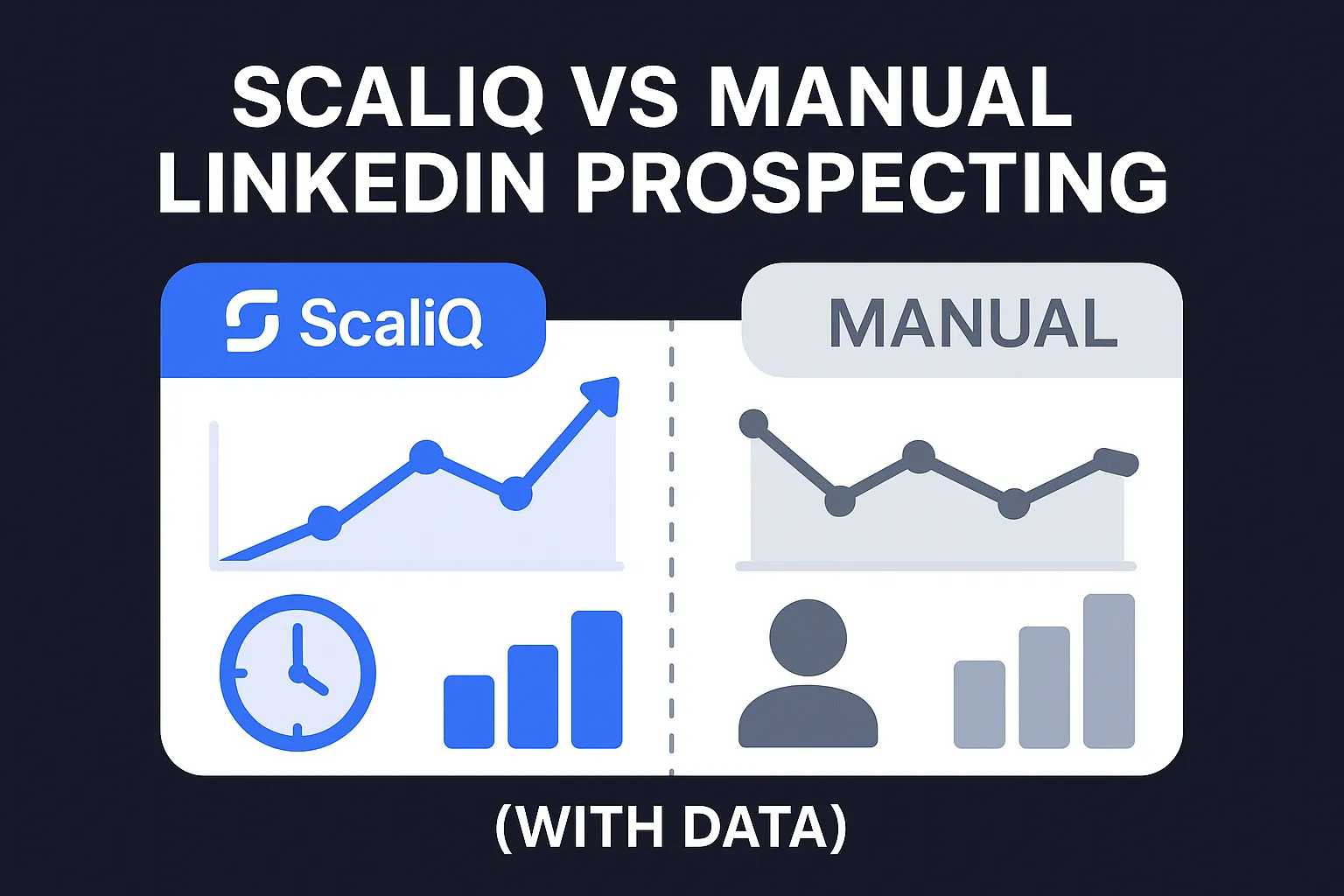
Sales leaders and SDRs face a critical choice: continue the manual slog or embrace data-driven automation. This article provides a transparent, performance-based comparison of ScaliQ vs manual LinkedIn prospecting. We move beyond the buzzwords to analyze timing, reply patterns, and efficiency data, offering a clear ROI model to help you decide when automation wins—and when human intervention is non-negotiable.
Why Manual LinkedIn Prospecting Breaks Down
To understand the value of automation, we must first dissect the friction points of the manual workflow. A typical manual prospecting session involves identifying a prospect, reviewing their profile, sending a connection request, logging the activity in a CRM, setting a reminder for a follow-up, and then repeating this process dozens of times daily.
While this approach feels "hands-on," it suffers from severe scalability issues:
• Slow Processes: Manually navigating profiles and typing messages limits an SDR to a low volume of outreach per day.
• Inconsistent Follow-Ups: The biggest killer of conversion is the lack of follow-up. In a manual workflow, if a spreadsheet isn't updated or a reminder is missed, that lead is lost forever.
• Limited Daily Output: Even the most diligent SDR hits a ceiling. Maintaining high-quality manual outreach for hours leads to decision fatigue.
• No Data Visibility: Manual prospectors rarely track "reply timing" or "acceptance rates" systematically. They operate on gut feeling rather than data.
As volume increases, human error spikes. Burnout becomes a tangible risk as SDRs spend more time on data entry than on actual selling. While some argue that manual work ensures quality, the reality is often a trade-off: you get high customization but at a volume so low it fails to generate a predictable pipeline.
This is where ScaliQ steps in as a data-driven alternative, shifting the focus from manual repetition to strategic oversight.
What ScaliQ Automates and How It Improves Consistency
ScaliQ is not just about sending messages faster; it is about regulating the consistency and intelligence of the outreach process. It automates the heavy lifting of timing, sequencing, and follow-up management, ensuring that no prospect slips through the cracks due to human forgetfulness.
The Power of Automated Consistency
Unlike a human who might forget to send a follow-up on day three, ScaliQ executes sequences with machine-like precision. It removes the inconsistencies inherent to manual work, such as timing gaps or emotional hesitation after a non-response.
Safety and Structured Workflows
Generic automation tools often prioritize speed over safety, leading to account restrictions. ScaliQ differentiates itself through safety-first features that mimic human behavior patterns, ensuring compliance with platform terms.
Behavioral Intelligence
Beyond simple scheduling, ScaliQ leverages transparency features like analytics dashboards and reply-pattern insights. It helps teams understand not just who replied, but why and when.
Research into automated sales prioritization highlights the importance of data in decision-making. According to an academic study on automated sales prioritization, leveraging algorithmic sorting and timing can significantly outperform random or intuition-based manual selection. ScaliQ applies similar principles to ensure outreach lands when it is most likely to be seen.
Data and Performance Comparison: Manual vs ScaliQ
When we strip away the marketing language and look at the metrics, the differences between manual and automated workflows become stark.
Output & Speed Differences
The most immediate impact is volume. An SDR performing manual LinkedIn prospecting might effectively process 20–30 new prospects a day before quality degrades. In contrast, ScaliQ can safely maintain a consistent volume of outreach that is 3–5x higher than manual benchmarks, handling the administrative burden of connection requests and follow-ups in the background.
This difference in data-driven outreach performance allows SDRs to wake up to booked meetings rather than a to-do list of connection requests.
Reply Timing & Consistency
Manual prospectors send messages when they are working—usually 9 AM to 5 PM in their local time zone. This often mismatches with when a prospect is active.
ScaliQ utilizes optimized send timing based on data insights. By analyzing reply-pattern insights, the platform can execute steps at times that maximize visibility, a feat that manual workflows cannot replicate at scale without SDRs working around the clock.
Follow-Up Accuracy & Message Quality
The drop-off rate in manual follow-ups is massive. Most manual prospectors stop after one or two unreplied messages. ScaliQ ensures the full sequence is delivered.
Furthermore, message quality is often assumed to be higher in manual outreach, but fatigue leads to typos and generic "just checking in" messages. Automation ensures the script is followed perfectly every time. Recent research into LinkedIn profile success suggests that consistent, professional attributes in communication significantly impact connection acceptance, reinforcing the need for the standardized quality control that automation provides.
Cost, Time, and ROI Implications for SDR Teams
For sales leaders, the decision often comes down to the bottom line. How does the cost of a tool compare to the cost of human labor?
Time Saved Daily
If manual outreach takes 2–3 hours per day, that is 10–15 hours per week per SDR. In a month, an SDR spends roughly 60 hours just clicking buttons—time that could be spent on discovery calls, closing, or strategic account research.
Cost per Meeting & Efficiency Modelling
When you factor in the hourly wage of an SDR, the cost of manual prospecting is astronomical.
• Manual Model: High labor cost + Low volume + Inconsistent conversion = High Cost Per Meeting.
• ScaliQ Model: Fixed subscription cost + High volume + Predictable conversion = Lower Cost Per Meeting.
By stabilizing the inputs (volume and timing), ScaliQ creates a predictable ROI model where teams can forecast pipeline based on active sequences.
Burnout & Workflow Stability
SDR burnout is a real threat to revenue stability. repetitive, low-value tasks are a primary driver of turnover. By offloading the "grind" to ScaliQ, teams create a healthier workflow where humans focus on high-value interactions.
However, automation handles the delivery, not necessarily the creative personalization. For teams looking to layer hyper-personalization on top of their automation, we recommend exploring workflows discussed on the Repliq blog, which details how to blend automated delivery with personalized content.
When Manual Steps Still Matter
While ScaliQ outperforms manual work in volume, consistency, and data tracking, there are specific scenarios where manual prospecting strengths are undeniable.
Strategic Targeting for Tier 1 Accounts
For your absolute highest-value prospects (the "whales"), a fully automated approach may not suffice. These prospects require deep research—listening to their podcasts, reading their 10-K reports, and referencing specific LinkedIn comments.
Human-First Conversations
Automation is excellent for opening the door, but a human must walk through it. Once a prospect replies, automation should stop, and the SDR must take over to manage the nuance of the conversation.
Credibility and Trust
A study on LinkedIn credential impact indicates that the perceived credibility of a profile heavily influences interaction rates. While automation handles the sending, the profile itself—and the eventual human response—must be authentic and high-quality. The best workflow is a "human-in-the-loop" system: ScaliQ handles the outreach, and the SDR handles the relationship.
Conclusion
The debate of ScaliQ vs manual LinkedIn prospecting is not about replacing humans; it is about optimizing where humans spend their energy. Manual prospecting is inherently slow, inconsistent, and data-poor. ScaliQ offers a predictable, scalable, and data-backed alternative that frees SDRs from administrative drudgery.
By leveraging analytics-driven insights rather than relying on volume hype, sales teams can build a pipeline that is resilient and efficient. If you are ready to stop clicking buttons and start closing deals, it is time to trial ScaliQ and experience transparent, measurable outreach improvements.