

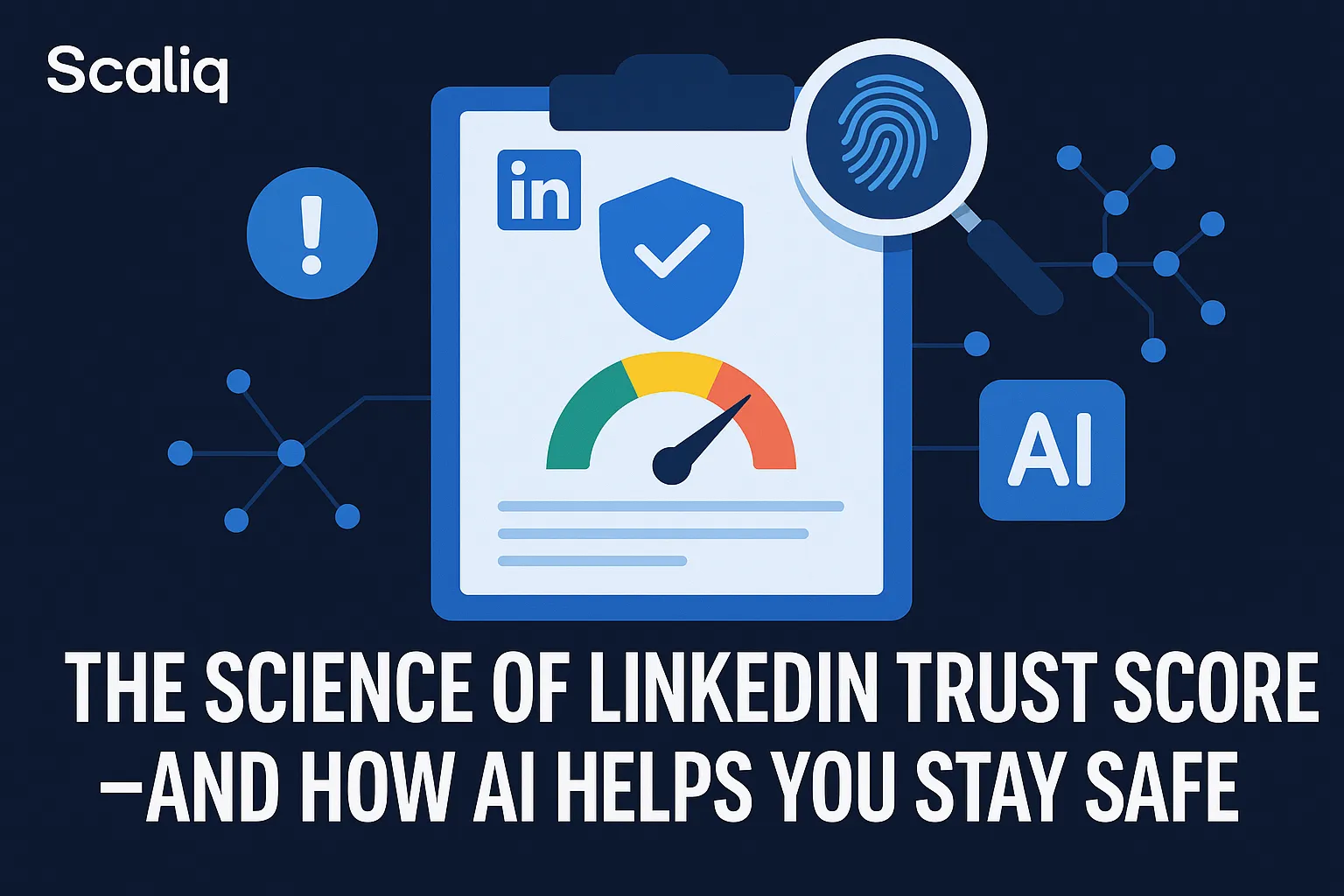
The Science of LinkedIn Trust Score — And How AI Helps You Stay Safe
Every action you take on LinkedIn—every connection request, profile view, and message—is silently evaluated. While you focus on networking and outreach, LinkedIn’s backend algorithms are continuously calculating a hidden metric: your account’s Trust Score. This invisible number dictates your visibility, your connection acceptance rates, and ultimately, whether your account remains active or faces restriction.
Most users only realize this score exists when it is too late—when they hit a "weekly invitation limit" or receive a sudden identity verification challenge. However, by taking a forensic, technical approach to understanding LinkedIn’s behavioral and metadata-level detection systems, it is possible to maintain a high-integrity account even while scaling your professional presence.
This article provides a deep dive into the signals LinkedIn monitors, how the trust score decays based on specific triggers, and how advanced AI models can predict risk before a restriction occurs. Drawing from ScaliQ’s experience in preventing blocks across thousands of accounts using behavioral anomaly models, we will expose the science of staying safe.
The Behavioral and Technical Signals That Trigger Restrictions
Unlike basic automation tools that simply count how many messages you send, LinkedIn’s defense systems employ forensic analysis. They look for patterns that are statistically impossible or highly improbable for a human to generate.
Competitors in the automation space often ignore these deeper signals, focusing only on "limits." However, true safety requires managing the entire digital footprint, from network graph anomalies to message similarity scoring.
Behavioral Velocity Signals
Velocity refers to the speed and volume of actions over time. LinkedIn monitors:
• Burst Velocity: Sending 20 connection requests in 2 minutes.
• Sustained Velocity: Sending requests for 12 hours straight without a break.
Human behavior is bursty but erratic. We might send five requests, read a post, send two more, and then leave for lunch. Machines tend to operate linearly. Sudden spikes in velocity—such as going from 0 profile views a day to 500—cause immediate trust score decay.
Session Fingerprinting & Environment Integrity
Every time you log in, LinkedIn fingerprints your session. They look at your IP address, device type, timezone, and WebRTC leaks.
Red-Flag Fingerprints include:
• Inconsistent Timezones: An IP address in New York but a system time set to London.
• Datacenter IPs: accessing LinkedIn from a known cloud hosting provider (AWS, Azure) rather than a residential ISP.
• Rotating Proxies: An IP address that changes with every request during a single session.
According to the NIST Digital Identity Risk Management guidelines, distinct device markers are critical for establishing assurance levels. If your digital fingerprint drifts too wildly between sessions, LinkedIn assumes account compromise or bot activity.
AI-Generated Messaging & Similarity Detection
LinkedIn is increasingly deploying Natural Language Processing (NLP) to detect AI-generated or templated content. If you send 100 messages that are 95% identical, or if your messages share the distinct syntactic structure of raw GPT-4 output without humanization, your "Spam Probabilty" score rises.
The platform uses Locality Sensitive Hashing (LSH) to group similar messages. To stay safe, outreach must be highly personalized and varied.
For deeper insights into crafting undetectable messages and avoiding NLP triggers, read our guide on safe messaging strategies.
Network Graph Anomalies
LinkedIn evaluates who you are connecting with. This is known as graph analysis. A healthy network grows organically—you connect with people in your industry, your city, or your alumni network.
Suspicious Graph Patterns:
• Cluster Hopping: Suddenly connecting with 50 people in a completely unrelated industry or geography.
• Low-Affinity Connecting: Sending requests to users with whom you share zero mutual connections (2nd or 3rd degree).
A Social bot detection study (arXiv) highlights that malicious accounts often have "star-shaped" networks (many outgoing links, few incoming, low clustering coefficient), whereas real users have "mesh" networks (mutual friends).
Safe Activity Thresholds and Automation Footprint Reduction
Safety is not just about doing less; it is about doing better. To scale activity without triggering alarms, you must adhere to quantitative bounds that mimic high-performing human users.
ScaliQ’s thresholds differ from generic competitor lists because they are built from real-time anomaly data, not arbitrary guesses.
Evidence-Based Daily and Weekly Limits
While every account varies based on age and Trust Score, observed safe patterns generally fall into these ranges for warmed-up accounts:
• Connection Requests: 20–35 per day (focusing on high acceptance rates).
• Messages: 60–80 per day (spread across existing connections).
• Profile Views: 80–120 per day (mimicking research behavior).
Crucial Adjustment: New accounts (under 6 months) or those with low Trust Scores must operate at 30–50% of these limits. Account reputation takes weeks to build but days to destroy.
Reducing Your Automation Footprint
To minimize detection, you must reduce your "automation footprint." This involves:
1. Randomized Delays: Never use fixed intervals (e.g., exactly 60 seconds between actions). Use specific distributions (e.g., 45s to 180s).
2. Micro-Breaks: Program pauses that simulate distraction (e.g., a 15-minute pause after 10 actions).
3. Humanized Navigation: Tools like Skylead or We-Connect often jump directly to profile URLs. A human user searches, clicks a list, scrolls, and then clicks the profile.
Session Integrity Best Practices
Maintaining a stable environment is as important as the activity itself.
• Use Static Residential IPs: Ensure your IP address looks like a home connection, not a server.
• Device Consistency: Do not log in from five different devices in one week.
• Cookies/Cache Management: Retain cookies to show session continuity.
Referencing NIST AI Security and Resilience frameworks, secure AI-assisted environments must maintain provenance. This means the "chain of custody" for your session (IP, Device, Browser) must remain unbroken to prove identity validity.
How AI Predicts Trust Score Decay Before LinkedIn Flags You
The future of account safety is predictive, not reactive. Most tools tell you after you have been restricted. ScaliQ uses AI to predict trust score decay before LinkedIn takes action.
By modeling behavioral anomalies and graph health scores, we can identify when an account is entering the "danger zone" (Tier 2 Throttling) and automatically pause activity.
Detecting Weak-Signal Anomalies
Humans cannot see micro-anomalies, but Machine Learning can. ScaliQ monitors:
• Velocity Derivatives: The rate of change in your activity speed.
• Latency Shifts: Changes in how quickly LinkedIn’s server responds to your requests (slower responses often indicate throttling).
• Fingerprint Micro-Shifts: Slight variations in browser rendering that might signal a leaky proxy.
These weak signals are the precursors to a trust score drop.
Predicting Restriction Probability
Using risk scoring models, we calculate the probability of a restriction occurring in the next 24 hours. This involves:
• Threshold Breach Prediction: Analyzing if current velocity will trigger a limit based on historical data.
• Decay Acceleration: Identifying if recent negative interactions (ignored messages) are compounding to lower the score faster than usual.
Research into Behavioral abuse detection (arXiv) confirms that time-series analysis of user logs can predict suspension events with high accuracy before they happen.
Real ScaliQ Case Patterns
In analyzing thousands of accounts, ScaliQ has detected specific patterns that precede flags. For example, we frequently observe a subtle increase in "challenge pages" (invisible CAPTCHAs loaded in the background) days before a user notices any issue. By detecting this HTTP response pattern, ScaliQ halts activity immediately, preventing the hard restriction.
For more details on why trust scores drop even when you think you are doing everything right, visit our FAQ section.
Trust Score Recovery and Long-Term Account Protection
If your Trust Score has decayed, or if you have faced a restriction, the path back to safety requires a systematic protocol. Simply "waiting it out" is rarely enough; you must actively rebuild reputation.
Diagnosing the Type of Trust Score Damage
Recovery begins with diagnosis. Was the damage caused by:
• Behavioral: Too many actions too fast?
• Fingerprint: A "dirty" IP address or inconsistent device?
• Content: Spammy messaging reported by users?
• Graph: Connecting with too many unrelated people?
Identifying the root cause ensures you don't repeat the error during the warm-up phase.
Recovery Protocol (Step-by-Step)
1. The Cooling Period: Cease all automation for 7–14 days. Log out of all sessions except one mobile device.
2. Environment Hardening: Switch to a high-quality static residential IP. Clear cookies and establish a fresh, clean browser fingerprint.
3. Manual Warm-Up: For days 15–21, perform only manual, high-value actions (liking posts, commenting). No connection requests.
4. Controlled Re-Activation: Resume automation at 10% of previous capacity, increasing by 5–10% weekly only if no anomalies are detected.
Long-Term Stability Through AI Monitoring
Account protection is not a one-time fix; it is a continuous process. AI monitoring acts as a "check engine light" for your LinkedIn account. Instead of waiting for a breakdown, continuous anomaly detection allows you to adjust your strategy in real-time, ensuring long-term stability and consistent lead generation.
Tools, Resources, and Recommended Workflows
To maintain a forensic level of safety, you need the right information and the right infrastructure.
Authoritative Research for Trust & Risk Systems
For those interested in the technical underpinnings of digital identity and trust scores, we recommend reviewing:
• NIST SP 800-63 (Digital Identity Guidelines): The gold standard for understanding identity assurance levels and risk.
• NIST AI 100-1 (AI Risk Management Framework): Essential for understanding how AI systems classify and manage risk.
• arXiv Computer Science Repository: Specifically, papers on Trust Networks, Sybil Attack Detection, and Social Bot Identification.
Building a Forensic LinkedIn Safety Workflow
A robust safety workflow follows this hierarchy:
1. Environment: Secure a static residential IP and a consistent browser fingerprint (using tools like GoLogin or Incogniton).
2. Behavior: Set conservative limits tailored to account age. Use randomization.
3. Messaging: distinct, personalized, and humanized content.
4. Monitoring: Use a tool like ScaliQ to monitor hidden trust signals and predict risks.
Conclusion
The "LinkedIn Trust Score" may be hidden, but it is not random. It is a sophisticated, forensic calculation based on identity, velocity, environment, and network graph health. Understanding these detection vectors is the difference between a thriving professional network and a restricted account.
While traditional automation tools focus on speed, the future belongs to safety. By leveraging AI to predict trust score decay and detect micro-anomalies, you can scale your outreach without compromising your digital identity. ScaliQ stands as the only AI-powered system capable of this predictive trust protection at scale.
Don't guess with your account safety. Explore ScaliQ’s tools, FAQs, and blog to equip yourself with the forensic insights needed to navigate LinkedIn’s ecosystem securely.