

What Makes LinkedIn Outbound Perform Better Than Email? (Data vs Myth)
For decades, cold email was the undisputed king of B2B outreach. It was scalable, inexpensive, and—for a long time—predictable. But in recent years, the landscape has shifted dramatically. Sales leaders are watching email open rates plummet while technical barriers to the inbox rise. Meanwhile, LinkedIn has quietly evolved from a networking site into the highest-performing channel for B2B engagement.
This isn’t just a feeling; it is a measurable trend backed by hard data. Outdated assumptions about email dominance no longer hold up against the reality of modern spam filters and user behavior.
In this analysis, we are moving beyond anecdotes. Drawing on insights from thousands of outbound campaigns managed and analyzed by ScaliQ, we break down exactly why LinkedIn consistently outperforms email in reply rates and engagement. We will explore the technical failures of modern email deliverability, the behavioral psychology that favors LinkedIn, and how a hybrid sequencing strategy can maximize results across both channels.
Why LinkedIn Outperforms Email in Modern Outbound
The fundamental difference between LinkedIn and email isn't just about the platform; it is about the environment in which communication occurs. Email is an open protocol often cluttered with transactional noise, newsletters, and spam. LinkedIn, conversely, is a closed ecosystem built entirely around professional identity and trust.
Modern outbound success relies on trust. When a prospect receives a cold email, they have zero context about the sender other than a signature line. On LinkedIn, the sender is a real person with a visible history, connections, and professional footprint. This identity-based environment significantly lowers the friction for a reply.
At ScaliQ, we analyze data from thousands of active campaigns to track these shifts in real-time. Our aggregated insights reveal a consistent pattern: prospects are far less frustrated by LinkedIn messages than cold emails because the context is immediate. While email suffers from "cold fatigue"—where buyers auto-delete messages from unknown domains—LinkedIn leverages a social framework where connecting is a norm, not an intrusion.
According to Pew Research on professional LinkedIn usage, the platform is viewed by users specifically as a venue for career and business advancement, creating a psychological readiness to engage that the general email inbox simply cannot replicate.
Transparency and Identity: Why Trust Is Built Differently
Trust is the currency of B2B sales. On email, trust must be earned within the first three seconds of reading a subject line—a nearly impossible feat in 2024. Identity verification on email requires manual research; the recipient has to Google you to know you are real.
On LinkedIn, identity is intrinsic to the message. Before a prospect even reads your pitch, they see your face, your headline, and your mutual connections. This transparency drastically reduces the "perceived spam" factor. A message from a verified profile with 500+ connections and relevant content activity carries a weight of credibility that a text-based email from sales@unknown-startup.com never will.
Visibility: Messages Appear Where Prospects Already Spend Time
Email inboxes are defensive environments; users go there to clear tasks, archive receipts, and delete noise. LinkedIn is a consumption environment. Users scroll the feed to learn, network, and see what their peers are doing.
This difference in "intent" is critical. LinkedIn’s notification system alerts users to messages in the same stream as their social interactions. This visibility means your message appears where prospects are voluntarily spending their time, rather than in a queue they are trying to empty. In a business-intent environment, a well-crafted outreach message is seen as an opportunity rather than an interruption.
The Technical Decline of Email Deliverability
While LinkedIn’s engagement is rising, email is facing an existential crisis regarding technical deliverability. The decline in email performance is rarely due to poor copywriting or lack of personalization; it is a structural issue with how the internet now polices communication.
Major providers like Google and Outlook have tightened their defenses significantly. With the implementation of stricter DMARC policies and increasingly aggressive spam heuristics, the "open rate" metric has become unreliable, and the "reply rate" has suffered collateral damage.
According to NIST email security guidelines and FTC CAN-SPAM compliance guidance, the requirements for legitimate bulk senders are more rigorous than ever. If your technical setup isn't perfect, your message doesn't just get ignored—it never even reaches the inbox.
Inbox Placement Crisis: Why Open Rates Are Dropping
The modern inbox is guarded by AI-driven security filters that categorize mail before the user even sees it. "Promotions" tabs, "Other" inboxes, and silent spam filtering mean that a significant percentage of B2B emails are effectively invisible.
Benchmarks across the industry are stark. Many B2B campaigns that once enjoyed double-digit engagement now struggle to achieve 1–3% reply rates. This isn't because prospects aren't interested; it is because the "deliverability tax" on cold email has become too high. If you are sending volume, you are fighting an uphill battle against algorithms designed to block you.
Domain Reputation and Warming Falloff
In the past, "warming up" an email domain was a silver bullet. You spent two weeks sending automated traffic, and then you were safe to blast. That reality is gone. Domain reputation is now volatile and evaluated in real-time.
A single day of high bounce rates or a few spam reports can tank a domain's reputation for weeks. Unlike our competitors who treat deliverability as a static checklist, we see it as a dynamic risk. Cold email fatigue is real—not just for the prospects, but for the domains themselves. The more you send, the harder it becomes to land in the primary inbox.
Why LinkedIn Avoids These Filters Entirely
LinkedIn completely sidesteps this technical minefield. There are no "spam folders" in the same sense, and there are no domain reputation scores to manage. LinkedIn’s delivery system is algorithmic, not gatekept by third-party mail servers.
If you send a message on LinkedIn, it is delivered. The only variable is whether the user accepts it, not whether a server rejects it. This 100% technical deliverability rate is a massive advantage that email simply cannot match.
Behavioral and Algorithmic Advantages of LinkedIn
Beyond the technicalities, LinkedIn wins on behavioral psychology. The platform is designed to keep users engaged, and its algorithms actively reward relevance.
Research from Harvard on algorithmic influence in communication suggests that platforms prioritizing social connection and relevance (like LinkedIn) generate higher engagement than static communication protocols (like email).
Behavioral Mechanics: Business Intent, Not Distraction
When a prospect opens their email, they are often context-switching—jumping from a client fire-drill to a newsletter to a receipt. Their cognitive load is high, and their patience is low.
When they open LinkedIn, they are in a dedicated business mindset. They are looking for industry news, talent, or partnerships. This "business intent" means they are psychologically primed to receive professional inquiries. A pitch that feels intrusive in an email inbox often feels relevant in a LinkedIn message thread because the user is already in "work mode."
Algorithmic Boost: Why Value-Based Messages Travel Further
LinkedIn’s ranking model prioritizes content based on proximity (mutual connections), relevance (industry overlap), and recency. This creates a unique "surround sound" effect for outbound.
If you engage with a prospect's content—liking a post or leaving a thoughtful comment—before sending a message, the algorithm is more likely to surface your profile to them. Your message doesn't exist in a vacuum; it is supported by your activity in the feed. This algorithmic boost allows value-based messages to travel further and land softer than a cold email ever could.
Personalization Matters More on LinkedIn
On email, personalization often feels robotic ("I saw you went to [University]"). On LinkedIn, personalization feels natural because the context is right there. Referencing a recent post, a mutual connection, or a shared group feels like genuine networking rather than data scraping. This emotional fluency increases the likelihood of a positive response.
Real Reply-Rate Comparison Using Large-Scale Data
At ScaliQ, we don't guess—we measure. Our proprietary dataset covers thousands of outbound campaigns across diverse sectors, giving us a clear view of the battlefield.
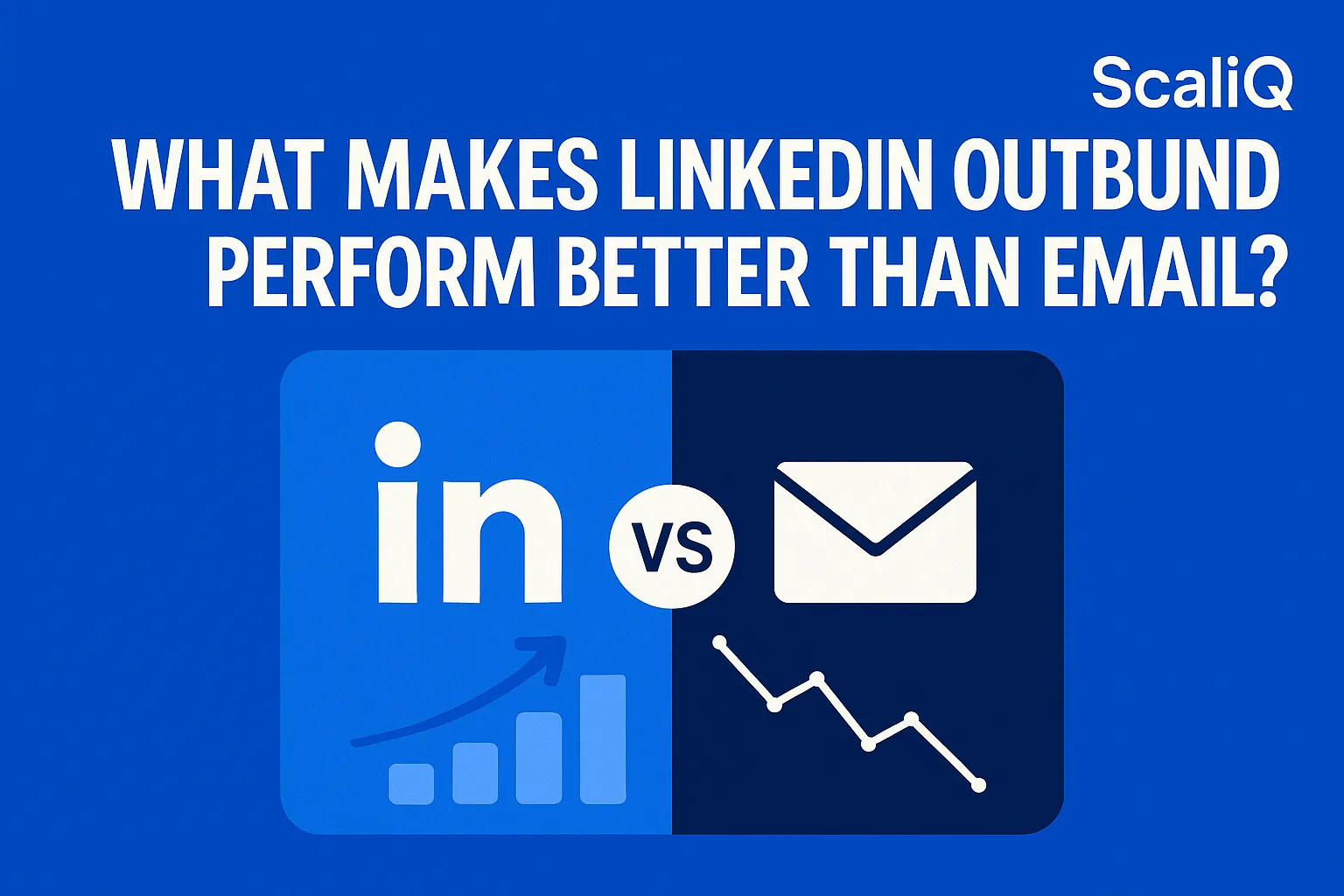
The data is conclusive: LinkedIn consistently drives higher engagement.
• LinkedIn Average Reply Rates: 3% – 8%
• Cold Email Average Reply Rates: 1% – 3%
Cross‑Industry Patterns
These patterns hold true across most B2B industries, though the gap widens in relationship-heavy sectors like SaaS, consulting, and professional services. In these fields, the "human element" of LinkedIn creates a 2x to 3x performance lift over email. Even in traditional industries like manufacturing or logistics, LinkedIn is rapidly gaining ground as decision-makers migrate to digital networking.
Why LinkedIn’s Reply Rates Are More Stable
Email performance is notoriously volatile. One week you have a 5% reply rate; the next week, a spam filter update kills your campaign. LinkedIn’s reply rates are remarkably stable. Because the engagement is based on identity and content rather than server whitelisting, a good campaign tends to perform consistently over time.
When Email Still Wins (and When It Doesn’t)
Despite LinkedIn’s dominance, email is not dead. It has simply changed roles. While it is no longer the best tool for the initial "cold handshake," it remains unmatched for specific use cases.
Best Use Cases for Cold Email Today
Email still wins when you need to convey dense information or reach very specific targets:
1. Enterprise Outreach: Large organizations often have strict internal firewalls but rely heavily on email for formal vendor evaluation.
2. Executive Messaging: C-Suite executives may delegate their LinkedIn management but still monitor their own high-priority email inbox.
3. Documentation: Sending attachments, decks, or long-form proposals is still a native email behavior.
Avoiding Email in Early‑Stage Cold Sequences
The biggest mistake modern SDRs make is burning their email domains on top-of-funnel cold outreach. Using email for the first touchpoint is high-risk and low-reward. It endangers your domain reputation for a 1% chance of a reply. It is far smarter to reserve email for step 3 or 4 in a sequence, once some level of familiarity has been established.
The Hybrid Outreach Strategy That Outperforms Both Channels Alone
The data is clear: the highest performing campaigns don't choose one channel. They use both. OECD research on hybrid engagement strategies highlights that multi-channel approaches significantly improve response rates by accommodating user preference.
ScaliQ data confirms that hybrid workflows—using LinkedIn and Email in tandem—generate a 30% lift in engagement compared to single-channel campaigns.
Simple Hybrid Flow That Outperforms Standalone Channels
To maximize results, you need a workflow that leverages the strengths of both platforms:
1. Step 1 (LinkedIn): Send a connection request (blank or low-friction).
2. Step 2 (LinkedIn): Once connected, send a value-based message (no hard pitch).
3. Step 3 (Email): If no reply, follow up via email. Reference the connection: "Hi [Name], we connected on LinkedIn earlier this week..."
This "warm email" approach bypasses the trust gap. You aren't a stranger anymore; you are a connection.
Behavior-Based Triggering Using Engagement Signals
Advanced outbound teams use behavior to trigger steps. For example, if a prospect views your profile but doesn't reply to a message, that is a signal to switch channels.
• Did they open the email but not click? Send a LinkedIn voice note.
• Did they like a post? Send a relevant case study via email.
For teams looking to automate these complex signals without losing the human touch, tools like NotiQ are essential for managing notifications and triggering timely follow-ups based on real engagement data.
Why Hybrid Removes Channel Bias
Some prospects live in their inbox; others live on LinkedIn. You don't know which one your prospect prefers until you try both. Hybrid strategies statistically balance your reach, ensuring you don't miss a qualified lead simply because you picked the wrong channel for that specific individual.
Future Trends in LinkedIn & Email Outreach
The landscape is moving fast. Over the next 2–3 years, we anticipate a widening gap between "spam" and "signal."
AI-Powered Personalization at Scale
Generic templates are dying. AI is making it possible to ingest a prospect's recent posts, company news, and hiring data to generate hyper-personalized messages at scale. On LinkedIn, this will look like thoughtful networking. On email, however, AI will likely be used defensively by spam filters to identify and block AI-generated cold emails.
Email Authentication: More Rigid, More Punishing
The trend toward stricter email security will continue. We expect DMARC and BIMI (Brand Indicators for Message Identification) to become mandatory for inbox delivery. If you aren't authenticating your domains with military precision, your email outreach will essentially cease to function.
Tools, Compliance, and Data Sources
Successful outbound is compliant outbound. In an era of GDPR and CCPA, using data ethically is non-negotiable.
Authoritative Sources Used
This analysis relies on data and guidelines from:
• Pew Research Center (Social Media & Work Trends)
• NIST (National Institute of Standards and Technology - Email Security)
• FTC (Federal Trade Commission - CAN-SPAM Act)
• Harvard University (Research on Algorithms and Communication)
• OECD (Digital Economy Papers)
How ScaliQ Collects and Analyzes Campaign Data
ScaliQ aggregates anonymized performance metrics from thousands of B2B campaigns to understand macro-trends. We do not scrape private data; we analyze the metadata of campaign performance (open rates, reply rates, delivery success) to provide the industry with accurate benchmarks. Always ensure your own data extraction methods comply with platform Terms of Service and local privacy laws.
Conclusion
The debate between LinkedIn and email isn't about preference; it's about performance. The data proves that LinkedIn currently offers superior deliverability, higher trust, and better reply rates for initial B2B contact.
However, the ultimate winner is the hybrid strategy. By leading with the social proof of LinkedIn and supporting it with the professional utility of email, you create a safety net that captures the most leads.
Don't rely on outdated myths. Evaluate your channels based on the data. If you are ready to modernize your outbound strategy, explore more data-backed insights on the ScaliQ blog.