

How to Build a Two-Tier Outreach Funnel (Filtering + Conversion Agents)
The era of "spray and pray" outbound is definitively over. For years, the standard playbook was volume: buy a massive list, load it into a sequencer, and blast generic templates until a meeting was booked. Today, that strategy results in burned domains, plummeting deliverability, and SDR burnout.
The problem isn't just that prospects are ignoring emails; it is that modern outbound stacks are fragmented and inefficient. Teams waste resources enriching and messaging leads that never should have entered the sequence in the first place.
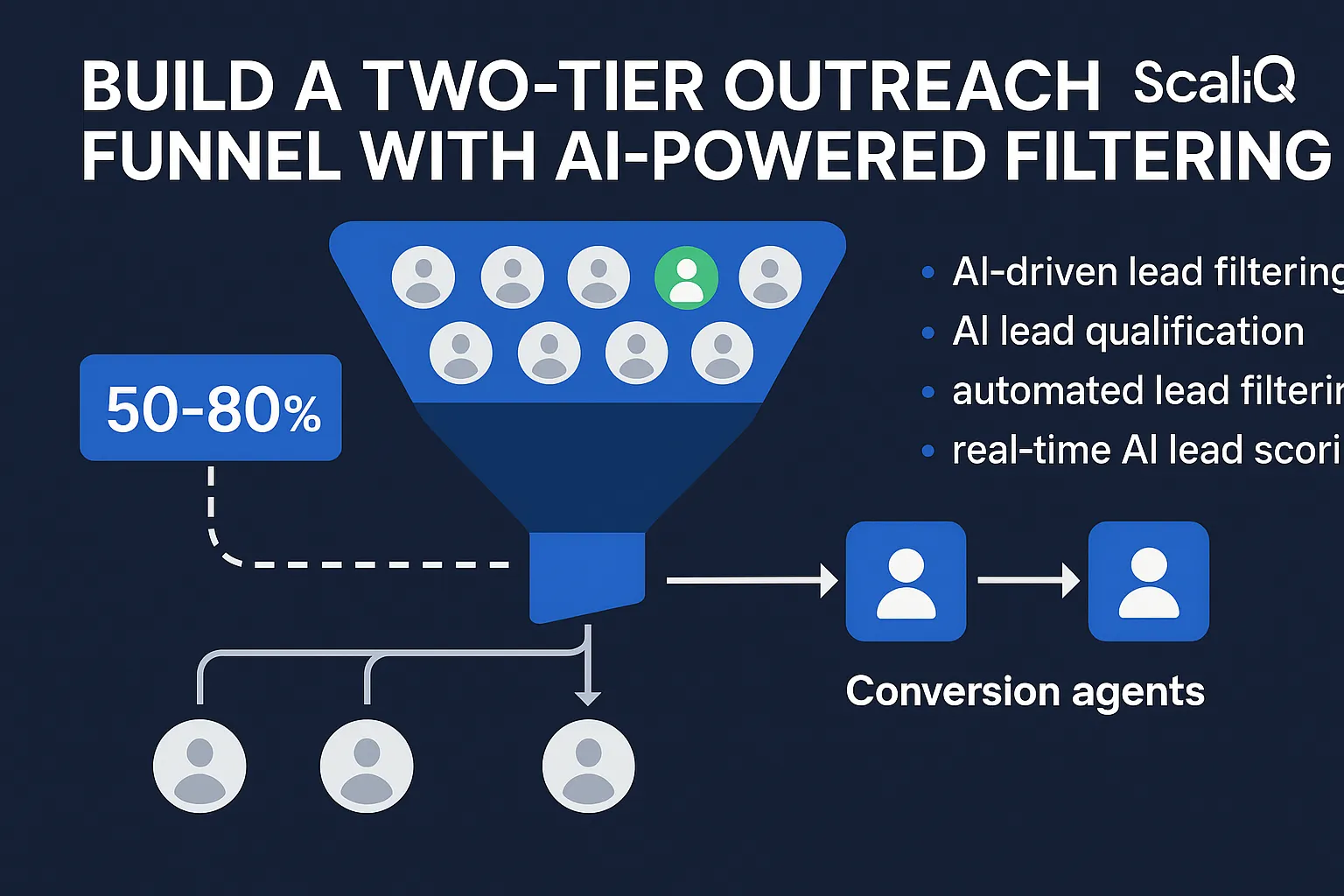
The solution lies in a structural shift: the two-tier outreach funnel. By deploying AI filtering agents (Tier 1) to ruthlessly eliminate 50–80% of noise before a single message is sent, growth teams can reserve their high-touch conversion agents (Tier 2) for the prospects that actually matter.
This guide is for advanced growth operators and outbound architects. We will dismantle the traditional linear sequence and replace it with a systems-first, multi-layer architecture—the same methodology used by ScaliQ’s systems-first multi-layer funnel architecture—to maximize reply rates and minimize risk.
What a Two-Tier Outreach Funnel Is
A two-tier outreach funnel is a tiered prospecting system that separates lead qualification from lead conversion. Unlike traditional sequencing tools that treat every email on a list as equal, a two-tier system introduces a strict "gatekeeper" layer.
• Tier 1 (Filtering Agents): Autonomous agents responsible for data validation, risk assessment, and ICP (Ideal Customer Profile) scoring. Their job is to reject leads.
• Tier 2 (Conversion Agents): High-level agents responsible for generating hyper-personalized messaging and managing engagement. Their job is to convert the survivors of Tier 1.
The logic is simple: Qualification → Routing → High-Touch Outreach.
This architecture differs fundamentally from standard automation. In a standard flow, you upload 1,000 leads and email 1,000 people. In a two-tier flow, you upload 1,000 leads, Tier 1 filters out 600 unqualified or risky contacts, and Tier 2 focuses intense resources on the remaining 400 high-fit prospects.
When designing these autonomous systems, it is critical to adhere to responsible AI standards. As outlined in the OECD AI Principles, AI systems should be robust, secure, and safe throughout their entire lifecycle, ensuring that automation is used to enhance decision-making rather than indiscriminately automate risk.
For a deeper look at how systems-first architecture powers modern growth, you can explore ScaliQ as a reference point for building these unified stacks.
The Goal of Tier 1 (Filtering Layer)
The primary objective of the filtering layer is noise reduction. A healthy Tier 1 agent should remove 50–80% of unqualified leads before they ever reach a sequencer.
This layer handles automated lead qualification by executing:
• Enrichment verification: Ensuring the prospect still holds the specific role and the company is active.
• Risk checks: Identifying spam traps or companies with strict firewalls.
• Scoring: analyzing firmographic fit (revenue, headcount, industry).
The output of Tier 1 is not a meeting; it is a clean, verified, high-probability list passed to the next stage.
The Goal of Tier 2 (Conversion Layer)
Once a lead clears the filter, the goal shifts from efficiency to effectiveness. Tier 2 conversion agents utilize the structured data collected during Tier 1 to generate human-like, context-aware messaging.
Because the volume has been reduced, you can afford to spend more computational resources and API credits on personalization. This ensures a quality-over-volume approach, where every sent message is highly relevant to the recipient's current context.
Why AI Filtering Improves Lead Quality
The single biggest efficiency killer in outbound sales is the "false positive"—a lead that looks good on a static list but is actually irrelevant, high-risk, or departed. Sending messages to these contacts triggers spam filters and wastes SDR time on manual research.
AI filtering LinkedIn data and other public signals allows you to dynamically assess lead viability in real-time. By implementing automated prospect filtering, organizations typically see a 50–80% reduction in send volume while maintaining or increasing the total number of positive replies.
According to the NIST AI Risk Management Framework, managing AI risk requires mapping, measuring, and managing potential negative impacts. In outbound, this translates to using filtering to mitigate the risk of domain reputation damage caused by high bounce rates and low engagement.
The Cost of Poor Filtering (Why Most Outbound Fails)
Without a filtering layer, your funnel suffers from:
• Deliverability Collapse: Sending to invalid emails or "catch-all" servers destroys domain health.
• Reply Rate Dilution: Messaging irrelevant prospects lowers your overall engagement metrics, signaling to email providers that your content is spam.
• SDR Fatigue: When SDRs spend hours responding to "not interested" or "wrong person" replies, morale and productivity plummet.
The goal is to reduce low-quality outbound leads to zero so that every notification an SDR receives is a genuine conversation opportunity.
How AI Models Improve Data Quality
Human SDRs cannot manually check 1,000 leads a day for nuanced signals. AI models, however, excel at high-speed pattern matching. AI-driven lead filtering can analyze:
• Behavioral Signals: Has this company hired recently? Are they posting about specific pain points?
• Social Metadata: Is the prospect active on LinkedIn, or is their profile a "ghost town"?
• ICP Pattern Matching: Does this company look like our best existing customers based on technographics?
This depth of analysis transforms a cold list into a dynamic, prioritized queue.
How Multi-Stage Routing Works in Practice
Multi-stage routing is the traffic control system of your outreach funnel. It determines the path a lead takes based on the data gathered in Tier 1.
In practice, this involves "If/Then" logic that is far more complex than standard email tools allow.
• Pass: Lead meets all criteria → Route to Tier 2 Agent A (High Personalization).
• Enrich More: Lead looks promising but lacks a verified email → Route to Waterfall Enrichment Agent.
• Fail: Lead does not meet revenue threshold → Route to "Nurture" or Delete.
This multi-stage outbound sequence ensures that you never treat a CEO of a Fortune 500 company the same way you treat a founder of a pre-seed startup. Research in AI Multi-Agent Routing suggests that decomposing complex workflows into specialized sub-agents significantly reduces error rates and improves task completion accuracy compared to monolithic models.
Step 1 — Data Collection & Enrichment
The process begins with data ingestion. The system pulls public data from LinkedIn, job boards, and company registries.
• LinkedIn Enrichment: Verifies current title, tenure, and recent activity.
• Technographics: Identifies software stacks (e.g., do they use Salesforce?).
This automated enrichment replaces the manual prospect research that typically consumes 30% of an SDR's day.
Step 2 — AI Scoring & Qualification Logic
Once data is collected, the scoring model evaluates the lead. This is not just "Good/Bad"; it is a gradient.
• Tier A (90-100 score): Perfect fit, high intent.
• Tier B (70-89 score): Good fit, low intent.
• Tier C (0-69 score): Drop immediately.
Using automated qualification and signal-based scoring, the system makes a definitive decision on whether the cost of outreach is justified by the potential return.
Step 3 — Routing to Conversion Agents
Approved leads are handed off to conversion routing.
• High-Score Leads: Sent to an agent that drafts a bespoke message referencing a recent LinkedIn post.
• Mid-Score Leads: Sent to a semi-automated sequence with industry-specific relevance.
Tier 2 agents ingest the structured data (e.g., "Company X just raised Series B") and inject it directly into the copy, ensuring relevance at scale.
Key Signals Used for Qualification and Risk Reduction
To build a robust filter, you need to define the signals that matter. High-performing teams move beyond basic demographics (Location, Job Title) and look for dynamic qualification signals.
ICP Fit Signals
These are the foundational requirements for a sale.
• Company Stage: Seed vs. IPO.
• Department Size: Growth of the engineering team vs. sales team.
• Tech Stack: Presence of complementary or competitive technologies.
• Lead Scoring: The automated scoring model aggregates these features to calculate a "fit probability."
Behavioral & Engagement Signals
Behavioral scoring identifies timing.
• Content Engagement: Did the prospect comment on an industry influencer's post recently?
• Hiring Velocity: Is the company aggressively recruiting for roles your product supports?
• Posting Frequency: Active users are more likely to reply to LinkedIn InMail or DMs.
Risk Signals (Deliverability + LinkedIn Safety)
To avoid outbound spam risk, the system must identify danger zones.
• Sending Frequency: Has this prospect been contacted recently by another team member?
• Spam Triggers: Does the prospect's domain have a history of blocking external emails?
• Platform Limits: Is the SDR's LinkedIn account approaching its daily connection limit?
Enrichment Completeness Signals
Sometimes, the best decision is to wait. If a lead lacks a verified mobile number or professional email, prospect enrichment protocols should hold the lead back until data is found, rather than sending a low-probability guess.
As noted in the NIST AI RMF Roadmap, establishing risk-mitigation procedures—such as verifying data completeness before action—is essential for deploying trustworthy AI systems in high-stakes environments like commercial outreach.
Where ScaliQ Fits in a Multi-Layer Outbound Stack
In the fragmented landscape of sales tools, ScaliQ positions itself not just as a tool, but as the architectural backbone of a multi-layer outbound system. While competitors often focus on a single slice of the stack—Clay for data tables, Apollo for databases, or Instantly for sending—ScaliQ integrates the intelligence layer with the execution layer.
ScaliQ as the Filtering Intelligence Layer
ScaliQ operates as the brain of Tier 1. It orchestrates the AI filtering system, managing the agents that scour public data, score leads, and decide who passes the gate. By automating this cognitive load, ScaliQ reduces manual SDR workload by 70–90%, allowing humans to focus solely on closing.
For teams looking to understand how structured data feeds into better messaging, check out resources on personalization strategies at Repliq's blog, which discusses the downstream effects of good data on conversion rates.
ScaliQ as the Conversion Layer
Once the filter is applied, ScaliQ transitions to the conversion layer. Here, AI conversion agents utilize the rich context gathered in Tier 1 to construct messages that feel handcrafted. Instead of generic templates, ScaliQ enables the deployment of dynamic agents that adapt tone, length, and call-to-action based on the specific persona being targeted.
Case Studies, Benchmarks, and Output Gains
Implementing a two-tier funnel creates measurable shifts in outbound efficiency. The industry benchmark for successful filtering is removing 50–80% of raw leads to protect domain health and focus effort.
Case Study 1 — LinkedIn-Heavy ICP
A B2B SaaS company targeting CTOs implemented a Tier 1 filter to analyze LinkedIn activity.
• Before: 1,000 connection requests sent → 150 accepted → 10 replies.
• Filtering Rule: Only route prospects who have posted in the last 30 days.
• After: Filtered 1,000 leads down to 250 active users.
• Result: 250 requests sent → 180 accepted → 45 replies.
• Gain: 4x increase in replies with 75% less volume.
Case Study 2 — Multi-Channel Email + LinkedIn ICP
A marketing agency used multi-signal scoring to reduce spam complaints.
• Strategy: Tier 1 agents verified email deliverability and cross-referenced it with company growth signals (hiring).
• Outcome: "Catch-all" emails were routed to a manual validation step, while "Verified" emails with high growth scores went to conversion agents.
• Result: Open rates increased from 35% to 68%, and domain reputation was restored within 4 weeks.
Tools, Workflows, and System Architecture
Building this requires a specific outbound funnel architecture. It is no longer enough to buy a list and hit "send."
Core Components (Enrichment, Filtering, Routing, Agents)
To replicate a two-tier system, your stack must include:
1. Data Source: (e.g., LinkedIn Sales Nav, Apollo).
2. Enrichment/Waterfall: (e.g., Prospeo, Datagma).
3. Intelligence/Routing Layer: (ScaliQ).
4. Sending Infrastructure: (Smartlead, Instantly).
The fragmentation problem arises when these tools don't talk to each other. A unified system like ScaliQ replaces the need for complex Zapier patches between these layers.
Example Workflow Blueprint
1. Ingest: Pull 500 leads from Sales Navigator search.
2. Tier 1 Agent:, Check: Is the company B2B? (Yes/No)., Check: Is the prospect still at the company? (Yes/No)., Check: Probability of Reply > 20%? (Yes/No).
3. Filter: Drop 350 leads. Keep 150.
4. Tier 2 Agent:, Analyze last 3 LinkedIn posts of the 150 survivors., Draft 150 unique openers.
5. Execute: Push to sending tool.
This workflow leverages ai outreach tools to ensure zero waste.
Future Trends in AI Multi-Agent Outbound
The future of outbound is adaptive. We are moving toward autonomous SDR agents that do not just follow a linear path but adjust their strategy in real-time.
• Adaptive Funnels: If a prospect opens an email 5 times but doesn't reply, the agent automatically switches channels to LinkedIn or invites them to a webinar instead of asking for a demo.
• Behavioral Scoring via Social Signals: Agents will continuously monitor target accounts for "trigger events" (e.g., a new CTO is hired) and initiate outreach the moment the signal is detected.
• AI Multi-Agent Future: Specialized agents (Researcher, Copywriter, Strategist) will collaborate on a single account strategy, mimicking a full revenue operations team at machine speed.
This guide is for advanced growth operators and outbound architects. We will dismantle the traditional linear sequence and replace it with a systems-first, multi-layer architecture—the same methodology used by ScaliQ’s systems-first multi-layer funnel architecture—to maximize reply rates and minimize risk.