

Introduction: Why Website Traffic Growth Matters for B2B Prospecting
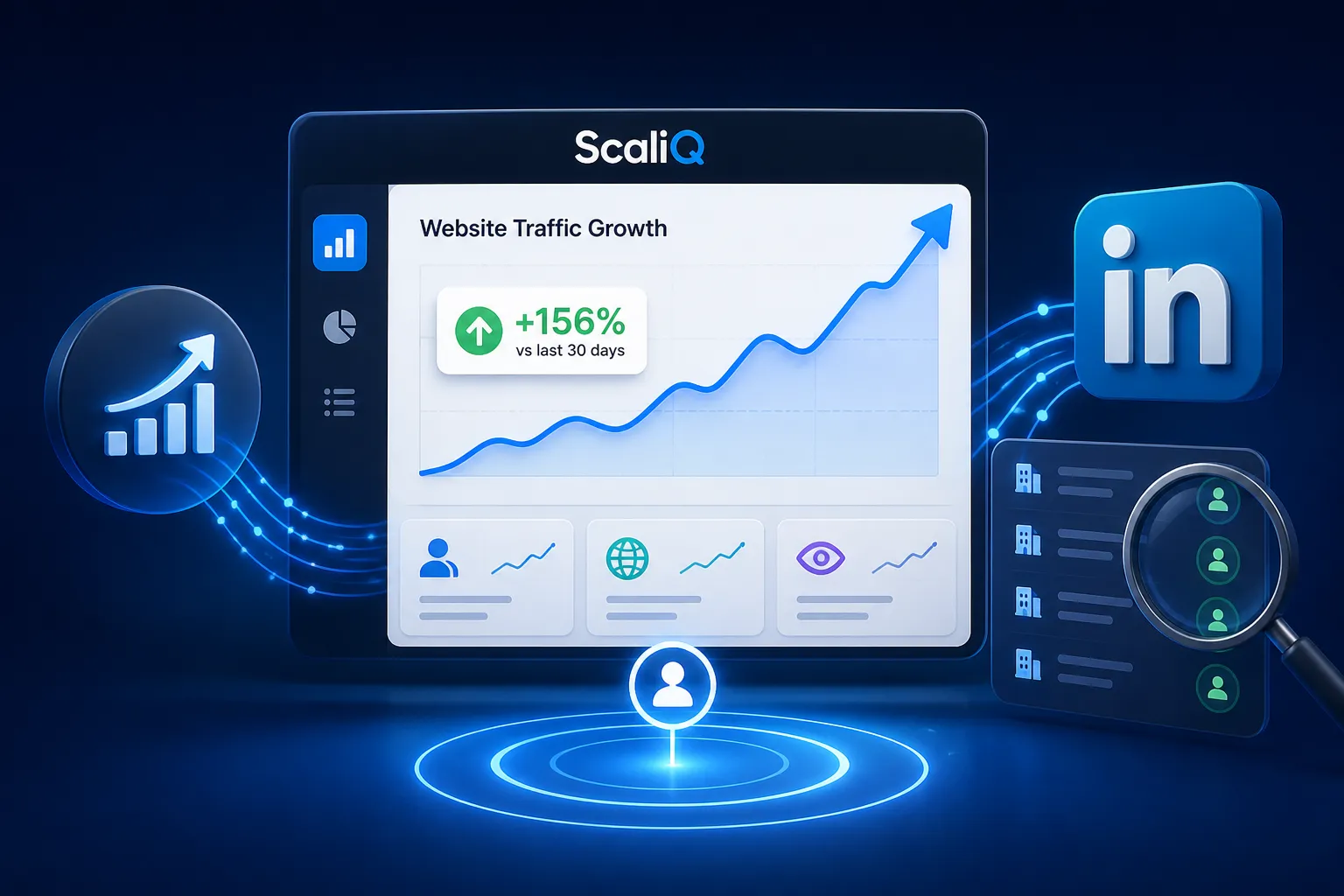
Modern sales teams face a paradox: they have access to more website analytics and LinkedIn data than ever before, yet struggle to determine which accounts actually deserve their attention right now. While many organizations rely on generic intent scores, website traffic growth—when properly analyzed—serves as a highly effective, account-level prioritization signal.
It is vital to establish upfront that a website traffic growth signal is an indicator for account research, not definitive proof that an individual is ready to buy. However, sustained traffic acceleration can strongly indicate increasing market demand, greater marketing investment, a new product launch, geographic expansion, or active competitive research.
This article will show advanced B2B sales and marketing teams how to detect, validate, score, and activate these traffic changes through a repeatable account-prioritization and LinkedIn sales outreach workflow. It is important to acknowledge the limitations of this data: anonymous traffic does not automatically identify a specific decision-maker. To be useful among B2B prospecting triggers, traffic growth must be rigorously validated against Ideal Customer Profile (ICP) fit, traffic source, landing-page behavior, geography, and engagement quality.
ScaliQ acts as a data-driven research and intelligence layer that helps revenue teams interpret this business momentum, bridging the gap between raw web analytics and actionable outreach without presenting inferred website behavior as confirmed individual intent. By connecting traffic trend analysis to a systematic workflow, teams can reach the right accounts at the exact moment their operational focus shifts.
What Website Traffic Growth Can Signal About an Account
Website Traffic Growth Is an Account-Level Trigger, Not Proof of Purchase Intent
A website traffic growth signal is a measurable change in an organization’s web activity that justifies immediate account research and prioritization. To utilize this data effectively, revenue teams must distinguish between four distinct metrics:
• Traffic volume: The total amount of activity a website receives.
• Traffic growth: How that volume of activity changes over a specific period.
• Traffic acceleration: Whether the rate of growth itself is increasing, signaling rapid momentum.
• Traffic quality: Whether the visits align with relevant audiences, geographic locations, target pages, and high-value engagement patterns.
Traffic growth should always guide sales attention toward an account. It should never serve as assumed evidence that a named LinkedIn contact visited the site or is actively evaluating a purchase. Consistently framing this as "company-level momentum" ensures sellers approach the account with curiosity rather than unwarranted assumptions.
What Increasing Traffic May Reveal
When an account exhibits sustained traffic growth, there is usually a driving business event behind it. Possible explanations for this company-level momentum include:
• Increasing market demand for their category.
• Greater investment in demand generation and paid media.
• A recent product or feature launch driving market curiosity.
• Strategic expansion into a new geography or market segment.
• Competitive or category research ahead of a major initiative.
• Elevated public relations, content marketing, or campaign activity.
The same website traffic analysis can mean completely different things depending on the company’s business model and how well they fit your ICP. Sellers must view demand generation signals and sales intelligence signals as starting points. The goal is to convert each possible explanation into a testable research hypothesis rather than an unsupported conclusion about buying intent. A directional signal informs a validated account hypothesis; it does not equal confirmed individual intent.
How to Separate Meaningful Growth From Traffic Noise
Measure Sustained Growth Instead of One-Time Spikes
Not all traffic increases are created equal. A single, isolated traffic spike is often the result of one-off news coverage, a short-lived campaign, industry seasonality, a referral anomaly, or automated bot traffic.
To separate the signal from the noise, teams must review growth across multiple time windows. Compare short-term changes against a longer historical baseline. Meaningful growth depends heavily on:
• The account’s normal traffic baseline.
• Expected industry seasonality.
• Company size and market maturity.
• Traffic source and landing-page relevance.
• The duration and recency of the upward trend.
When answering the question of what threshold or rate of traffic growth should trigger prospecting, there is no universal percentage. Instead, teams should use account- and segment-specific thresholds. Begin with a testable scoring rule (e.g., a 30% week-over-week sustained increase for a mid-market account) and adjust it against historical outcomes.
Validate the Source Mix
The prospecting implications of traffic growth change drastically depending on where the traffic originates. A thorough analysis should compare:
• Branded search growth: Often reflects growing brand awareness or direct PR impact.
• Non-branded search growth: May indicate category discovery, demand generation, or shifting market needs.
• Paid campaign traffic: Shows active marketing investment.
• Referral traffic: Could stem from partner networks, reviews, or viral content.
• Direct traffic: Suggests strong brand recall or internal company activity.
• Social traffic: Highlights content resonance or community engagement.
• High-intent landing-page visits: Traffic to product, pricing, or comparison pages carries higher relevance.
Branded traffic may reflect awareness, while non-branded traffic points to category discovery. Neither should be automatically treated as immediate purchase intent. Source analysis reveals whether website traffic trends by company are broad and durable or artificially concentrated in a single campaign. This context is essential for understanding website visitor intent within B2B website traffic.
Check Geography, Engagement, and Landing-Page Behavior
Account-level validation requires digging deeper into the engagement metrics. High-quality growth should be verified using:
• Geographic relevance to your company’s target market.
• Engagement quality (bounce rates, time on site, pages per session).
• Relevant page categories (e.g., B2B solutions vs. career pages).
• Repeat or sustained activity patterns.
• Device or channel anomalies, where available.
A massive increase in low-quality or geographically irrelevant traffic should immediately reduce the signal’s priority. Use this validation checklist before proceeding:
1. Is the account in our ICP?
2. Is the growth occurring in a relevant market or region?
3. Are relevant business, pricing, or product pages involved?
4. Is the pattern sustained over days or weeks?
5. Is there a plausible business event explaining the change?
Note: Aggregate or account-level signals carry inherent uncertainty. They should never be represented to prospects as identified individual browsing behavior.
Identify Common Causes of False Positives
Sales and marketing teams must document the likely cause of a traffic surge before activating an outreach sequence. Common causes of false positives in B2B buyer intent signals include:
• Predictable seasonality.
• Paid media campaigns driving low-intent clicks.
• Viral content or unrelated news coverage.
• Referral anomalies from off-topic domains.
• Bots, scrapers, or low-quality automated traffic.
• Tracking pixel or attribution software changes.
• Website redesigns or domain migrations.
Investigating these factors ensures that account-level website engagement metrics remain reliable, preventing outreach based on irrelevant anonymous website visitors.
A Practical Framework for Turning Traffic Growth Into LinkedIn Outreach
To move from signal detection to sales action, revenue teams need a structured, repeatable workflow. Unlike generic intent scores that are opaque and difficult to interpret, this transparent, six-stage framework ensures every outreach effort is grounded in context.
1. Detect traffic acceleration.
2. Validate quality, duration, and relevance.
3. Confirm ICP fit.
4. Research the account and likely stakeholders.
5. Develop a relevant outreach hypothesis.
6. Launch, track, and learn from the outcome.
This composite workflow sets ScaliQ apart from standalone web-traffic analytics, generic buyer-intent platforms, and manual LinkedIn research by connecting traffic trends directly to account research, contact discovery, and outreach action. It turns sales triggers for LinkedIn outreach and account intent data LinkedIn prospecting into precise prospect prioritization.
Stage 1: Detect and Record the Signal
The first step is capturing the right data. Define the minimum fields for a research record:
• Account name and domain.
• Growth period (e.g., past 14 days).
• Comparison baseline.
• Traffic source mix.
• Relevant pages or page categories.
• Geography.
• Detection date.
• Signal confidence.
Recency is critical; a valid signal loses practical value if sales action happens weeks too late. In the CRM, separate these stages clearly: “new signal,” “validated signal,” “activated signal,” and “outcome recorded.”
Stage 2: Validate the Account and Business Context
Before searching for individual contacts, confirm the organization matches your ICP. Next, research public company context to corroborate the web data. Look for:
• Current positioning and messaging.
• Product or service changes.
• Geographic or market expansion activity.
• Hiring patterns (especially in specific departments).
• Public announcements and press releases.
• Relevant LinkedIn company updates.
Corroborating public events increases confidence without relying on an opaque score. For teams looking to streamline this, ScaliQ serves as a data-driven intelligence layer for interpreting traffic momentum and prioritizing accounts efficiently.
Stage 3: Map the Signal to a Business Hypothesis
Translate the traffic trend into a business question that your outreach can explore:
• Is the company investing heavily in a new market?
• Are they actively scaling their demand generation efforts?
• Is the organization launching a new product or category?
• Are they experiencing growth-related operational pressure?
• Are they trying to increase visibility in a highly competitive market?
Always distinguish observed information from inference. Never use messaging that says or implies, “We saw that you visited our website.” Instead, use B2B prospecting triggers and buyer intent data to inform a hypothesis about their current priorities, aligning perfectly with account-based marketing intent signals.
How to Score and Prioritize Accounts
Build a Transparent Composite Account Score
A practical account score combines multiple dimensions to prioritize sales effort, not to predict a guaranteed purchase. A transparent score should evaluate:
• Traffic growth strength.
• Trend duration and recency.
• ICP fit.
• Traffic quality.
• Relevant page or source behavior.
• Corroborating company events.
• Confidence in account identification.
Recording the reason for each score allows sellers to understand and, if necessary, challenge the prioritization. A conceptual scoring table might look like this:
• Signal Dimension: Sustained non-branded search growth.
• Evidence: 40% increase over 3 weeks; hiring 3 new SDRs.
• Confidence Level: High.
• Suggested Action: Prioritize immediate outreach to the VP of Sales.
This transparency turns abstract sales intelligence signals into actionable prospect prioritization based on a clear website traffic growth signal.
Use Confidence Levels
Categorize signals into three practical confidence levels:
• Low confidence: The traffic change is unverified, poorly explained, or weakly connected to the ICP. Action: Continue monitoring.
• Moderate confidence: Growth is sustained and relevant but lacks corroborating business context. Action: Conduct account research and initiate low-pressure engagement.
• High confidence: Sustained, relevant growth aligns perfectly with ICP fit and is supported by multiple public or account-level business signals. Action: Prioritize timely, highly relevant outreach.
Confidence applies exclusively to the account-level hypothesis. It does not eliminate uncertainty or establish that a specific person viewed a page.
Decide When Traffic Growth Should Outrank Other Triggers
Traffic growth must be weighed against other triggers like funding, hiring, leadership changes, technology adoption, product launches, content engagement, review activity, and explicit intent data.
While traffic growth may appear earlier in the buying cycle, it is often less specific than explicit buying signals (like requesting a demo). A composite signal model is recommended rather than automatically ranking traffic above a Series B funding round or a C-suite hire. The differentiators here are explainability, signal validation, and actionability—far superior to opaque intent scores or isolated platform alerts.
LinkedIn Contact Selection and Outreach Messaging
Find the Right Stakeholders After Detecting Account Momentum
Account-level traffic growth does not identify the correct contact by itself. You must map the business hypothesis to the relevant roles:
• Marketing/Demand-Gen Leaders: When patterns suggest campaign or category growth.
• Sales/Revenue Leaders: When the hypothesis concerns pipeline expansion or go-to-market execution.
• Product Leaders: When traffic relates to product launches or new use cases.
• Operations/Growth Leaders: When the company appears to be scaling rapidly.
Validate role relevance, seniority, geographic responsibility, and current company affiliation before reaching out. Select a small, targeted number of stakeholders rather than spamming every employee. This is how to prioritize LinkedIn prospects accurately, ensuring LinkedIn sales outreach is driven by thorough account research.
Build Outreach Around the Business Problem, Not Private Behavior
Outreach messages must reference public company context or a plausible business challenge—never inferred browsing activity. The ideal structure includes:
1. A relevant company observation.
2. A business hypothesis or problem.
3. A useful point of view or resource.
4. A low-pressure question.
Different scenarios require different messaging. Branded traffic growth requires a different angle than non-branded search growth, product page interest, or expansion into a new market. For executing these sequences seamlessly, Repliq can assist with LinkedIn outreach execution, message sequencing, and follow-up operations.
Suggested LinkedIn Outreach Template Frameworks
Note: The following are examples. They do not claim to know whether a person visited a website or engaged with a specific page.
Template 1: Broad, Sustained Market Momentum
Template 2: Expansion into a New Category or Geography
Template 3: Ambiguous Traffic Growth (Research Approach)
Combining Traffic Growth With Other B2B Intent Signals
Create a Multi-Signal Account View
Traffic growth becomes exponentially more powerful when combined with other B2B buyer intent signals, such as ICP and firmographic fit, hiring activity, funding, product launches, technology changes, and public LinkedIn engagement.
Each signal answers a different question:
• Traffic growth: Is market or digital activity increasing?
• Hiring: Is the organization investing in capacity?
• Funding/Expansion: Is there a strategic growth event?
• Product activity: Is there a new use case or commercial priority?
• Role research: Who may own the relevant problem?
Corroborating these account-based marketing intent signals reduces false positives without guaranteeing purchase readiness, refining your website engagement lead scoring.
Align Marketing and Sales Around the Same Signal
Marketing and sales must share a unified definition of what constitutes a qualified account signal. Teams must agree on who validates the signal, when sales is notified, which content or message is appropriate, and how outcomes are returned to marketing.
Marketing can use the signal for account-based content or campaign prioritization, while sales uses it for research and timing. For more insights on shared signal interpretation and demand-generation workflows, visit the ScaliQ Blog.
Measurement, CRM Activation, and Workflow Automation
Connect the Signal to CRM Stages
To make the workflow auditable and improvable, represent it clearly in your CRM using dedicated fields:
• Signal type.
• First detected date.
• Last validated date.
• Growth window.
• Confidence level.
• ICP fit.
• Assigned owner.
• Contacted date.
• Outreach angle.
• Result.
Documenting the reasoning ensures accountability. Sales should only be alerted after basic validation is complete, rather than having every traffic anomaly forwarded to their inbox.
Measure Signal-to-Pipeline Performance
A robust measurement framework is essential to prove value. Track:
• Time from signal detection to contact.
• Reply rate and positive reply rate.
• Meetings booked and qualified opportunities.
• Pipeline generated.
• Conversion by signal confidence.
• Conversion by traffic source or page category.
Compare traffic-triggered outreach against a historical baseline or control group. Remember that a correlation between traffic growth and pipeline does not automatically prove causation, but it does validate these sales intelligence signals for prospect prioritization and website traffic analysis.
Automate the Repetitive Steps, Not the Judgment
Automation should handle the heavy lifting, but human intuition remains critical.
Systematize: Detecting changes, applying initial filters, enriching account records, creating alerts, routing accounts, and logging outcomes.
Require Human Review: Interpreting unusual traffic patterns, selecting the right business hypothesis, choosing the specific stakeholder, reviewing privacy implications, and approving message relevance.
ScaliQ supports the research, prioritization, and workflow orchestration elements of this process, but it is not a replacement for human verification or responsible sales judgment.
Privacy, Compliance, and Responsible Use of Website Signals
Distinguish Aggregate Analytics From Individual Identification
Ethical prospecting requires a clear distinction between aggregate website measurement, account-level trend analysis, probabilistic company identification, and individual identification. A company-level traffic signal should never be framed as proof that a specific person visited a website.
Teams must use clear confidence labels, handle data carefully, and maintain transparency. For authoritative guidelines on cookies, tracking technologies, and responsible data collection, refer to the FTC privacy and data security guidance.
Apply Data Minimization and Purpose Limitation
Collect and activate only the data strictly required for account prioritization and relevant outreach. Organizations must continuously review their consent and tracking requirements, data-sharing arrangements, retention practices, access controls, and regional privacy obligations.
Understanding the difference between aggregate web measurement and personally identifiable information is crucial. Teams should consult NIST website privacy practices to ensure compliance.
Avoid Intrusive or Overconfident Outreach
Never send messages that say, "We know you visited our pricing page," or "We saw your team researching our product." Revealing inferred individual behavior or making unverified claims about a prospect's purchase stage is intrusive and damages trust.
Always use public company context and business problems as the foundation for outreach. For context on the risks of cross-site observation and third-party tracking, review Stanford research on third-party tracking and the one-million-website tracking study.
Common Mistakes and How to Avoid Them
• Treating total traffic volume as purchase intent., Fix: Analyze growth, relevance, source mix, and duration instead of raw volume.
• Triggering outreach from a single unexplained spike., Fix: Check for seasonality, campaigns, news coverage, referrals, bots, and tracking changes.
• Assuming anonymous website visitors identify an individual., Fix: Keep the signal at the account level and use confidence labels to gauge website visitor intent.
• Contacting the wrong stakeholder., Fix: Map the business hypothesis to role responsibilities and public company context.
• Writing messages that expose inferred browsing behavior., Fix: Use public signals and problem-oriented language as sales triggers for LinkedIn outreach.
• Using an opaque composite score., Fix: Show the evidence and reasoning behind the prioritization directly in the CRM.
• Failing to measure incremental impact., Fix: Track outcomes against a historical baseline or control group.
Conclusion: Turn Traffic Momentum Into Better-Timed Prospecting
Website traffic growth is a highly effective, account-level prospecting trigger when it reflects sustained, relevant business momentum. By moving away from opaque intent scores and focusing on verifiable growth, revenue teams can time their outreach perfectly.
Success relies on a disciplined, seven-step sequence:
1. Detect acceleration.
2. Validate traffic quality and persistence.
3. Confirm ICP fit.
4. Add corroborating signals.
5. Identify relevant LinkedIn stakeholders.
6. Use non-intrusive, problem-oriented outreach.
7. Measure pipeline impact.
Traffic growth is a prioritization aid, not definitive proof of buying intent. ScaliQ provides a practical intelligence layer to turn fragmented web and account signals into explainable, perfectly timed sales action.
Evaluate how ScaliQ can help your team detect account momentum, validate a website traffic growth signal, and execute highly relevant LinkedIn sales outreach based on proven B2B prospecting triggers.