


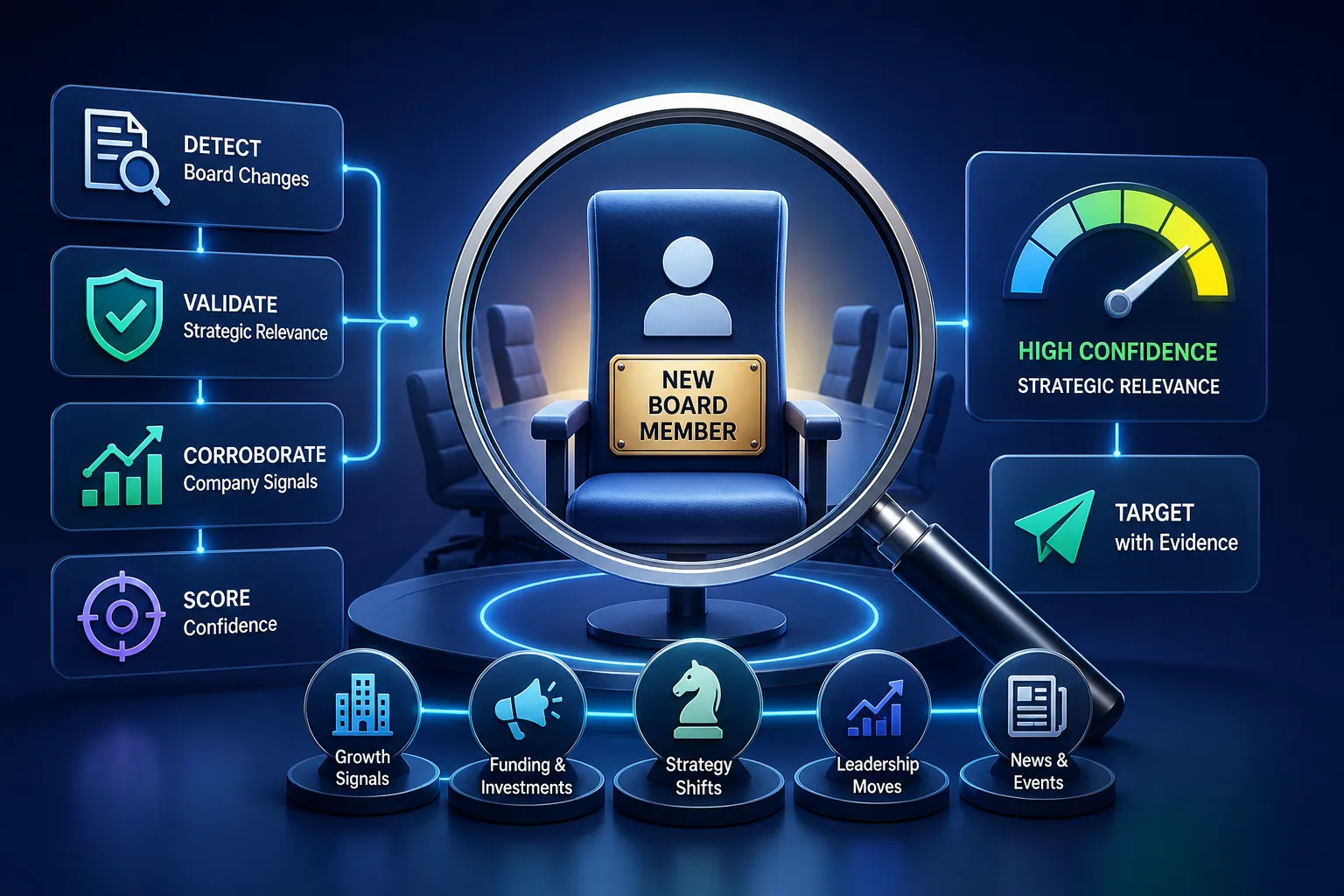
How to Target Companies With Newly Appointed Board Members
A newly appointed board member can be a highly valuable account signal—but only when validated against a company’s broader strategy, governance context, and public evidence. In B2B sales, the commercial problem is clear: company leadership changes are often discovered haphazardly across fragmented regulatory filings, investor-relations pages, press releases, LinkedIn updates, and business media.
To capitalize on these events, revenue teams must understand the critical distinction between a public governance event and verified buying intent. A generic alert about a new director is not a mandate to buy software; it is a prompt for deeper investigation.
This article introduces a multi-signal workflow that moves revenue teams from initial detection to validation, scoring, executive mapping, responsible outreach, and performance measurement. Designed for advanced sales leaders, account executives (AEs), sales development representatives (SDRs), and account-based marketing (ABM) teams, this guide provides a repeatable process to replace reliance on generic executive alerts.
The five-stage framework covers:
1. Understand why the appointment matters.
2. Find and validate the new board member.
3. Score the strength of the trigger.
4. Convert research into relevant outreach.
5. Operationalize and measure the workflow.
By treating a new board member sales trigger as a starting point for account research rather than a shortcut to a pitch, teams can elevate their executive prospecting and LinkedIn outreach signals. At ScaliQ, we operate as a research-driven account-intelligence brand focused on source traceability, transparent scoring, and interpretation that goes far beyond generic executive or intent-data lists.
Why Board Appointments Can Signal Strategic Change
A board change creates a timely research opportunity, but revenue teams must be cautioned against treating every appointment as evidence of active demand. A board appointment is a potential governance change signal, not an automatic buying signal.
When a new director joins a board, they often bring specific expertise, oversight capacity, relationships, or experience directly connected to an existing company priority. According to OECD research on board composition, the makeup of a board is fundamentally tied to governance, accountability, and the execution of long-term strategy.
Strategic contexts that may increase the relevance of a board appointment include:
• Digital transformation initiatives
• Cybersecurity and risk oversight
• Artificial intelligence and technology investment
• Sustainability and regulatory priorities
• M&A, fundraising, or geographic expansion
• Operational resilience and governance transformation
To interpret a board appointment sales trigger accurately, teams must distinguish between different types of company leadership changes:
• Board appointment: A new individual joins the board.
• Board expansion: The company increases board capacity or adds a new perspective.
• Board replacement: One director is replaced, potentially indicating succession, capability change, or governance adjustment.
• Committee appointment: The director receives responsibilities that clarify a specific governance priority.
Ultimately, the appointment should prompt rigorous account research—not a premature conclusion that the company is ready to buy. This research-led interpretation sharply contrasts with tools that surface leadership or intent events but fail to explain whether a board appointment is strategically meaningful.
When a New Director Is Commercially Relevant
Certain director attributes can increase an account's research priority. These include:
• Relevant operating experience
• Specific committee responsibilities (e.g., Audit or Risk Committee)
• Experience in a transformation area related to the company’s published priorities
• Prior work in a market, geography, or business model relevant to the account
• Appointment type and seniority, such as independent director, executive director, board chair, or committee chair
Sellers must avoid presenting a biography as proof of internal plans. Instead, connect the director’s public background with company-level evidence before forming a prospecting hypothesis. The core qualification question is: “What observable company priority could this appointment plausibly reinforce?”
By focusing on verifiable professional context rather than unsupported assumptions about private board discussions or individual motives, teams can effectively leverage new board member prospecting and director appointment signals to identify newly appointed board members who align with a verified business need.
Routine Governance Change vs. Strategic Signal
Not all appointments are created equal. Distinguishing between a routine governance change and a potentially meaningful strategic event is critical for trigger-based prospecting.
Weak or incomplete signals include:
• Only a social post with no company confirmation
• No clear relevance between the director’s experience and company priorities
• No corroborating company activity
• Conflicting dates, titles, or appointment status
Stronger conditions include:
• The appointment is confirmed through a company disclosure or filing.
• The role or committee assignment has a clear governance relevance.
• The company has publicly stated a related priority.
• Additional evidence appears in hiring, earnings commentary, funding, M&A, technology, or expansion activity.
False positives should be documented rather than silently discarded. When evaluating board change intent data and account-based sales signals, assign a confidence level to each signal and retain the evidence trail in your CRM to improve future targeting.
How to Find and Validate New Board Members
To build a reliable pipeline, sales teams need a repeatable discovery and verification process across public, professional, and authoritative sources. Not all sources are equally reliable. Teams should utilize a strict source hierarchy:
1. Regulatory filings
2. Company investor-relations pages
3. Official company announcements and press releases
4. Reputable business reporting
5. LinkedIn and other professional-network activity
6. Sales-intelligence and workflow platforms
Each source plays a distinct role. LinkedIn can help discover executive changes and professional context. Investor-relations pages provide company-specific confirmation. Regulatory filings validate formal appointments and committee details. For public companies in the U.S., refer to SEC Form 8-K Item 5.02(d) to understand how filings validate newly elected directors and disclose relevant appointment details. Sales platforms can support discovery, enrichment, and activation but should never replace primary evidence validation.
When documenting executive change intent data and company leadership change alerts, capture the following fields:
• Director name
• Company
• Appointment or announcement date
• Appointment type
• Committee assignment
• Source URL
• Evidence summary
• Confidence level
Knowing how to find new board members is only half the battle; validating them is where the value lies. Using platforms like ScaliQ can help structure research-driven account intelligence and preserve the vital source context around detected signals.
A Source-by-Source Discovery Workflow
Begin with a defined account list or target-market segment rather than monitoring every company indiscriminately.
A structured monitoring workflow follows these steps:
1. Identify a possible board change through alerts, company updates, professional networks, or sales-intelligence tools.
2. Search the company’s investor-relations materials and official announcements.
3. Check applicable regulatory disclosures. For interpretation, consult SEC guidance on director appointment filings.
4. Review the director’s public professional background.
5. Compare dates, role descriptions, and committee information across sources.
If discrepancies arise during director appointment LinkedIn prospecting or when reviewing a board appointment press release, mark the signal as unverified. Record the conflicting information and avoid outreach until the appointment and company context are sufficiently clear. Sales intelligence leadership changes must be fact-checked before activation.
What to Research Before Contacting the Account
Always research the company’s own language before relying on the director’s biography. To build robust account research signals, examine the following evidence categories:
• Earnings commentary
• Investor presentations
• Strategy pages
• Hiring patterns
• Technology changes
• Funding or acquisition activity
• Geographic expansion
• Regulatory or risk disclosures
• Executive communications
The goal is to formulate a business hypothesis, not to infer confidential board priorities. Map the new director’s relevant experience to the company’s observable initiatives only when the connection is supported by public evidence. Every material claim in the account brief regarding company leadership changes or board succession strategy must link back to a public source and include its publication or filing date to ensure full source traceability.
How to Score Trigger Strength and Prioritize Accounts
A transparent scoring model helps teams distinguish promising board-change signals from routine governance activity. Prioritize accounts across four core dimensions:
• Recency: How recently was the appointment announced or formally disclosed?
• Role relevance: Does the director’s role, expertise, or committee assignment relate to a plausible business priority?
• Strategic fit: Does the appointment align with the company’s published direction or observable initiatives?
• Corroborating evidence: Are there additional company-level signals supporting the hypothesis?
Apply a confidence label to each account:
• Unverified
• Possible relevance
• Validated research signal
• High-priority multi-signal account
Remember that board-change signal scoring is a prioritization framework for multi-signal prospecting, not a prediction of purchase intent. Always document the reason behind each score so sellers can review, challenge, and update the recommendation.
A Practical Board-Change Signal Scoring Framework
To operationalize this, use a worksheet-style structure containing fields for:
• Appointment status
• Source quality
• Date and freshness
• Board or committee role
• Director-to-priority relevance
• Number and quality of corroborating signals
• Likely operating owner
• Data confidence
While score bands will vary by organization, a high score must require both a validated appointment and independent company evidence. A strict rule must be enforced: a single LinkedIn update or generic executive biography should not independently qualify an account for an outbound sequence. A true governance change signal or new director appointment business signal requires depth to become actionable account-based sales signals.
Combining the Board Signal With Other Buying-Context Signals
A board appointment rarely happens in a vacuum. Combine the appointment with other account-based marketing trigger events, such as:
• Leadership changes
• Hiring patterns
• Funding
• M&A
• Earnings commentary
• Technology investment
• Geographic expansion
• Strategic announcements
Multiple related signals are exponentially more useful than isolated event detection. However, distinguish between corroboration (evidence supporting the same business hypothesis) and correlation without relevance (events that occur near the appointment but do not clearly support the hypothesis).
Set a minimum evidence threshold before launching a sequence, while allowing high-value accounts to receive additional manual research. Unlike opaque intent scores or undifferentiated event alerts, ScaliQ explains the evidence behind a recommendation, transforming raw executive change intent data into validated buying intent signals. Learn more about this methodology on the Blog.
How to Turn Board Research Into Relevant Executive Outreach
Translating validated research into concise, evidence-led messaging requires discipline. The goal is to establish relevance without overpersonalizing or making unsupported claims.
The cardinal rule of executive prospecting: lead with a relevant company observation, not a generic congratulations message. Furthermore, the best initial contact is often the operating executive responsible for the relevant initiative—not the new director.
Target stakeholders often include:
• Executive sponsor
• Functional leader
• Transformation or technology owner
• Risk, compliance, or security leader
• Strategy, finance, or operations executive
Keep the board appointment as context for research rather than making it the entire pitch. Effective LinkedIn outreach signals and executive outreach rely on clearly distinguishing between what the company has publicly stated and what the seller is hypothesizing.
Building a Responsible Outreach Hypothesis
Construct your messaging using a four-part structure:
1. Observed event: Identify the verified appointment or governance change.
2. Company context: Reference a public priority or corroborating signal.
3. Relevant problem: Explain the operational issue the seller may be able to help with.
4. Low-friction question: Ask whether the priority is relevant to the recipient’s remit.
Sellers must strictly avoid speculating about confidential board discussions, claiming the new director mandated a purchase, using personal details unrelated to the business context, or treating a board biography as proof of intent.
Instead, use uncertainty-aware language such as “may indicate,” “appears consistent with,” or “is this an area your team is evaluating?” This ensures responsible personalization and maximizes the effectiveness of a board appointment sales trigger in executive networking outreach.
Outreach Variations by Appointment Type
The outreach angle will differ based on the director's role:
• A first-time independent director
• An executive director
• A board chair
• A committee chair
• A director with transformation, cybersecurity, AI, sustainability, or regulatory expertise
The appointment type should influence research depth and stakeholder mapping, not justify stronger assumptions about new independent director company strategy. Create separate messaging paths for the company/operating team, the likely executive sponsor, the relevant functional leader, and (only when there is a clear, appropriate reason) the new director.
A brief outreach-template framework might look like this: "Hi [Name], I noticed [Company]’s recent appointment of [Director] to the [Committee] and the concurrent focus on [Public Priority] mentioned in your recent earnings call. This often indicates a shift toward [Related Operational Challenge]. We help teams like yours solve [Specific Problem]. Is this an area your team is currently evaluating?"
For executing personalized outreach after validating the director appointment signal and grounding the executive outreach message in public evidence, platforms like Repliq.Co can serve as the execution layer. Ensure all outreach is privacy-aware: use professional information responsibly, respect platform terms, and ensure personalization is relevant, proportionate, and accurate.
How to Operationalize and Measure Board-Change Signals
Turning one-off research into a repeatable CRM and account-based marketing workflows requires a clear operational handoff:
1. Detect the possible board change.
2. Validate the appointment.
3. Add company and strategic context.
4. Score the account.
5. Map stakeholders.
6. Assign ownership.
7. Approve outreach.
8. Record outcomes.
To track board-change signals effectively, configure your CRM with fields for:
• Trigger type
• Appointment date
• Source URL
• Evidence summary
• Signal score
• Confidence level
• Corroborating signals
• Assigned owner
• Outreach status
• Meeting, opportunity, and pipeline outcomes
A documented source trail improves handoffs, enables accurate data refreshes, and ensures quality control. This operational rigor highlights the massive gap between merely detecting CRM sales triggers and operationalizing a transparent, evidence-backed recommendation that sales, marketing, and revenue operations teams can trust.
Data Freshness, False Positives, and Ownership
Information decays. Establish a process for reviewing outdated or conflicting information. Use status labels such as:
• New
• Under validation
• Validated
• Rejected
• Needs refresh
• Activated
Define processes for handling duplicate appointments, nominations versus formal appointments, and changes in committee assignments. Assign clear responsibility for research validation, account ownership, messaging approval, CRM updates, and signal-performance reporting.
Establish a research SLA based on your specific sales cycle and data freshness requirements. Crucially, include a compliance and accuracy checkpoint before automation or outreach. Human review must remain available when source quality, identity, role, or strategic relevance is uncertain to ensure board appointment validation, sales signal accuracy, and ethical trigger-based prospecting.
Measuring Whether Board Triggers Improve Pipeline
Activity volume alone is insufficient; the goal is better account prioritization and more relevant executive conversations. Define metrics across the full workflow:
• Validated-trigger rate
• False-positive rate
• Research-to-outreach conversion
• Reply quality
• Meeting rate
• Opportunity creation
• Influenced pipeline
• Conversion by appointment type
• Conversion by corroborating-signal count
Compare board-triggered accounts with an appropriate internal baseline rather than claiming universal performance improvements. Segment reporting by independent director, board chair, committee chair, board expansion, board replacement, and single-signal versus multi-signal accounts. When analyzing sales trigger measurement, influenced pipeline, and account prioritization metrics, always publish or internally review the methodology behind any performance claim, including the population, time period, signal definition, and comparison group.
Tools and Resources for a Board-Change Research Workflow
No single platform is sufficient on its own. A robust workflow requires a combination of sources, categorized by their distinct roles in discovery, validation, and activation.
For authoritative validation of public-company disclosures, SEC EDGAR remains the premier starting point.
While professional-network discovery, enrichment platforms, intent systems, and prospecting databases offer scale, ScaliQ provides the differentiated interpretation and evidence layer connecting detection, validation, scoring, and activation. We bridge the gap between finding board member data sources and executing a research-led workflow that documents exactly why executive prospecting tools and sales intelligence leadership changes matter.
Conclusion — Treat Board Appointments as Research Openings, Not Buying Proof
A new board member sales trigger is a powerful catalyst for executive prospecting, provided it is treated as a research opening rather than proof of a purchase mandate. The framework is clear: detect the appointment, validate it through authoritative sources, assess its strategic relevance, combine it with corroborating signals, score confidence transparently, map the right stakeholder, and execute evidence-led outreach while meticulously measuring pipeline impact.
The true commercial value of validated sales signals comes from interpretation. Knowing that a director joined a board is a commodity; understanding how that appointment aligns with a company's observable priorities is a competitive advantage. This approach satisfies the core need of revenue teams: earlier and more relevant executive conversations without the risk of unsupported personalization.
To explore how you can structure research-driven account intelligence and operationalize signal workflows effectively, see how ScaliQ can elevate your strategy through transparent source traceability and responsible signal interpretation.
Frequently Asked Questions
Why is a new board member a useful sales trigger?
A board appointment may reveal changing expertise, governance priorities, oversight needs, or strategic context within a company. However, the appointment alone does not establish active buying intent. The value of a board appointment sales trigger lies in its ability to prompt targeted research, which must be combined with company-level corroboration to form a valid new board member sales trigger.
How can sales teams find companies with newly appointed board members?
Teams can find company leadership change alerts through regulatory filings, investor-relations pages, official company announcements, reputable reporting, LinkedIn, and sales-intelligence tools. It is best practice to use professional networks for discovery and context, and then validate the event independently to ensure you know exactly how to find new board members accurately.
What should teams research before contacting a company after a board appointment?
Before reaching out, review the company’s stated priorities, earnings commentary, investor materials, hiring trends, technology activity, funding, M&A, and expansion signals. Research committee responsibilities and relevant professional experience to build strong account research signals, without inferring private motives or relying solely on board change intent data.
Should sellers contact the new board member directly?
The relevant operating executive is often the more appropriate initial contact for executive prospecting. While there are circumstances where contacting the director may be reasonable—provided the executive outreach message is relevant, respectful, and based on public information—sellers must never treat the director as the presumed buyer or mandate-holder for a new independent director company strategy.
How should a board-change signal be scored?
A governance change signal should be assessed based on recency, source quality, role or committee relevance, strategic fit, and corroborating evidence. Board-change signal scoring requires a confidence label and a clear evidence trail. Scoring prioritizes research workflows and should never be presented as undeniable proof of purchase intent.
How soon should a sales team contact a company after a board appointment?
There is no universal timing rule for trigger-based prospecting. Timing depends on confirmation status, signal freshness, company context, the length of your sales cycle, and whether a relevant business hypothesis exists. Teams should act only after sufficient board appointment validation rather than reacting instantly to an unverified announcement.
What compliance and privacy considerations apply to LinkedIn-based executive prospecting?
When utilizing LinkedIn outreach signals, you must use publicly available professional information responsibly. Respect platform terms, privacy requirements, and applicable outreach rules. Avoid sensitive, irrelevant, or intrusive personal details to ensure responsible personalization. Human validation is required before automated enrichment or personalized outreach. Compliance disclaimer: Platform usage, data handling, and privacy-aware prospecting obligations should always be reviewed against your team’s applicable legal policies and regulatory requirements.