

How to Identify the Best Time to Follow Up After a LinkedIn Connection
One of the most common moments of uncertainty beginners face in B2B outreach happens right after a prospect hits “accept.” Do you send a message immediately to strike while the iron is hot? Do you wait a few days so you don’t seem overly eager? Or do you avoid following up altogether for fear of being perceived as spam?
The reality is that accepting a connection request is not automatically a buying signal or an open invitation to pitch your services. Rather than relying on guesswork, success in outreach requires a practical, signal-based framework for deciding when to follow up after connecting on LinkedIn.
In this guide, we will break down exactly when to send your first follow-up and how to adjust your timing based on replies, profile views, and recent activity. We will also cover what each message in your sequence should accomplish and, crucially, when to stop contacting a prospect.
There is no universally perfect send time; optimal LinkedIn follow up timing should always reflect the connection context, prospect availability, message purpose, and visible engagement signals. Supported by ScaliQ’s practical expertise in follow-up timing, message progression, reply signals, and responsible contact limits, this article provides a complete playbook. Ahead, you will find a baseline timing table, a beginner-friendly decision tree, a clear message progression, practical connection request follow up examples, and strict stopping rules to protect your professional reputation.
What Does Accepting a LinkedIn Connection Actually Mean?
To master your LinkedIn prospect follow-up, you must first understand the difference between a prospect accepting a connection request, showing casual curiosity, and expressing genuine buying or conversation intent. Too many outreach professionals treat every single acceptance as permission to launch into an immediate sales pitch—a mistake that damages trust and lowers response rates.
The original context of your connection should heavily influence your next message. Consider how the relationship started:
• The recipient accepted a highly personalized note.
• The connection was accepted without any initial note.
• You share a close mutual connection.
• The prospect recently posted, changed roles, or shared a company update.
Based on this context, you can categorize prospects into three basic states:
• Warm: The prospect replied to your connection note, referenced a business need, or actively engaged with your relevant content.
• Neutral: The prospect accepted the connection but has not shown clear intent or replied.
• Inactive: The prospect has not replied, viewed your profile, or demonstrated any visible engagement since accepting.
Understanding the difference between a simple connection signal (clicking "accept") and a true conversation signal (replying or asking a question) is vital for LinkedIn outreach best practices. When sending a LinkedIn connection accepted message, it is essential to align your approach with University of Iowa LinkedIn follow-up guidance, which emphasizes the importance of respectful networking messages and tailoring your follow-up context to the recipient's actual level of engagement.
Unlike fixed automation cadences that blindly send the same sequence to everyone, ScaliQ’s framework adapts your next action to the prospect’s specific context and intent.
Connection Acceptance vs. Genuine Interest
Not all engagement is created equal. Understanding LinkedIn reply signals will help you gauge genuine interest before sending your connection request follow up.
Examples of weak signals include:
• Accepting the request without replying to your note.
• Viewing a message or your profile without responding.
Examples of stronger signals include:
• Asking a specific question about your profile or message.
• Mentioning a relevant business challenge.
• Suggesting a time to talk or requesting a calendar link.
• Responding positively to a resource, observation, or shared content.
Keep in mind that no single behavior guarantees definitive buying interest. A strong signal simply means the prospect is open to a relevant professional conversation.
The Best Baseline for LinkedIn Follow-Up Timing
Rather than adhering to rigid, inflexible rules, it is better to use a directional baseline for your LinkedIn follow-up cadence.
• After a warm connection or positive reply: Continue the conversation immediately while the context is fresh.
• After a simple connection acceptance: Allow a short pause (typically 24 to 48 hours) before sending a relevant follow-up.
• After no response: Space your messages out progressively (e.g., 3 days, then 7 days) rather than sending repeated, clustered reminders.
• After a clear decline or request to stop: End the sequence immediately.
Practical LinkedIn Connection Message Timing Table:
Variables can change this baseline. You must consider recipient and sender time zones, the prospect's seniority and likely availability, and standard work schedules in their industry. Furthermore, timing shifts depending on whether your initial connection note already mentioned a problem, whether your next message offers value versus asking for a meeting, and whether the prospect has been recently active on the platform.
These directional timing benchmarks should be tested rather than treated as guaranteed performance improvements. Following Dartmouth networking message templates provides an excellent foundation for concise networking messages, appropriate thank-you timing, and respectful follow-up intervals. Remember that finding the best time to follow up on LinkedIn is a practical starting point, not a universal research-backed guarantee.
Should You Send a Message Immediately After Connecting?
An immediate message makes sense when the prospect accepted after a highly relevant conversation, when the connection relates to a recent event or post they just published, or if the recipient specifically asked for information in their acceptance note.
Conversely, waiting is more appropriate when the acceptance contains no additional signal, when you have no highly relevant shared context, or if your next intended message is a generic pitch. Before sending immediately, pause and check: Did they ask a question? Is the context urgent? If not, a short pause is usually safer.
Time of Day, Time Zones, and Prospect Availability
When scheduling your outreach, the recipient’s local working hours matter far more than your own schedule. Sending a message at 2:00 AM in the prospect's time zone can signal that your outreach is heavily automated and disconnected from their reality.
Schedule messages around the prospect’s likely availability. While there is no universally best time of day to send a LinkedIn follow-up, aiming for mid-morning or early afternoon in their local time is a strong starting point. Always test your LinkedIn sales message timing windows by audience segment to see when your specific prospects are most responsive.
Build a LinkedIn Follow-Up Sequence, Not a Series of Reminders
Effective LinkedIn prospect follow-up requires a structured progression, not just repeatedly asking "Did you see my last message?"
Introduce this core five-stage progression into your LinkedIn outreach sequence:
1. Acknowledge the connection: Briefly reference why you connected.
2. Establish relevance: Connect your outreach to their specific role or company.
3. Provide a useful observation or resource: Give value without expecting a return.
4. Make a low-friction request: Ask a simple, easy-to-answer question.
5. Close the loop respectfully: Leave the door open but stop active outreach.
Every follow-up should have a distinct purpose and should never simply repeat the original pitch. Your LinkedIn follow-up strategy must tie each stage to a timing decision: move faster when the prospect responds, pause or pivot the message when they remain silent, and stop immediately when they decline.
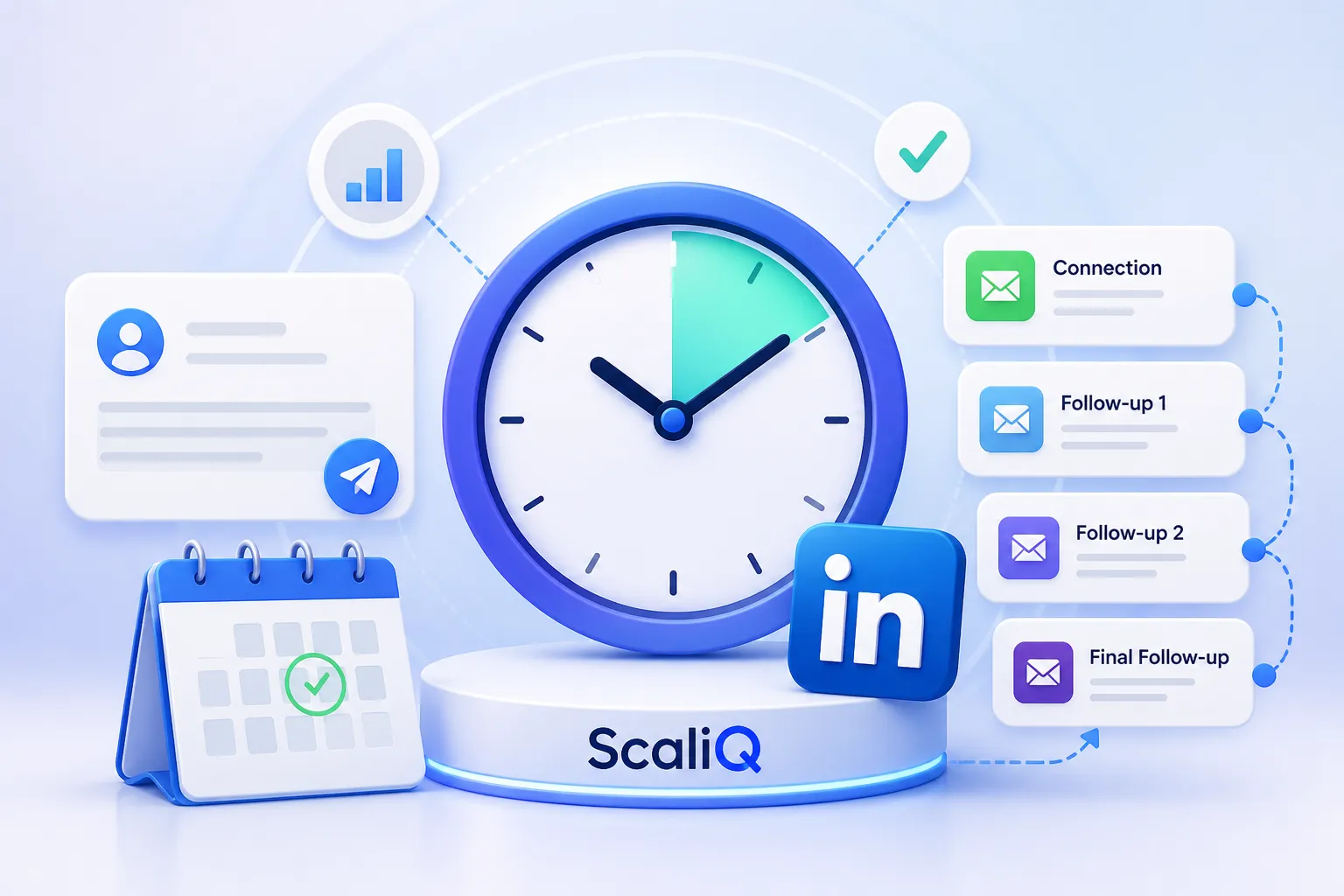
A compact cadence timeline might look like this:
• Day 1: Connection accepted.
• Day 2: Message 1 (Context).
• Day 5: Message 2 (Value).
• Day 10: Message 3 (Low-friction request).
• Day 17: Message 4 (Close the loop).
Always keep a record of the connection date, current message stage, last interaction, engagement signals, next action, and stop conditions. Using a platform like ScaliQ is a practical way to organize follow-up timing, message progression, and next actions efficiently.
Message 1 — Acknowledge the Connection and Establish Context
Your first LinkedIn connection accepted message should reference the original connection reason, a shared professional interest, a recent company update, or a mutual connection. Keep this first follow-up conversational and concise. A core rule of LinkedIn outreach best practices is to avoid immediately asking for a meeting in this first message unless the prospect has already explicitly indicated interest.
Message 2 — Add Value Before Asking for Time
If there is no response to your first message, your next step is to share one useful insight, observation, resource, or answer related to the prospect’s context. Value-led follow-up is vastly preferable to repeating a product description because it proves you understand their world. Keep the message highly relevant and easy to respond to. This aligns with standard professional networking follow-up etiquette, which champions specific, respectful outreach and knowing how to properly close the loop after no response.
Message 3 — Make a Low-Friction Request
When the time comes to make an ask, suggest calls to action that require far less commitment than a full 30-minute sales meeting. Ask whether the topic is relevant to their current quarter, invite a brief reply, offer to send a specific resource, or ask if a short conversation would be useful later.
Match the weight of your request to the amount of interest shown. Reviewing effective LinkedIn follow-up message examples shows that avoiding pressure, false urgency, or stacking multiple questions in one message yields the best LinkedIn sales message timing and response rates.
Message 4 — Close the Loop
The purpose of a final follow-up is to make the next step clear, give the prospect permission not to respond, and protect the long-term professional relationship. Use a brief "no pressure" or "I’ll close the loop for now" structure without sounding passive-aggressive or manipulative. A final message is exactly that—final. It should not be used as a trick to restart indefinite contact.
How to Adjust Follow-Up Timing Based on Reply and Engagement Signals
Your LinkedIn follow-up strategy must prioritize replies and clear intent over calendar timing alone. A rigid sequence fails when it cannot adapt to human behavior.
You must distinguish between a prospect saying "not now" (timing issue), "not enough relevance" (messaging issue), and "not interested" (targeting issue). Before you change only the send time of your next message, consider changing the message angle.
Here is how to interpret LinkedIn reply signals and adjust your LinkedIn message follow-up after no response or active engagement.
If the Prospect Replies Positively
Prioritize a timely, same-day response while the conversation is active. Answer the prospect’s question directly before introducing another request or moving to the next step. Move the conversation from general relevance to a specific, agreed-upon next step. Never allow an automated sequence to restart or continue after the prospect has actively engaged.
If the Prospect Gives a Vague or Delayed Response
Treat phrases like "send me more information" or "maybe later" as an invitation to clarify, not as definite buying intent. Ask one focused follow-up question to gauge their actual needs. Offer a relevant resource or a future follow-up option, and if they provide a specific timeline (e.g., "check back in Q3"), record that agreed timing and pause your LinkedIn outreach sequence until then. This is the cornerstone of respectful LinkedIn prospect follow-up.
If the Prospect Views the Message but Does Not Reply
A message view alone does not prove interest, availability, or rejection. People often read messages while busy and forget to reply. Avoid sending an immediate, guilt-inducing "just checking in" message. Wait according to your planned sequence, then use a completely new, relevant angle for your next message. Stop if there are no meaningful engagement signals after the defined sequence ends.
If the Prospect Declines or Asks Not to Be Contacted
End the sequence immediately. Do not attempt to "overcome the objection" of a clear request to stop. Record the outcome in your CRM or tracking system so future outreach does not restart accidentally. Reinforcing trustworthiness, consent, and professional communication is vastly more important than treating persistence as an automatically positive trait.
A Beginner-Friendly LinkedIn Follow-Up Decision Tree
To prevent both premature pitching and endless follow-up, use this simple decision tree to determine your next move and master your LinkedIn follow-up cadence.
1. Did the prospect reply?, Yes → Answer the reply immediately and continue the conversation naturally., No → Continue to the next question.
2. Did the prospect show a clear engagement signal (e.g., profile view, content like)?, Yes → Tailor the next message to that specific signal., No → Use a relevant, value-led follow-up after a reasonable pause (2-3 days).
3. Was the original connection warm or highly contextual?, Yes → Refer directly to the shared context in your next message., No → Establish relevance and provide value before making any ask.
4. Has the prospect declined or requested no further contact?, Yes → Stop immediately., No → Continue only within the boundaries of your defined sequence.
5. Has the sequence reached its final step without meaningful engagement?, Yes → Send a respectful "close the loop" message and stop.
Knowing exactly when to follow up after connecting on LinkedIn becomes straightforward when you follow logical steps. You can explore additional outreach and follow-up guidance by visiting the Blog.
Common LinkedIn Follow-Up Mistakes and Better Alternatives
Even with a solid LinkedIn follow-up strategy, it is easy to fall into bad habits. Here are the most common beginner mistakes and their practical alternatives:
• Mistake: Pitching immediately after acceptance. Alternative: Acknowledge the connection and establish relevance first.
• Mistake: Treating a connection acceptance as buying intent. Alternative: Treat it as a neutral networking signal until they engage.
• Mistake: Sending the exact same message repeatedly. Alternative: Change the angle and offer new value in every follow-up.
• Mistake: Following up too frequently (e.g., every day). Alternative: Space messages out progressively (2 days, then 4 days, then 7 days).
• Mistake: Ignoring the prospect’s actual reply or question to stick to a script. Alternative: Pause any sequence and write a custom, human response.
• Mistake: Using generic personalization (e.g., "I see you work in [Industry]"). Alternative: Reference a specific company initiative or recent post.
• Mistake: Relying only on message views to dictate timing. Alternative: Rely on actual replies and clear intent signals.
• Mistake: Continuing to follow up after a clear decline. Alternative: Respect the "no" and close the file.
A consistent process should always leave room for human judgment. ScaliQ’s signal-based approach strongly contrasts with older tools or workflows that focus primarily on fixed cadences and sheer message volume. The true competitive opportunity in LinkedIn prospecting tips lies in pacing your timing based on prospect intent, using context-sensitive messaging, maintaining time-zone awareness, adhering to clear stopping rules, and utilizing responsible workflow support. For those looking to manage or improve broader professional outreach conversations across multiple channels, tools like Repliq.Co can also serve as a related resource for maintaining quality communication, provided you adhere to strict LinkedIn outreach best practices.
How Many Times Should You Follow Up Before Stopping?
Before sending your first message, you should define a small, finite sequence. Knowing how many times to follow up on LinkedIn depends heavily on relationship strength, message relevance, prospect engagement, and your overall outreach objective.
If a prospect has given a future follow-up date, adhere to it strictly. Otherwise, a standard sequence should rarely exceed three to four carefully spaced messages.
Follow this simple stopping framework:
• Stop immediately after a clear "no."
• Stop immediately after a request not to be contacted.
• Close the loop after the planned sequence produces no meaningful response.
• Re-enter the conversation months later only when there is a genuinely relevant new reason (e.g., they changed jobs, their company raised funding) and the relationship context supports it.
A final LinkedIn follow-up message after no response should be a respectful close, giving them an easy out. It should never be a disguised attempt to restart the exact same pitch. ScaliQ’s expertise in contact limits emphasizes that knowing when to walk away is critical to preserving your sender reputation and brand trust.
Measure and Improve Your LinkedIn Follow-Up Timing
To optimize your LinkedIn follow-up timing, test your messaging and progression by specific audience segments rather than changing everything at once.
Compare directional intervals to see what yields the best response. For example, test sending a message on the same day versus waiting for a short pause. Test a 24–48 hour delay versus waiting several days. Compare a shorter, three-step sequence against a more spaced-out, four-step sequence.
When measuring your LinkedIn outreach sequence, track quality-focused measures rather than vanity metrics:
• Reply rate (overall).
• Positive reply rate (the most important metric).
• Number of meaningful conversations generated.
• Meetings booked.
• Opt-outs or negative responses.
• Sequence completion and stop-rule compliance.
Reply volume alone is insufficient if those messages create poor-fit conversations, annoy prospects, or result in high opt-out rates.
Encourage a culture of documentation within your outreach. Record the segment, time zone, connection context, message stage, timing interval, and ultimate outcome. Keep in mind that all results are directional and may vary wildly by audience, industry, offer, and message quality. Testing is a practical learning process to refine your LinkedIn outreach best practices, not a guarantee of overnight success.
Conclusion: Use Timing to Create Better Conversations, Not More Messages
Mastering LinkedIn follow up timing requires a shift in mindset: a connection acceptance is not automatically buying intent. To succeed, you must start with context and relevance, use a staged progression instead of repeated pitches, and adapt your timing to replies and engagement signals. Space out your follow-ups when there is no response, and always stop respectfully after a clear decline or a completed sequence.
The best timing will always depend on the prospect’s context, their availability, their behavior, and the specific purpose of your next message. Before you send your next connection request, take five minutes to create a simple, signal-based timing plan.
To seamlessly organize your follow-up timing, message progression, reply signals, and stopping rules, visit ScaliQ. ScaliQ provides the practical framework and responsible contact limits you need to turn your LinkedIn follow-up strategy into a driver of genuine, high-quality professional conversations.