

Introduction: Why Upmarket Signals Matter for LinkedIn Outreach
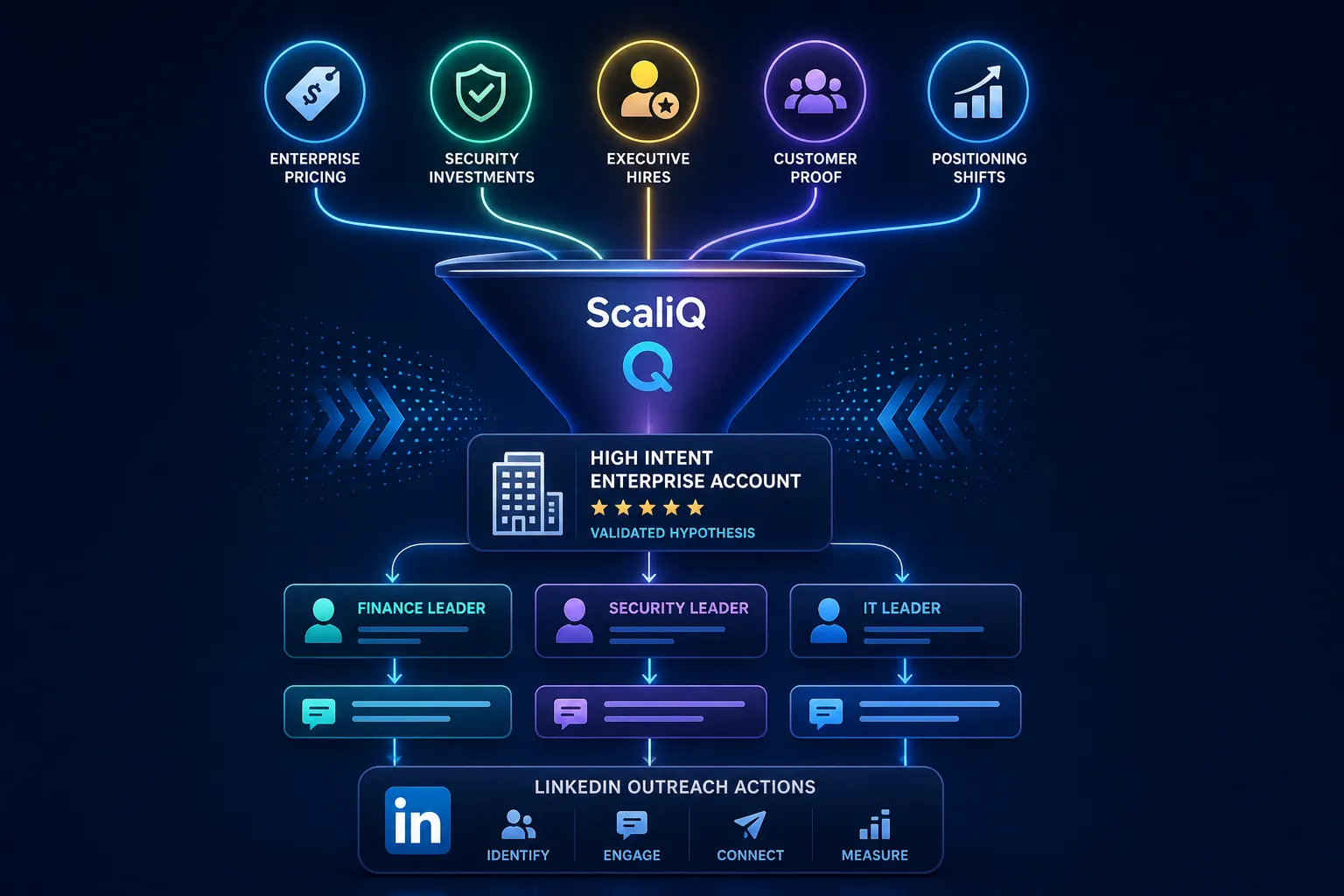
Companies rarely announce a complete upmarket strategy in a single, definitive public statement. Instead, their movement toward larger, more complex customers is usually visible through a steady pattern of structural changes across pricing, security compliance, executive hiring, product packaging, and market positioning.
The central problem for modern go-to-market organizations is that sales teams often notice these isolated changes but fail to translate them into cohesive account prioritization, stakeholder selection, and relevant outreach. A seller might notice a new Chief Revenue Officer on LinkedIn, but without connecting that hire to a recent shift in enterprise pricing, the resulting outreach remains generic and easily ignored.
This guide provides a practical system for moving from signal detection to a validated account hypothesis, mapping the buying group, crafting role-specific messaging, and measuring the results. A successful LinkedIn outreach strategy for companies moving upmarket is not about assuming immediate buying intent from one isolated event, nor is it about using invasive personalization. It is about documenting publicly observable evidence, separating verified facts from assumptions, and deploying a low-friction business hypothesis to start a meaningful conversation.
As a go-to-market research and signal-intelligence resource, ScaliQ focuses on interpreting these exact enterprise pricing shifts, security feature rollouts, executive hires, and positioning changes. We treat public company changes as coordinated GTM signals rather than isolated alerts. However, it is critical to remember that public signals indicate a hypothesis—an upmarket sales trigger—not confirmed buying intent. Every enterprise expansion prospecting motion must be human-validated before any outreach begins.
Recognizing the Signals of an Upmarket Move
There is a distinct difference between ordinary company growth and a deliberate upmarket go-to-market strategy. Adding headcount or opening a new office indicates scale, but altering product governance or hiring a specialized enterprise sales leader indicates a strategic shift.
To execute effective enterprise sales prospecting, teams need a trigger taxonomy that helps identify changes in the account’s actual go-to-market motion. When observing sales trigger events, sellers must distinguish what the observation confirms (e.g., a new pricing tier exists), what it may imply (e.g., the company wants larger contract values), and what it does not prove (e.g., the company has an immediate budget for new software). Always record the signal source, date, confidence level, and likely business implication before initiating contact.
Enterprise Pricing, Packaging, and Commercial Changes
One of the most reliable indicators of an upmarket shift is an update to a company's commercial structure. This includes the introduction of new enterprise pricing tiers, custom "Contact Sales" pricing language, a shift toward annual-contract positioning, usage-based packaging, or features explicitly designed for larger accounts (such as single sign-on or advanced admin controls).
Pricing and packaging changes strongly suggest a shift toward larger contract values, more complex buying processes, or entirely new customer segments. However, sellers must avoid treating a pricing page update alone as undeniable proof of an enterprise motion. A pricing page sales signals approach works best when paired with another indicator, such as an executive hire or a security investment.
A seller can convert this observation into a neutral hypothesis: Because the company is updating its pricing tiers, they may be preparing to support larger accounts and might be reviewing their commercial or operational infrastructure to support that enterprise expansion prospecting.
Security, Compliance, and Implementation Readiness
As companies move upmarket, they inevitably encounter stricter procurement and IT requirements. Public indicators of this shift include new security features (like SOC 2 or ISO 27001 compliance announcements), governance capabilities, dedicated implementation resources, or enterprise risk messaging.
These changes directly reflect the requirements of larger buyers, procurement teams, legal departments, and security reviewers. This signal connects to critical enterprise concerns such as data protection, implementation risk, operational continuity, and vendor approval workflows. As highlighted in the research on enterprise buying centers, security, legal, procurement, and technical stakeholders heavily influence enterprise purchases.
When executing enterprise buyer outreach based on security compliance sales triggers, use only publicly verifiable statements. Phrase your assumptions as questions rather than conclusions, and avoid making unsupported claims about a prospect’s internal compliance status or security maturity.
Executive Hires and Commercial Leadership Changes
Leadership transitions are powerful indicators of strategic realignment. New appointments for a Chief Revenue Officer (CRO), VP of Enterprise Sales, Chief Information Security Officer (CISO), Chief Marketing Officer (CMO), or VP of Partnerships often serve as an upmarket sales trigger.
However, the same executive hire can signal vastly different priorities depending on the role. A new CRO may indicate a push for commercial scaling and enterprise pipeline generation. A new CISO may be tasked with building the trust requirements necessary to close enterprise deals. A new product leader may indicate a shift toward enterprise-grade packaging or product-market expansion.
Executive hiring sales intelligence becomes exponentially stronger when it aligns with pricing updates or security investments. Before initiating executive-level LinkedIn outreach, research the executive’s specific remit, past experience, and public priorities to ensure your message is highly relevant.
Customer Proof, Partnerships, Product Packaging, and Positioning
Companies signal their upmarket intentions through the company they keep and the stories they tell. This includes showcasing new enterprise customer logos, publishing complex case studies, announcing strategic partnerships, repositioning their category, or revising website language to target a higher-level buyer.
Customer proof indicates that the company is actively building credibility with larger accounts. Partnerships may suggest expanded distribution channels or new implementation capacity required for enterprise deployments. These positioning changes can reveal a target-account shift well before the company publishes a formal go-to-market announcement.
When conducting account-based prospecting on LinkedIn, look for combinations of these signals rather than overreacting to one logo or one website update. A coordinated go-to-market motion shift is best understood by analyzing multiple data points. For teams looking to operationalize this, ScaliQ ScaliQ serves as a dedicated resource for interpreting public GTM signals and turning company changes into actionable account hypotheses.
Validating and Scoring Enterprise Expansion Accounts
Moving from signal collection to account prioritization is critical. Without a validation process, sales teams risk pursuing every account that shows low-confidence activity, wasting time and burning bridges.
The core operating artifact for enterprise expansion prospecting is the account hypothesis. This framework defines what changed, what it may mean, which business priority it suggests, and who within the organization may care. Sellers must strictly separate direct observations from their own interpretations and proposed outreach angles.
Build an Account Hypothesis Before Writing the Message
Before drafting a single message, build a repeatable account-research structure to guide your enterprise account-based selling:
• Observation: What specific, public change occurred?
• Source and date: Where and when was this change observed?
• Possible implication: What larger business priority might this reflect?
• Relevant stakeholders: Which roles may own or influence that priority?
• Evidence gap: What information is missing and still needs to be validated?
• Outreach hypothesis: What useful question or point of view could begin a conversation?
The hypothesis should connect the upmarket sales trigger to a measurable business issue, such as enterprise revenue growth, deal size, retention, sales efficiency, implementation readiness, or buyer trust. Crucially, warn your team against claiming that a company is “definitely moving upmarket” without corroborating evidence. Frame it as a strategic possibility within the enterprise buyer journey.
Use a Two-Signal or Three-Signal Validation Rule
To reduce false positives caused by ordinary company growth or isolated announcements, require at least two related signals before prioritizing an account for direct outreach. Use a three-signal rule when the evidence is ambiguous or the account is of high strategic importance.
Explore combinations such as:
• Enterprise pricing + a new commercial executive
• Security investment + enterprise customer proof
• Revised positioning + enterprise-focused product packaging
• Partnership announcement + a hiring pattern aligned to larger customers
Corroboration is the foundation of multi-signal account intelligence. While AI-assisted research can help discover these patterns at scale, human review is absolutely necessary to verify the signal, check its recency, and confirm its relevance to the account hypothesis. Classify your findings: High confidence when signals are recent, related, and independently sourced; Medium confidence when the pattern is plausible but incomplete; and Low confidence when the ICP expansion relies on one weak signal.
Score Fit, Timing, Trigger Strength, and Stakeholder Accessibility
Once validated, apply a practical scoring model using four dimensions to prioritize your LinkedIn enterprise prospecting:
• Enterprise fit: Does the account match your target customer profile?
• Trigger strength: How clearly do the observed changes suggest an upmarket motion?
• Timing: Are the signals recent enough to support timely, relevant outreach?
• Accessibility: Can the team identify and responsibly reach the relevant stakeholders?
A strong trigger never compensates for poor ICP fit. Prioritize accounts where the signal pattern, commercial relevance, and stakeholder access perfectly intersect. This deliberate framework stands in stark contrast to volume-led, automated workflows that scrape data to blast generic emails. While broad discovery platforms can surface accounts, enterprise success requires a consistent interpretation and scoring framework focused on validated hypotheses, human-reviewed evidence, and pipeline relevance. To see how teams can operationalize signal tracking and account scoring effectively, explore Blog ScaliQ’s broader GTM and research resources.
Mapping the Enterprise Buying Committee
Contacting a single senior executive is rarely sufficient for an enterprise motion. An upmarket shift impacts the entire organization. The same upmarket signal represents entirely different priorities for commercial, product, technical, security, procurement, and end-user stakeholders.
Mapping the enterprise buying committee connects your outreach to message relevance, internal consensus building, risk reduction, and overall account progression.
Identify the Economic Buyer, Champion, and Functional Owners
Begin by mapping the likely economic buyer—the individual responsible for budget allocation or strategic outcomes. Next, identify a functional champion who experiences the operational problem directly and possesses the internal capital to advance an evaluation.
Depending on the signal, add relevant commercial, marketing, product, or RevOps leaders. If the signal involves revenue growth or packaging, a CRO or VP of Product is essential. The first contact in your B2B social selling motion should be selected based on the trigger and the business hypothesis, not solely on their seniority. As noted in the research on social media in organizational buying, LinkedIn plays a vital role in supporting information discovery and interpretation across multiple members of an organizational buying unit.
Include Technical, Security, Legal, Procurement, and User Stakeholders
Enterprise readiness requires more than just a willing sales leader. Security, technical, legal, procurement, and end-user roles become highly relevant—especially following security compliance sales triggers, governance updates, or enterprise packaging signals.
Research the committee without assuming that every role has final decision authority. Document each stakeholder’s likely concern, the evidence they will need to see, and the appropriate communication angle. A commercial conversation may create initial interest, but risk and implementation stakeholders ultimately determine whether an opportunity progresses through the enterprise buyer journey. The systematic review of enterprise buying centers supports this reality: distributed influence and complex buying-center dynamics define enterprise sales prospecting.
Create a Stakeholder-Specific Message Hypothesis
A role-based framework ensures your LinkedIn outreach personalization hits the mark:
• Founder or CEO: Focus on strategic expansion, market positioning, and enterprise growth.
• CRO or VP Sales: Focus on pipeline quality, deal size, sales efficiency, and enterprise revenue.
• Product leader: Focus on packaging, use-case expansion, adoption, and implementation requirements.
• CISO or security leader: Focus on trust, governance, security review, and risk reduction.
• RevOps or marketing leader: Focus on account prioritization, signal quality, and measurable GTM execution.
Use the prospect’s observable change as context, then ask a question that tests the hypothesis. Never insert personal details that are unrelated to the business change, as this can feel invasive and unprofessional during enterprise buyer outreach.
Building Signal-Based LinkedIn Outreach
Treat your LinkedIn outreach strategy for companies moving upmarket as a carefully sequenced series of relevant actions, rather than one generic connection request. The objective is to start a credible business conversation, not to force a meeting before the account hypothesis is even validated. Combine your LinkedIn activity with supporting email, content sharing, executive engagement, or warm introductions.
Use an Observation–Implication–Question Structure
When crafting your B2B social selling messages, rely on a strict framework:
• Observation: Reference a relevant, publicly verifiable company change.
• Implication: Explain the business issue, challenge, or priority that the change may create.
• Question: Ask a low-friction question that allows the prospect to confirm or correct your hypothesis.
Avoid leading with product features, exaggerated familiarity, or unsupported statements about the prospect’s internal strategy. Use one clear signal in the first message, reserving additional evidence for later in the conversation. Ensure the messaging strategy reflects the recipient’s specific role rather than copying and pasting the same text across the entire buying committee.
Adapt the Message to the Trigger
Create a trigger-to-message matrix to guide your enterprise buyer outreach:
• Enterprise pricing or packaging: Ask how the team is adapting their qualification, segmentation, or enterprise sales coverage to support the new tiers.
• Security or compliance investment: Ask how new security requirements are affecting their enterprise evaluation and implementation timelines.
• Executive commercial hire: Ask which upmarket priorities the new leader is expected to accelerate.
• Customer proof or partnership: Ask how the company is translating their new credibility or distribution channels into enterprise pipeline.
• Positioning shift: Ask which specific buyer segment or business problem the revised positioning is designed to reach.
Every message must include a credible reason for contacting that specific person. End with a low-pressure call to action (CTA), such as asking if the hypothesis is directionally accurate, offering a relevant industry benchmark, or proposing a brief exchange of perspectives.
Sequence LinkedIn Touches Without Becoming Repetitive
Outline a practical LinkedIn outreach sequence without prescribing unsupported performance benchmarks. A standard flow for enterprise sales prospecting includes:
• Touch 1: Engage with relevant public content or send a concise connection request tied directly to the business change.
• Touch 2: Share a specific observation or question after the connection is accepted.
• Touch 3: Add a role-relevant point of view, a helpful resource, or a diagnostic prompt.
• Touch 4: Follow up with a clear reason to continue the dialogue or politely close the loop.
Know when to stop. Cease outreach if there is no response, if you uncover weak evidence, if the prospect invalidates your hypothesis, or if there are signs the message is irrelevant. Coordinate this activity with email and executive engagement so the account does not receive disconnected repetitions. The sequence should optimize for qualified conversation and account progression. For context on engagement dynamics, refer to the peer-reviewed research on LinkedIn engagement and B2B sales, which discusses the relationship between LinkedIn engagement, website activity, and sales outcomes. For practical outreach execution, sales engagement, and coordinating follow-up actions after strategic signal research, Repliq.Co RepliQ offers robust infrastructure.
Keep Personalization Evidence-Based and Respectful
Responsible LinkedIn outreach personalization means using relevant public business information to improve timing and relevance. It does not mean collecting unnecessary personal details. Name the source or context naturally, without appearing to monitor every prospect's daily activity.
Avoid making assumptions about a prospect's budget, strategic intent, internal operational problems, or security posture. Always respect platform rules, privacy expectations, and the fundamental difference between publicly observable information and confirmed buyer intent. Include a validation question that gives the recipient an easy, face-saving way to correct your interpretation.
Measuring Qualified Engagement and Pipeline Influence
To evaluate an upmarket LinkedIn motion, revenue teams must move beyond vanity metrics like connection volume, acceptance rates, and generic reply counts. Because enterprise opportunities involve multiple stakeholders and longer progression paths, LinkedIn outreach metrics must be measured at the account and buying-group level. Capture both leading indicators and revenue-related outcomes.
Track Signal and Research Quality
First, measure whether the team is finding useful, timely, and corroborated signals. High-quality account intelligence is the bedrock of enterprise expansion prospecting. Suggested research metrics include:
• Percentage of prioritized accounts with two or more validated signals.
• Average signal recency and source quality.
• Percentage of hypotheses confirmed, corrected, or invalidated by prospects.
• Coverage of relevant stakeholders mapped within priority accounts.
Invalidated hypotheses are not failures; they are highly useful learning signals that improve future scoring models and prevent sellers from wasting time on poor outreach.
Measure Qualified Engagement and Account Progression
Prioritize metrics that demonstrate whether the account is actually becoming more engaged and accessible to your sales team:
• Positive replies from target roles (not just polite declines).
• Meetings booked with relevant economic buyers, champions, or technical stakeholders.
• Buying-group coverage and multi-threading within priority accounts.
• Repeat engagement with relevant content or resources.
• Movement from a target account to a qualified opportunity.
• Opportunity creation, stage progression, and overall pipeline influence.
Distinguish a polite response or a simple connection acceptance from a qualified business conversation. Tag the original sales trigger events and the account hypothesis in your CRM or RevOps reporting. This allows teams to review exactly which signals consistently contribute to pipeline progression, echoing the principles found in the peer-reviewed LinkedIn engagement research cited earlier.
Improve the Framework Through Test-and-Learn Reviews
Continuously review performance by trigger category, stakeholder persona, message angle, CTA, and sequence stage. Compare accounts that were engaged based on a single signal against accounts with corroborated signals to test whether multi-signal validation improves conversation quality.
Document which specific messages generate useful corrections, positive replies, meetings, or multi-stakeholder engagement. Use these findings to refine your trigger taxonomy and scoring model, rather than simply increasing outreach volume to compensate for low conversion.
Conclusion: Turn Public Change Into Enterprise Pipeline
Successfully prospecting into companies moving upmarket requires discipline. The core process is clear: identify an upmarket sales trigger, validate it with related evidence, build a robust account hypothesis, score the account, map the enterprise buying committee, tailor the message to the stakeholder, and measure qualified progression.
Companies moving upmarket create observable public changes, but those changes only become valuable when sellers connect them to business priorities and stakeholder needs. Begin by focusing on one specific trigger category—such as enterprise pricing updates, security investments, or executive hiring—and test this framework against a defined account segment.
To explore a deeper approach to GTM research, account signals, and enterprise expansion prospecting, ScaliQ discover ScaliQ’s signal-intelligence resources and start turning public GTM changes into measurable enterprise pipeline.