


LinkedIn Outreach for Corporate Legal Services Providers
Successful LinkedIn outreach for corporate legal services providers is not about maximizing connection volume or deploying generic automated messaging. It is about identifying high-fit companies, understanding nuanced buying committees, and creating credible, trust-based business conversations. Far too often, corporate legal providers rely on generic prospect lists and broad service pitches that fail to reflect a target company’s growth stage, international footprint, regulatory exposure, or organizational complexity.
This article provides a repeatable, compliance-conscious workflow for generating, qualifying, and nurturing corporate legal leads through LinkedIn. By adopting a strategic framework—spanning account segmentation, stakeholder mapping, trigger-based research, message personalization, compliant execution, follow-up, and pipeline measurement—firms can build a sustainable legal services lead generation engine. Positioned at the forefront of this methodology, ScaliQ serves as a strategic prospecting partner for corporate legal services providers, specializing in segmenting prospects by growth stage, international presence, and corporate complexity to drive meaningful executive engagement.
Define the Right Corporate Legal Prospect Before Starting Outreach
A precise ideal customer profile (ICP) is the foundation of relevant LinkedIn outreach and a more qualified pipeline. The best-fit prospect is defined by much more than industry or employee count. True qualification requires evaluating legal complexity, growth trajectory, geographic exposure, and the likely need for external counsel or specialized support.
Account selection must connect directly to the provider’s actual capabilities, jurisdictional coverage, practice areas, and preferred client profile. By rigorously separating high-fit accounts from low-intent contacts before sending a single connection request, business law firm prospecting becomes vastly more efficient, yielding higher-quality corporate legal leads and a stronger return on legal services sales prospecting efforts.
Segment Accounts by Growth Stage
Legal requirements differ drastically across startups, scale-ups, established enterprises, and multinational organizations.
• Startups: Look for signals related to recent funding rounds, initial incorporation, early commercial agreements, employment growth, and preparation for market expansion.
• Scale-ups: Focus on operational complexity. These companies are entering new markets, accelerating hiring, forming strategic partnerships, executing transactions, and recognizing the need to formalize internal legal processes.
• Established Enterprises: Consider multi-entity corporate structures, rigid procurement processes, international operations, and the need for seamless coordination across internal legal teams.
When executing corporate legal prospecting, it is critical to use growth-stage segmentation to inform your approach. However, avoid implying that a company inherently needs legal advice based on a single public signal; public data merely indicates a potential conversation entry point, not a definitive legal lead qualification.
Evaluate International Presence and Corporate Complexity
International operations routinely create complex requirements involving multiple jurisdictions, subsidiary entities, cross-border contracts, and distributed internal stakeholders. A practical segmentation framework for international legal services should categorize accounts into:
• Domestic or single-jurisdiction businesses.
• Internationally expanding companies establishing their first foreign footprints.
• Multinational organizations with widely distributed operations.
• Complex corporate groups with numerous entities, subsidiaries, or distinct business lines.
Corporate complexity dictates your messaging strategy. The outreach message sent to a founder of a single-jurisdiction startup should never be the same as the one sent to a general counsel or procurement leader at a complex corporate group. Note that while public company information can inform cross-border legal prospecting prioritization, it does not establish a legal conclusion, a regulatory breach, or a specific, confirmed legal need.
Identify the Corporate Legal Buying Committee
Within complex organizations, multiple roles influence a legal-services decision. A comprehensive corporate counsel prospecting strategy must map out:
• Founders and CEOs.
• General counsel (GC) and chief legal officers (CLO).
• In-house legal team members and specialists.
• Legal operations leaders.
• CFOs and finance leaders.
• Procurement stakeholders.
• Compliance, HR, or risk executives (where relevant).
Understanding legal buyer personas means recognizing the difference between the person experiencing the business issue, the legal decision-maker, the budget owner, and the procurement gatekeeper. General counsel outreach might focus on specialist support, while a CFO cares about cost predictability. Map multiple relevant stakeholders within a priority account rather than relying on a single point of contact.
Use Business Triggers to Create a Legitimate Reason for Contact
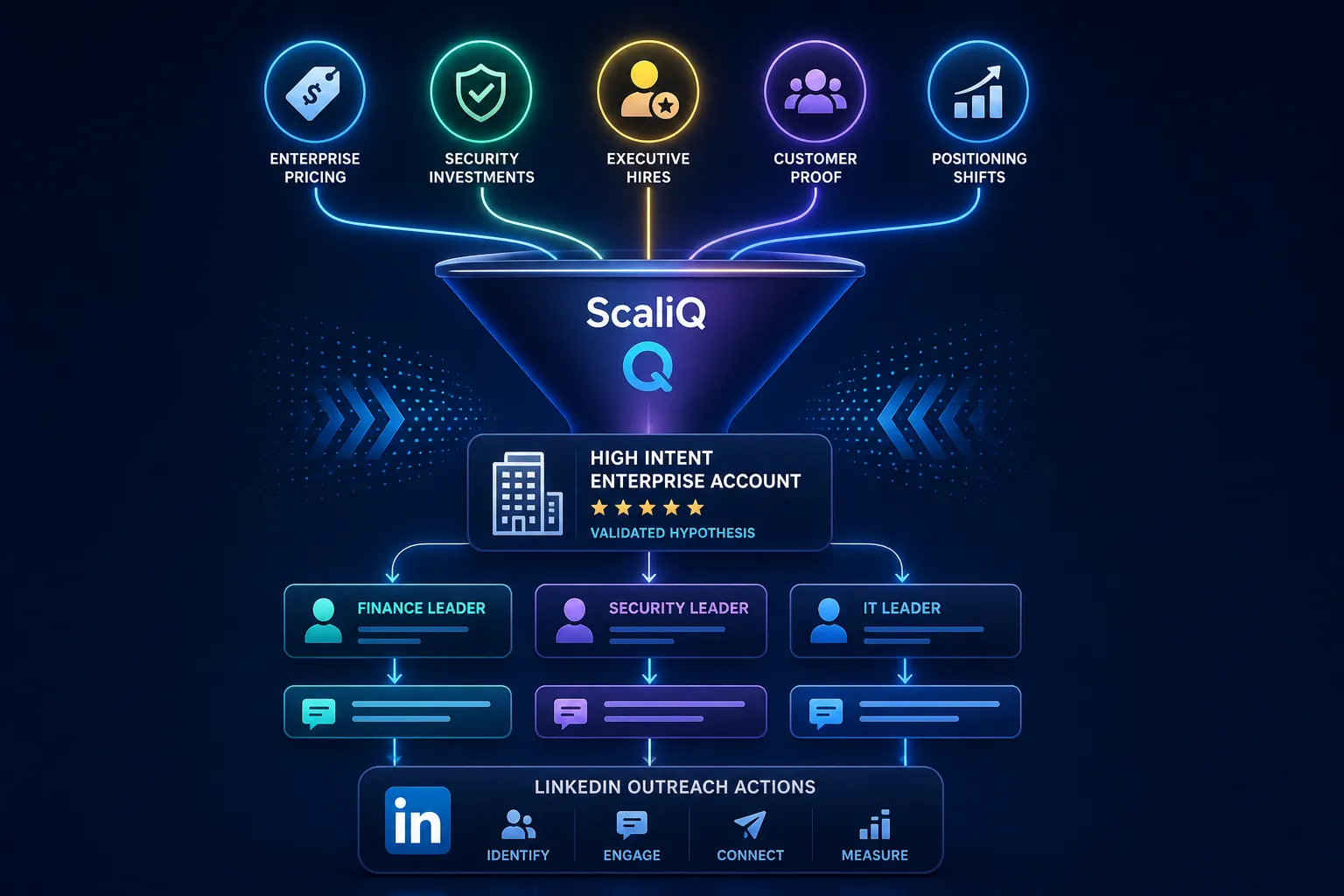
Research-led, trigger-based outreach is vastly more relevant than generic messages listing legal services. A trigger is a publicly observable business development that creates a logical reason to research an account and initiate contact. It is not proof that the company requires a particular legal service.
Prioritize triggers that are recent, relevant to your firm’s capabilities, and appropriate to reference without revealing or assuming confidential information. Document the trigger, its source, the date, and its potential business relevance before reaching out to a prospect to ensure your corporate legal business development efforts remain contextual and professional.
High-Value Corporate Events to Monitor
Effective account-based prospecting relies on monitoring high-value corporate events, such as:
• Funding rounds or major investment activity.
• International expansion or office openings.
• Acquisitions, mergers, or strategic partnerships.
• Significant hiring surges across legal, finance, or operations departments.
• New market, product, or jurisdiction launches.
• Corporate restructuring or changes in executive leadership.
• Publicly announced regulatory or compliance developments within their sector.
Turn these corporate legal opportunities into thoughtful questions or useful resources rather than direct sales pitches. When engaging in legal services prospecting, meticulously distinguish confirmed public information from assumptions.
Match Triggers to the Most Relevant Stakeholder
A single business trigger matters differently depending on the executive's role:
• Founders/CEOs care about speed, risk mitigation, and expansion readiness.
• General Counsel care about internal capacity, specialist support, and external coordination.
• CFOs care about financial predictability, commercial risk, and operational efficiency.
• Procurement Leaders care about vendor qualification, scope clarity, and process adherence.
Select your primary contact based on the trigger's nature, and identify secondary stakeholders to ensure comprehensive coverage. CFO prospecting requires a fundamentally different angle than outreach to general counsel or legal operations leaders.
Build a Research Brief Before Sending a Message
Before initiating LinkedIn lead generation for law firms, compile a concise account research brief containing:
• Company stage and corporate structure indicators.
• International presence or jurisdictional footprint.
• The relevant business trigger.
• The contact’s role and likely influence.
• Existing legal or operational context visible publicly.
• A relevant educational asset or conversation angle.
Human review of every brief before outreach is mandatory. Emphasize confidentiality, accuracy, and professional discretion in legal lead qualification. Never use or disclose non-public information, and never frame public prospect research as actionable legal advice.
Create LinkedIn Messages That Build Trust Without Giving Legal Advice
Messaging for executive and legal audiences must balance relevance, professionalism, and restraint. Generic statements like “we help businesses with all their legal needs” fall flat with corporate decision-makers. Instead, B2B law firm marketing should lead with business context, a relevant observation, a practical resource, or a low-pressure question. Keep the tone professional and executive-focused, utilizing language appropriate for intermediate marketing and business-development teams executing LinkedIn lead generation for law firms.
Structure the Initial Connection Message
A highly effective LinkedIn connection message follows a concise structure:
1. Context: Identify the specific professional or business context.
2. Signal: Reference a relevant public signal or shared area of interest.
3. Value: Explain why the connection may be useful.
4. Restraint: Avoid an immediate service catalogue or meeting demand.
Examples (to be factually reviewed and individualized):
• General Counsel: "Hi [Name], noticed [Company]'s recent expansion into [Market]. Connecting with legal leaders navigating cross-border regulatory alignment. Would love to follow your team's progress."
• Founders/CEOs: "Hi [Name], congratulations on the recent Series B. I share insights on scaling corporate governance for high-growth tech firms—thought it might be relevant to connect."
Placeholders are drafting aids only; final corporate legal outreach messages must be uniquely tailored. Avoid assumptions about their specific legal services outreach needs.
Adapt the Value Proposition by Buyer Role
Messaging should reflect the recipient’s daily responsibilities rather than listing your firm's practice areas.
• General Counsel: Focus on capacity extension, specialist support, multi-jurisdiction coordination, and business alignment.
• Founders: Focus on practical support during growth, expansion, and transaction preparation without assuming a legal problem exists.
• CFOs: Focus on budget visibility, commercial risk mitigation, and predictable billing structures.
• Legal Operations/Procurement: Focus on process integration, responsiveness, scope clarity, and vendor fit.
Aligning your value proposition with the buyer role elevates general counsel outreach and broadens law firm business development beyond standard corporate legal services marketing.
Use Thought Leadership as the Primary Conversation Asset
Sharing practical resources related to corporate growth, international operations, legal operations, or business risk is the most effective way to build trust. Educational content creates a lower-pressure path to engagement than a direct sales request.
Repurpose your firm's insights into LinkedIn posts, short videos, executive checklists, FAQs, and website resources. Connect every shared resource to a specific audience or trigger. For examples of how educational content can support LinkedIn conversations, website traffic, and B2B legal marketing strategies, explore the ScaliQ blog. Corporate legal content marketing establishes authority and paves the way for legal thought leadership to drive inbound interest.
Build a Repeatable LinkedIn Outreach Workflow
To scale this strategy, it must become an operational process used consistently without sacrificing personalization or professional judgment. A repeatable LinkedIn outreach strategy moves logically from account selection to reporting:
1. Define the target account segment.
2. Research the company and trigger.
3. Map the buying committee.
4. Prepare a role-specific message.
5. Send a controlled connection request.
6. Follow up with insight rather than pressure.
7. Qualify the response.
8. Record the outcome in the CRM.
While automation can support execution, human review must control message quality and sensitive decisions in law firm client acquisition and legal services lead generation.
Separate Research, Personalization and Execution
A structured legal business development workflow separates responsibilities:
• Research: Identify account context, triggers, and stakeholders.
• Personalization: Convert relevant information into a credible message.
• Execution: Manage timing, follow-up, and response handling.
• Measurement: Connect activity to qualified conversations and pipeline.
Separating these functions prevents rushed, generic outreach. A review checkpoint is essential before any message is sent. Note that AI-assisted prospecting and LinkedIn workflow automation require strict human verification, particularly when messages reference legal, regulatory, corporate, or cross-border matters.
Choose What to Automate and What to Keep Human-Led
Automation should support administration, not replace judgment.
Suitable automation tasks: Organizing account research, flagging potential triggers, suggesting message variations, tracking follow-up stages, updating CRM fields, and reporting on campaign activity.
Tasks requiring human control: Final account and contact selection, accuracy review, legal or regulatory interpretation, confidentiality decisions, handling sensitive replies, and escalating to a lawyer or business-development leader.
While automation-first tools flood the market, ScaliQ differentiates itself through legal-market segmentation, trust-led messaging, and compliance-aware execution, ensuring legal outreach personalization remains professional and compliant LinkedIn automation standards are met. AI prospecting for law firms must always be human-governed.
Integrate LinkedIn Activity With CRM and Website Measurement
Connect your outreach activity directly to your CRM for law firms. Track account and contact records, source and campaign fields, website visits, content engagement, qualification status, meeting outcomes, and sourced revenue.
Use consistent naming conventions for audience segments, triggers, and campaigns. Connection volume alone does not demonstrate commercial value; pipeline does. For teams looking to optimize reply management and prospecting operations within their legal services sales funnel, RepliQ is a valuable resource for streamlining LinkedIn pipeline measurement and engagement tracking.
Design a Professional Follow-Up Sequence for Corporate Decision-Makers
Persistence is necessary, but it must not become repetitive, intrusive, or overly promotional. A LinkedIn follow-up sequence for corporate legal prospecting should be based on relevance and timing rather than repeated demands for a meeting. Follow-up frequency should be determined by context, engagement, and professional judgment—not a universal number. If a prospect objects or requests no further contact, stop immediately.
Suggested Follow-Up Sequence
A practical executive LinkedIn outreach sequence includes:
• Message 1: Connection request based on role, context, or relevant business signal.
• Message 2: Thank the prospect for connecting and share a concise, highly relevant insight or resource.
• Message 3: Ask a low-pressure question about their business context, strictly avoiding requests for confidential details.
• Message 4: Offer a relevant conversation only when the prospect shows interest or the context clearly supports it.
• Final message: Close the loop respectfully, leaving the door open for future engagement.
Ensure you have alternative legal services outreach sequence paths prepared for positive replies, neutral replies, objections, and non-responses to optimize law firm business development.
Respond to Common Prospect Reactions
Corporate counsel outreach will generate varied responses. Prepare professional replies for:
• “We already have external counsel.” (Acknowledge and position as a specialist or overflow resource).
• “Send information by email.” (Comply promptly with a tailored, concise overview).
• “We are not looking right now.” (Respect the timing and offer to stay in touch via thought leadership).
• “Please contact procurement.” (Thank them and ask for the appropriate contact's name).
• “What specific service do you provide?” (Clarify based on their role and business trigger).
Respect existing relationships and avoid criticizing incumbent providers. Crucially, avoid providing personalized legal advice in unsolicited messages. If a prospect describes a legal issue, recommend an appropriate professional conversation rather than offering definitive conclusions, ensuring rigorous law firm lead qualification and proper handling of legal prospecting objections.
Protect Trust, Privacy and Professional Reputation
Generic LinkedIn outreach playbooks often underemphasize compliance and risk controls. Requirements vary by jurisdiction, communication channel, professional rules, and organizational policy. A written outreach policy covering data sources, message review, retention, opt-outs, escalation, and account security is essential for compliant legal marketing and professional conduct in legal outreach.
Apply Data-Protection and Direct-Marketing Controls
Privacy-conscious prospecting requires using accurate, appropriately sourced prospect information and avoiding the collection of unnecessary personal data. Document the purpose of using prospect information and respect all objections and requests to stop contact. Always review whether an outreach channel and message are appropriate for the target jurisdiction.
Organizations must adhere to the ICO direct marketing guidance regarding transparency, lawful planning, data protection by design, and honoring objections. Furthermore, strictly observe GDPR direct-marketing rights concerning profiling, automated processing, and the absolute right to object. This article is not a substitute for jurisdiction-specific legal marketing compliance advice.
Extend Controls to Email and Multichannel Follow-Up
A LinkedIn conversation frequently transitions to email, creating additional compliance and recordkeeping considerations. Multichannel legal outreach must distinguish between LinkedIn messaging rules and commercial email regulations.
When executing compliant sales outreach via email, adhere strictly to the FTC CAN-SPAM compliance guide. This includes providing truthful sender information, accurate subject lines, physical-address requirements, and clear opt-out mechanisms for applicable commercial email.
Secure Outreach Accounts and Protect Prospect Information
To ensure secure LinkedIn outreach and prospecting data security, implement:
• Strong authentication and controlled access.
• Monitoring for unusual account activity.
• Clear permissions for team members and external vendors.
• Secure handling of CRM and prospect information.
• An incident-response process for compromised accounts or data.
Firms should follow the CISA social-media account protection guide for authentication, monitoring, and response protocols. Additionally, consult NIST phishing guidance to mitigate social media account protection risks, impersonation, and social-engineering threats in professional messaging.
Measure LinkedIn Outreach by Qualified Pipeline, Not Connection Volume
An executive measurement framework links activity to meaningful business outcomes. Distinguish between visibility metrics, engagement metrics, qualification metrics, and revenue metrics. Report by audience segment, growth stage, trigger, buyer role, and campaign. Most importantly, clearly define a qualified corporate legal lead before measurement begins to ensure accurate law firm pipeline reporting.
Track the Core Outreach Metrics
Key LinkedIn outreach KPIs include:
• Connection acceptance rate.
• Response rate and positive response rate.
• Qualified conversation rate.
• Meetings or referral conversations booked.
• Website visits and content engagement driven by outreach.
• Opportunities created.
• Sourced or influenced revenue.
Acceptance rate alone may merely reward broad, untargeted outreach rather than commercial quality. Review response quality and fit alongside numerical volume to accurately gauge legal services marketing analytics and corporate legal lead metrics.
Create a Corporate Legal Lead-Qualification Checklist
Assess each prospect systematically:
• Fit with the provider’s practice areas and jurisdictional coverage.
• Company growth stage and international presence.
• Corporate or organizational complexity.
• Relevance of the business trigger.
• Role and influence in the buying committee.
• Potential timing or business priority.
• Appropriate next step.
Distinguish clearly between a connection, an engaged contact, a qualified conversation, and a verified sales opportunity to maintain high standards for corporate legal lead qualification and B2B law firm prospecting.
Use Reporting to Improve the Next Campaign
Compare performance across variables to optimize your account-based marketing for legal services:
• Founders versus general counsel.
• Domestic versus international accounts.
• Startups versus mature enterprises.
• Trigger-led versus non-trigger-led campaigns.
• Manual versus CRM-assisted workflows.
Focus on learning and message quality rather than indiscriminate volume. (Note: Any campaign metrics or examples provided by ScaliQ in strategy sessions are anonymized or illustrative to protect client confidentiality, showcasing trends in law firm business development metrics and LinkedIn campaign optimization).
Practical 30-Day Implementation Plan for Corporate Legal Providers
Launch your LinkedIn outreach plan using a staged operating model. This corporate legal lead generation strategy ensures intermediate marketing or business-development teams build a sustainable, quality-focused system.
Week 1 — Define Segments, Personas and Guardrails
• Select priority segments based on growth stage, international presence, and corporate complexity (your legal ICP).
• Define primary and secondary corporate legal buyer personas for each segment.
• Document qualifying triggers and disqualifying conditions.
• Establish privacy, confidentiality, professional-conduct, and human-review rules to govern your LinkedIn prospecting strategy.
Week 2 — Build Account Lists and Research Briefs
• Create a prioritized account list using the agreed segmentation framework.
• Conduct corporate account research on public company signals and map relevant stakeholders.
• Record the trigger, research date, role, and potential conversation angle.
• Prepare role-specific message drafts and educational resources for legal prospect list building and account-based prospecting.
Week 3 — Launch Controlled Outreach
• Begin with a limited, quality-focused group of accounts.
• Review each connection message before sending.
• Use distinct messaging paths for general counsel, founders, CFOs, legal operations, and procurement.
• Log replies, objections, content engagement, and follow-up status to monitor the personalized legal outreach and executive prospecting campaign.
Week 4 — Review Quality and Improve the System
• Evaluate response quality, qualified conversations, website traffic, and pipeline signals.
• Identify which segments and triggers produce the most relevant engagement.
• Refine message language without removing human review.
• Update CRM fields, qualification rules, and follow-up guidance to enhance legal lead generation analytics and prospecting workflow optimization.
Tools and Resources for a Scalable Outreach Program
Tools should support your strategy, not replace legal-market knowledge, professional judgment, or relationship development. Native LinkedIn Sales Navigator for law firms aids in research and account discovery. CRM and attribution systems track pipeline. Enrichment platforms (like ZoomInfo or Apollo) and sequencing tools (like Expandi) support broader CRM-assisted outreach.
While broad tools improve scale, ScaliQ differentiates by providing the strategic layer that connects legal-services-specific research, segmentation, personalization, and measurement with compliance safeguards and trust-led messaging.
Manual Prospecting Versus Assisted Workflows
Evaluate the trade-offs in legal outreach technology:
• Manual research and message creation: High personalization, low scale.
• CRM-assisted tracking: Better reporting, moderate scale.
• AI-assisted research and personalization (with human approval): Optimal balance of speed, accuracy, and compliance.
• Automation-heavy campaign execution: High scale, high risk to reputation and compliance.
For high-value legal-services audiences, a controlled, AI-assisted LinkedIn outreach approach with mandatory human oversight is strongly recommended over purely automated prospecting.
Conclusion — Turn LinkedIn Activity Into a More Qualified Corporate Legal Pipeline
Successful LinkedIn outreach for corporate legal services providers requires moving beyond generic networking to execute a structured, complexity-aware strategy. By segmenting accounts by growth stage, international presence, and corporate complexity, you can accurately map the buying committee. Utilizing public business triggers creates relevance, allowing you to lead with insight rather than a service catalogue. By keeping sensitive decisions human-led and measuring qualified conversations and revenue contribution, you transform basic outreach into a measurable corporate legal pipeline.
The objective is not more LinkedIn activity in isolation; it is building a credible, measurable path to high-value business law firm prospecting and corporate legal leads. ScaliQ provides unmatched expertise in growth-stage, international, and corporate-complexity segmentation to help firms achieve precisely this.
Evaluate your current prospecting workflow today and visit ScaliQ to implement a structured, highly qualified approach to corporate legal-services prospecting.