

LinkedIn Prospecting for Procurement Software Companies
Generic title-based lead generation is no longer sufficient for procurement SaaS companies. While identifying a Chief Procurement Officer on LinkedIn is easy, determining whether their organization is actually in the market for a solution is a much more complex challenge. Too often, procurement software sellers reach the right job titles but engage them at the wrong accounts, in the wrong buying stage, or without the proper business context.
To generate qualified procurement software leads, sales and marketing teams must prioritize prospects based on company complexity, spend-related indicators, procurement maturity, organizational change, and relevant technology initiatives. This article provides a comprehensive workflow for doing exactly that. It covers how to define the ideal customer profile, identify account signals, map the buying committee, personalize outreach, sequence follow-ups, and measure pipeline quality.
Designed for intermediate to advanced revenue teams, this guide bypasses basic LinkedIn networking advice in favor of practical frameworks, message examples, and qualification criteria. By leveraging ScaliQ’s approach to signal-led LinkedIn prospecting, procurement SaaS prospecting becomes a targeted, research-led process focused on operational readiness rather than mere contact volume.
Why Procurement Software Prospecting Requires More Than Job Titles
A procurement software buying opportunity cannot be identified reliably through job title targeting alone. Procurement technology decisions are rarely made in a vacuum; they involve a complex web of stakeholders spanning procurement, finance, supply chain, operations, IT, legal, and executive leadership. Finding a procurement leader is fundamentally different from identifying an account with an active procurement problem.
When teams rely solely on job titles for B2B procurement lead generation, they frequently encounter low-quality or poorly qualified leads. This approach leads to generic LinkedIn outreach that fails to resonate, an incomplete understanding of the buying committee, and frustratingly long procurement software sales cycles. Furthermore, title-based targeting offers limited visibility into the operational realities that drive purchases, such as spend volume, supplier network scale, and workflow complexity.
By contrast, account-level qualification focuses on operational context. A company may employ a "Director of Procurement," but if they have no current procurement transformation initiative, limited spend complexity, and no mandate for change, they are not a viable prospect. Effective prospecting requires a relationship-led approach built on trust and relevance. As noted in academic research on social selling practices, modern B2B salespeople create value by aligning their outreach with the buyer's specific business context, utilizing deep qualification and trust-building throughout the sales process to engage procurement decision-maker targeting effectively and resonate with procurement technology buyers.
Define the Ideal Customer Profile for Procurement Software Leads
To build a healthy procurement software sales pipeline, teams need a practical Ideal Customer Profile (ICP) framework to determine which companies deserve dedicated prospecting attention. A robust ICP combines firmographic, operational, procurement, technology, and organizational criteria.
When defining this profile, evaluate the following dimensions:
• Company size and employee growth: Rapid scaling often breaks manual purchasing processes.
• Geographic footprint and operating entities: Multiple locations increase supplier and approval complexity.
• Supplier, category, or spend complexity: High volumes of vendors or diverse spend categories necessitate better management tools.
• Procurement maturity and process standardization: Organizations moving from decentralized to centralized purchasing are prime targets.
• Existing technology environment: The presence of specific ERP, finance, source-to-pay, or spend-management systems dictates integration needs.
• Recent business transformation: Mergers, acquisitions, or restructuring often trigger a reevaluation of procurement workflows.
It is crucial to distinguish between fit and timing. Fit indicates that the organization resembles your target customer profile structurally. Timing indicates that a current organizational change or initiative makes procurement software immediately relevant.
Before researching individual LinkedIn profiles, create a simple account-scoring worksheet. A suggested qualification structure includes:
• High fit: Complex organization with clear procurement or spend-management challenges and evidence of recent change.
• Potential fit: Relevant organizational complexity but limited evidence of an active initiative or timing signal.
• Low fit: Limited operational complexity, unclear use case, or no identifiable procurement need.
For teams looking to operationalize this, ScaliQ serves as a powerful resource for identifying and prioritizing accounts using company complexity, spend indicators, and operational signals, streamlining account-based marketing for procurement SaaS and overall procurement software lead generation.
Identify the Company Signals That Indicate Procurement Software Readiness
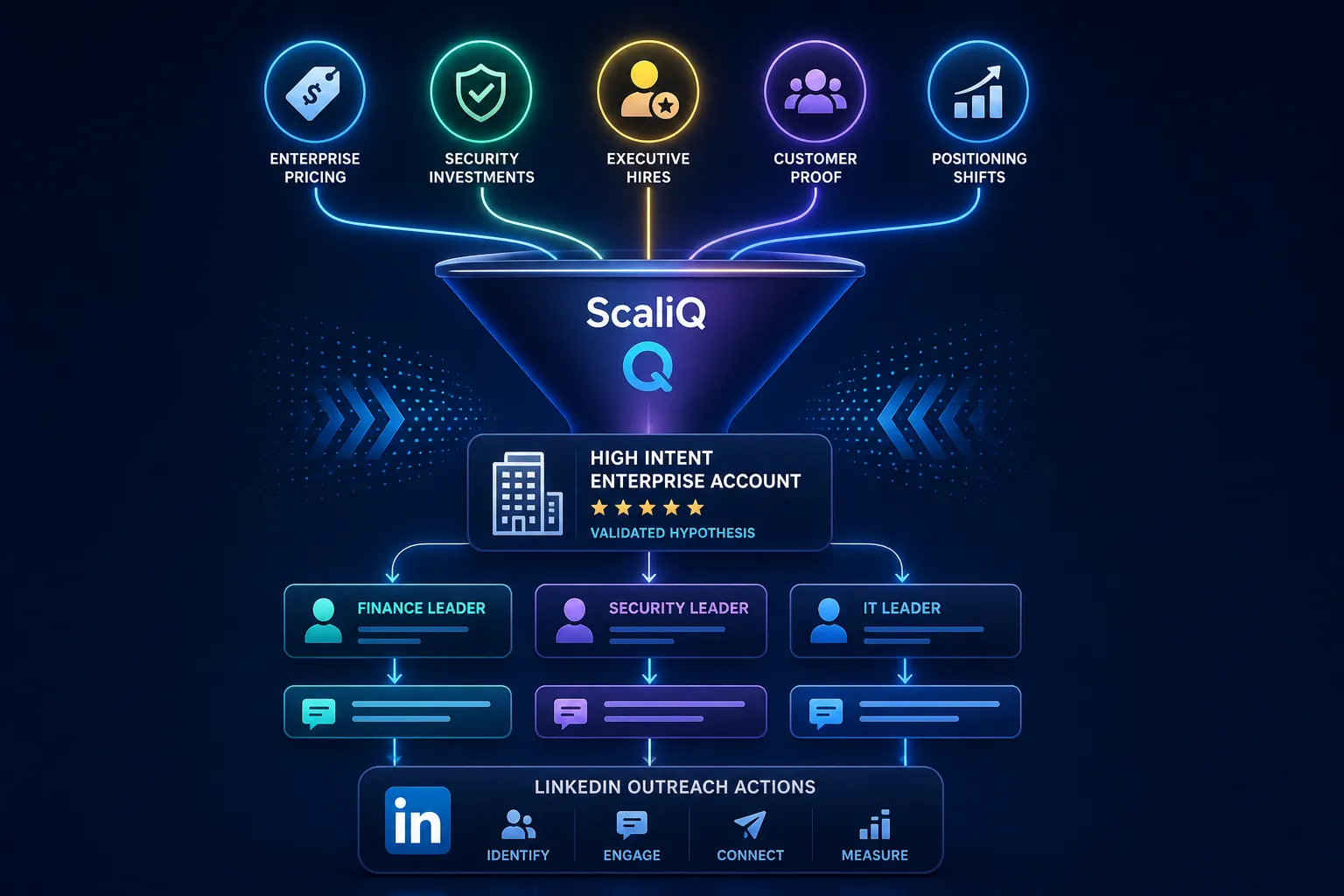
To distinguish accounts with a plausible procurement software opportunity from those that merely match a persona list, sellers must look for specific company signals. These signals should be categorized logically and treated as hypotheses for outreach, not definitive proof of a purchase initiative.
Organizational Complexity and Growth Signals
Rapid employee growth, the opening of new locations, the addition of multiple business units, or geographic expansion directly increase purchasing and supplier-management complexity. As headcounts rise, informal approval structures fail. However, growth should be used as a hypothesis rather than proof of buying intent. Sellers must validate whether this growth is likely to affect procurement workflows, approval structures, or spend visibility before reaching out to procurement operations leaders or other procurement software prospects based on company complexity signals.
Procurement and Operations Signals
Relevant operational indicators include procurement hiring, the creation of new procurement operations roles, sourcing initiatives, supplier-risk activity, and public efforts to formalize purchasing processes. While hiring indicates capability building, it does not automatically prove a near-term software project. Connect these operational signals to possible use cases, such as:
• Intake and purchasing orchestration.
• Source-to-pay process improvement.
• Supplier management and onboarding.
• Spend visibility and analytics.
• Compliance and approval control.
Tracking these procurement transformation trends helps identify high-probability source-to-pay software prospects based on their current procurement maturity.
Technology, Finance, and Business-Change Signals
Major corporate events—such as ERP implementations, finance transformation programs, acquisitions, reorganizations, and new operating models—frequently create new procurement workflow requirements. It is vital to distinguish a highly relevant technology change from a generic company announcement. Always add a validation step: confirm that the signal specifically impacts procurement, finance, supply chain, or operations before initiating outreach. Treat these intent signals for procurement software as strong indicators, but remember they are hypotheses. They point toward potential spend management software leads or ERP implementation signals, but require further discovery to confirm a project exists.
Rank Accounts Before Starting LinkedIn Outreach
Turning multiple company signals into a repeatable prioritization method ensures your team focuses on the highest-yield opportunities. Implement a practical scoring model based on:
• Account fit: How closely the company matches the structural ICP.
• Operational complexity: Whether the organization possesses meaningful purchasing, supplier, or approval complexity.
• Change or timing: Whether a recent event could make procurement software immediately relevant.
• Use-case clarity: Whether a plausible procurement problem can be mapped to your solution.
• Stakeholder coverage: Whether the relevant buying committee can be identified and reached on LinkedIn.
Use a small number of score bands (e.g., Tier 1, Tier 2, Tier 3) rather than creating false precision with complex numerical scores. Ensure your team understands how to separate problem awareness, project intent, budget readiness, and organizational fit.
To guide research, use a signal-to-message matrix:
This matrix must guide research and relevance, not automate unsupported assumptions. Human review of high-value accounts remains essential before outreach, particularly when signals involve sensitive organizational changes or inferred business problems. This disciplined approach drives effective account-based prospecting for SaaS, accurate procurement account prioritization, and the responsible use of procurement buying signals.
Map the Procurement Software Buying Committee
Relying on a single procurement contact is a common point of failure. To succeed, sellers must reach the full buying group. Different stakeholders evaluate procurement software through entirely different lenses, prioritizing different risks, workflows, and business outcomes.
Chief Procurement Officers and Procurement Executives
CPOs focus on strategic priorities such as spend control, procurement maturity, supplier visibility, governance, and overall business enablement. When conducting CFO and CPO prospecting, use executive-level language centered around measurable control, risk mitigation, and operational transformation. Avoid leading with granular feature lists when speaking to these top procurement decision makers and procurement leaders.
Procurement Directors and Procurement Operations Leaders
These practitioners are focused on process standardization, intake management, approvals, user adoption, data quality, and eliminating day-to-day workflow friction. They are highly responsive to solutions that solve operational pain, which is often more visible to them than to executives. Tailor your procurement SaaS prospecting to highlight how procurement workflow software can make procurement operations leaders more effective.
CFOs, Controllers, and Finance Stakeholders
Finance leaders care about spend visibility, financial controls, budget alignment, compliance, reporting accuracy, and seamless integration with existing finance systems. Clarify the difference between finance-led concerns (e.g., cash flow, auditability) and procurement-led concerns (e.g., supplier relationships). Do not assume every CFO owns procurement technology decisions, but involve them early as economic buyers. Targeted CFO prospecting is crucial for spend visibility software, requiring a deep understanding of finance and procurement alignment.
Supply Chain, Operations, IT, and Other Influencers
These stakeholders evaluate supplier continuity, operational efficiency, system integration, data security, implementation effort, and change management. Even when they are not the initial business owner, supply-chain leaders and IT professionals can heavily influence or block an evaluation. Address these procurement technology buyers and procurement software stakeholders by proactively mitigating technical and operational risks.
Document each contact’s role in the buying process, their likely business concern, the relevant account signal, a supporting proof point, and an appropriate call to action. Providing your team with a downloadable buying-committee template asset to map champions, economic buyers, users, technical evaluators, and potential blockers is highly recommended.
Build a Research-Led LinkedIn Outreach Sequence
A practical outreach process prioritizes relevance and conversation quality over sheer message volume. Before sending a connection request or direct message, complete three research steps: confirm the account-level signal, confirm the person’s likely role in the buying committee, and identify one relevant procurement, finance, operations, or systems problem to explore.
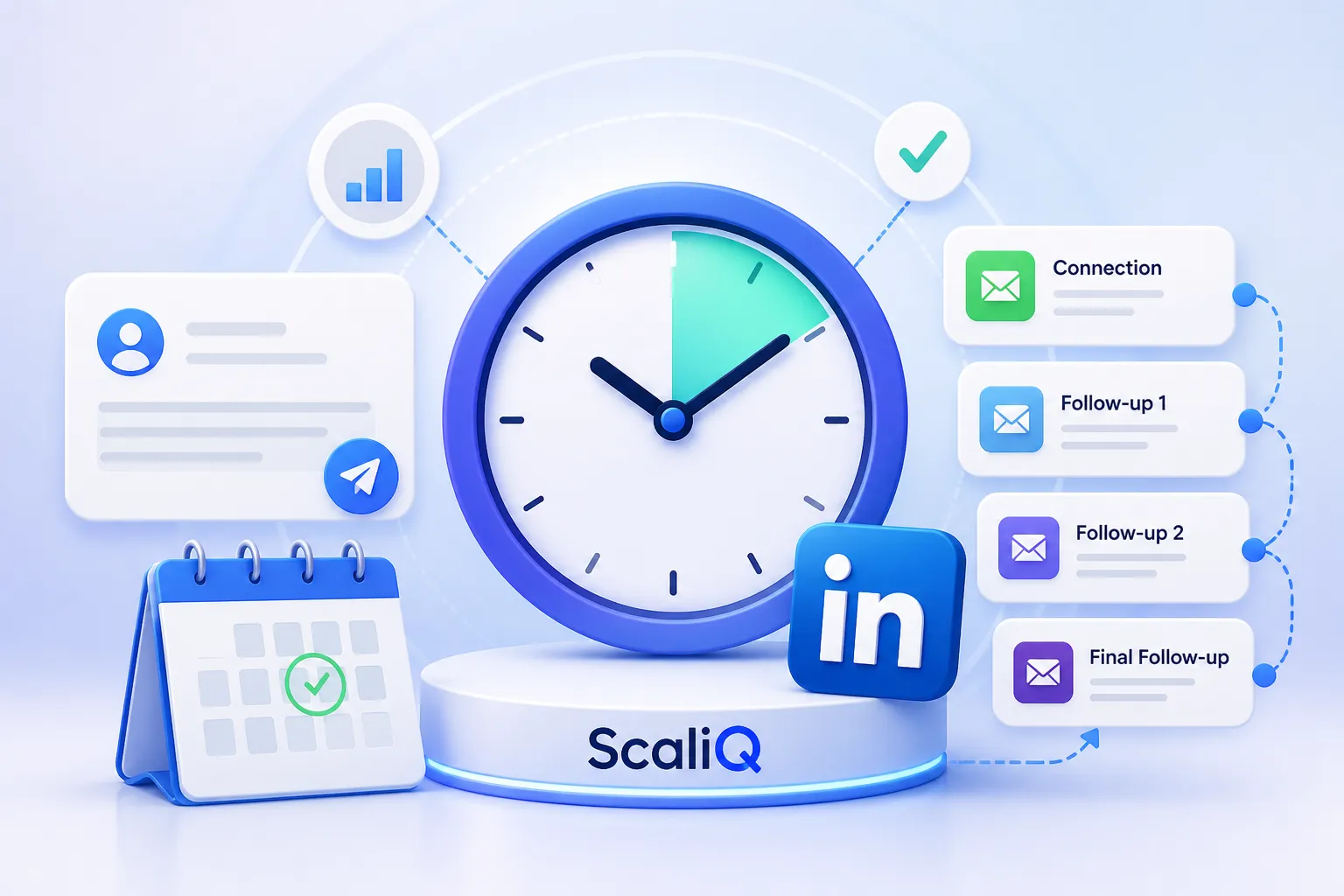
As supported by academic research on integrated B2B prospecting, LinkedIn should support a broader, multi-channel sales process rather than operating as a standalone silo. Each sequence stage plays a specific role:
• Connection or first touch: Establish relevance using an account signal without forcing a product pitch.
• Insight-led follow-up: Share a useful observation, framework, or educational resource.
• Use-case follow-up: Connect the account signal to a possible procurement workflow challenge.
• Qualification follow-up: Ask a low-friction question about current priorities or process maturity.
• Close-the-loop message: Offer a simple next step or leave the conversation open professionally.
Timing and cadence must reflect the account’s value, signal strength, and relationship context rather than relying on a universal, rigid number of automated follow-ups. This ensures high-quality LinkedIn outreach for procurement software, effective B2B SaaS sales engagement, and successful LinkedIn prospecting for SaaS.
Suggested Procurement-Specific Message Framework
Structure your LinkedIn outreach message around four pillars:
• Context: Mention the relevant company or role signal.
• Hypothesis: State a cautious, relevant possibility rather than claiming to know the prospect’s exact problem.
• Value: Offer an insight, checklist, or useful comparison.
• Question: Ask a low-friction question that invites correction or clarification.
Here is a foundational template for procurement leader outreach and procurement software messaging:
Adapt this template with persona-specific variations depending on whether you are messaging a CPO, a procurement operations leader, a CFO, a supply-chain leader, or an IT stakeholder.
What to Share Before Asking for a Demonstration
Educational content creates a much lower-friction first step than an immediate product demonstration request. Share practical content that matches the account’s likely questions, such as:
• A procurement software ICP worksheet.
• A buying-committee mapping template.
• A signal-to-message matrix.
• A procurement workflow checklist.
• A guide to evaluating source-to-pay or spend-visibility requirements.
Providing value upfront builds trust. You can link to educational resources from the ScaliQ blog to offer research frameworks and signal checklists that support your procurement software content marketing, procurement lead nurturing, and source-to-pay software sales efforts.
Personalize Procurement SaaS Outreach Without Researching Every Account Manually
Teams can scale research and personalization while preserving accuracy and human judgment by separating personalization into three distinct levels:
• Account personalization: Why this company may be relevant (e.g., recent acquisition).
• Persona personalization: Why this stakeholder may care (e.g., CFO focusing on compliance).
• Use-case personalization: Which procurement problem or workflow is worth exploring (e.g., standardizing intake).
Create reusable message logic based on signal categories rather than inserting superficial profile details (like where a prospect went to college). AI-assisted research and enrichment tools can help organize public account information, categorize signals, suggest likely buying-committee roles, draft message variations for review, and flag missing evidence.
However, critical elements must remain human-reviewed. A human must verify whether the signal is current and relevant, ensure the message avoids unsupported claims, confirm the account is appropriate for contact, and check that the tone suits a senior executive. Automation should support research and consistency, not replace seller judgment. This signal-led workflow heavily contrasts with broad database automation approaches that prioritize contact volume over relevance. Partnering with tools like Repliq can assist in establishing repeatable workflows for AI-assisted prospecting, procurement account research, and personalized LinkedIn outreach without sacrificing quality.
Measure LinkedIn Prospecting by Account Quality and Pipeline Progress
To evaluate whether outreach is producing qualified opportunities rather than just empty activity, procurement SaaS teams must measure performance across the entire funnel.
Account and Research Metrics
Begin by tracking the percentage of target accounts that actually meet your ICP criteria. Measure the proportion of accounts that have a documented signal, a clear use-case hypothesis, and a fully mapped buying committee. Review data completeness and monitor the number of accounts requiring manual correction. These procurement prospecting metrics reveal your qualified account rate and the health of your account-based marketing metrics before a single message is sent.
Engagement and Conversation Metrics
Move beyond vanity metrics like profile views or raw connection volume. Instead, track connection acceptance rates, meaningful replies, positive responses, follow-up engagement, and content interactions. Crucially, separate generic replies from actual conversations that reveal a current problem, project, or active evaluation. This provides a true picture of your LinkedIn outreach performance, B2B SaaS outreach metrics, and procurement lead qualification efficiency.
Pipeline and Commercial Metrics
Ultimately, success is measured by qualified meetings booked, opportunity creation, buying-committee coverage within active deals, sales-cycle progression, and overall pipeline influence. Compare signal-led account groups with broader prospecting groups only when methodology and qualification criteria are consistent. Reviewing performance by persona, signal type, use case, and message angle will reveal exactly which strategies yield the most qualified procurement leads and drive the procurement software sales pipeline.
Compliance, Accuracy, and Trust in LinkedIn Prospecting
Responsible operating principles are non-negotiable when handling business contact data and outreach automation. Prospecting teams must verify relevant platform rules, privacy obligations, and applicable marketing requirements in their operating jurisdictions.
Practical safeguards include:
• Using truthful sender and company information.
• Avoiding deceptive subject lines or exaggerated claims.
• Providing appropriate opt-out or objection handling where required.
• Honoring unsubscribe and do-not-contact requests promptly.
• Avoiding the collection or use of unnecessary personal information.
• Keeping account and contact records accurate and up to date.
• Reviewing automated or AI-generated messages before sending.
• Respecting LinkedIn platform limits and avoiding indiscriminate automation.
Public availability of information does not grant unrestricted permission to use it for every marketing purpose. Document the source, date, relevance, and confidence level of all important account signals. For commercial outreach requirements in the US, teams should adhere to the FTC CAN-SPAM compliance requirements. In the UK and Europe, teams must follow the ICO guidance on B2B marketing regarding social-media direct messages and the use of publicly available business-contact data. (Note: This article is an operational framework, not legal advice. Always confirm requirements for your specific markets and channels to ensure compliant LinkedIn outreach, responsible B2B prospecting, and proper procurement lead generation compliance.)
A Practical 30-Day LinkedIn Prospecting Plan for Procurement Software Teams
Convert this framework into an actionable implementation sequence over four weeks.
Week 1 — Define the ICP and Signal Taxonomy
Start by documenting target company characteristics, primary procurement use cases, stakeholder groups, and strict disqualifying criteria. Create a signal library covering company growth, hiring trends, ERP or finance transformations, acquisitions, supplier complexity, and procurement initiatives. By the end of this week, build the first version of your account-scoring worksheet to streamline your procurement SaaS ICP, procurement account qualification, and procurement buying signals.
Week 2 — Build and Map a Target-Account List
Prioritize your accounts using the criteria of fit, complexity, timing, use-case clarity, and stakeholder coverage. Map out the specific procurement, finance, supply-chain, operations, IT, and executive contacts for your top-tier accounts. Record the exact evidence behind each account hypothesis to ensure precise procurement decision-maker targeting, buying-committee mapping, and identification of procurement software prospects.
Week 3 — Create Persona-Specific Outreach
Draft targeted messages for CPOs, procurement directors, procurement operations, CFOs, controllers, supply-chain leaders, and IT stakeholders. Match every message to a specific signal and a relevant business question. Prepare the educational resources you will share before requesting a demonstration, ensuring your LinkedIn outreach for B2B software, procurement leader messaging, and procurement SaaS prospecting are value-driven.
Week 4 — Launch, Review, and Improve
Launch your outreach starting with a controlled account segment rather than maximizing volume. Review message relevance, account qualification accuracy, response quality, and buying-committee coverage. Identify which signals generate useful conversations and which lead to weak assumptions. Update your ICP, scoring rules, and message library based on observed data. Provide your team with a checklist to ensure the ICP is defined, signals are documented, committees are mapped, messages match the persona, compliance reviews are completed, and qualification criteria are recorded. This establishes a sustainable engine for B2B procurement lead generation, an optimized LinkedIn prospecting workflow, and a healthy procurement software pipeline.
Conclusion: Build a Signal-Led Procurement Software Pipeline
Effective LinkedIn prospecting for procurement software companies depends on prioritizing accounts, not just contacts. By combining company complexity, spend-related indicators, procurement maturity, and change signals, revenue teams can identify organizations with a genuine readiness to buy. Success requires mapping the full buying committee, adapting the message to address the distinct concerns of procurement, finance, operations, supply-chain, and IT leaders, and using AI to support research while maintaining strict human review.
Always remember that a relevant signal creates a research hypothesis—it is not an unsupported claim about a prospect’s priorities. By measuring qualified-account and pipeline outcomes instead of mere activity volume, teams can build a highly efficient, predictable revenue engine.
To implement a more structured approach to identifying procurement software opportunities and prioritizing high-fit accounts, explore ScaliQ. ScaliQ provides a research-led, signal-driven methodology tailored specifically for engaging procurement, finance, supply-chain, and operations leaders based on verified company complexity and spend indicators, ensuring your procurement software leads, procurement SaaS prospecting, and LinkedIn outreach yield maximum ROI.