

Introduction: Why New Customer Announcements Matter for Prospecting
For many B2B sales and growth professionals, company news feeds are a constant stream of noise. Prospectors see press releases and social media posts celebrating new client acquisitions, but they often treat these updates as isolated PR exercises. By ignoring the strategic subtext of these announcements, revenue teams miss crucial evidence of market momentum, shifting strategic priorities, and changing operational requirements.
New customer announcement signals are timely, public indicators that can drastically improve account prioritization and the relevance of your LinkedIn sales triggers. However, it is essential to establish a trust-focused framework: a public customer announcement is not automatic proof of buying intent. Instead, it is a well-lit starting point for account research, stakeholder qualification, and a highly relevant conversation.
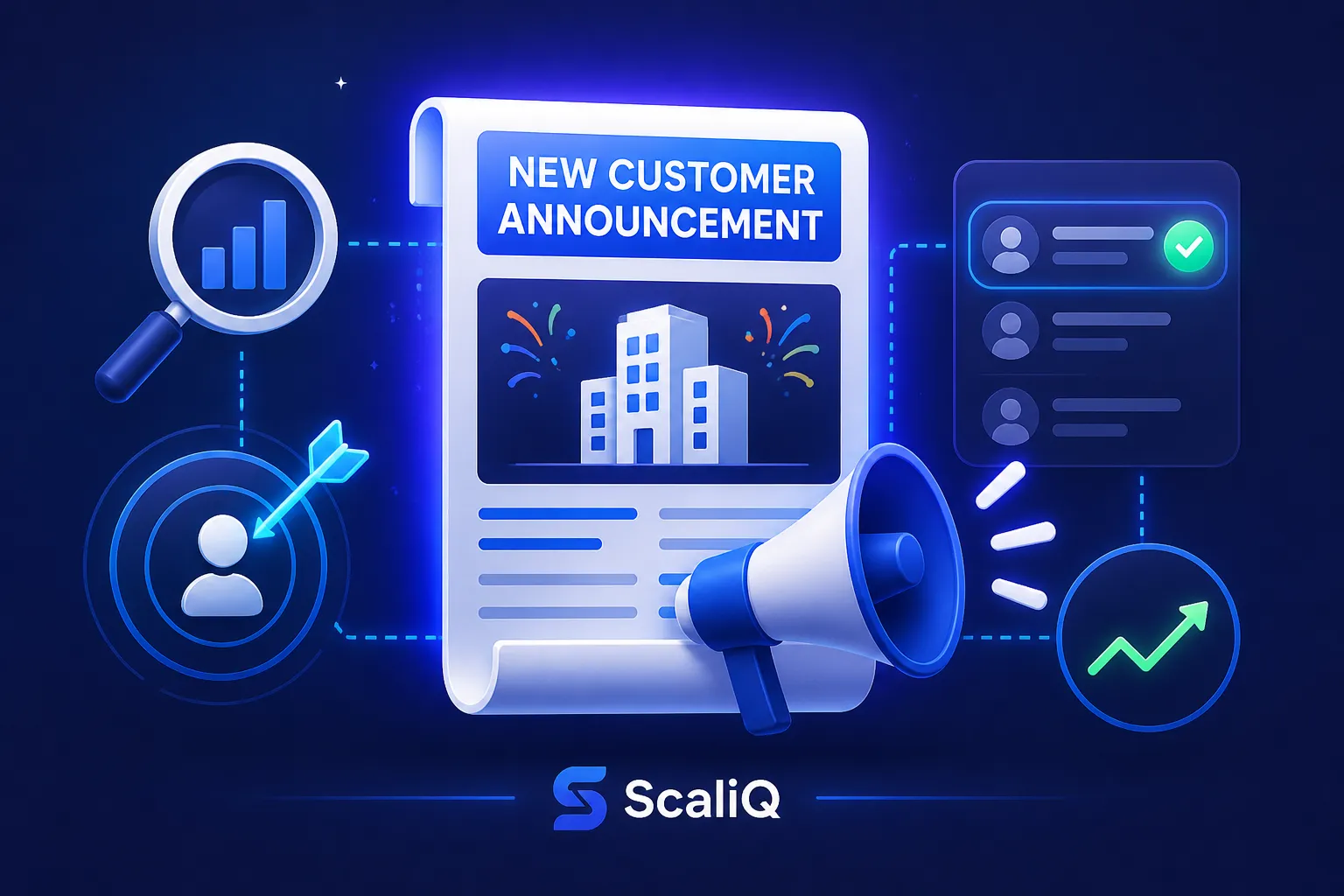
This guide provides a repeatable workflow for customer win prospecting. You will learn how to identify the announcement, classify the underlying signal, validate the account context, map affected stakeholders, personalize your outreach, and measure the results. By using publicly available information and encouraging human review before outreach, you can effectively leverage ScaliQ—a growth-focused intelligence resource—to interpret customer wins, reveal ICP direction, and turn public momentum into actionable prospecting insight.
What Makes a New Customer Announcement a Useful Sales Trigger?
There is a distinct difference between a routine company update and a prospecting-worthy signal. The commercial value of any announcement depends entirely on its relevance, recency, specificity, and likely impact on the target business.
To determine if an announcement is a viable sales trigger, it must help answer at least one of these critical questions:
• Is the company entering a new market, segment, geography, or growth phase?
• Does the customer relationship suggest a new use case or operational workflow?
• Which internal teams may now face implementation, scaling, reporting, or coordination pressure?
• Does the announcement resemble the company’s existing Ideal Customer Profile (ICP) or hint at a newly emerging segment?
It is vital to distinguish customer-win prospecting from generic intent-data prospecting. While intent data attempts to measure invisible digital behavior, customer announcements supply verified public context. They do not independently prove active demand or budget, but they provide the "why" behind your outreach, transforming cold buying intent signals into warm customer success signals.
The Four Signal Categories to Extract
To avoid getting lost in PR jargon, prospectors need a practical taxonomy for interpreting announcement details. When analyzing company news, extract information into these four categories:
• Momentum signals: Look for language indicating rapid company growth signals, expansion, increased customer volume, major new contracts, or a larger operating footprint.
• Market and ICP signals: Note the specific details of the acquired customer, including their industry, company size, geography, organizational maturity, use case, and business model. This aids in ongoing ICP refinement.
• Operational-change signals: Identify references to implementation, system integration, onboarding, workflow changes, new reporting needs, aggressive hiring, or cross-functional coordination.
• Proof-point signals: Capture specific customer outcomes, recurring use cases, named product applications, or language that reveals exactly why the customer selected the vendor. These customer proof points are invaluable for mirroring language in your outreach.
Strong, Moderate, and Weak Prospecting Signals
Not all news is actionable. To maintain efficiency, readers must prioritize announcements rather than reacting to every piece of company news.
• Strong signal: A recent, highly specific announcement that closely matches your target account’s industry or operating model and indicates a meaningful, immediate business change.
• Moderate signal: A relevant customer story or partnership that suggests a possible use case, but requires additional company and stakeholder research before outreach.
• Weak signal: A broad press release, a generic testimonial, an old announcement, or a news item with no clear relevance to the prospect’s current operational priorities.
Score each of these customer win signals for sales against five criteria: recency, ICP relevance, potential business impact, evidence of operational change, and your confidence in the interpretation. Remember, a public announcement is a conversation trigger—not definitive evidence that an account is ready to buy. Treat these sales prospecting intent signals as hypotheses to test.
A Repeatable Announcement-to-LinkedIn Prospecting Workflow
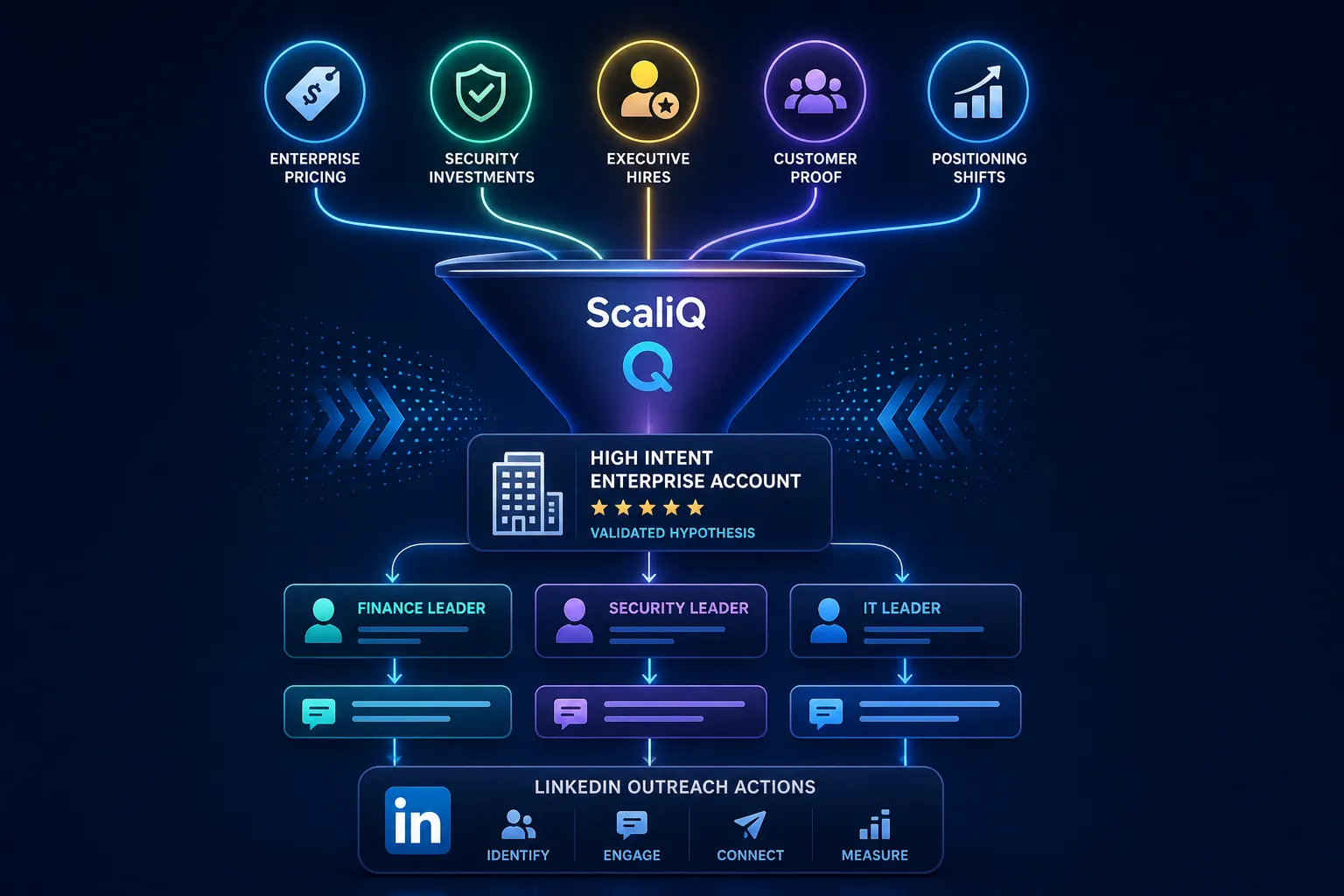
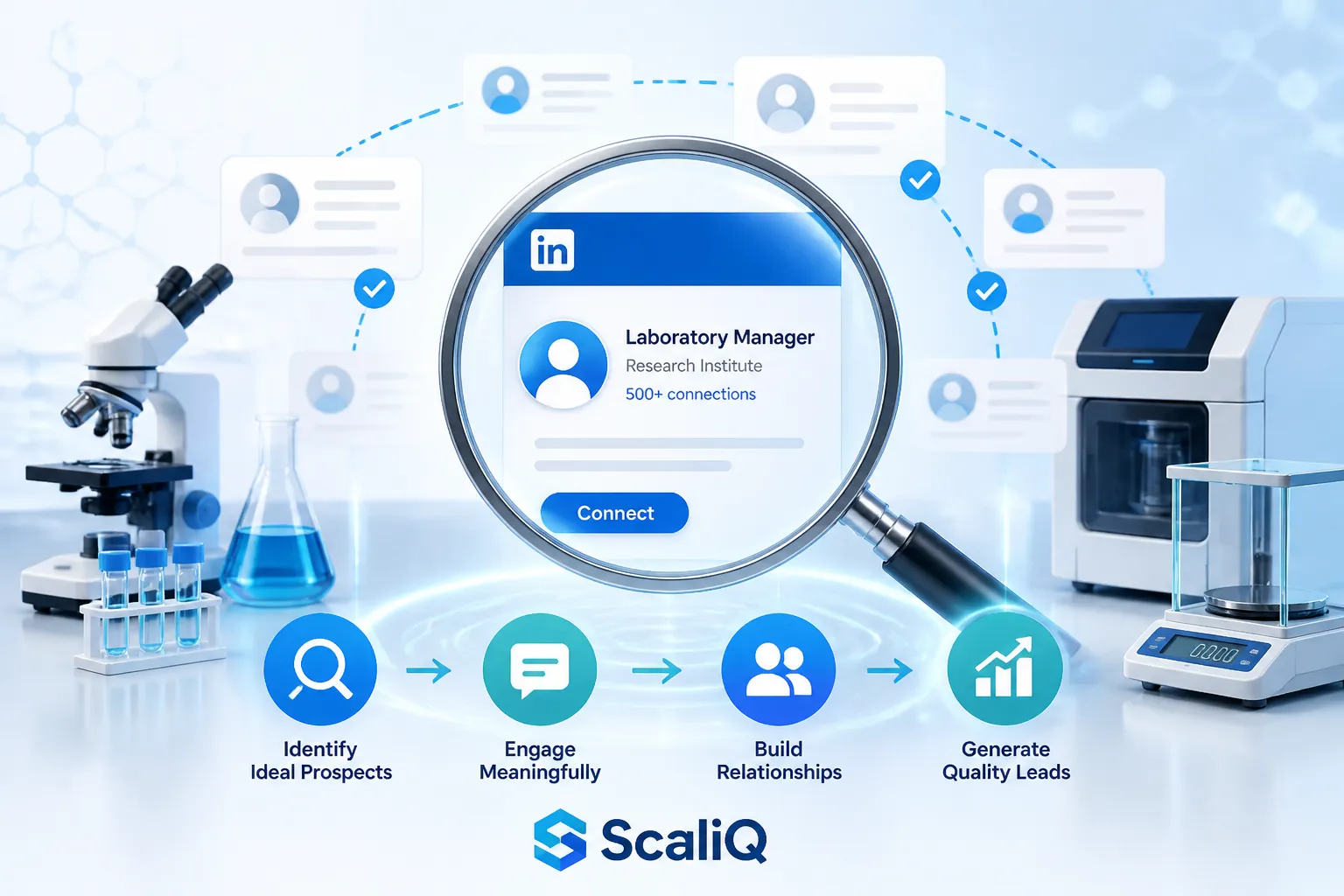
Turning public news into useful sales action requires a systematic approach. The most effective LinkedIn prospecting workflow follows a simple, repeatable sequence: Discover → Classify → Validate → Map → Personalize → Engage → Measure.
The true value of this account-based prospecting method comes from interpretation and context, not merely collecting customer announcements for prospecting. This process stands in stark contrast to high-volume automation that blasts generic outreach immediately after detecting a signal.
Step 1: Discover and Capture the Announcement
Creating a manageable monitoring process prevents information overload. Start by identifying relevant sources: company websites, dedicated customer-story pages, LinkedIn company updates, press releases, newsletters, and existing CRM research.
When you spot a signal, capture the announcement date, company names, stated use case, customer industry, geography, and any named business outcome. Record the source URL and quote only the specific public detail that supports your research hypothesis. Avoid the trap of collecting every minor update; focus strictly on announcements connected to your target market, customer profile, or known business challenges. For deeper insights into how to monitor customer announcements and use company news prospecting to inform your research, explore the ScaliQ blog on leveraging customer win signals.
Step 2: Validate the Signal and Account Context
Validation prevents stale, misleading, or overinterpreted announcements from entering your prospecting workflow. First, confirm that the announcement is recent enough to be useful and that the named customer or prospect account is correctly identified.
Next, compare the signal against available firmographic and business context, including industry, company size, geography, growth stage, and relevant roles. Look for corroborating public company intelligence, such as related hiring activity, product changes, or leadership commentary. However, do not present those details as proof of intent. Distinguish verified facts from hypotheses—an announcement does not prove a budget, project, pain point, or purchase timeline.
Assign a simple priority level to guide your account research:
• High: Recent, highly relevant, and likely to affect target stakeholders.
• Medium: Relevant but requiring more evidence or account research.
• Low: Interesting but too broad, old, or weakly connected to your target offer.
Step 3: Map Likely Stakeholders on LinkedIn
Once validated, identify the people most likely to feel the operational impact of the announcement. Start with the function directly connected to the news, such as operations, revenue, customer success, marketing, IT, product, finance, or executive leadership.
Map multiple stakeholders rather than relying on a single assumed buyer. Look for:
• The executive sponsor who may own the strategic outcome.
• The functional leader responsible for implementation or performance.
• The operational user who actually experiences workflow friction.
• A potential internal champion or subject-matter expert.
Use LinkedIn to review current roles, relevant posts, career history, shared connections, and publicly stated responsibilities. Keep this LinkedIn stakeholder mapping strictly tied to the announcement. Do not collect personal information that is irrelevant to the business conversation. Professional profiles may contain sensitive information; always practice responsible decision-maker research and review CISA's guidance on business networking security risks to ensure secure and ethical LinkedIn sales triggers research.
Step 4: Translate the Signal Into a Relevant Message
The final step before engagement is moving from observation to useful, non-intrusive outreach. Build your message around a public fact, a reasonable business implication, and a thoughtful question—not an unsupported conclusion.
Use a structured approach for observation-led messaging:
• Observation: “I saw that your team recently announced…”
• Context: “That often creates questions around…”
• Question: “How are you approaching…?”
• Value: Offer a relevant perspective or resource rather than forcing a hard sales pitch.
Avoid implying insider knowledge, claiming the prospect has a problem they haven't stated, or presenting yourself as monitoring their personal activity. Social selling with company news requires tact. Always conduct a human review before sending any automated connection request or personalized LinkedIn outreach. When executing repeatable, personalized outreach at scale, tools like RepliQ can assist, provided that personalization and human review firmly guide the process.
How Customer Wins Reveal ICP Direction and Operational Requirements
Beyond one-off outreach, customer announcements profoundly improve your strategic market understanding. While a single customer win generates a prospecting hypothesis, a pattern of wins can reveal a shifting ICP.
Connect customer announcements to three strategic questions:
1. Which industries and company profiles are showing the strongest fit?
2. Which use cases appear repeatedly?
3. What emerging operational requirements surface as customers grow or expand?
The goal is not to blindly copy a competitor's customer list, but to identify repeatable characteristics and business situations that inform your broader strategy.
Identify Recurring Customer Patterns
To convert multiple announcements into actionable ICP refinement, create a simple comparison table. Track fields such as industry or segment, company size or maturity, geography, use case, stated business outcome, implementation complexity, and the roles involved.
Group announcements by recurring attributes rather than treating each customer as an isolated story. Identify whether the strongest pattern relates to firmographics, business stage, operational complexity, or a specific use case. Turn these patterns into testable ideal customer profile hypotheses, such as: “Companies entering this growth phase may need stronger coordination across these teams.” This customer win analysis turns raw data into powerful account-based marketing trigger events.
Infer Operational Needs Without Overclaiming
Deriving useful questions from an announcement requires maintaining accuracy and avoiding assumptions. Use cautious, consultative prospecting language such as “may indicate,” “could create,” or “is worth validating.”
Connect customer growth signals or implementation news to possible requirements involving workflow coordination, data visibility, customer onboarding, reporting and measurement, internal handoffs, or scaling processes. Remember that these are discovery hypotheses, not facts established by the announcement. Convert each hypothesis regarding operational requirements into a targeted discovery question for LinkedIn or a subsequent sales conversation, keeping public evidence strictly separated from internal inference.
LinkedIn Outreach Examples Based on Customer Announcement Signals
To put this theory into practice, here are specific examples for connection requests and follow-up messages. Keep each message concise, specific, and grounded in the customer announcement outreach, rather than overloading it with product claims. The right message depends heavily on the signal category and the stakeholder’s role.
New Market or Segment Expansion
Entering a new market often creates coordination, localization, reporting, demand-generation, or customer-success requirements. When you spot market expansion signals, contact the leaders responsible for the new market, growth function, operations, or customer delivery.
Use an observation-led message that references the publicly announced expansion and asks how the team is adapting its process. Caution: do not assume the expansion is causing a specific problem.
Example message direction:
"Hi [Name], I saw the recent announcement about [Company]'s expansion into [New Market]—congratulations on the growth milestone. Usually, scaling into a new segment shifts operational priorities for the delivery team. How is your team adapting its internal handoff process to support this new volume?"
This approach perfectly utilizes LinkedIn sales triggers for growth-stage prospecting.
Implementation or Operational Change
Implementation signals reveal cross-functional work involving operations, IT, product, customer success, or finance. After mapping the stakeholder group, frame your B2B prospecting personalization around learning how teams are managing the operational change, rather than suggesting their current implementation is failing.
Example message direction:
"Hi [Name], noticed [Company] recently rolled out [New System/Process] for your enterprise clients. When teams undergo that kind of operational change, cross-functional visibility often becomes a hurdle. How are you ensuring smooth data handoffs between CS and Ops during this rollout?"
Customer Proof Point or Use-Case Announcement
A named use case can reveal a related problem faced by similar companies. Use these customer proof points as a reason to research comparable accounts and refine messaging—not as permission to imply that every similar company has the exact same need.
Example message direction:
"Hi [Name], I read the recent case study on how [Competitor/Peer] used [Specific Method] to reduce onboarding time. It made me curious about [Company]'s approach to [Specific Use Case]. Are you currently exploring ways to streamline your onboarding workflows this quarter?"
This use-case prospecting effectively leverages customer success signals without overstepping.
Measurement, Compliance, and Common Mistakes
To ensure this workflow is sustainable, trustworthy, and measurable, revenue teams must track the right trigger-based prospecting metrics. Monitor the announcement date, signal category, account and stakeholder relevance, time from discovery to outreach, response quality, meetings booked, opportunity progression, and conversion rates compared with non-trigger-based outreach. Response quality and pipeline progression are far more meaningful LinkedIn outreach measurement metrics than raw connection volume.
Avoid these common mistakes:
• Treating every announcement as guaranteed buying intent.
• Contacting the wrong stakeholder without mapping the account.
• Sending a generic message that merely repeats the press release.
• Overstating what the announcement proves.
• Automating outreach without human validation.
• Using personal or sensitive information unnecessarily.
Responsible sales prospecting requires strict adherence to ethical guidelines. Use only relevant, publicly available business information and represent yourself honestly. Review the U.S. Office of Government Ethics’ professional networking ethics guidance to avoid the misuse of professional affiliations. Furthermore, adhere to NIST’s online privacy best practices when handling public data. If you encounter suspicious profiles during your research, consult the FBI guidance on how to vet professional networking contacts.
Tools and Resources for Customer-Win Prospecting
Treat customer announcement monitoring as a practical operating system rather than a single-platform tactic. A robust sales intelligence workflow requires a blend of resources:
• Company websites and customer-story pages: For primary announcement context and verified proof points.
• LinkedIn: For stakeholder research, company updates, and relationship mapping.
• Company intelligence and firmographic sources: For validating account fit and business context.
• CRM systems: For recording signals, tracking outreach, and measuring outcomes.
• AI-assisted sales research: For clustering announcements and surfacing recurring patterns (always with human review).
This framework is highly targeted. It contrasts sharply with data-enrichment-first workflows that lack announcement context, broad company-intelligence databases that offer no LinkedIn messaging guidance, and native LinkedIn features that identify updates but cannot automatically determine commercial relevance. AI can accelerate discovery, classification, and pattern recognition, but final signal validation, personalization, and outreach judgment must remain human-reviewed.
To seamlessly connect customer intelligence, ICP direction, and repeatable growth workflows, explore ScaliQ.
Conclusion: Turn Customer Momentum Into Better Prospecting
Mastering new customer announcement signals fundamentally changes how you approach outbound sales. By executing a disciplined process, you can turn public noise into high-converting conversations.
To recap the core workflow: find relevant customer announcements, classify the underlying signal, validate the account and business context, map the affected stakeholders on LinkedIn, write personalized messages based on observed facts and informed questions, and measure your pipeline impact.
Customer win prospecting creates immediate, highly relevant outreach triggers while simultaneously improving your long-term ICP refinement. Always remember the strategic distinction: announcements are signals to investigate, not definitive proof of purchase intent.
To learn more about how interpreting customer wins can reveal growth momentum, refine your ICP, and uncover emerging operational requirements, visit the ScaliQ blog.